






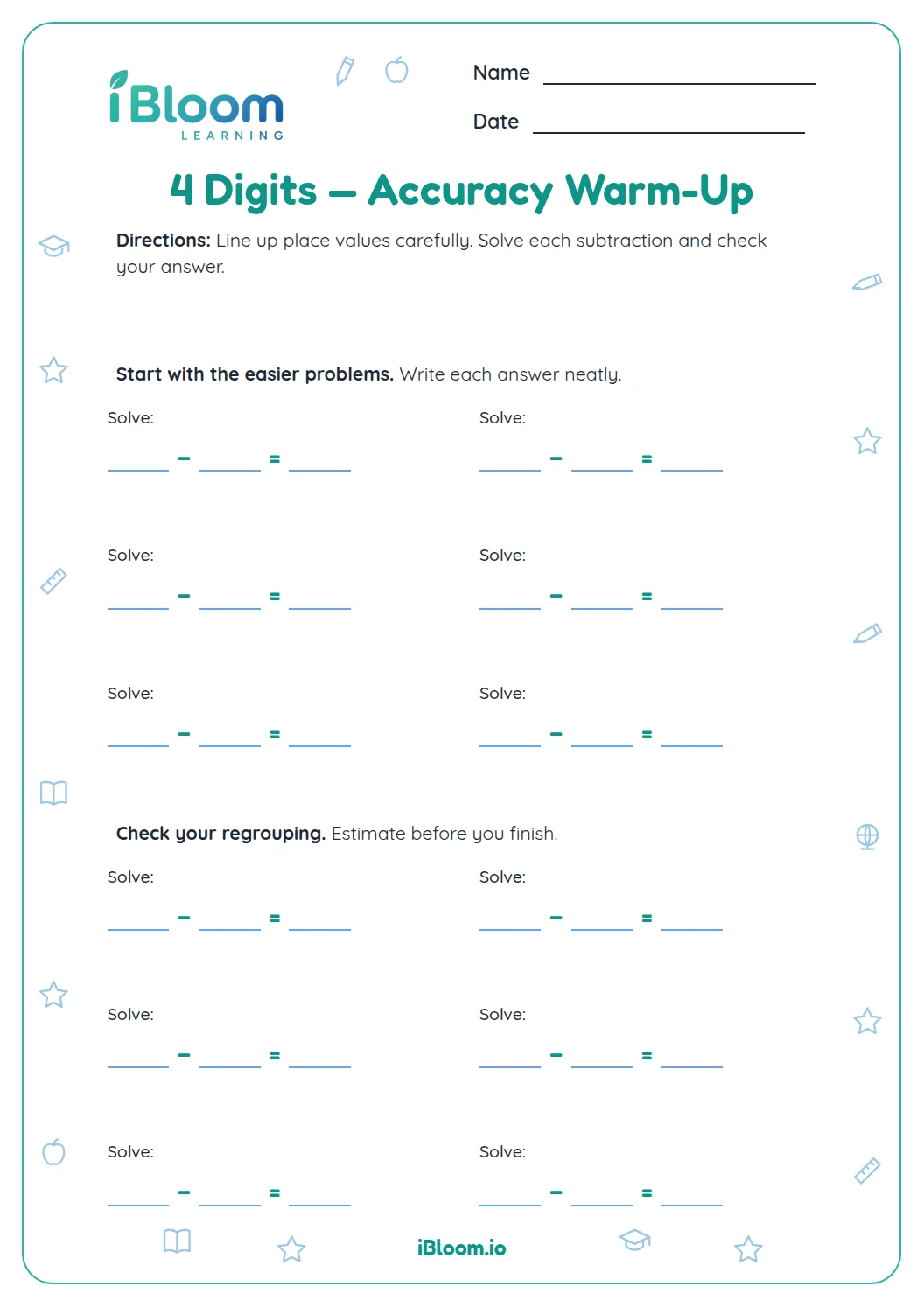
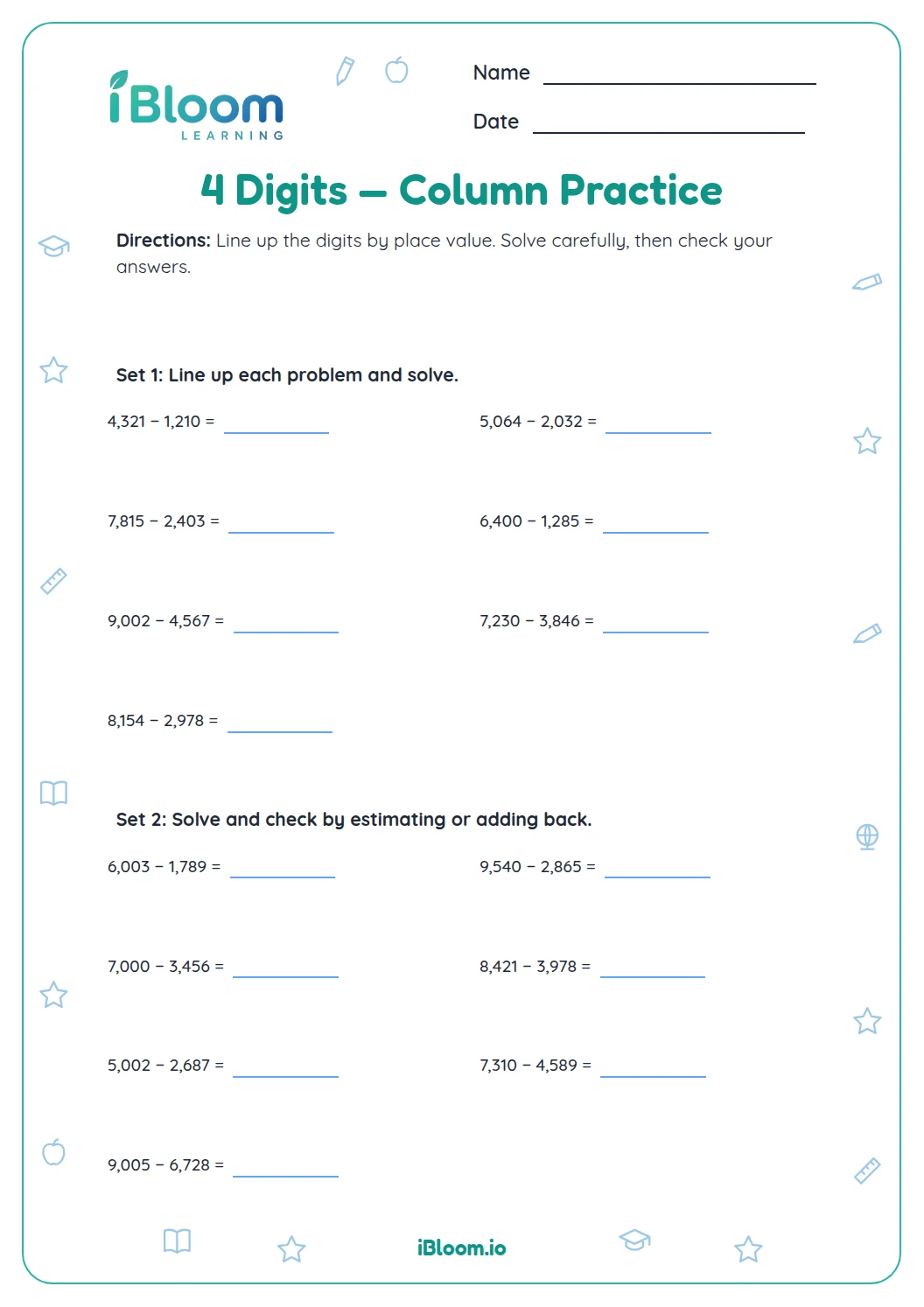
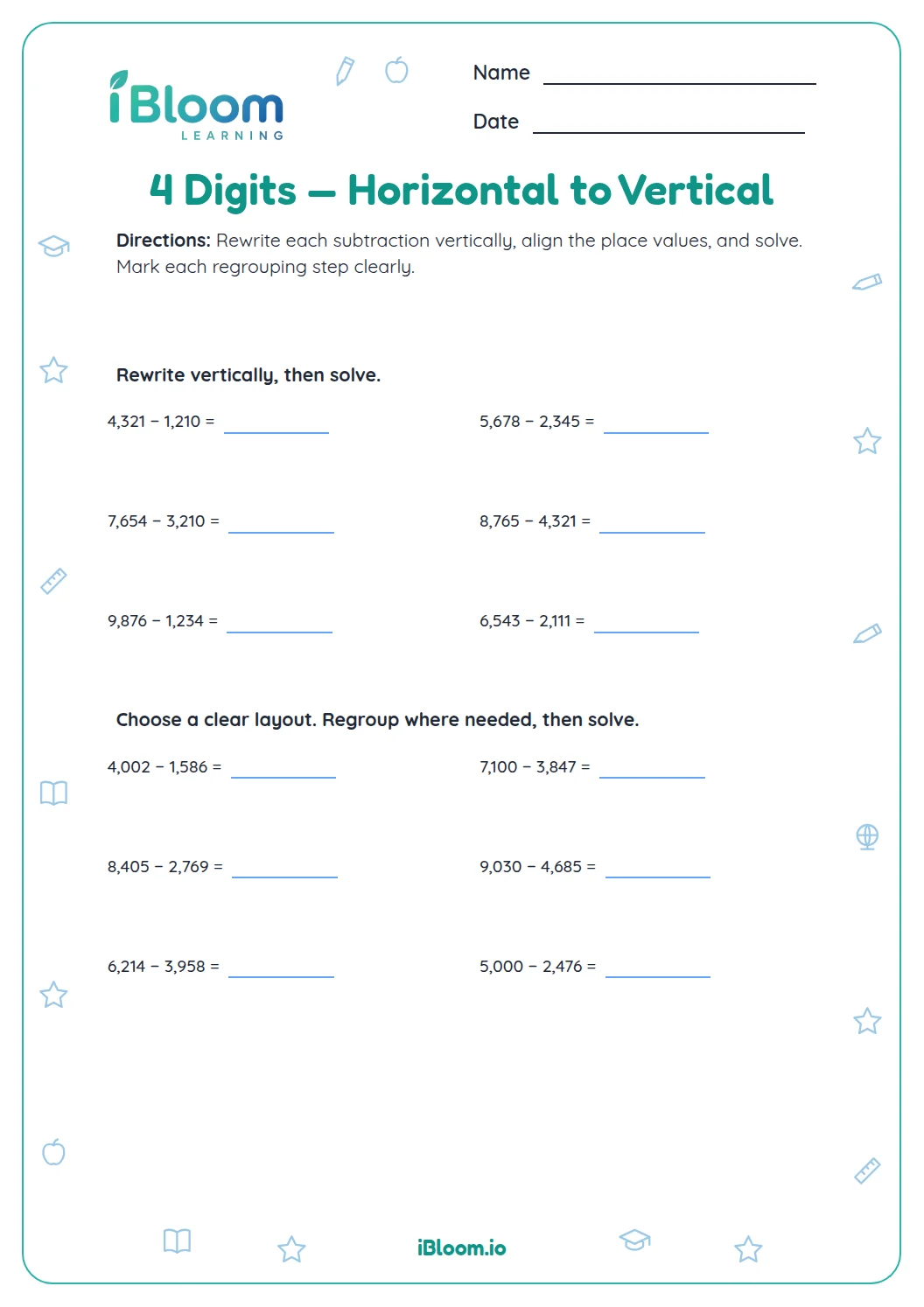
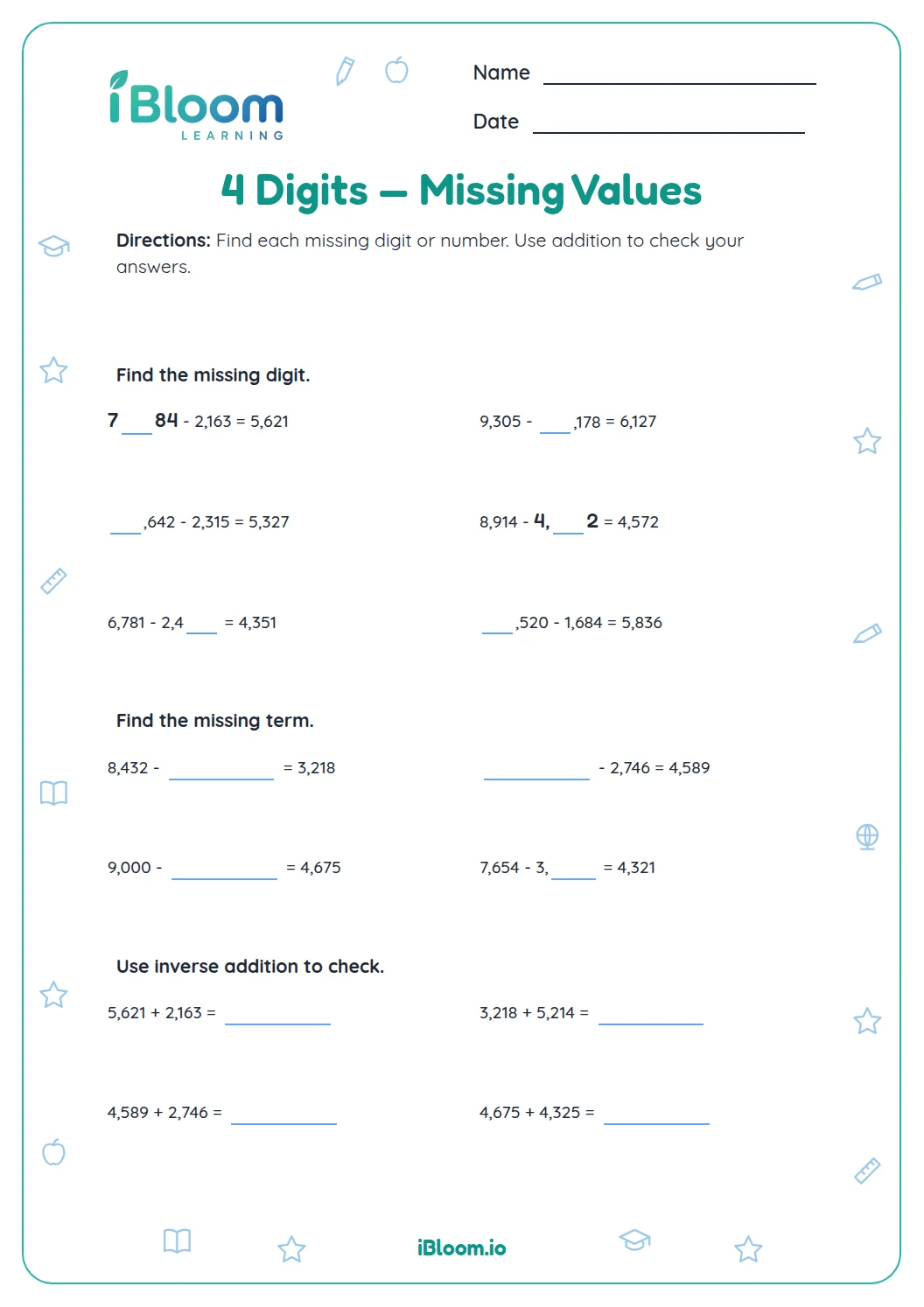
About this worksheet
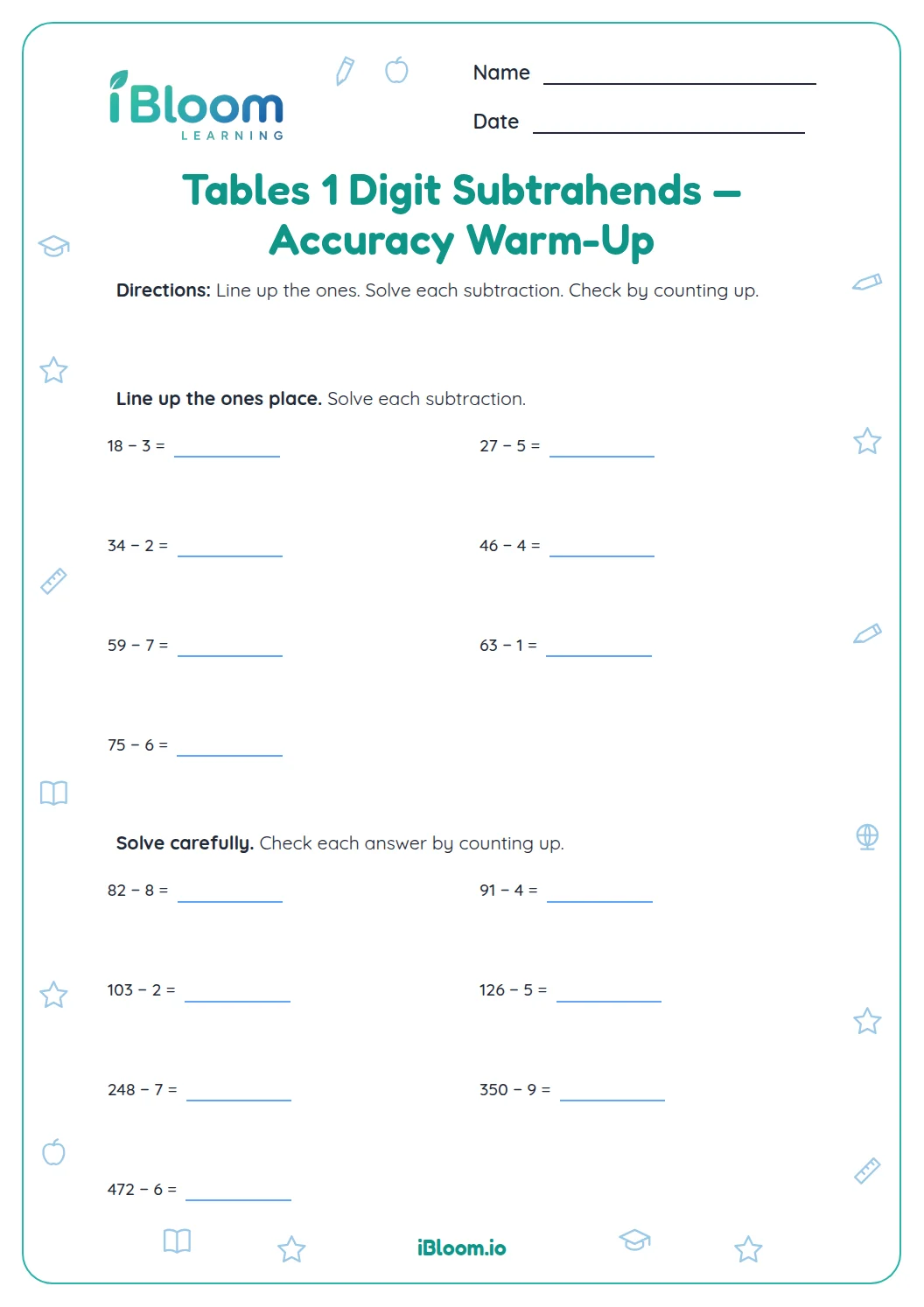
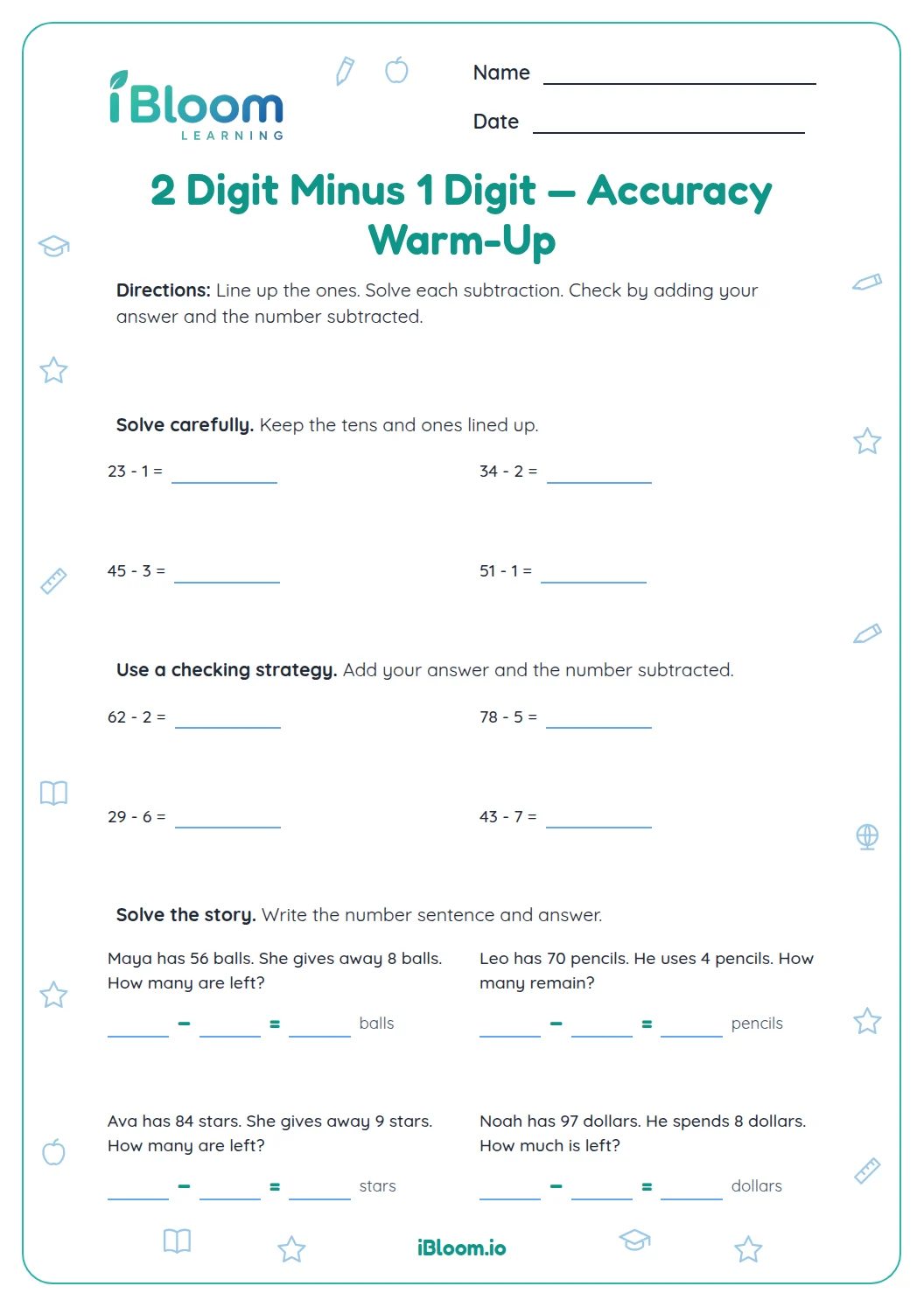
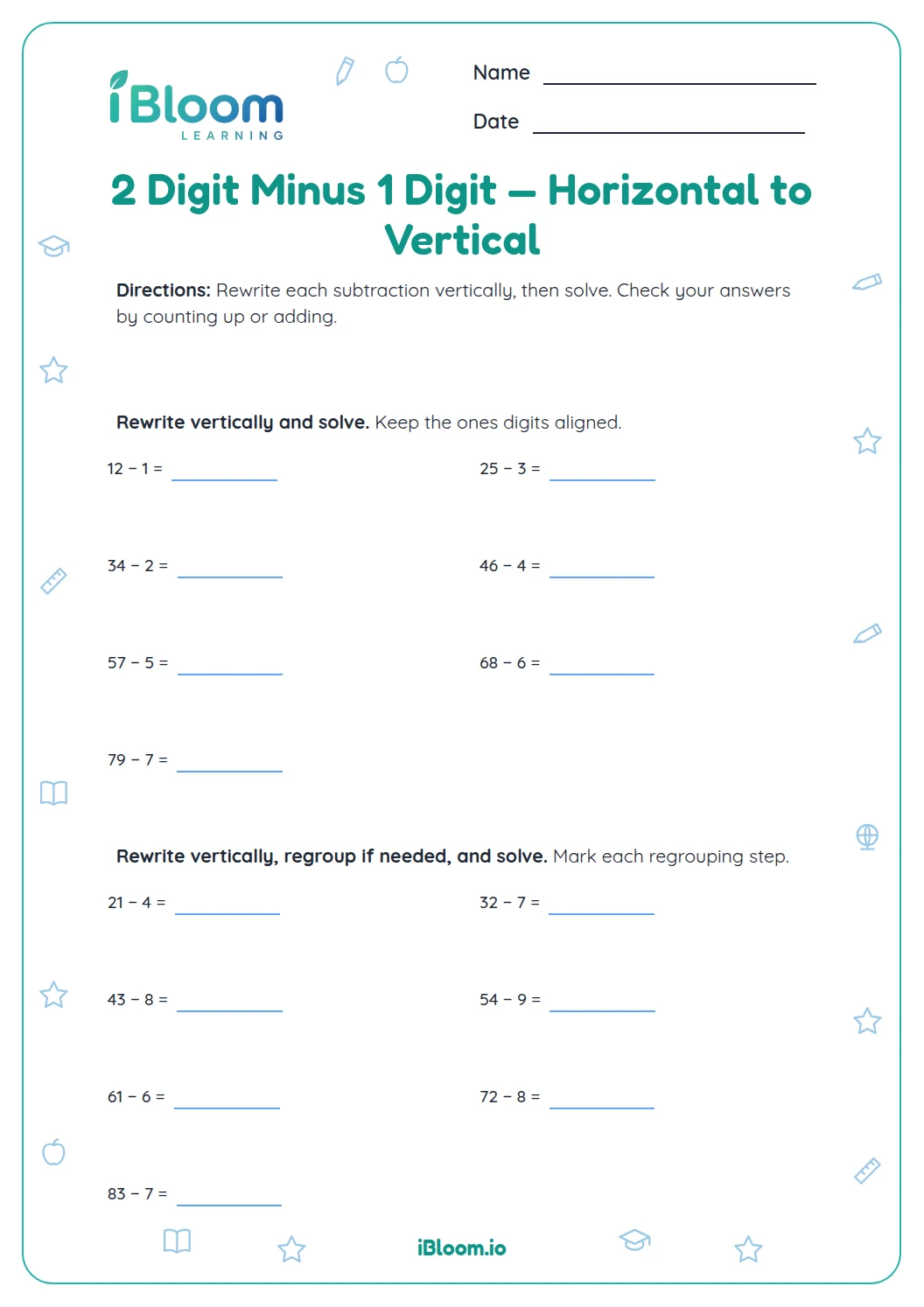
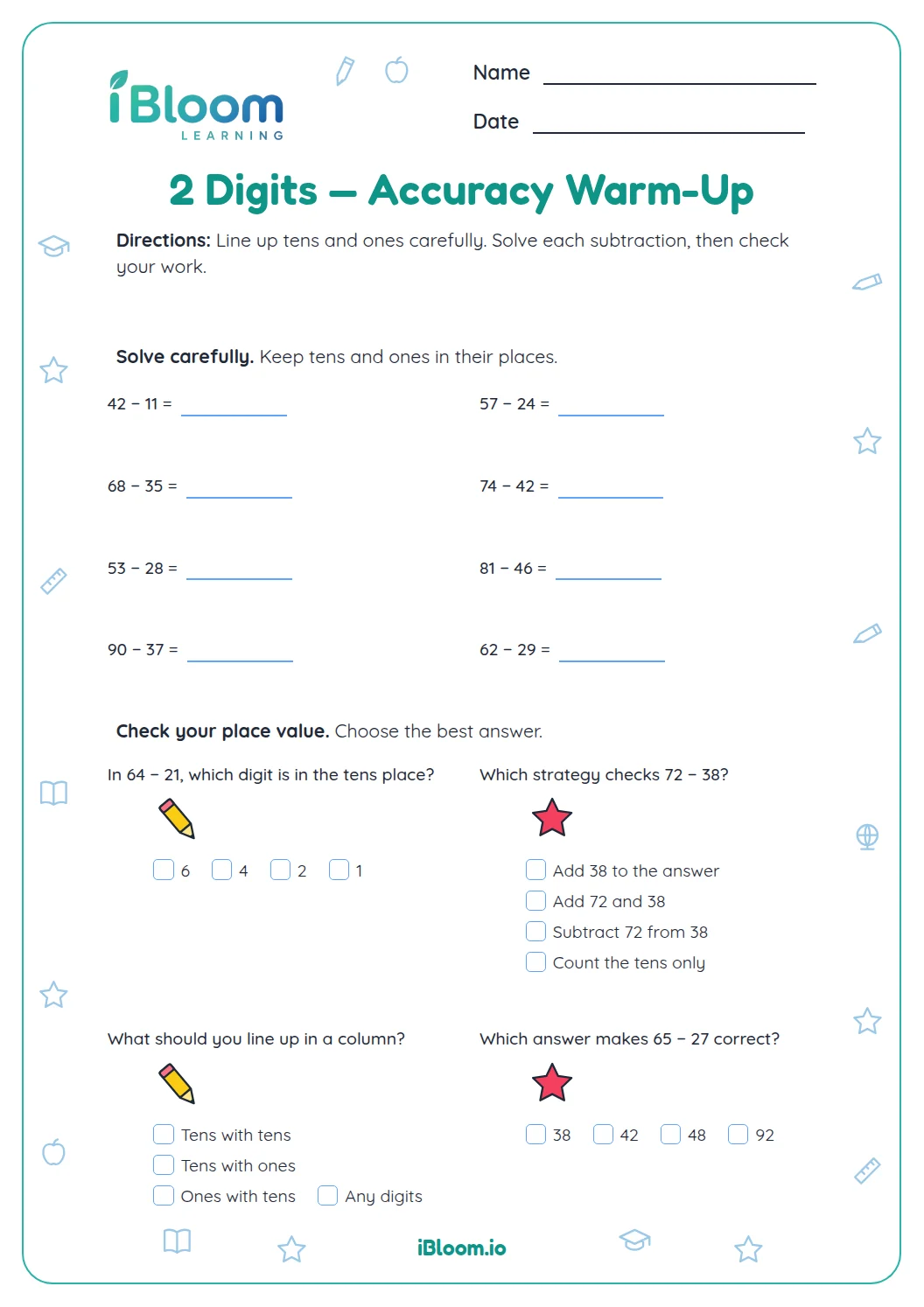
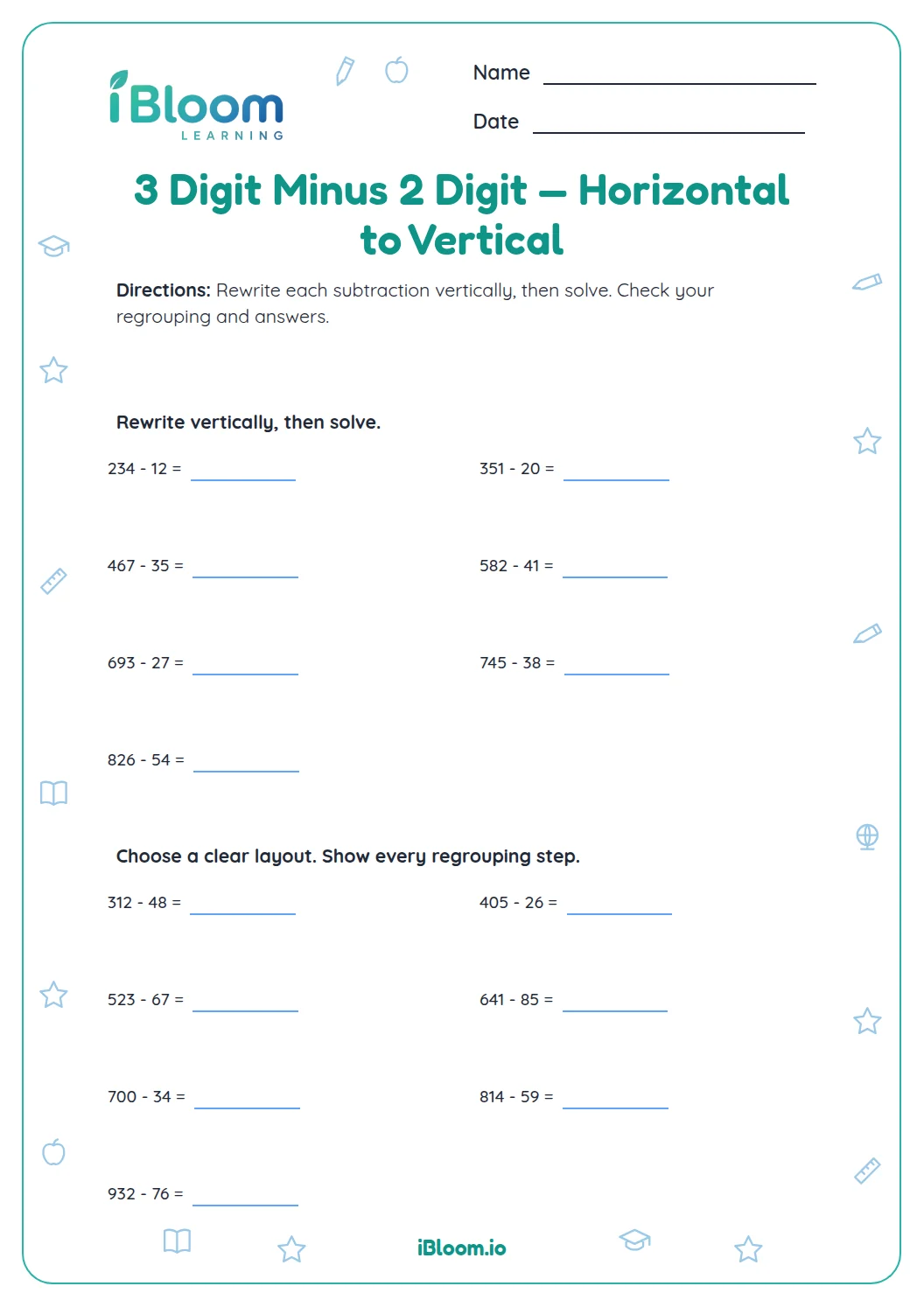
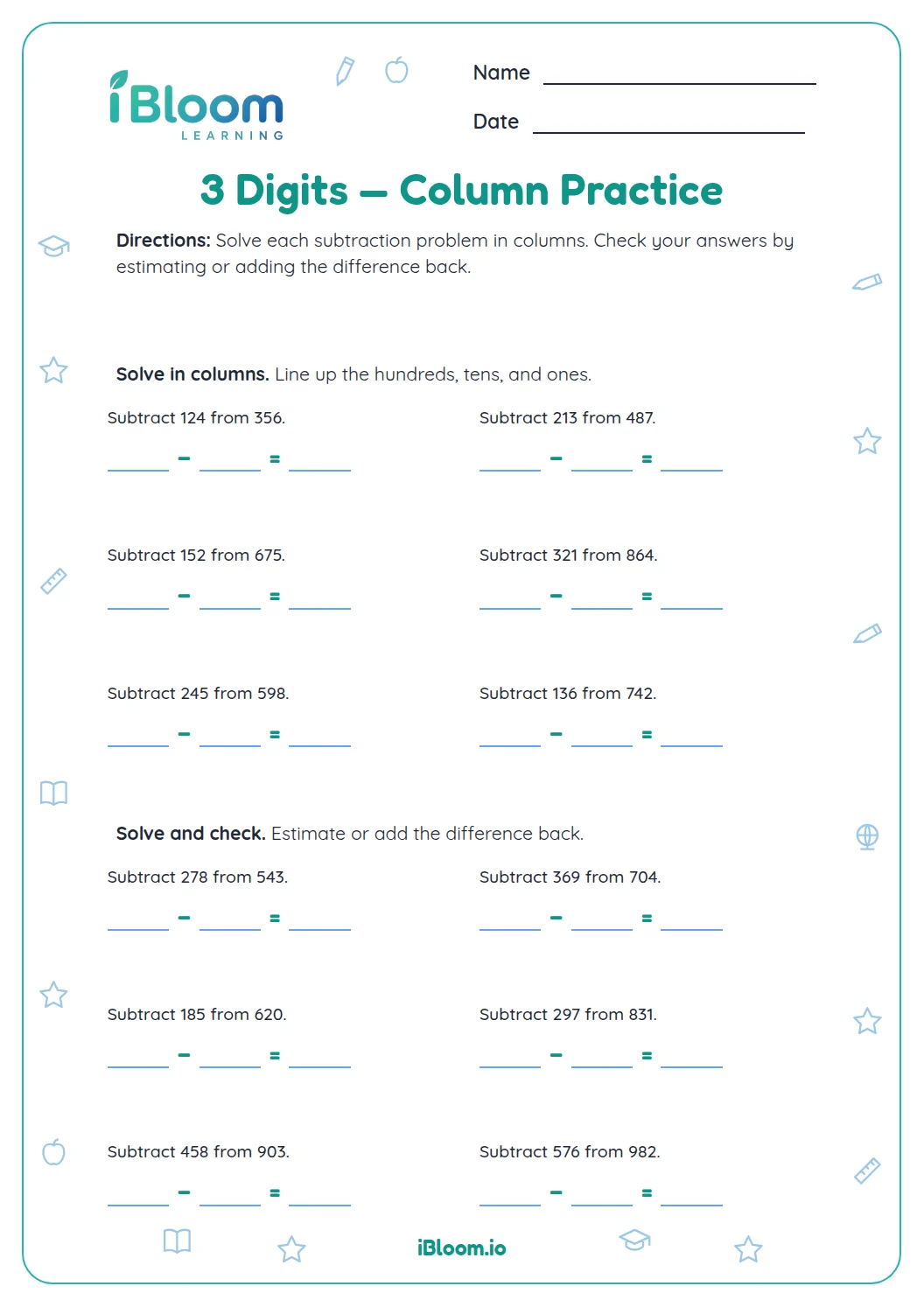
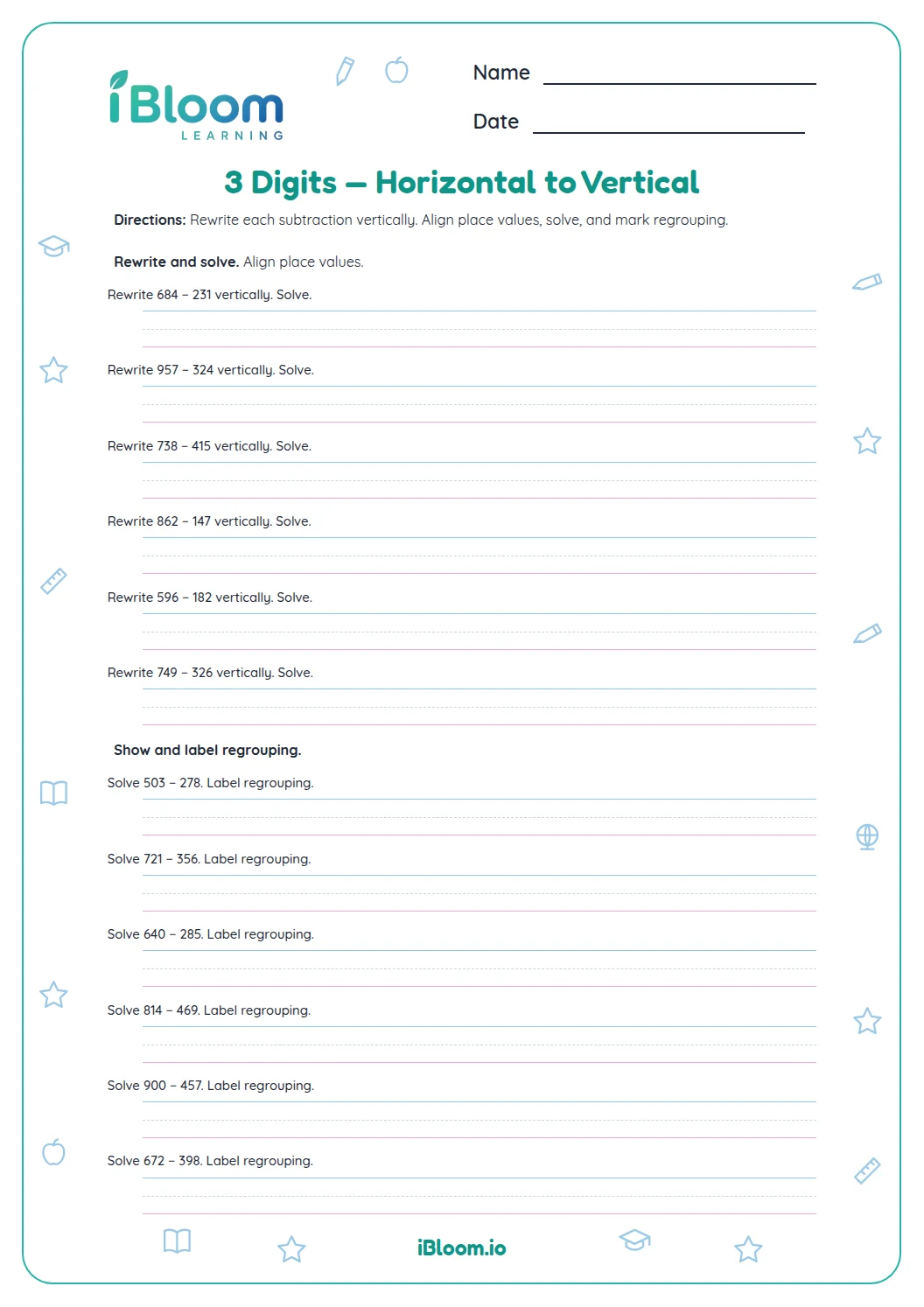
This printable gives Grades 2–4 learners 16 chances to rewrite horizontal subtraction facts vertically and solve them. The minuends range from two-digit to three-digit numbers, and every subtrahend is one digit. Several problems require regrouping. The separate key supports checking the difference and the column setup.
Aligned to 3.NBT.A.2
How do you set up a horizontal fact?
Copy the minuend above the subtrahend, lining up the ones digits. For a three-digit number, keep the hundreds digit in its own column. Then subtract the ones; regroup one ten as 10 ones when needed.
- 114 − 6 = ___
- 2Write 14 above 6, with the ones aligned.
- 3Regroup: 14 − 6 = 8.
When do you need to regroup?
Part A begins with two-digit facts. Later problems use three-digit minuends, so keep the hundreds, tens, and ones aligned. Check the ones digits before subtracting: 156 − 9 needs one ten regrouped, while 268 − 4 does not.
How can you check a difference?
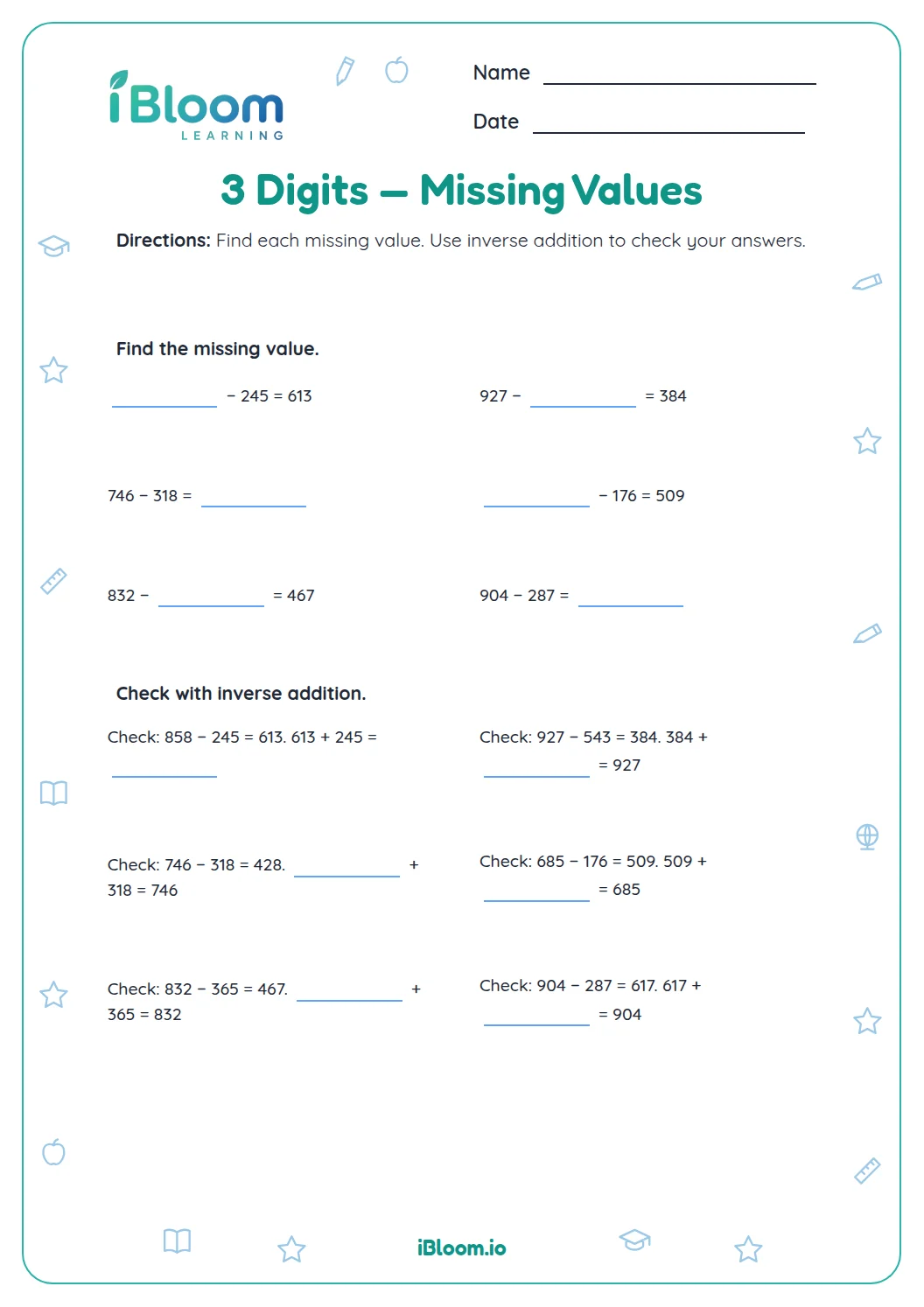
Add the subtrahend to your difference. For 156 − 9 = 147, check 147 + 9 = 156. If the sum does not return to the minuend, inspect the regrouping and the column alignment.
How to use this worksheet
- 1Copy each horizontal fact into a vertical setup.
- 2Line up ones, tens, and hundreds digits in matching columns.
- 3Subtract the ones; regroup a ten when necessary.
- 4Subtract the tens and write the difference.
- 5Add the subtrahend to check your result.
Mistakes to watch for
The mistake
Subtracting the smaller ones digit first without regrouping.
The fix
Trade one ten for 10 ones before subtracting.
The mistake
Misaligning digits when rewriting.
The fix
Place each digit under the matching place value before subtracting.
The mistake
Checking by subtracting again.
The fix
Use addition: difference + subtrahend should equal the minuend.
Common Core alignment
This worksheet practices the listed Common Core skill.
Subtract within 1,000 using place-value strategies.
On this sheet: The questions directly practice this skill.
Show the official wordingHide the official wording
Fluently add and subtract within 1000 using strategies and algorithms based on place value, properties of operations, and/or the relationship between addition and subtraction.
What to practice next
Make more practice
Further reading
Questions parents and teachers ask
What does horizontal to vertical mean here?
Each problem is printed across one line, such as 14 − 6. Rewrite the numbers in a column with the ones digits aligned, then subtract; the later questions provide working space for the written setup. Check the matching difference in the key after aligning each place value and solving the subtraction.
Which problems need regrouping?
Some facts, including 14 − 6 and 56 − 9, have a ones digit in the minuend that is smaller than the subtrahend. Regroup one ten as 10 ones for those items. Facts such as 68 − 4 can be solved without regrouping.
How many questions and pages are included?
The worksheet has 16 subtraction questions over two practice pages. A separate two-page answer key lists the differences so a learner or adult can check the completed work. Check the matching difference in the key after aligning each place value and solving the subtraction.
How should a learner check a difference?
Use addition to check: add the subtrahend to the difference. For example, 47 + 9 returns to 56, so 56 − 9 = 47 is consistent. Revisit the column setup if the check does not match. Check the matching difference in the key after aligning each place value and solving the subtraction.
Is this suitable for independent practice?
A learner who can subtract within 100 can work through the facts independently. An adult may model how to align 14 and 6 vertically, then ask the learner to decide whether each later problem needs regrouping. Check the matching difference in the key after aligning each place value and solving the subtraction.