




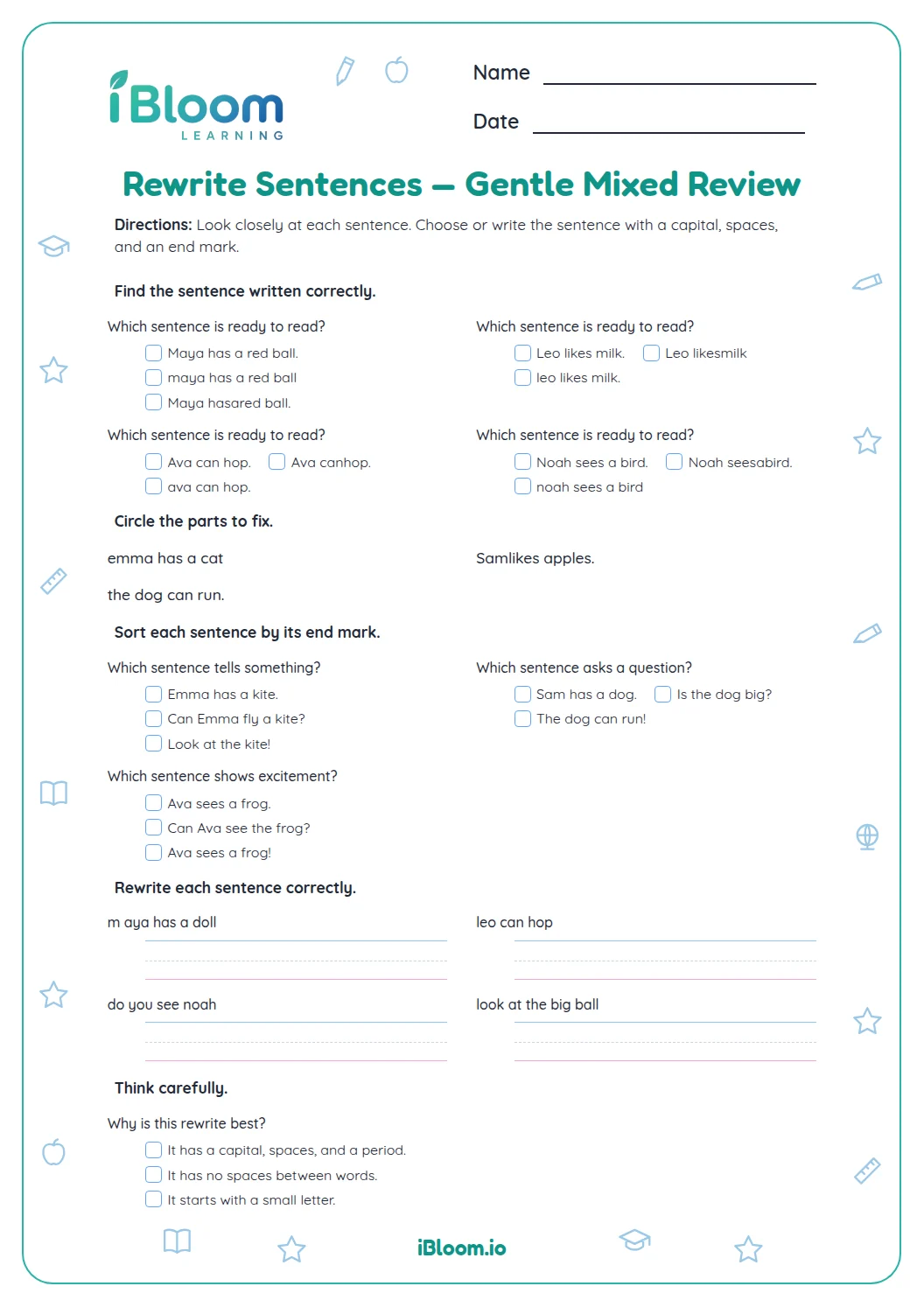
About this worksheet
This free printable worksheet helps Pre-K and Kindergarten children use words they know in whole sentences about home, school and pets. In Part A, children listen to four sentences with a missing word and fill in the bubble under the picture that finishes each one: a bed, a dog, a bus or milk. In Part B, they pick the word that fits four more sentences. In Part C, they copy two short sentences on writing lines, and in Part D they write their own sentence about a dog. It practices Common Core L.K.1f and L.K.2a, and the answer key is printed separately.
Aligned to L.K.1f and L.K.2a
What does it mean to use words in a familiar context?
A familiar context is a sentence about things a young child already knows: a bed, a dog, a bus, milk. When the setting makes sense to them, children can focus on how the sentence works. They hear which word is missing, think about what fits, and then see it in print.
This is why the sheet uses everyday sentences like "I sleep in my ___." The sentences are short, and the pictures give support for children who cannot read every word yet.
How can you help a young child finish a sentence?
Read each sentence aloud, pause at the blank, and let your child say a word before looking at the choices. Then ask which choice matches what they said, or which one makes sense if they picked something different. Saying the whole sentence again with the chosen word is the best check.
When it is time to write, show how a sentence starts with a capital letter, leaves a space between words and ends with a period. Pointing to each word as you read it back helps children see the spaces.
- 1The ___ barks at me.
- 2Think: Which animal barks? A dog barks.
- 3Choices: a dog, a cat, a fish
- 4Answer: the dog
- 5Say it again: The dog barks at me.
What is on this worksheet?
Part A has four sentences with a missing word, and each answer choice is a picture: bed, dog, bus and milk. Part B has four sentences with word choices, such as "I see the ___ in the sky" with sun, mat or pen. Part C asks children to copy "I see a cat." and "The sun is hot." on writing lines. Part D asks them to write their own sentence about a dog.
- Part A: 4 sentences, choose the picture that finishes each one
- Part B: 4 sentences, choose the word that fits
- Part C: 2 sentences to copy neatly
- Part D: 1 sentence to write about a dog
How to use this worksheet at home or in class
- 1Warm up by saying a sentence and leaving out a word, like "I wear a ___ on my head." Let your child fill it in.
- 2Read question 1 aloud together. Point to each picture and say its name before your child fills in the bubble under the one that fits.
- 3For Part B, read each sentence and the three words aloud, or let children who can read short words try on their own.
- 4In Part C, trace the first word with a finger, then let your child copy. Remind them to start with a capital letter and leave a space between words.
- 5In Part D, let your child say a sentence about the dog first, then write it. Writing sounds or drawing the dog first is fine for Pre-K.
- 6Check Parts A and B with the answer key. Celebrate every sentence, whether it is copied or invented.
Common mistakes and quick fixes
The mistake
Choosing a picture because it looks fun, not because it fits, such as the ball for "I sleep in my ___."
The fix
Say the whole sentence aloud with that picture. If it sounds silly, try another picture.
The mistake
Writing words with no spaces between them, such as "Iseeacat."
The fix
Have your child put a finger between words as they write, or use a craft stick as a spacer, then read the sentence back.
The mistake
Forgetting the capital letter or the period when copying.
The fix
Point to the first letter and the last mark of the model sentence and say "Big letter to start, dot to stop."
Common Core alignment
Most US states use the Common Core Language standards or a close state version. This sheet practices the two standards below.
Say and write complete sentences using words that make sense.
On this sheet: Children finish sentences with a word that fits, then write a sentence of their own.
Show the official wordingHide the official wording
Produce and expand complete sentences in shared language activities.
Start a sentence with a capital letter and write the pronoun I as a capital.
On this sheet: Each sentence children copy or write starts with a capital letter, and "I see a cat." has a capital I.
Show the official wordingHide the official wording
Capitalize the first word in a sentence and the pronoun I
What to practice next
Make more practice
Further reading
Questions parents and teachers ask
Can a preschooler do this worksheet?
Yes, with a grown-up. Part A uses pictures, so a preschooler can choose the picture that finishes each sentence when an adult reads it aloud. Parts B to D use more reading and writing. A preschooler can skip them, trace over the model sentences, or say a sentence about a dog aloud for Part D.
Why do the answer choices in Part A have pictures instead of words?
Pictures let children who cannot read yet show that they understand the sentence. The child hears "I sleep in my ___," thinks of a bed, and finds it. This builds the habit of choosing a word that makes sense, which later carries over to reading and writing words.
What if my child cannot read the words in Part B?
Read the sentence and the three words aloud, pointing to each one, and let your child choose. The words are short and familiar, such as sun, mat, pen, hat, sock, tree and book. Children who know some letter sounds can try sounding out the words before choosing.
How neat does the copying need to be?
It does not need to be perfect. Look for a capital letter at the start, a little space between words and a period at the end. Letters can be big and wobbly at this age. Praise the parts that are right, and try one small improvement next time.
What should my child write in Part D?
Anything that is a sentence about a dog is fine, such as "I see a dog." or "The dog can run." The key shows one sample, but the question has many right answers. Accept spelling that matches the sounds your child hears, and encourage a capital letter and a period.
Is there an answer key, and how long does it take?
Yes, the answer key is printed separately and shows the correct picture or word for Parts A and B, the copied sentences for Part C and a sample sentence for Part D. Plan on about 15 minutes; younger children may do better with Part A one day and the rest on another.