
About this worksheet
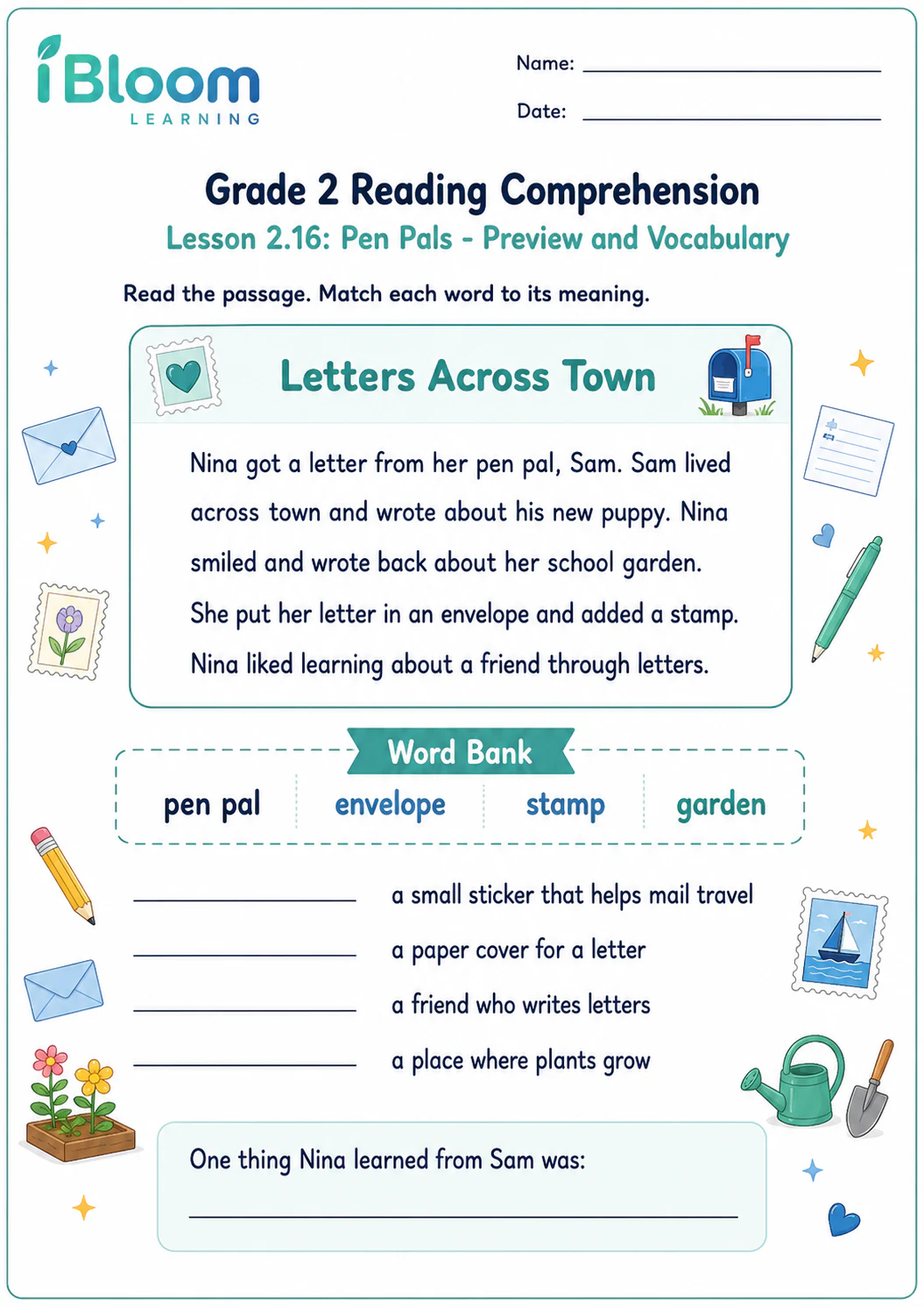
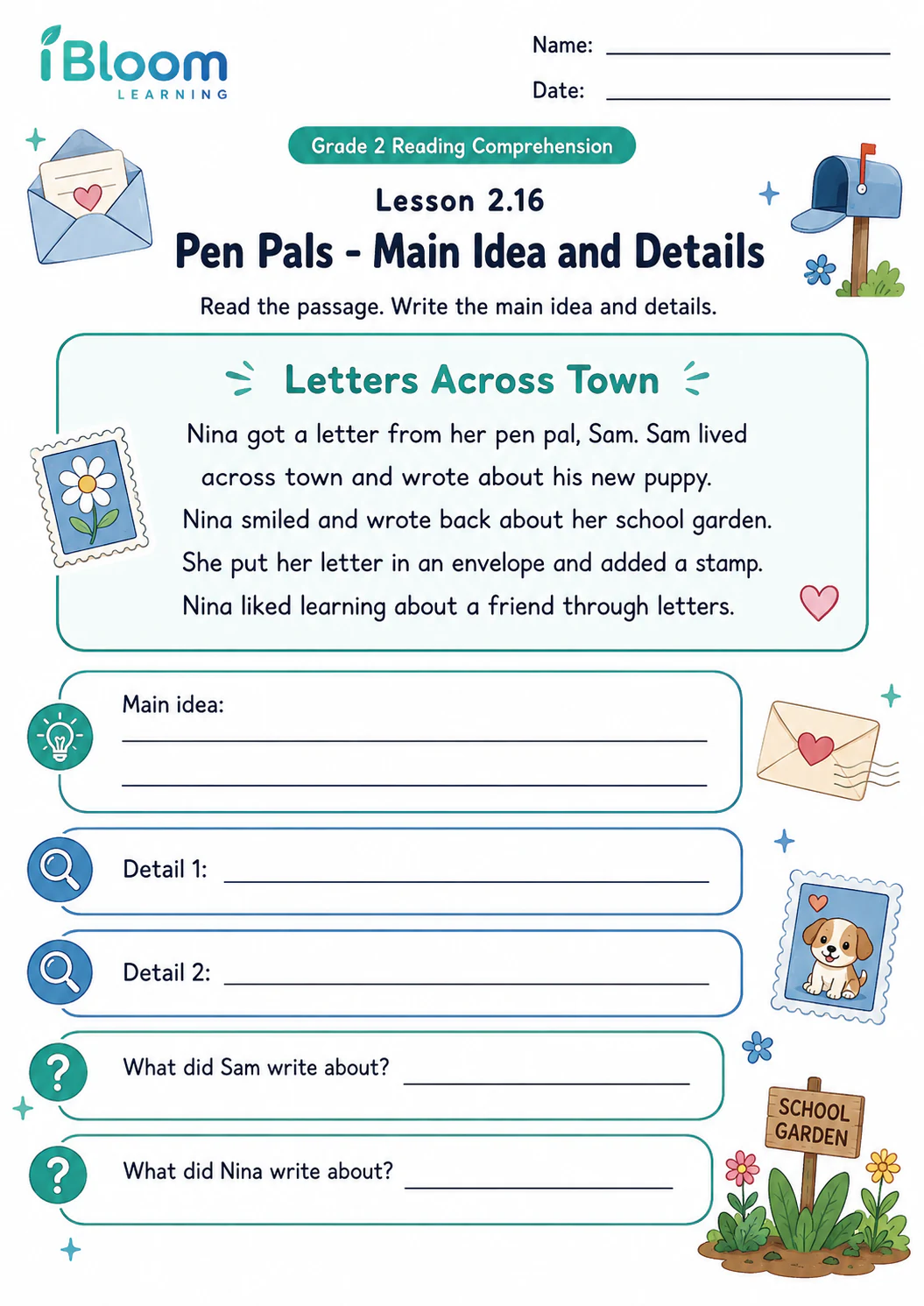
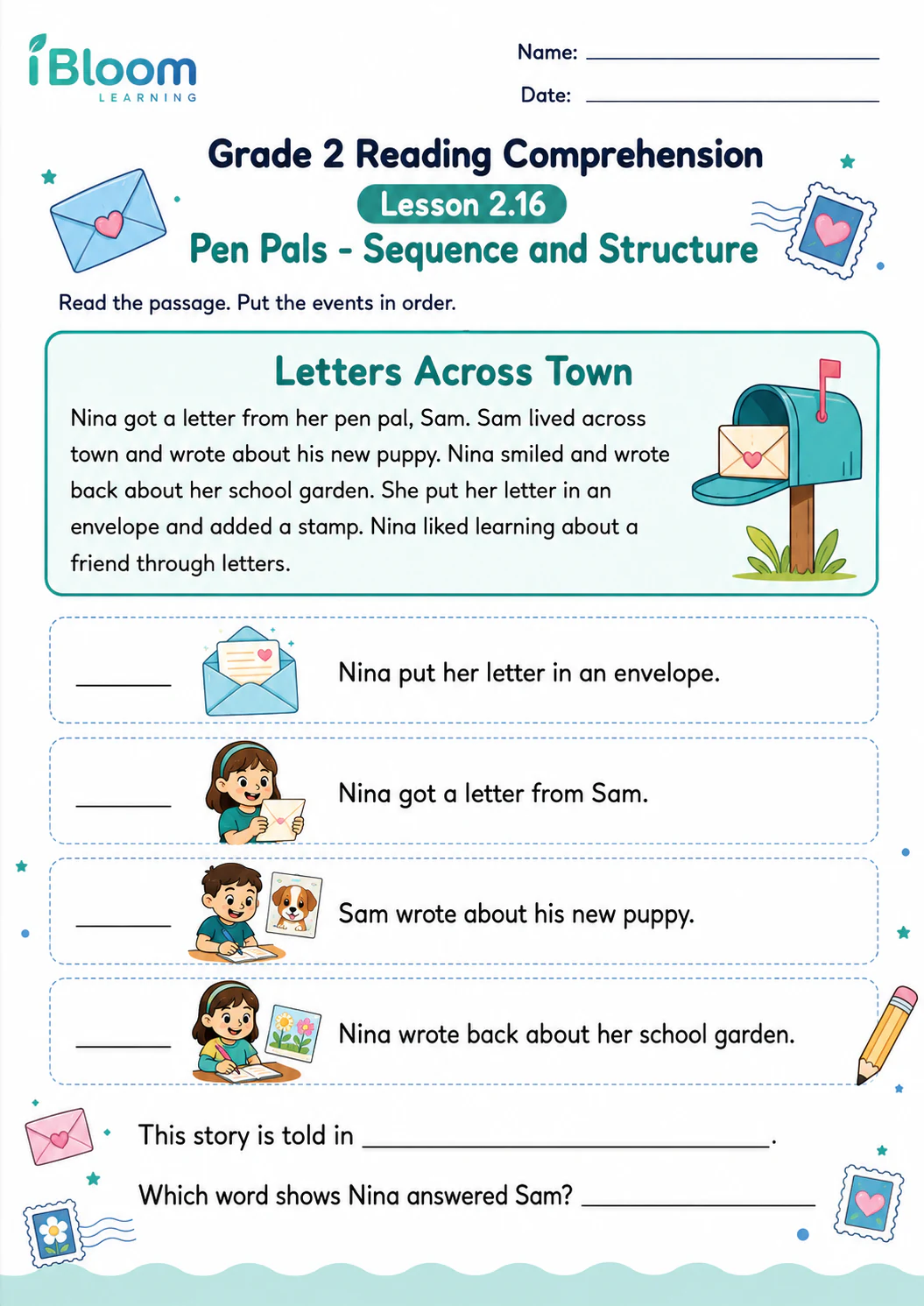
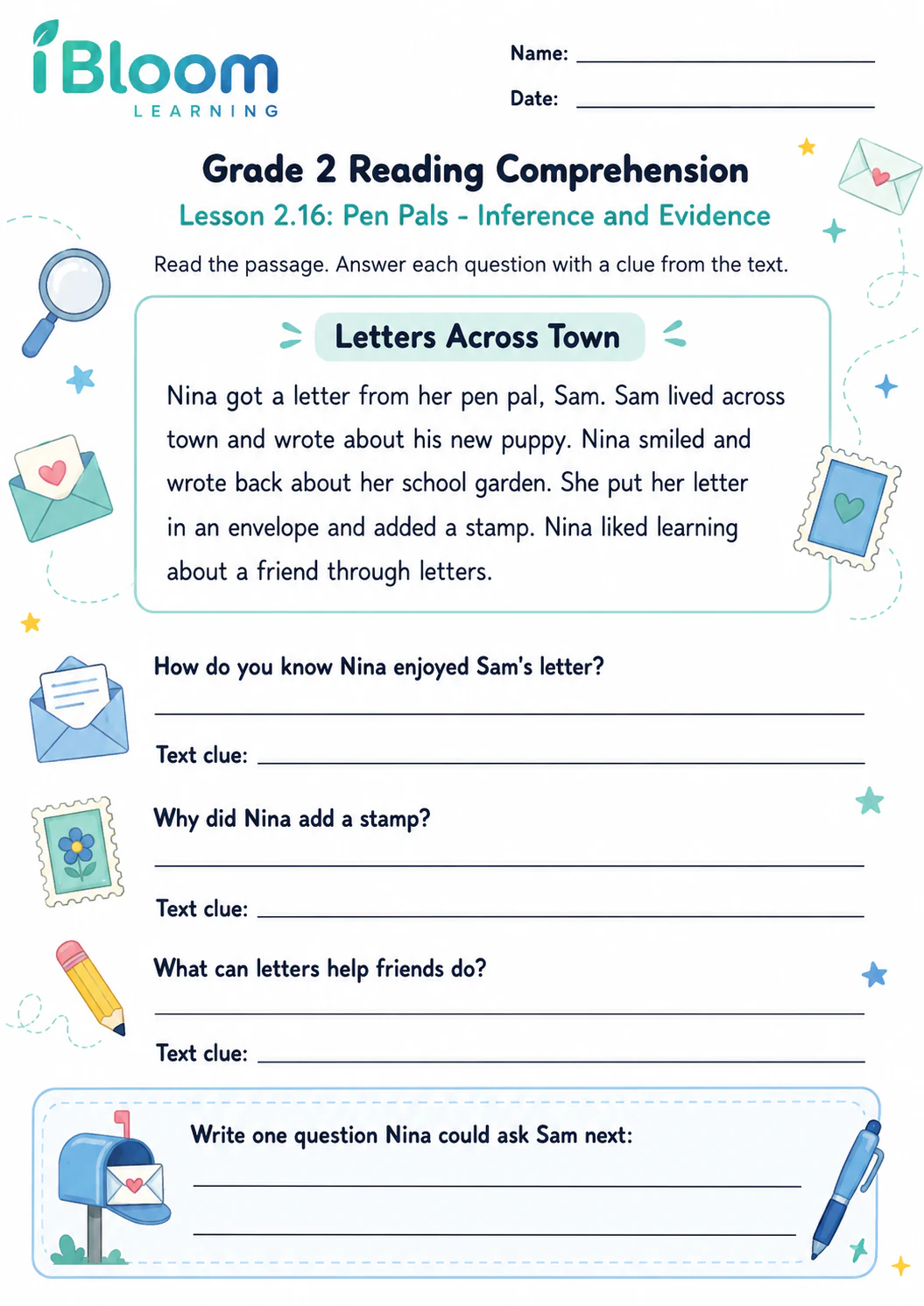
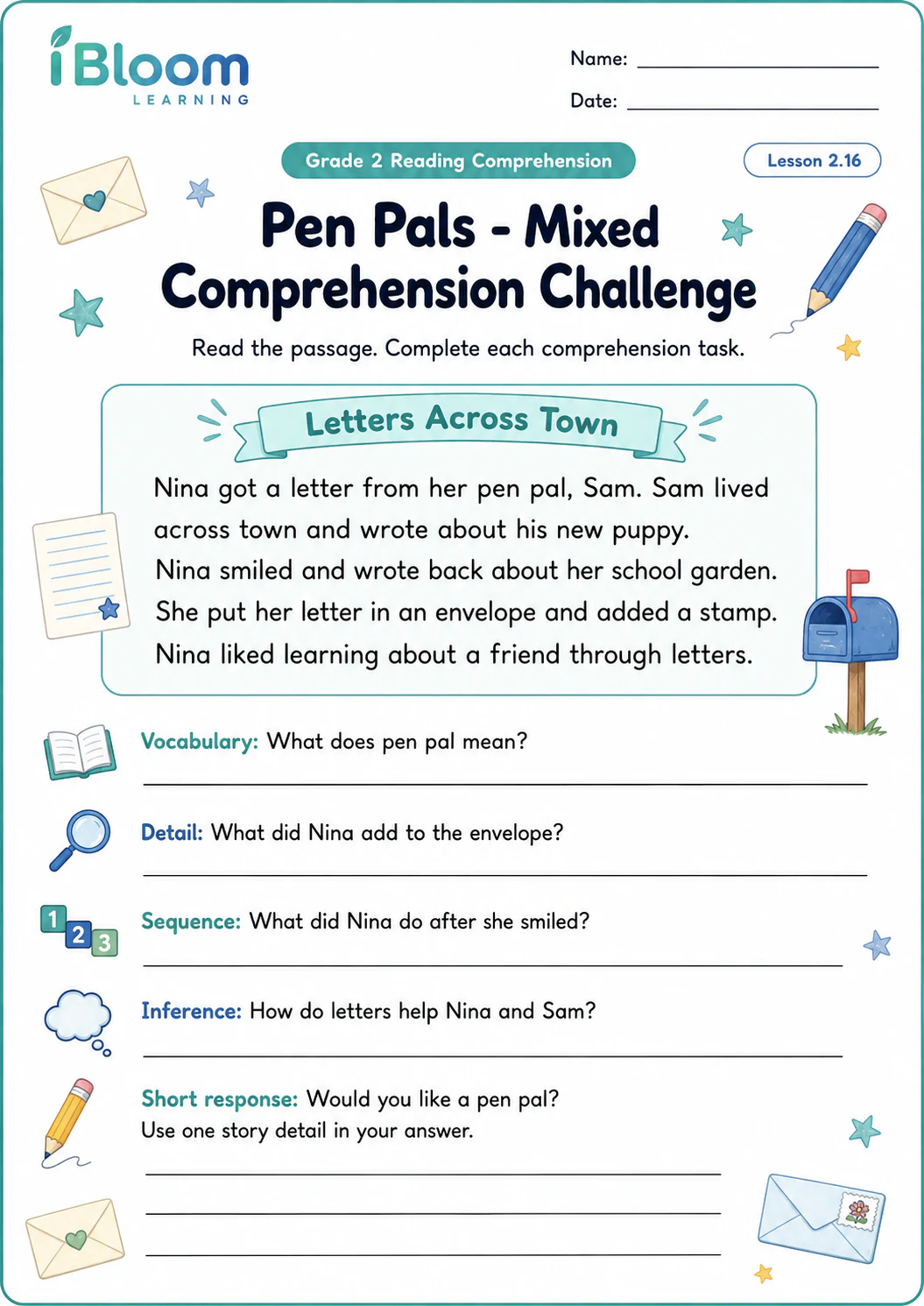
This free printable Grade 2 worksheet features Nina and her pen pal Sam, who writes about a new puppy while Nina shares news about her school garden. Across 14 questions, children recall who, what, and where details, explain a character’s action, infer from clues, and write responses tied to the passage. It practices CCSS RL.2.1 and W.2.8, with sample answers in the key.
Aligned to RL.2.1 and W.2.8
What will children write about?
The passage is Part A. Part B warms up with five short-answer questions about who, what, and where. Part C asks children to explain an action, recall a detail, and infer a feeling. Part D invites fuller responses based on the letters.
- Part A: read the passage
- Part B: recall five story details
- Part C: explain and infer; Part D: write fuller responses
How can a child use details in a response?
A strong response answers the question and points to the story. Nina writes back about the garden and asks what Sam’s puppy likes to play with, showing she is interested in his news.
How can readers infer what a character enjoys?
Use what a character says and does. Nina asks about the puppy and shares news about planting seeds. Those clues suggest that she enjoys learning about Sam and sharing details from her day.
- 1Question: What can you infer about Nina?
- 2Clue: She asks what Sam’s puppy likes to play with.
- 3Clue: She shares news about planting seeds.
- 4Answer: She is curious and enjoys learning about her pen pal.
What makes a written response clear?
Start with an answer to the question. Add a detail from the story, then explain how the detail fits. A response can be short; it does not need to retell the whole passage.
How to use this worksheet
- 1Read the story once to meet Nina and Sam.
- 2Answer Part A by rereading the sentence with the detail.
- 3For Part B, answer why questions with a reason from the story.
- 4In Part C, begin with a direct answer and add one matching detail.
- 5Check that each response names the right character or event.
- 6Use the sample key to discuss answers that use different words.
Common mistakes and quick fixes
The mistake
Copying an interesting detail without answering the question.
The fix
Say the answer first, then use the detail as support.
The mistake
Saying Nina has no interest in Sam’s puppy despite her question.
The fix
Notice that she asks what it likes to play with and shares garden news.
The mistake
Writing a long retelling instead of a response.
The fix
Choose only the detail that helps answer this question.
Common Core alignment
The story questions pair close reading with short written responses based on a provided text.
Answer questions about key story details.
On this sheet: Parts A and B ask readers to answer questions about characters, actions, and events.
Show the official wordingHide the official wording
Ask and answer such questions as who, what, where, when, why, and how to demonstrate understanding of key details in a text.
Use information from the story to answer a question.
On this sheet: Parts B and C use the passage as a source for written answers.
Show the official wordingHide the official wording
Recall information from experiences or gather information from provided sources to answer a question.
What to practice next
Make more practice
Further reading
Questions parents and teachers ask
What happens in the Pen Pals story?
Nina receives a letter from her pen pal Sam, who writes about his new puppy. She replies with news about the school garden and asks what the puppy likes to play with. Their notes give each friend a way to learn about the other’s day.
How many written response questions are included?
There are 14 questions in Parts B through D: five short answers and nine written responses. The passage is Part A. The answer key gives sample responses for questions that allow different wording, so children can compare their ideas with story details rather than copy a single sentence.
Does a child need to copy the sample answers exactly?
No. The key shows an example, not the only acceptable wording. A response is successful when it answers the question and uses a detail that fits the passage. For instance, a child may mention Nina’s garden or her question about Sam’s puppy.
How can I help a child who is unsure what to write?
Have the child point to the part of the passage that gives a clue. Then ask them to say the answer aloud before writing it. For a question about Nina, notice that she asks about Sam’s puppy and shares news about planting seeds.
How long does the page take?
Allow about 20 minutes for reading and answering all 14 questions. Children who are still building writing stamina can answer one question at a time and briefly reread the story before each response. An adult can pause between parts and talk through one clue aloud.