



About this worksheet
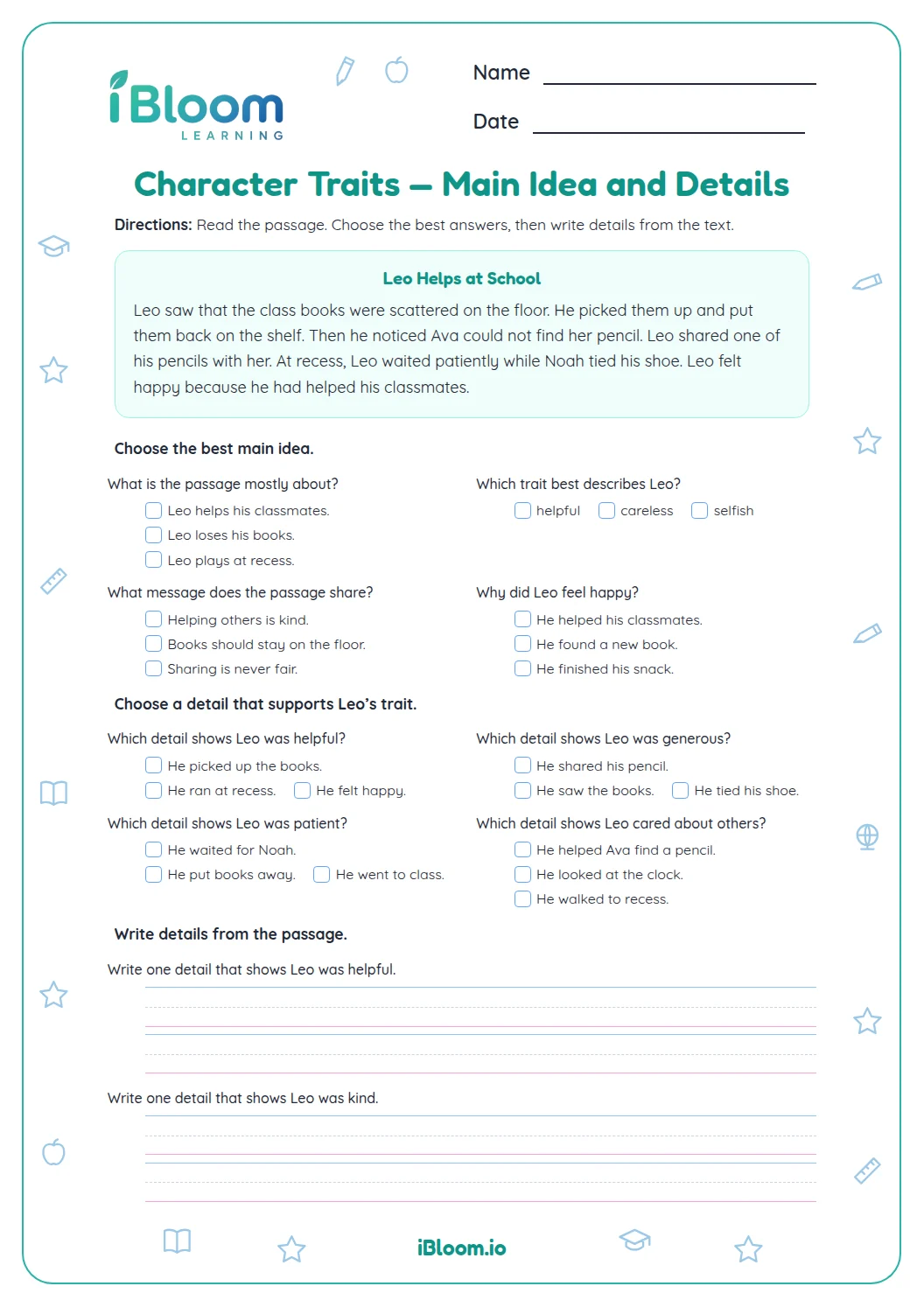
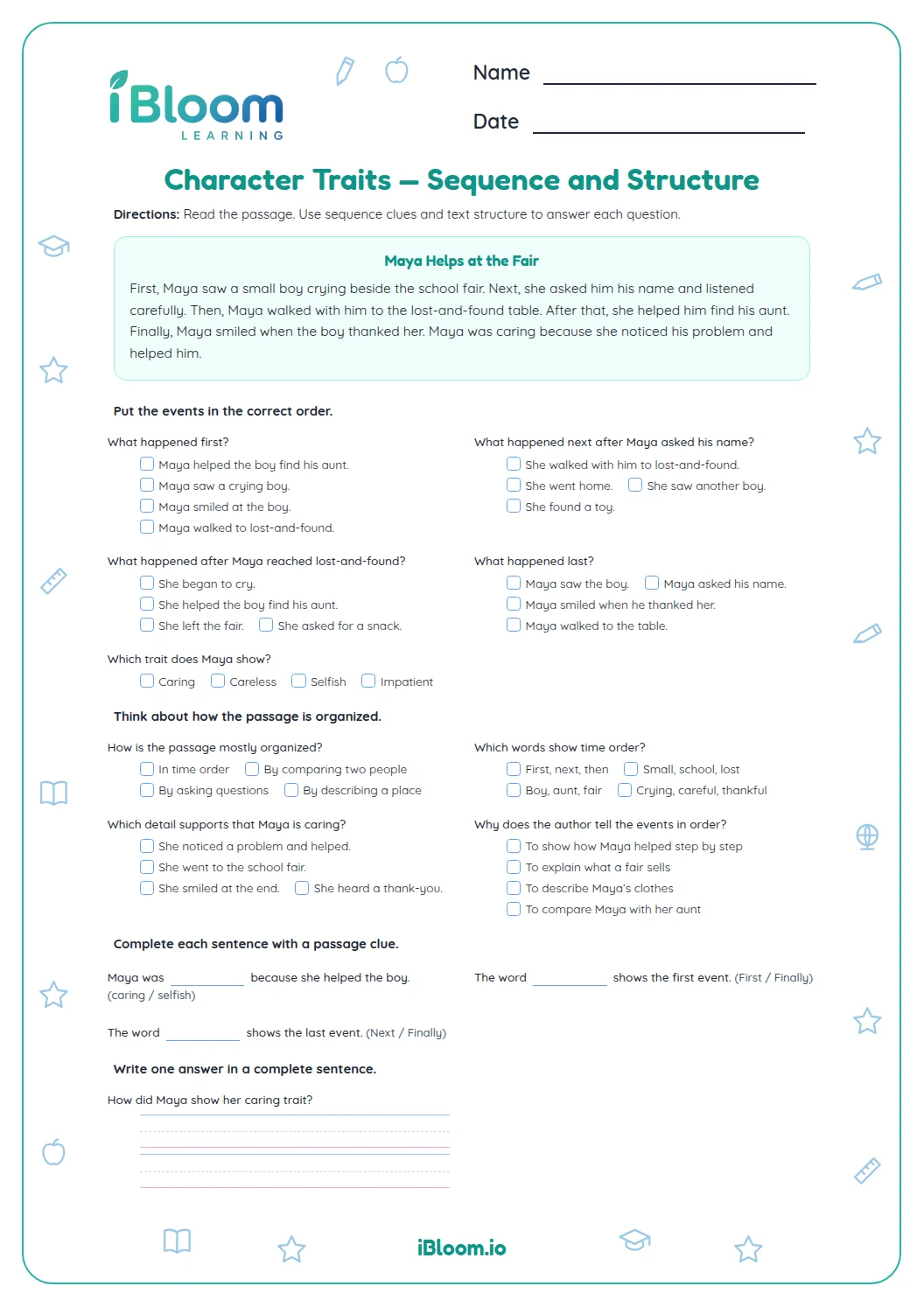
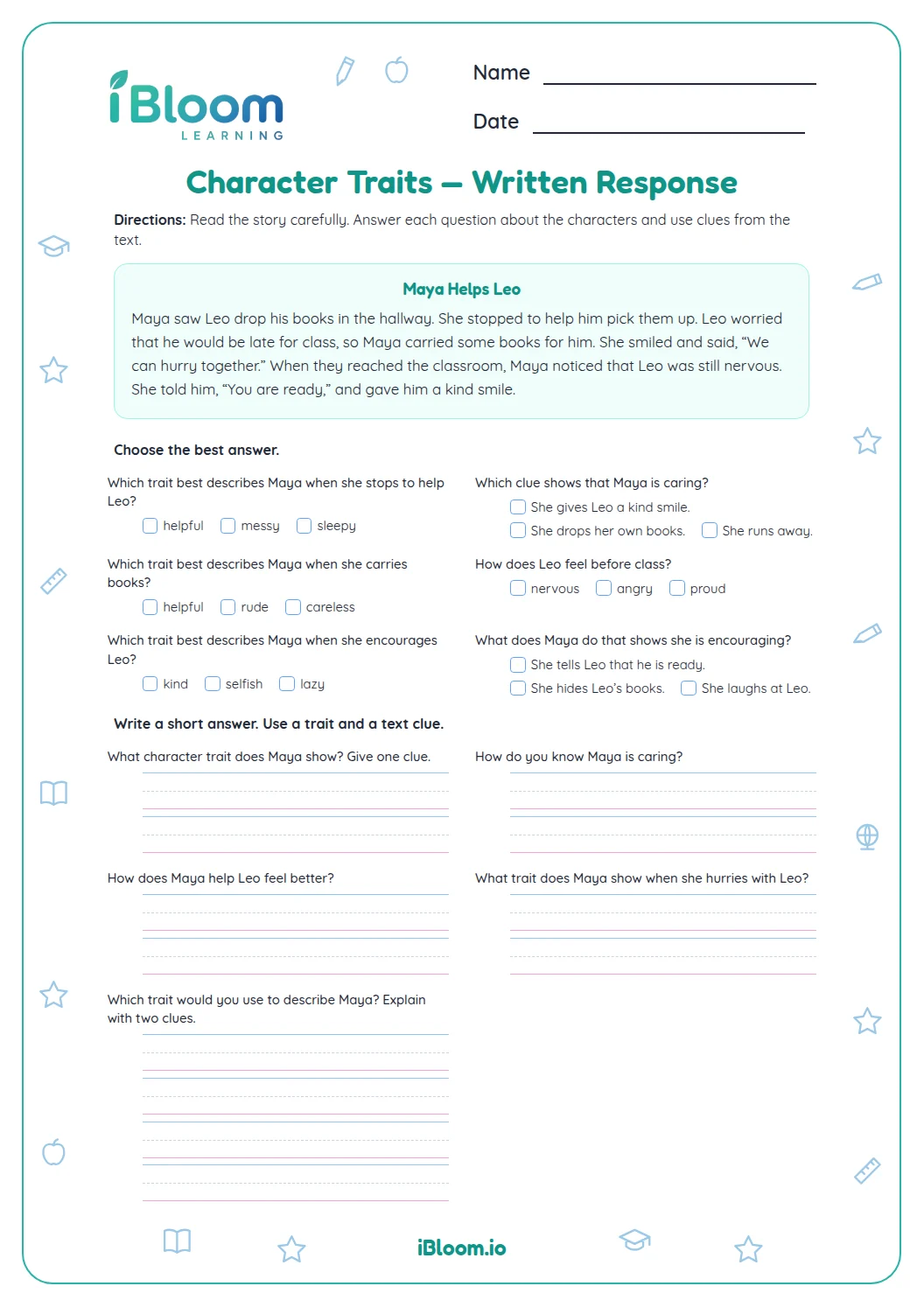
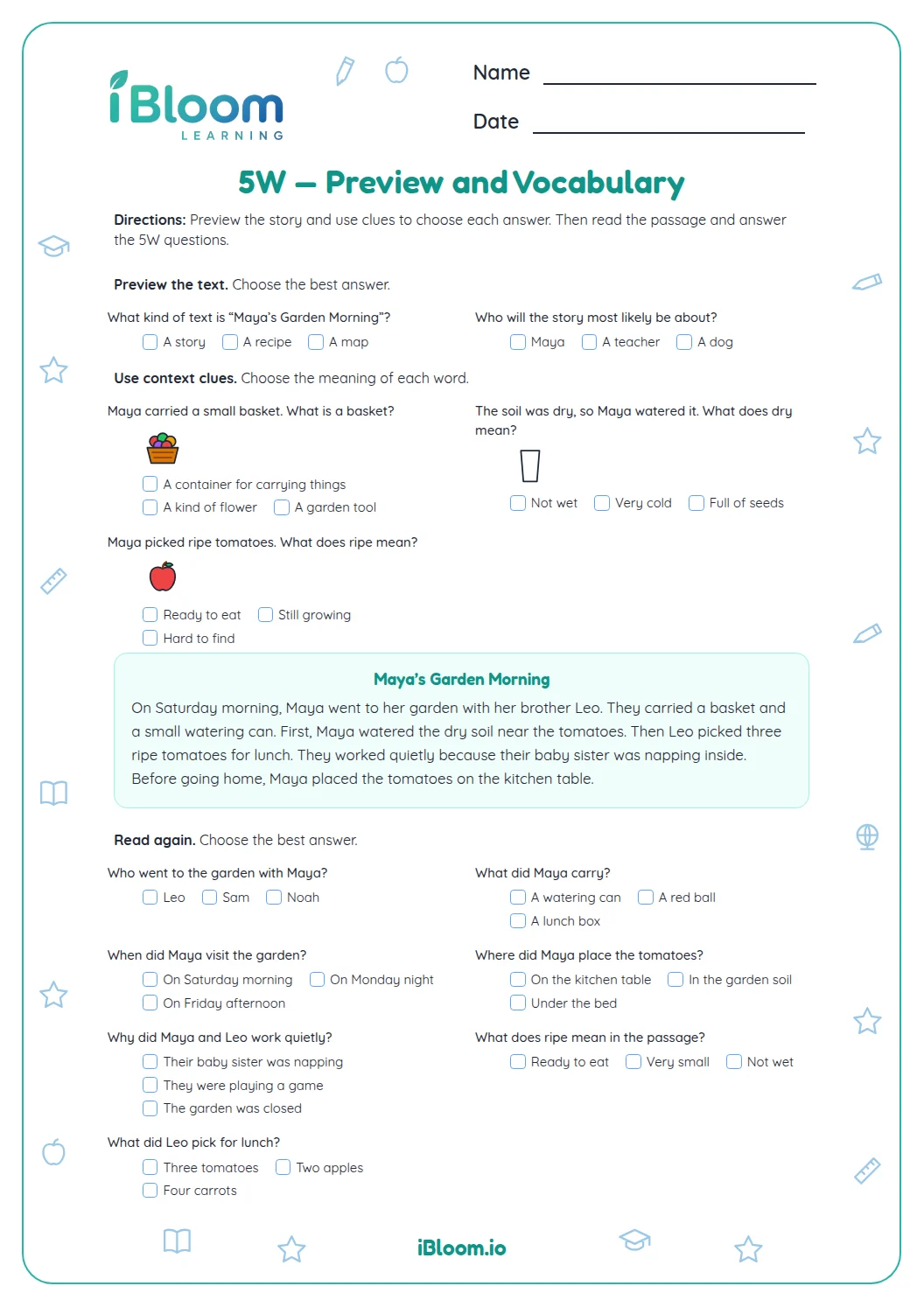
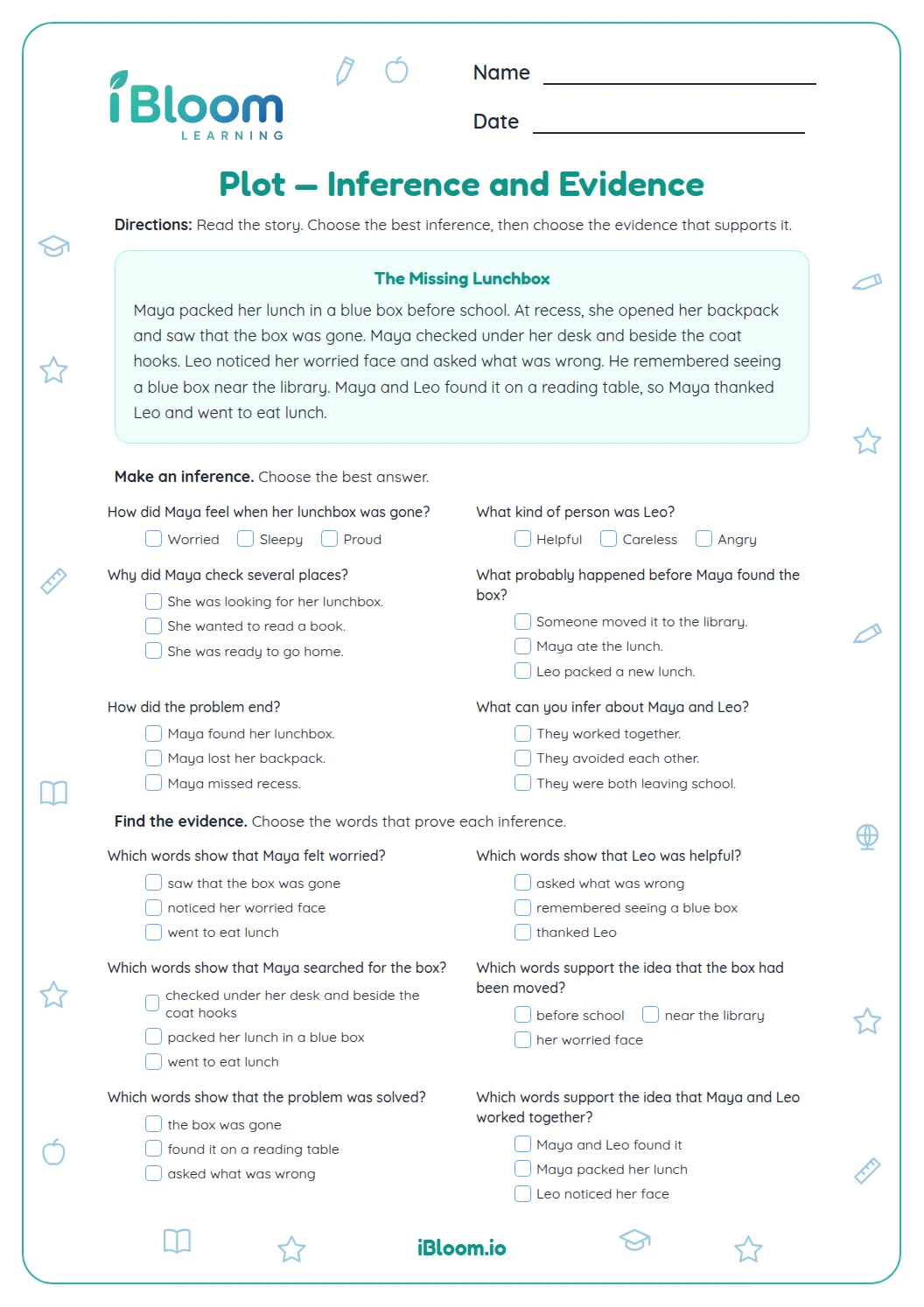
This Grade 2 printable pairs the Garden Helpers story with questions about character traits, feelings, challenges, and evidence. Children follow Maya, Leo, and Ava as they care for a school garden and respond to a hurt bird. The sheet has 14 questions across three parts, followed by a separate answer key. It practices CCSS RL.2.3 by asking readers to describe how characters respond to a challenge.
Aligned to RL.2.3
How do actions reveal a character trait?
A trait is a word that describes a person’s usual qualities. In this story, Nia finds mittens and takes them to the teacher’s desk. That choice supports traits such as thoughtful and responsible. A strong answer names both the trait and the action that supports it.
- 1Trait: responsible
- 2Story detail: Nia carries the mittens to the teacher’s desk
- 3The action supports the trait.
How do feelings change during a challenge?
Eli first feels worried because he cannot find his mittens. After Nia returns them, he feels relieved and thankful. Comparing these moments helps readers describe how a character responds as the story problem changes.
How can a reader support an inference?
Questions 13 and 14 ask for a response in the student’s own words. Children can point to a specific action or line of dialogue, then explain what it suggests about a character.
Ways to read together
- 1Read the story once for what happens, then reread to notice choices and feelings.
- 2Underline an action that gives a clue about Nia or Eli.
- 3For each trait answer, ask which story detail supports it.
- 4Compare how Eli feels before and after the mittens are returned.
- 5For written answers, include both the trait and a matching detail.
Character-trait mix-ups
The mistake
Choosing a trait from appearance rather than behavior.
The fix
Look for what the character says or does in the story.
The mistake
Naming a feeling as if it were a lasting trait.
The fix
Ask whether the word describes this moment or a broader quality.
The mistake
Giving a trait without evidence.
The fix
Add one action or line that supports the choice.
Common Core alignment
Readers use the story’s challenge and character actions as evidence.
Describe characters’ responses to a challenge using story details.
On this sheet: Questions ask how Nia and Eli respond to the lost-mittens problem.
Show the official wordingHide the official wording
Describe how characters in a story respond to major events and challenges.
What to practice next
Make more practice
Further reading
Questions parents and teachers ask
What is the story about?
Nia finds a pair of blue mittens at recess and helps return them to Eli. Their actions give readers clues about traits such as thoughtful, responsible, and grateful. The story is original to this printable, and the questions ask children to use its details.
What is a character trait?
A character trait is a quality that helps describe someone, such as helpful or patient. Readers infer traits from what a character says and does. In this worksheet, Nia’s decision to bring the mittens to the teacher’s desk supports a positive trait.
How does the sheet help with text evidence?
Many multiple-choice questions pair a trait or feeling with a story detail. The two written responses ask children to name a trait and support it with an event or explain a change in Eli’s feelings, keeping evidence connected to the passage.
Can children answer the questions without rereading?
They may remember some details, but rereading helps them select accurate evidence. Encourage your child to look back at the part where Nia finds the mittens and the ending where Eli thanks her, then match the detail to the question.
How many pages should I print?
The worksheet uses three pages because it includes a passage and 14 questions. A separate answer-key page follows. You can print the story and questions for the student and keep the key nearby for checking responses. Rereading the passage is a useful step before choosing an answer.