

About this worksheet
This Grade 2 printable pairs a short garden story with comprehension, vocabulary, and sight-word practice. Children answer questions about the people, events, sequence, and reasons, then search for eight sight words from the passage. The questions align with Common Core RI.2.1, answering questions about key details, and RF.2.3f, recognizing grade-appropriate irregularly spelled words. The separate answer key lists the expected story details and confirms the sight words in the grid.
Aligned to RI.2.1 and RF.2.3f
What details should a reader notice?
Readers can keep track of who is in the story, where events happen, and what changes. In Mia’s garden, Mia and Leo plant seeds in a box beside the shed.
How do readers explain why something happened?
A why question asks the reader to connect an action with a reason. For example, Leo ties the tall plant to a stick because it leans toward the path. The reason comes directly from the passage.
- 1The tallest plant leaned toward the ___.
- 2Look back to the passage for the place beside the garden.
- 3Answer: path.
How can children put story events in order?
Time words show when story events happen. The children plant seeds first, shoots appear later, and flowers and a bean come after that. Several sentence completions ask children to retrieve those details.
What does the word search reinforce?
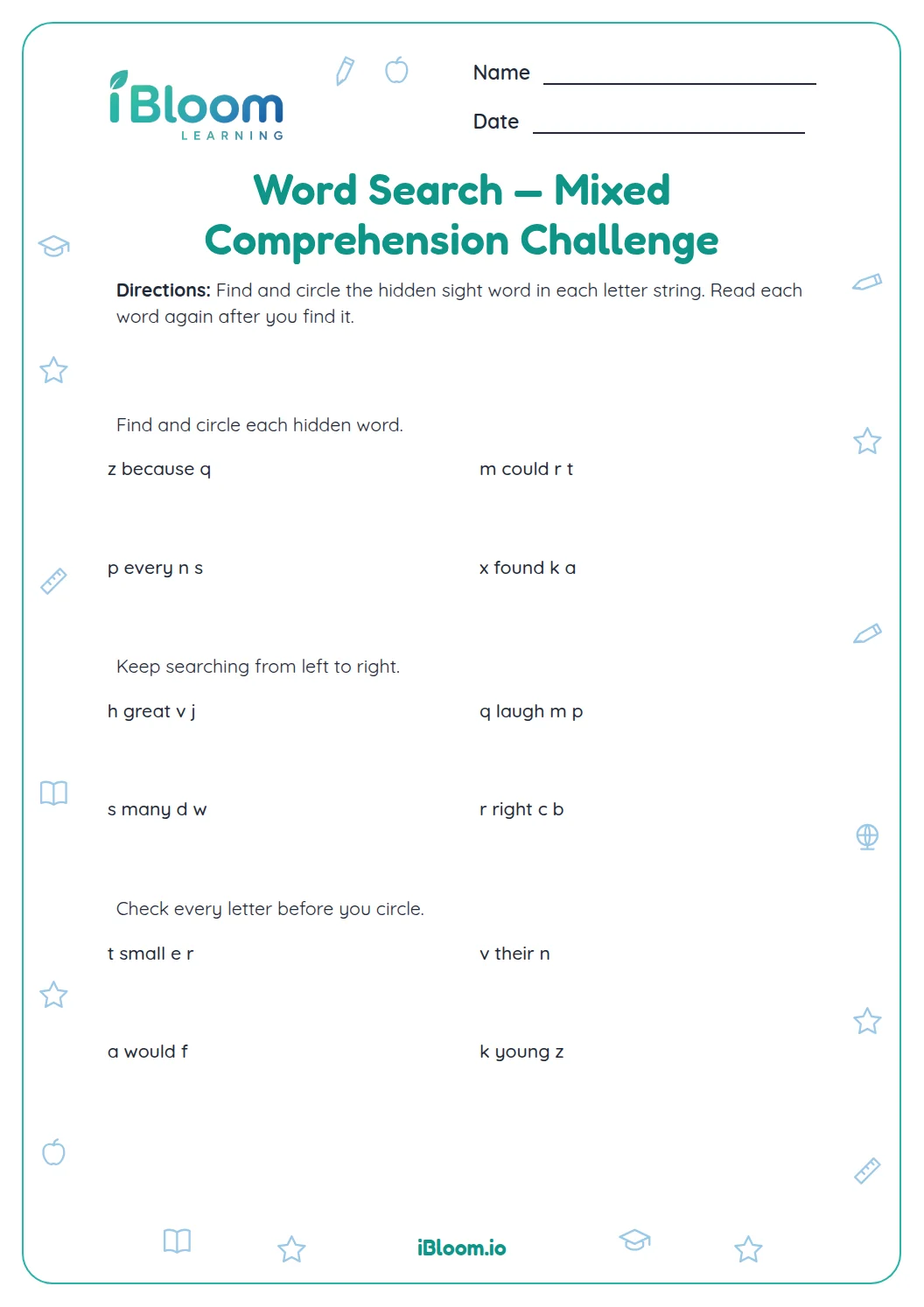
The grid repeats eight words that appear in the passage. Reading each word in the story first makes it easier to recognize in a different arrangement of letters.
How to use this worksheet
- 1Read the title and predict what the story may describe.
- 2Read the passage aloud or independently, pausing after each paragraph.
- 3For each question, return to the sentence that gives the clue.
- 4Use time words to check the order of events.
- 5Scan the word-search grid one word at a time and circle each find.
- 6Compare answers with the key and point back to the supporting detail.
Common mistakes and quick fixes
The mistake
Giving a reasonable answer that the passage never says.
The fix
Ask the child to point to the sentence that supports the answer.
The mistake
Mixing up what happened first and what happened later.
The fix
Underline time clues such as “after a week” and “by the end of the month.”
The mistake
Searching for a word without checking its letters in order.
The fix
Track one letter at a time across, down, or diagonally, then verify the full word.
Common Core alignment
Answer who, what, where, when, why, and how questions about key text details.
On this sheet: Questions ask children to retrieve details and explain a character’s actions from the garden passage.
Show the official wordingHide the official wording
Ask and answer such questions as who, what, where, when, why, and how to demonstrate understanding of key details in a text.
Recognize and read grade-appropriate irregularly spelled words.
On this sheet: Children read familiar high-frequency words in connected sentences and locate key words in the passage.
Show the official wordingHide the official wording
Recognize and read grade-appropriate irregularly spelled words.
What to practice next
Make more practice
Further reading
Questions parents and teachers ask
What does the story ask a reader to remember?
Mia and Leo plant bean seeds in a box beside a shed. The questions ask about what they do, when shoots and flowers appear, and why Leo ties a leaning plant to a stick. The passage gives the details needed to answer each item.
Which sight words do students search for?
The grid includes they, each, with, would, after, there, then, and because. Each word appears in the garden passage, so students can read it in context before locating the same spelling in the grid. Ask learners to point out the sentence clue and reread their answer in context.
How can I help if a child is unsure of an answer?
Ask the child to reread the sentence that describes the event and point to the words that support an answer. For a question about order or reason, have the child explain how that detail connects to the question. Ask learners to point out the sentence clue and reread their answer in context.
Can an adult read the passage aloud?
Yes. An adult can read the passage and questions aloud while the child follows the printed words. The child can still locate the supporting detail, complete each response, and search the eight sight words independently. Ask learners to point out the sentence clue and reread their answer in context.
What is included in the answer key?
The answer key lists the expected word or detail for each item and confirms the eight words in the grid. For questions with short responses, accept equivalent wording when it gives the same information as the story. Ask learners to point out the sentence clue and reread their answer in context.