



About this worksheet
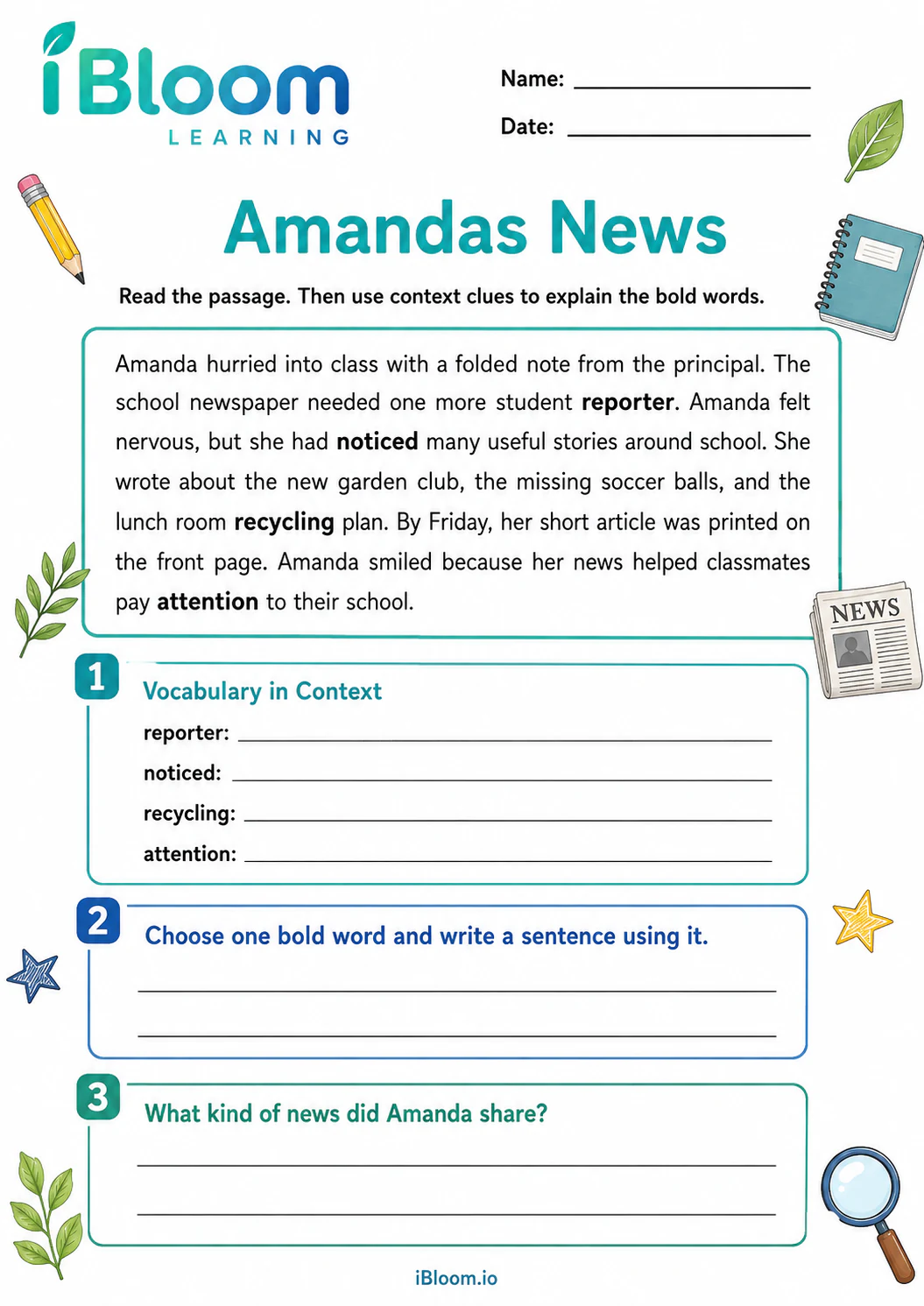
This free Grade 3 printable pairs an original 160-word story with 14 multiple-choice comprehension questions. Amanda volunteers to report school news, checks her details, and sees classmates respond to her article. Questions cover vocabulary, key details, sequence, character feelings, inference, main idea, and message. The page practices CCSS RL.3.1 and RL.3.2 and includes a separate answer key.
Aligned to RL.3.1 and RL.3.2
How can a reader find a detail in the story?
Reread the paragraph that tells about the newspaper assignment and the school events. A strong answer names an event the passage actually describes, such as the garden club or recycling plan.
- 1Amanda notices the garden club planted lettuce beside the playground.
- 2That event is stated in the first paragraph.
How do the events build Amanda’s confidence?
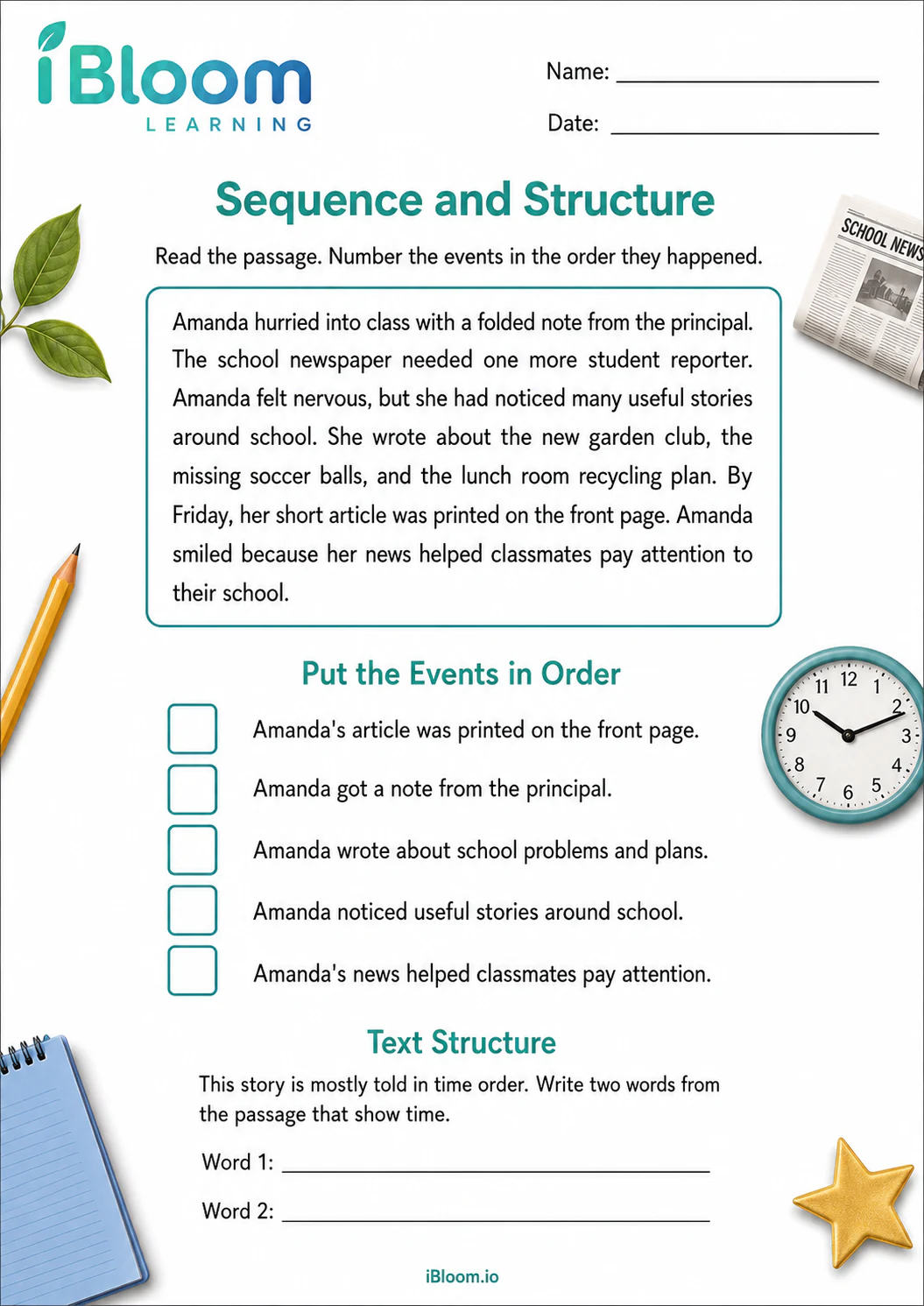
Amanda first feels nervous, then gathers information, writes and checks her article, and finally sees classmates respond. Putting these events in order helps explain the change in how she feels.
- First: Amanda gathers possible school stories.
- Next: she interviews and checks details.
- At the end: classmates read and respond.
What message can readers infer from Amanda’s story?
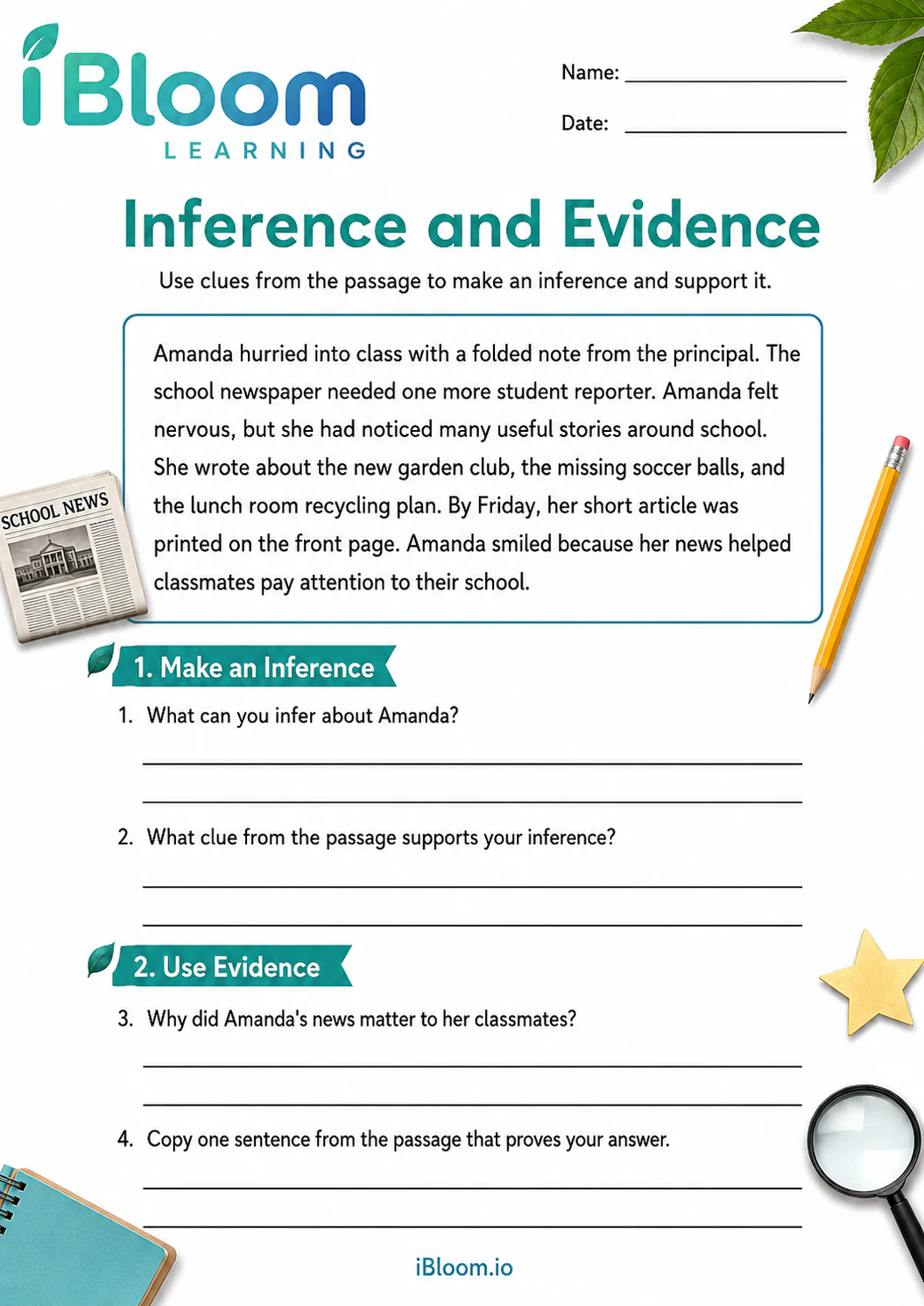
Amanda learns that careful reporting can help classmates notice useful things happening around them. The answer key accepts a similar idea supported by a detail from the story.
How to use this worksheet
- 1Read the passage once to understand what Amanda is trying to do.
- 2Reread the relevant paragraph before answering a detail question.
- 3For sequence questions, list the events in the order they happen.
- 4Use a detail from the story to support an inference or lesson.
- 5Write a complete sentence for questions that ask why or what the story teaches.
- 6Compare open responses with the sample answers in the key.
Common mistakes and quick fixes
The mistake
Answering from personal experience instead of the passage.
The fix
Point to a sentence in the story that supports the response.
The mistake
Mixing up the order of reporting steps.
The fix
Look for time words and trace the events from beginning to end.
The mistake
Calling the topic the main idea.
The fix
Say what Amanda does and why her reporting matters.
Common Core alignment
The story questions ask readers to understand and recount a narrative using evidence.
Answer questions with explicit details from a story.
On this sheet: Questions ask children to retrieve and cite details from Amanda’s story.
Show the official wordingHide the official wording
Ask and answer questions to demonstrate understanding of a text, referring explicitly to the text as the basis for the answers.
Recount the story and explain its central message through details.
On this sheet: Questions ask for the main idea and lesson supported by story events.
Show the official wordingHide the official wording
Recount stories, including fables, folktales, and myths from diverse cultures; determine the central message, lesson, or moral and explain how it is conveyed through key details in the text.
What to practice next
Make more practice
Further reading
Questions parents and teachers ask
How long is Amanda’s News?
Amanda’s News is a three-paragraph story of about 160 words, followed by 14 questions. Readers can return to the paragraph that contains a detail or reporting step. The story follows Amanda from her first assignment through the publication of her article.
What kinds of questions are included?
The 14 questions use two-choice answers and cover story details, vocabulary, sequence, inference, main idea, and message. Children can point to a sentence or event that supports each choice. The answer key lists the supported response for every question.
Should my child reread the passage?
Yes. Rereading the paragraph connected to a question helps children answer from the text. It is especially useful for questions about Amanda’s reporting steps and the details that support an inference. Reread the paragraph about Amanda’s interviews and editing. Then explain the steps in order: she gathered information, wrote the article, and checked the names and details.
What is the main idea of Amanda’s story?
Amanda gathers and checks school news, then sees classmates respond to her article. A complete answer can also explain that careful reporting helps people notice what is happening at school. One supported answer is that Amanda reports useful events taking place at school. The garden, missing soccer balls, and recycling plan are examples from her article.
How does the answer key help?
The separate key lists the correct choice for all 14 questions. For each response, a child can return to Amanda’s story and find the detail that supports it. This makes it easy to discuss how the text supports an answer.