

About this worksheet
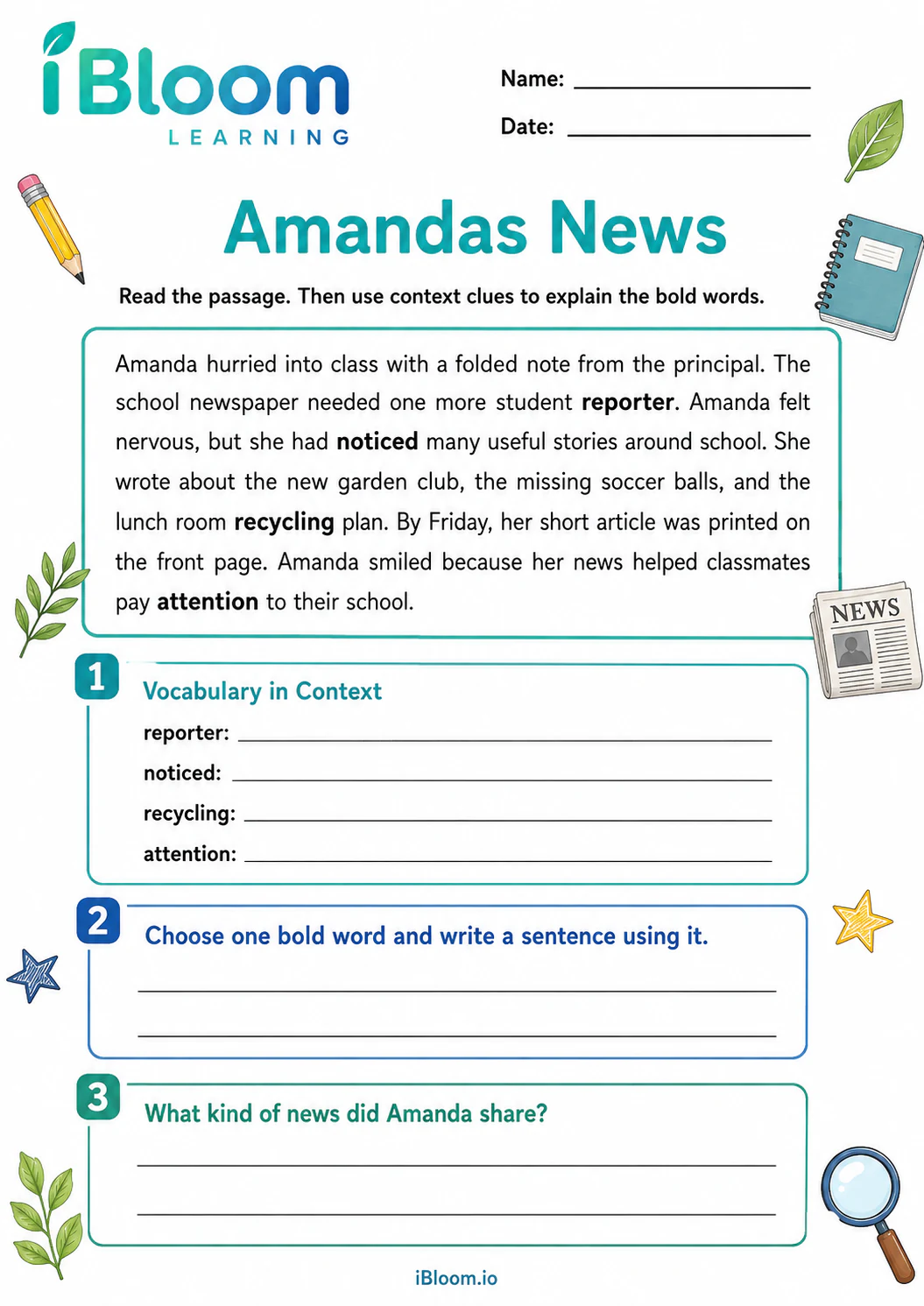
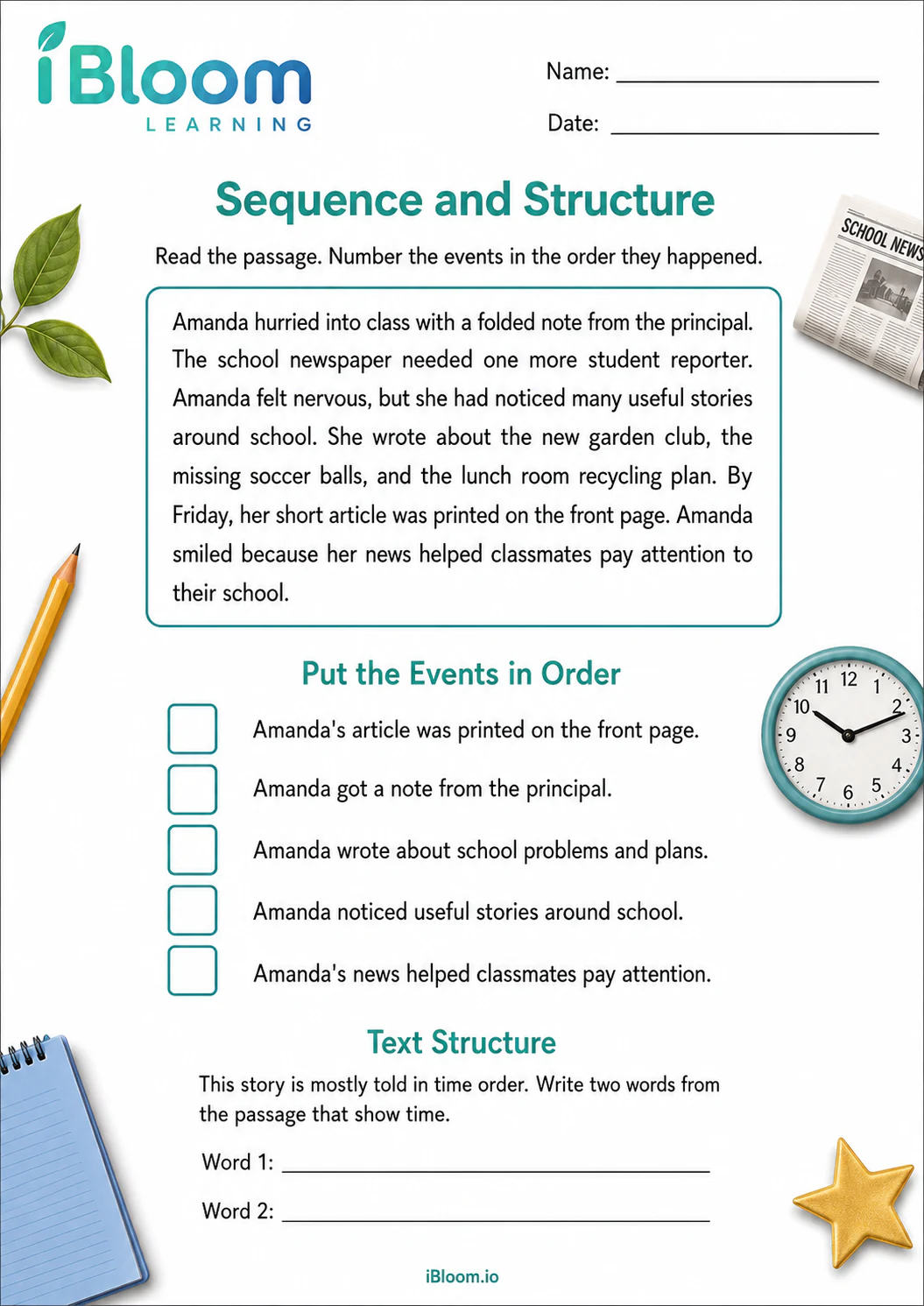
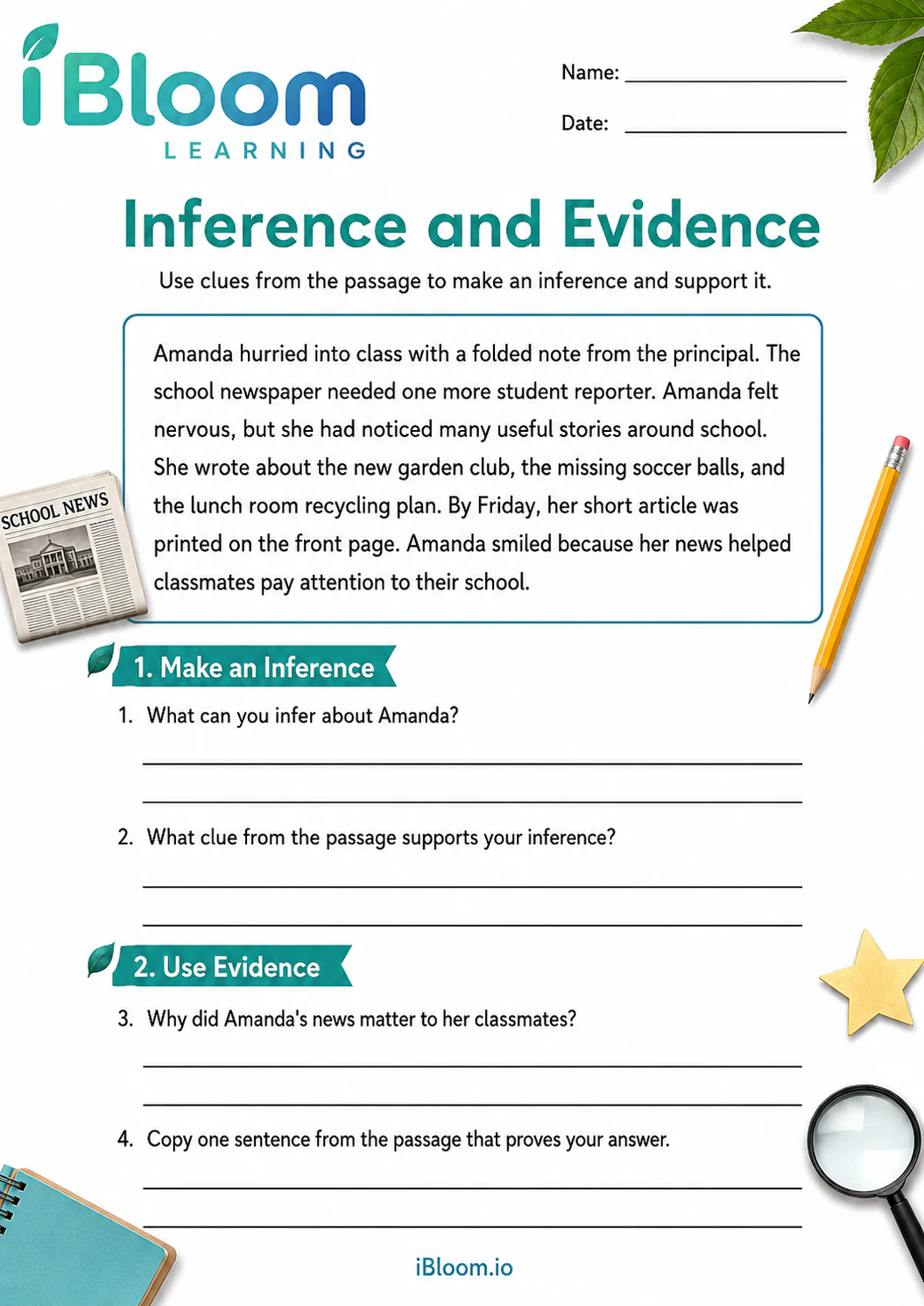
This free Grade 3 reading worksheet follows Amanda as she gathers school news and sees classmates respond to her article. The story keeps the garden club, missing soccer balls and lunchroom recycling topics at the center of her reporting. Part A is the passage, Part B has six brief written questions about its details, and Part C has four responses about Amanda’s feelings, actions and impact. It practices Common Core RL.3.1 and RL.3.3 through text-based answers and character analysis. A separate answer key provides sample responses.
Aligned to RL.3.1 and RL.3.3
What happens in Amanda’s News?
Amanda is interested in a newspaper job but worries about finding a story. She notices three school updates, checks her information and writes an article. After it appears, classmates ask about the garden club and read a recycling label.
The story gives students observable actions to use as evidence. They can explain Amanda’s growing confidence by connecting what she does before publication with what she sees afterward.
What makes a written answer convincing?
A useful response answers the exact question and points to a relevant detail. Naming a trait such as careful is a start; explaining that Amanda asks questions and checks labels makes the idea easier to support.
- 1Question: How did Amanda check her facts? Give two examples.
- 2She asks the coach about the missing balls and reads the recycling labels.
- 3Both actions come from the third paragraph.
- 4The response names two checks instead of just saying she worked hard.
How should adults check the responses?
For Part B, check the fact and whether the answer makes sense as a sentence. Part C invites explanations, so compare the child’s reasoning with the passage rather than requiring a word-for-word copy of the key.
The last question asks whether Amanda would be a good reporter, with two supporting details. A response that mentions noticing useful news and checking information has a clear basis in her actions.
How to use this worksheet
- 1Read the passage once for the sequence of events.
- 2Reread one paragraph at a time and locate details for Part B.
- 3Write brief complete sentences for the six detail questions.
- 4For Part C, state an idea and add the specific evidence requested.
- 5Use the key to check facts, then accept supported explanations in the child’s own words.
Common mistakes and helpful fixes
The mistake
Saying Amanda was excited at first without mentioning her worry.
The fix
Return to the opening paragraph: she wants the job but feels nervous about finding news.
The mistake
Claiming Amanda found the missing soccer balls.
The fix
The passage says she checked with the coach; it never gives a discovery or return of the balls.
The mistake
Answering a two-detail question with one example.
The fix
Underline the two distinct actions or responses in the answer before checking it.
Common Core alignment
Answer questions using details from Amanda’s school newspaper story.
On this sheet: Students retrieve details and use evidence to explain the effects of Amanda’s reporting.
Show the official wordingHide the official wording
Ask and answer questions to demonstrate understanding of a text, referring explicitly to the text as the basis for the answers.
Explain Amanda’s feelings and how her reporting affects her classmates.
On this sheet: The final questions connect Amanda’s worries, fact-checking and news article to the story’s events.
Show the official wordingHide the official wording
Describe characters in a story (e.g., their traits, motivations, or feelings) and explain how their actions contribute to the sequence of events.
What to practice next
Make more practice
Further reading
Questions parents and teachers ask
Is the story printed with the questions?
Yes, the full Amanda’s News passage is included as Part A. It follows her from receiving the principal’s note to seeing classmates react to her article. Students can return to the passage while answering the six detail questions in Part B and the four explanation questions in Part C.
Does every answer need to quote the passage?
No, children may explain the details in their own words. A response should still clearly refer to what happened in the story. For question 8, saying that Amanda spoke to the coach and checked recycling labels gives two accurate examples without copying a whole paragraph.
Why does Amanda smile at the end?
She sees that her news is helping classmates pay attention to their school. Two classmates ask about joining the garden club, and another reads a recycling label. Those actions give students concrete evidence for explaining her pleased reaction instead of only saying that her article was printed.
Are different answers acceptable for the last question?
Yes, the last question invites a judgment supported by two things Amanda did. The key gives one model, but students may select other relevant actions from the passage. Check whether the two details support the judgment, and ask the child to explain any connection that is unclear.
Can an adult help with reading before the writing?
Yes, an adult can read the passage aloud while the child follows the printed words. Then let the child find the relevant details and compose the responses. For support, say the answer aloud first, check it against the passage, and write a short sentence that keeps the same meaning.