
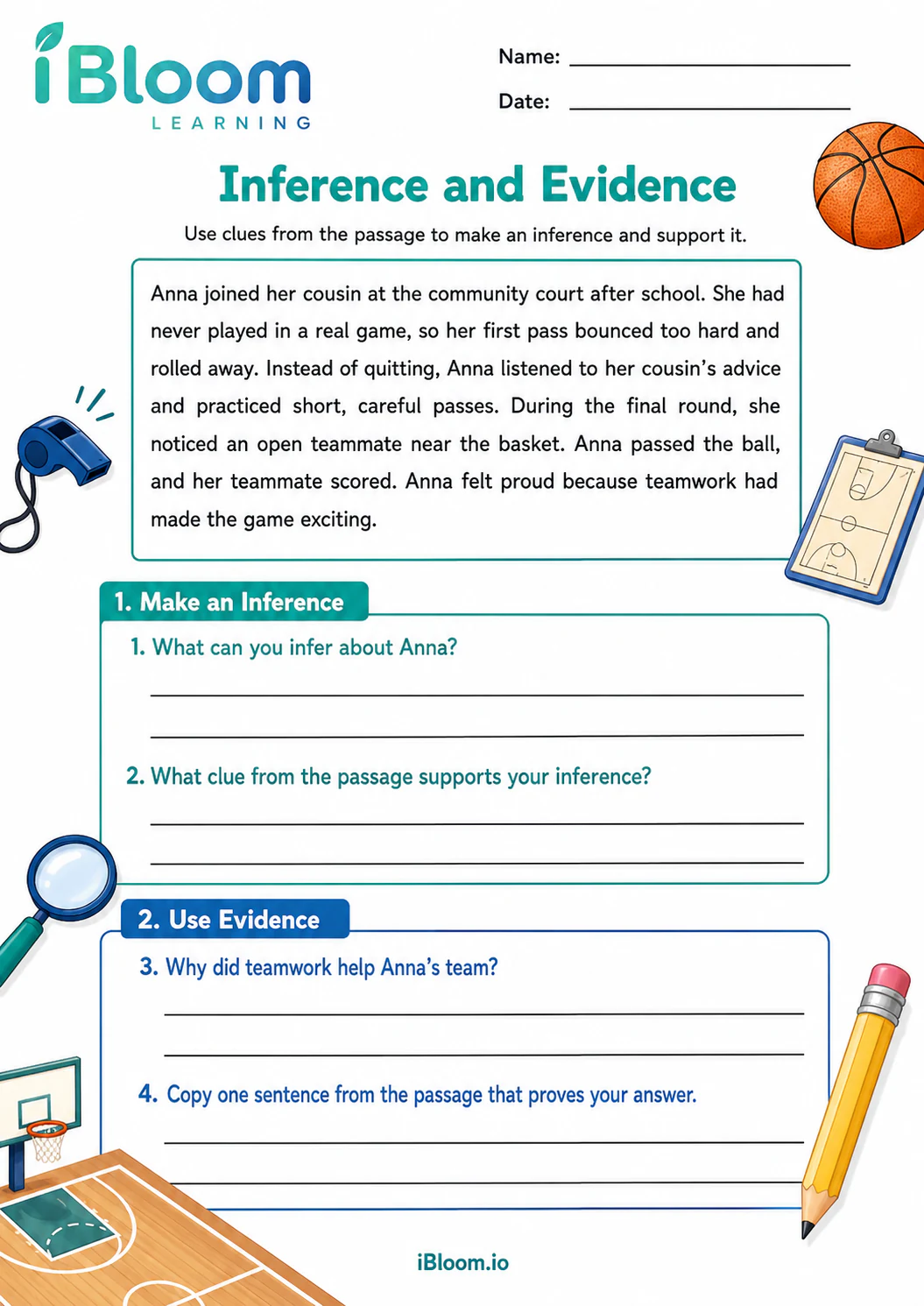
About this worksheet
This free Grade 3 reading worksheet centers on “The Muddy Cart,” an original story about Sam and Jo working together to move a garden cart. Students answer direct questions, infer why the characters act and feel as they do, and support their thinking with details from the passage. Fourteen questions follow the old sheet’s method of making an inference and pointing to textual evidence. A separate key includes sample responses. The practice aligns with CCSS RL.3.1.
Aligned to RL.3.1
What happens in “The Muddy Cart”?
After rain, Sam and Jo find a garden cart stuck on a muddy path while seed trays wait by the shed. Sam pushes and Jo places a flat stone under a wheel. Students answer direct questions before using these details to make and support inferences.
How can a reader infer why the cart moves?
The passage says the wheel was stuck in soft mud, Jo slid a flat stone under it, and the wheel lifted onto the stone. Those details support the inference that the stone gave the wheel a firmer surface.
- 1Clue: Jo placed a flat stone beneath the wheel.
- 2Inference: The stone helped the wheel roll out of the mud.
What counts as evidence in a written answer?
The final six questions ask students to use story details to explain the problem, the solution and what the partners’ actions suggest. One-line responses can name the clue and connect it to the answer.
How to use this worksheet
- 1Read the passage once to follow what happens.
- 2Return to the story and find a detail named in the question.
- 3For an inference, connect that detail to a reasonable idea.
- 4Use a specific story detail in each written response.
- 5Check written answers against the sample key; wording may vary.
Common mistakes and quick fixes
The mistake
Giving an inference without a story clue.
The fix
Name the detail that led you to the idea.
The mistake
Retelling a detail instead of explaining what it suggests.
The fix
Add what the clue helps you understand about the character or event.
The mistake
Using a detail that does not answer the question.
The fix
Reread the question and choose the line that directly supports your response.
Common Core alignment
This activity practices a skill named in the Common Core standards.
Answer questions and make inferences using details from the story.
On this sheet: Students answer story questions and support inferences with stated details.
Show the official wordingHide the official wording
Ask and answer questions to demonstrate understanding of a text, referring explicitly to the text as the basis for the answers.
What to practice next
Make more practice
Further reading
Questions parents and teachers ask
What story do students read?
They read “The Muddy Cart,” an original story about Sam and Jo trying to move a garden cart stuck in mud. Fourteen questions use details about their actions so students can answer and draw supported inferences. Students can reread the passage to check a detail.
How many questions are on this worksheet?
There are 14 questions: eight multiple-choice items and six short answers. Students begin with story details, make inferences, and then use evidence from the passage in their written responses. The last six prompts ask for brief, clue-based responses.
What does “use evidence” mean on this page?
Students point to a concrete detail in the story that supports their answer. For example, Jo places a flat stone under the cart’s wheel, a clue that helps explain how the pair got the cart moving. Students should connect the stone detail to its effect on the wheel.
Can written answers use different wording?
Yes. The key gives sample responses, not the only acceptable sentences. A response should answer the question and include a relevant story detail or a reasonable inference grounded in one of the passage clues. The passage offers several clues students can cite.
How long does this reading activity take?
Plan for about 20 minutes to read the passage, answer the questions and check the key. Students can reread the relevant paragraph when they need to confirm a detail or support an inference. A second read can help students find the exact sentence that supports an inference.
Which standard is practiced?
The page aligns with CCSS RL.3.1. Students ask and answer questions about the passage and refer to details in the text as the basis for their responses. The story details and questions both focus on the cart problem and its solution.