
About this worksheet
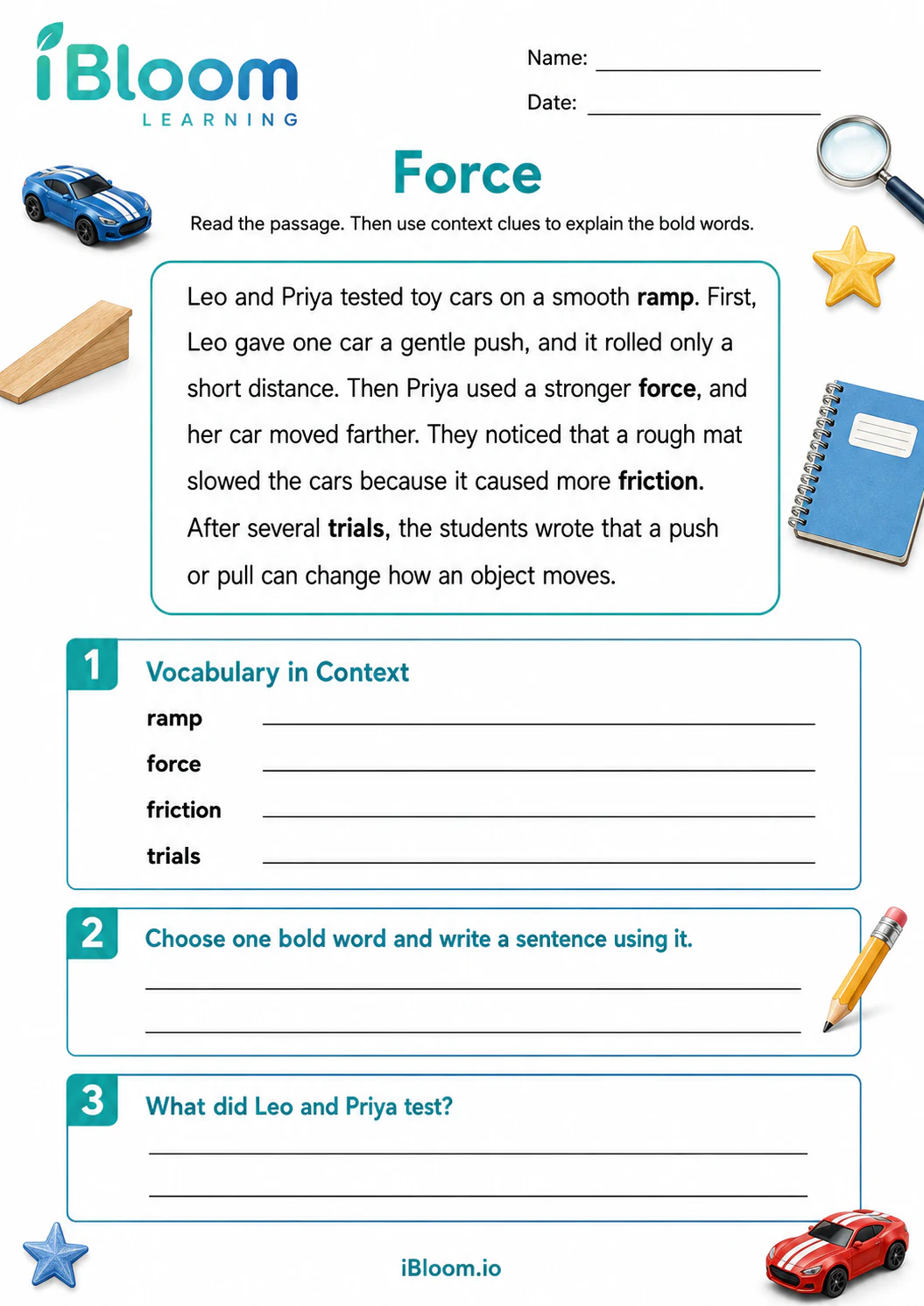
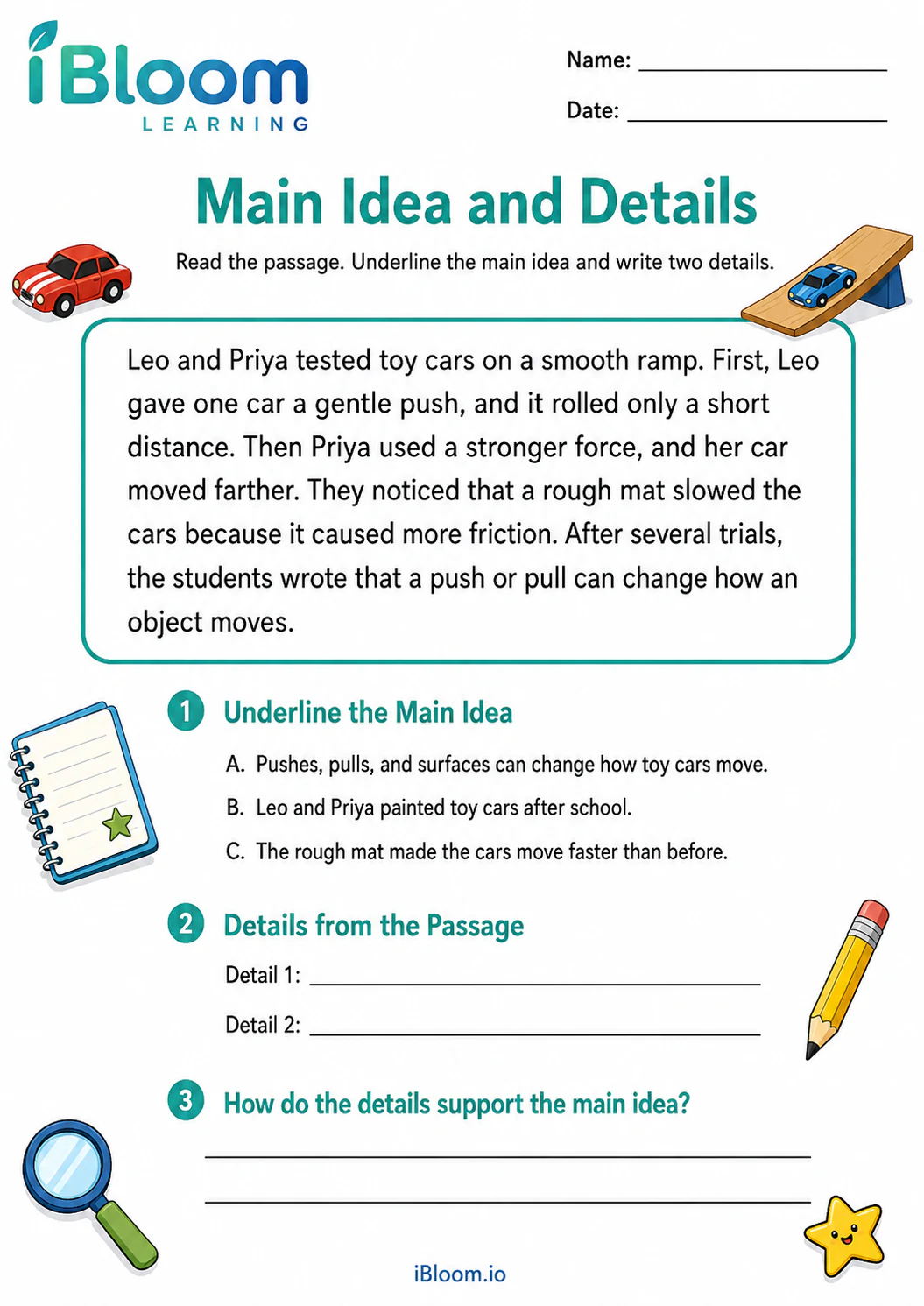
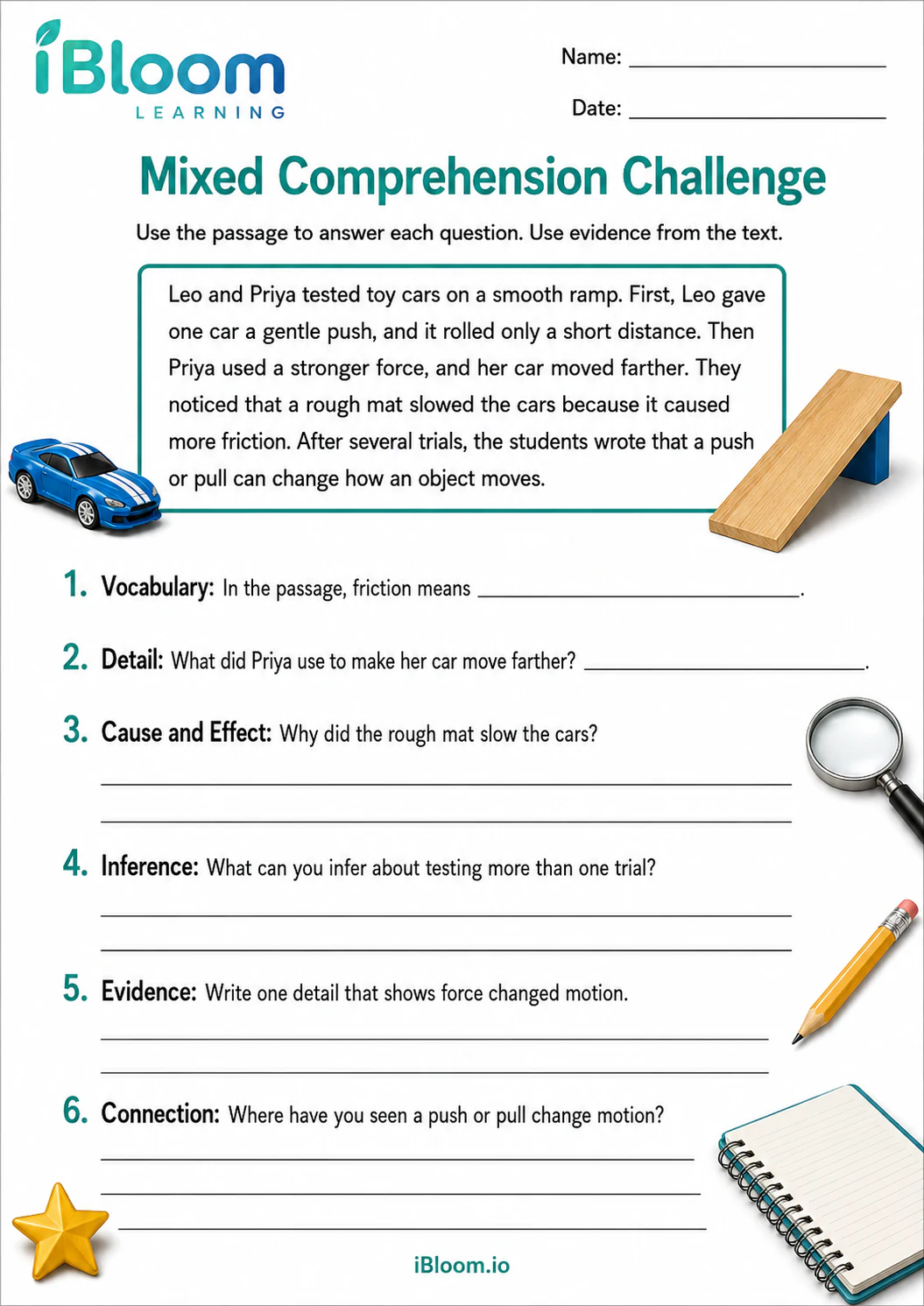
This free Grade 3 reading worksheet uses a passage about Leo and Priya testing pushes and pulls with toy cars on a ramp. Part A presents the experiment in four paragraphs. Part B has four sequence sentences to complete from a word bank. Part C has four multiple-choice questions about connections and paragraph organization. Part D asks for two written explanations using passage evidence. The work practices CCSS RI.3.3 by connecting scientific ideas and procedure steps through time, sequence and cause-and-effect language. A separate answer key supplies the choices, missing words and sample written responses.
Aligned to RI.3.3
Which words help readers follow the experiment?
First, Next, Then and Finally guide readers through the tests and the comparison. Have students connect each word to an action, rather than simply underline the time word. Next introduces returning the car to the starting line before the stronger push.
The sequence matters: Priya and Leo must complete the tests before they can compare the observations. The opening paragraph introduces the meaning of force and the equipment they will use.
How do the four paragraphs work together?
The first paragraph defines force and introduces the test. The second describes the two pushes. The third adds a pull and compares its direction with the push. The fourth gathers the observations into a conclusion.
Question 9 asks why the final paragraph comes after the tests. A useful answer connects the location of the paragraph to its job: readers need the observations before they can understand the comparison.
- 1Question: Why does the comparison come after the tests?
- 2Evidence: Finally, they compared their observations.
- 3They need results from the tests before they can compare them.
How much science knowledge does a child need?
All the information needed to answer is in the passage. Encourage students to point to the relevant sentence even when they already know what a push or pull does. This keeps the focus on reading the experiment accurately.
For question 10, students connect a stronger push with the farther stopping place. The phrase in their test keeps the conclusion tied to what these children actually observed.
Read the actions and their results
- 1Read the title and the first paragraph to identify the topic.
- 2Read all four paragraphs once without stopping for the questions.
- 3Underline the four time words and name the action each introduces.
- 4Complete Part B from the word bank, then find passage evidence for each choice in Part C.
- 5Answer Part D in complete sentences using the experiment’s results.
- 6Compare written answers with the key for meaning and evidence, not identical wording.
Mistakes to notice and how to help
The mistake
Saying the pull happened before the stronger push.
The fix
Find Then at the start of paragraph 3 and reread the push tests in paragraph 2.
The mistake
Choosing a paragraph’s topic when asked for its job.
The fix
Ask whether the paragraph introduces, describes a test or compares results.
The mistake
Explaining a result from general knowledge instead of the passage.
The fix
Point to the marked stopping places and the sentence saying the car traveled farther.
Curriculum alignment
Connect the order of the car tests with the actions, results and final comparison.
On this sheet: Students track test steps and explain relationships between a stronger push, its result and the comparison.
Show the official wordingHide the official wording
Describe the relationship between a series of historical events, scientific ideas or concepts, or steps in technical procedures in a text, using language that pertains to time, sequence, and cause/effect.
What to practice next
Make more practice
Further reading
Questions parents and teachers ask
Is Force a story or an informational passage?
It is an informational passage that explains force through a small car experiment. Priya and Leo carry out the tests, but the reading questions focus on scientific ideas, ordered steps and results. The four paragraphs move from introducing the idea to describing tests and then comparing observations.
What does sequence mean on this worksheet?
Sequence means the order in which the actions happen. Priya first tries a gentle push, then a stronger push, and Leo later tries a pull. Students use time words and nearby details to follow that order before explaining why the comparison belongs after the tests.
How is structure different from sequence here?
Sequence tracks the order of individual actions, while structure describes how the passage is organized. For example, paragraph 2 describes push tests, and paragraph 4 compares observations from the tests. The sheet asks about both so students connect what happened with why each paragraph is included.
Must written answers match the answer key exactly?
No, the two written responses can use different words if they express the same supported ideas. Question 9 should explain that the tests supply observations to compare. Question 10 should say that the stronger push sent the car farther and that the chalk marks showed the difference.
Can students refer back to the passage?
Yes, students should return to the passage while answering. Ask them to find a time word, action or result that supports a choice. For the written responses, reread the relevant paragraphs together and let the child explain the connection aloud before putting it into a sentence.