

About this worksheet
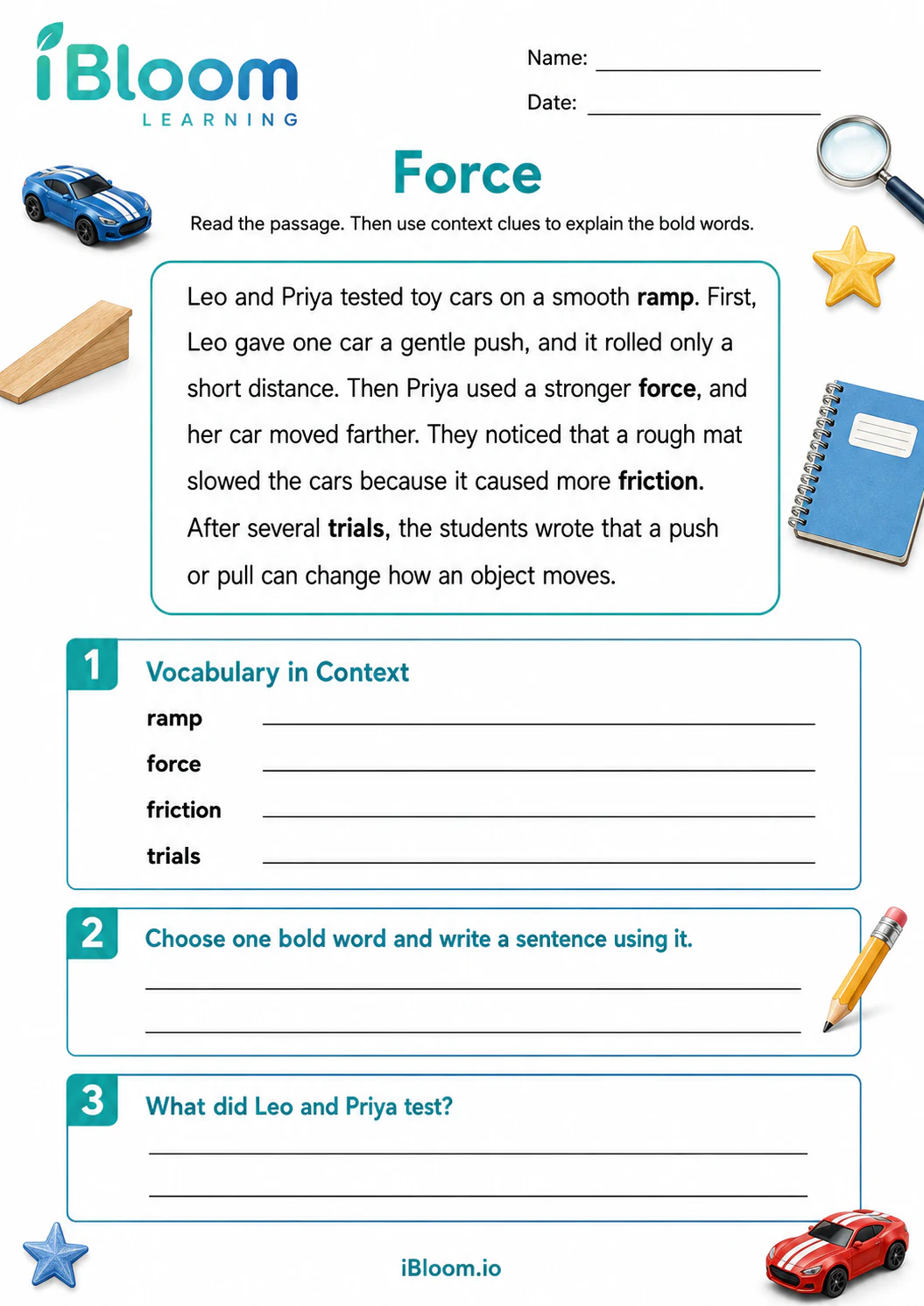
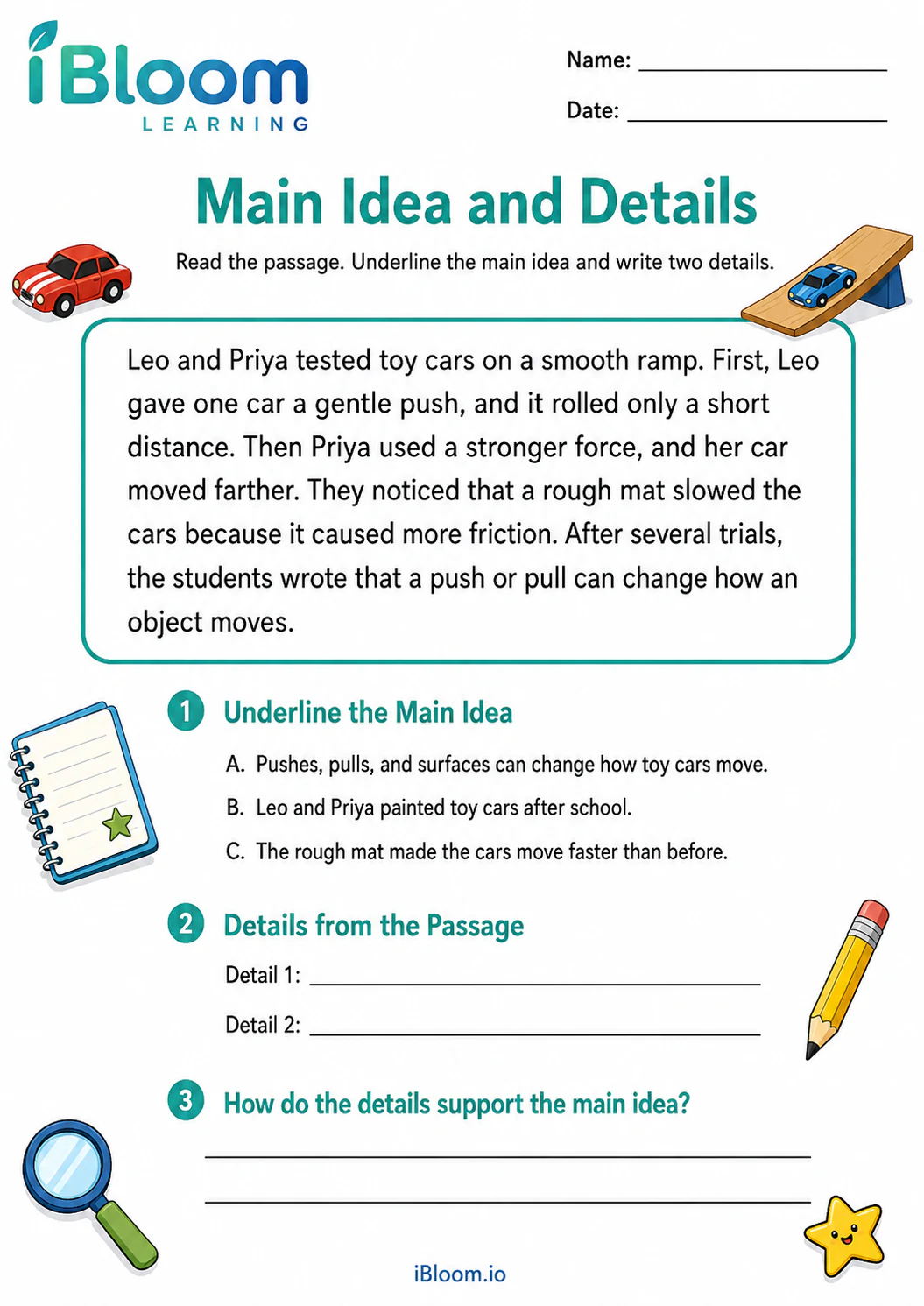
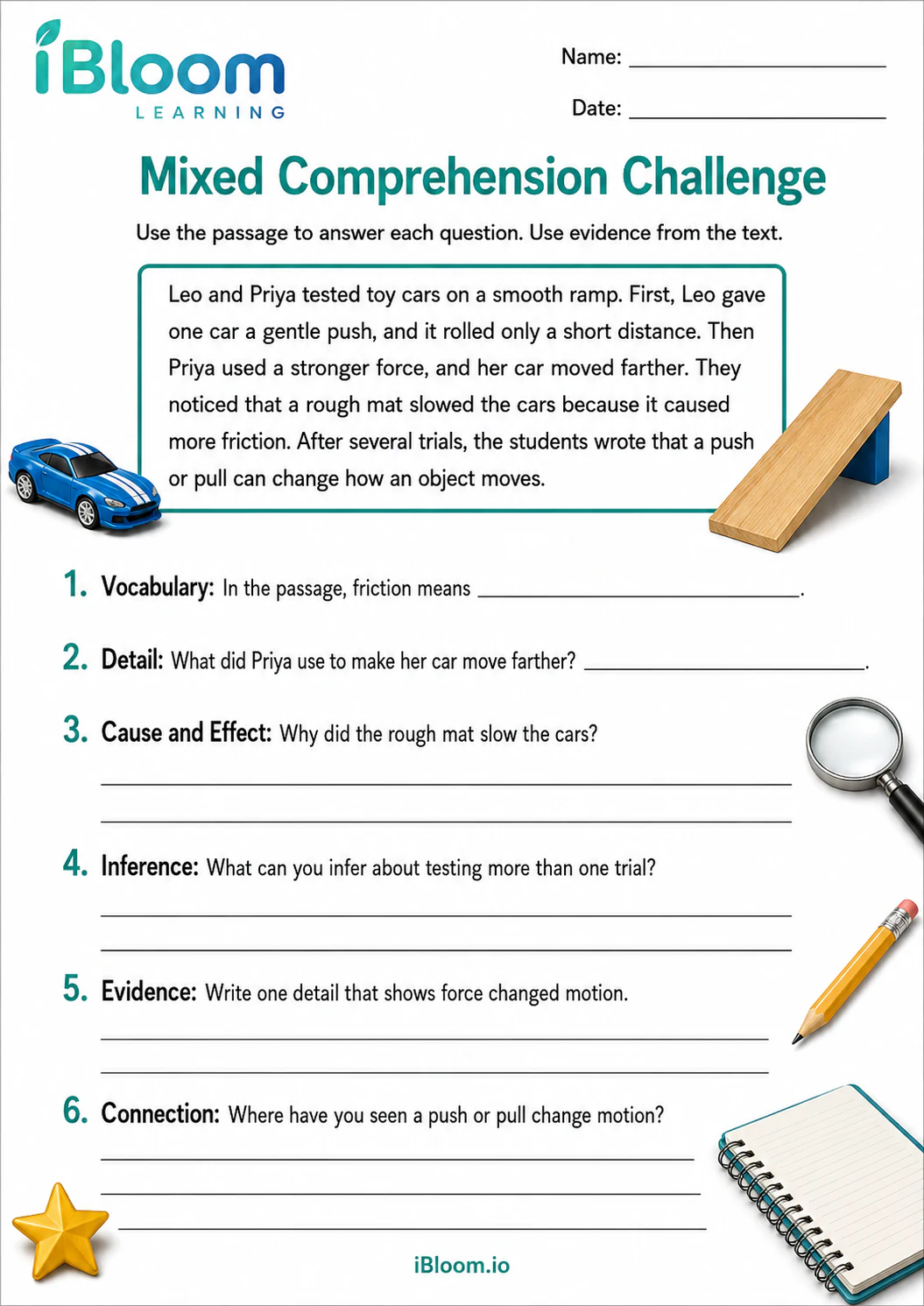
This Grade 3 reading printable follows Leo and Priya as they compare toy cars on a ramp. The story shows how a stronger push and a rough mat change the cars’ motion, matching the worksheet’s force skill. Questions ask children to track events, use context clues, explain a character’s thinking, and support a response with story details. It practices CCSS RL.3.1 and RL.3.3.
Aligned to RL.3.1 and RL.3.3
What changes the cars’ motion?
The story compares a gentle push and a stronger push on a smooth ramp. It then adds a rough mat, which slows a car as it crosses. Track one change at a time to follow the children’s observations.
How can details support an answer?
Use what the story says directly. For example, Priya pushes one car harder and it rolls farther; later, a car slows on the rough mat. Those two details support the final response.
How to read and respond
- 1Read once to find the test and its result.
- 2Reread when a question asks about a word or detail.
- 3Track which surface or push changes in each test.
- 4Use a specific story detail for evidence questions.
- 5Check the separate answer key after finishing.
Common reading mix-ups
The mistake
Mixing up the gentle and stronger pushes.
The fix
Reread the sentence that tells how far each car rolled.
The mistake
Saying the mat made the car faster.
The fix
Check the result: the car slowed while crossing the rough mat.
The mistake
Giving an opinion instead of a story detail.
The fix
Name what happened on the smooth ramp or rough mat.
Common Core alignment
The questions use story details and examine how characters test an idea.
Answer questions using explicit details from the story.
On this sheet: Children answer detail questions and use two story events in the written response.
Show the official wordingHide the official wording
Ask and answer questions to demonstrate understanding of a text, referring explicitly to the text as the basis for the answers.
Explain how characters’ actions shape events in a story.
On this sheet: Questions ask how Leo and Priya test the cars and record what they learn.
Show the official wordingHide the official wording
Describe characters in a story (e.g., their traits, motivations, or feelings) and explain how their actions contribute to the sequence of events.
What to practice next
Make more practice
Further reading
Questions parents and teachers ask
What is the story about?
Leo and Priya test toy cars on a smooth ramp, then put a rough mat across it. They compare how a gentle push, a stronger push, and the mat affect the cars’ movement. The story gives a clear sequence: compare pushes, add the mat, and observe the difference in movement.
What happens when the push is stronger?
The story says the car Priya pushed harder rolled farther on the smooth ramp. Children can use that detail to answer questions about how the strength of a push changes motion. That result helps students connect the strength of the push with the distance the car traveled.
How does the rough mat affect a car?
A car slows as it crosses the rough mat. Priya explains that the rough surface makes it harder for the wheels to roll. The worksheet asks students to use this event as evidence. Children can cite the sentence about the car slowing as it crosses the rough mat.
What should children include in the final response?
The final response asks for two details explaining how pushes and the rough mat changed the cars’ motion. A complete answer can state that a stronger push made a car roll farther and that the rough mat slowed another car.
How does the worksheet practice reading comprehension?
The 14 selected-response questions ask about events, vocabulary, and details in the story. The last question asks for a short evidence-based explanation, and the key provides a sample answer. The final prompt also asks students to explain their answer with two details from the passage.