


About this worksheet
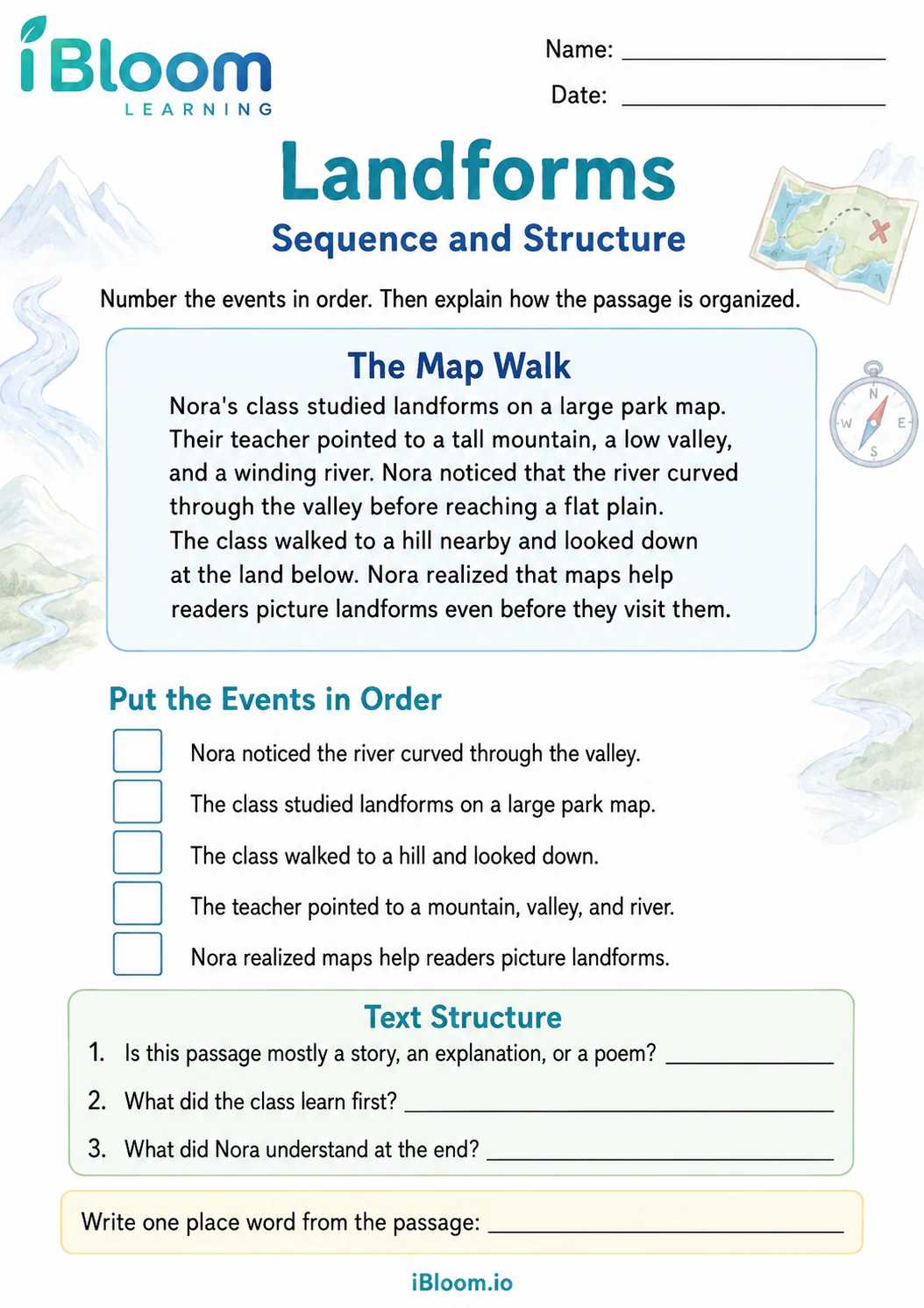
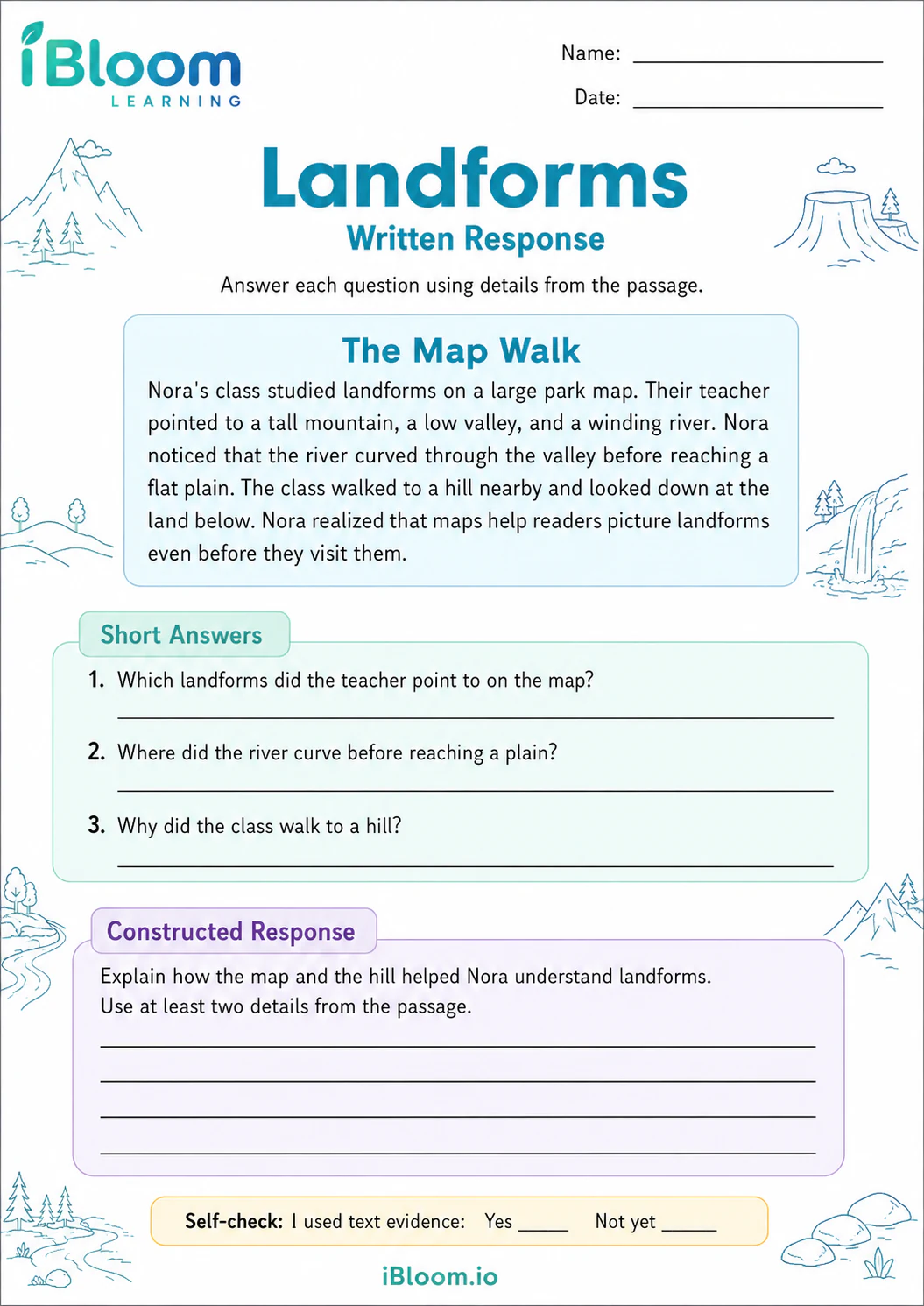
This free printable Grade 3 reading worksheet follows Nora’s class from a park map to a nearby hill. The original story, The Map Walk, describes a mountain, valley, river and plain as Nora connects map symbols with real land. Seven questions ask readers to make supported inferences, select evidence and explain three conclusions in their own words. The passage is Part A, followed by four choice questions in Part B and three written responses in Part C. The practice supports Common Core RL.3.1: answering questions with explicit reference to the text. The separate answer key includes sample written responses.
Aligned to RL.3.1
What is an inference in this story?
An inference is a conclusion that combines story clues with sensible reasoning. The story says Nora looks from the map to the land and back again. A reader can infer that she is checking how the two match. The conclusion explains her action rather than merely repeating it.
Keep the inference close to the words on the page. The map could show a route, but the teacher points out landforms. Those named features support the conclusion that the map introduces the land the class will see.
How can children choose the strongest evidence?
A useful clue directly supports the conclusion being discussed. Walking up a hill is part of the trip, but Nora’s call when she recognizes the bend is stronger evidence that she feels excited.
- 1Inference: Nora feels excited when she sees the bend.
- 2Story clue: “There’s the bend!” she called.
- 3Question 3: Excited
- 4Question 4: Calling out the bend
What happens across the three parts?
Part A is The Map Walk, a short narrative about connecting a map with a real view. Part B pairs two inferences with two evidence choices. Part C asks for three written responses about the hilltop view, Nora’s changing confidence and her next walk. Each response needs an inference and a story detail.
The landform words give the story its setting. Discuss valley as low land between higher areas and plain as a broad, flat area if those words interrupt the reading. Then return to what Nora notices and does.
How to use this worksheet
- 1Read The Map Walk once for the events.
- 2Reread the paragraph about the hill and notice what changes in Nora’s view.
- 3Answer Part B by testing each choice against the story.
- 4For questions 2 and 4, choose the clue that supports the preceding inference.
- 5Use “I think … because …” to plan each Part C response.
- 6Check the key and accept accurate evidence expressed in the child’s own words.
Mistakes to notice and fix
The mistake
Choosing a true detail that does not support the conclusion.
The fix
For Nora’s excitement, use her call when she spots the bend rather than the fact that she walks uphill.
The mistake
Treating an inference as any possible guess.
The fix
Ask for the sentence or action that makes the guess reasonable.
The mistake
Giving only a feeling, such as “Nora was happy.”
The fix
Add a relevant clue, such as her excited call when she recognizes the bend.
Common Core alignment
Support inferences about Nora’s map walk with details from the story.
On this sheet: Students choose evidence for conclusions and explain three inferences with story details.
Show the official wordingHide the official wording
Ask and answer questions to demonstrate understanding of a text, referring explicitly to the text as the basis for the answers.
What to practice next
Make more practice
Further reading
Questions parents and teachers ask
Does this worksheet include the passage children need?
Yes, The Map Walk is printed as Part A. It follows Nora’s class from a park map to a hill with a clearer view of the land. The questions use that passage, so students can return to its paragraphs while choosing inferences and finding evidence for their answers.
Is this a reading worksheet or a landform labeling activity?
This is a reading worksheet about a class learning from a map and a real landscape. Students follow Nora’s observations, infer her reasons and feelings, and support answers with details. Mountain, valley, river and plain provide the setting for the comprehension work and can be discussed before reading.
Must children copy exact sentences as evidence?
No, children may put an accurate story detail into their own words. For example, saying that Nora opens the map again when she hears about a lake supports her growing trust in maps. Ask students to point to the original sentence so you can check that the paraphrase stays faithful.
How do I check the three written responses?
Check for both a reasonable inference and a relevant detail from the story. A response about increased confidence could mention that Nora first saw the lines as a puzzle but later pointed out the valley. The key gives sample answers; accept other wording when both parts are supported.
How can I help without giving away an inference?
Ask the child to reread the paragraph where the action occurs and describe what changed. For the hilltop question, compare what the trees blocked on the way with what Nora could see at the top. Then let the child choose the conclusion and explain the clue independently.