



About this worksheet
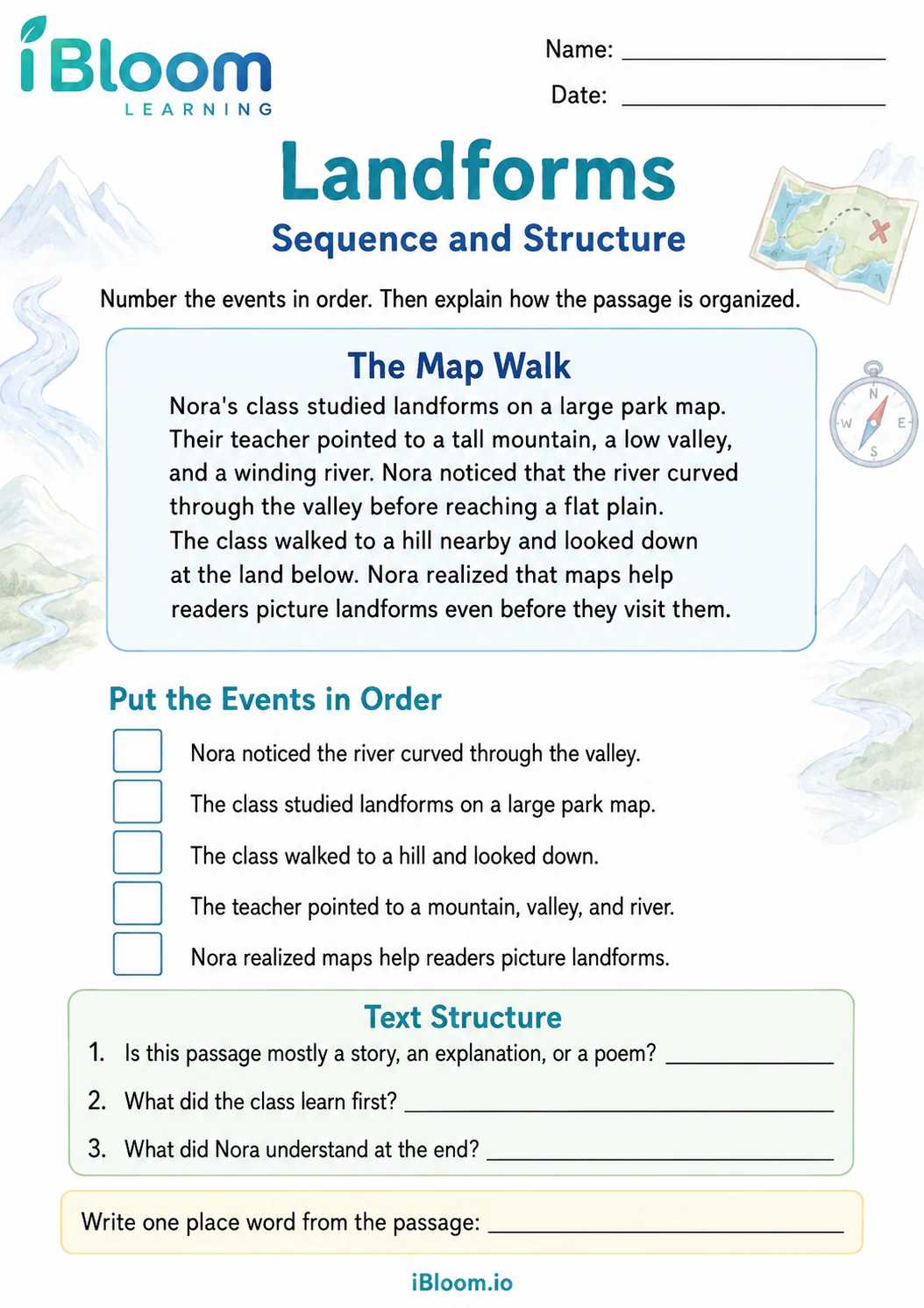
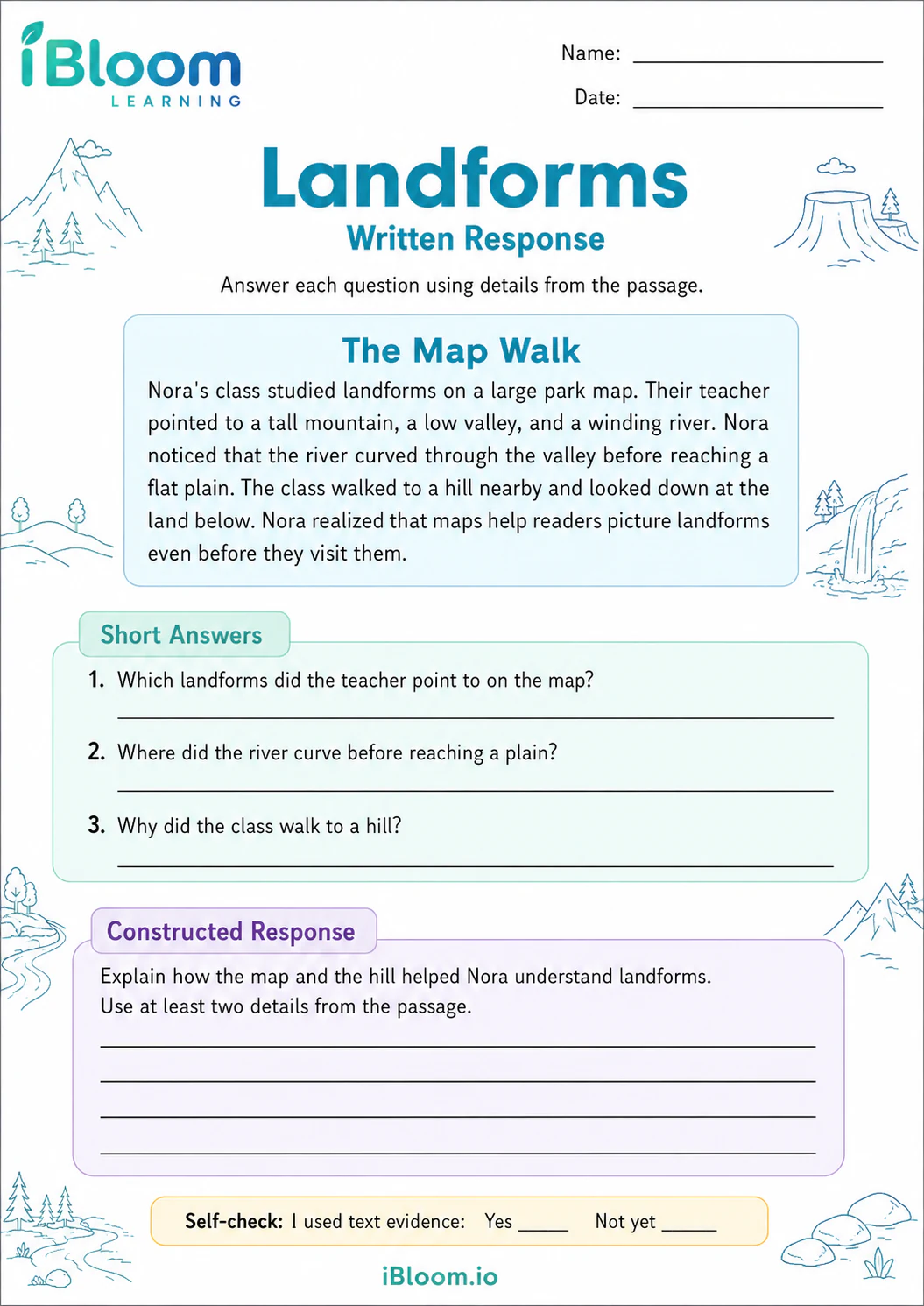
This free Grade 3 printable introduces landforms through an original informational passage about mountains, plains, plateaus, rivers, valleys, and peninsulas. Children preview the title, scan for topic words, and use sentence clues to work out what key terms mean. For example, readers use “broad, level top” to understand plateau. The page practices CCSS RI.3.4 for determining vocabulary meaning in a grade-level topic text.
Aligned to RI.3.4
How can a reader preview an informational passage?
Start with the title, then scan the text for repeated or bold topic words. Those clues suggest what the passage will explain before a careful rereading.
- 1The passage says a plateau has a broad, level top.
- 2It also says it stands above nearby land.
- 3Those nearby clues show that a plateau is raised and flat on top.
How do context clues explain landform words?
Read the full sentence and nearby sentences. “A low area between higher slopes” defines valley, while the three-sided water clue explains peninsula.
What vocabulary appears on the sheet?
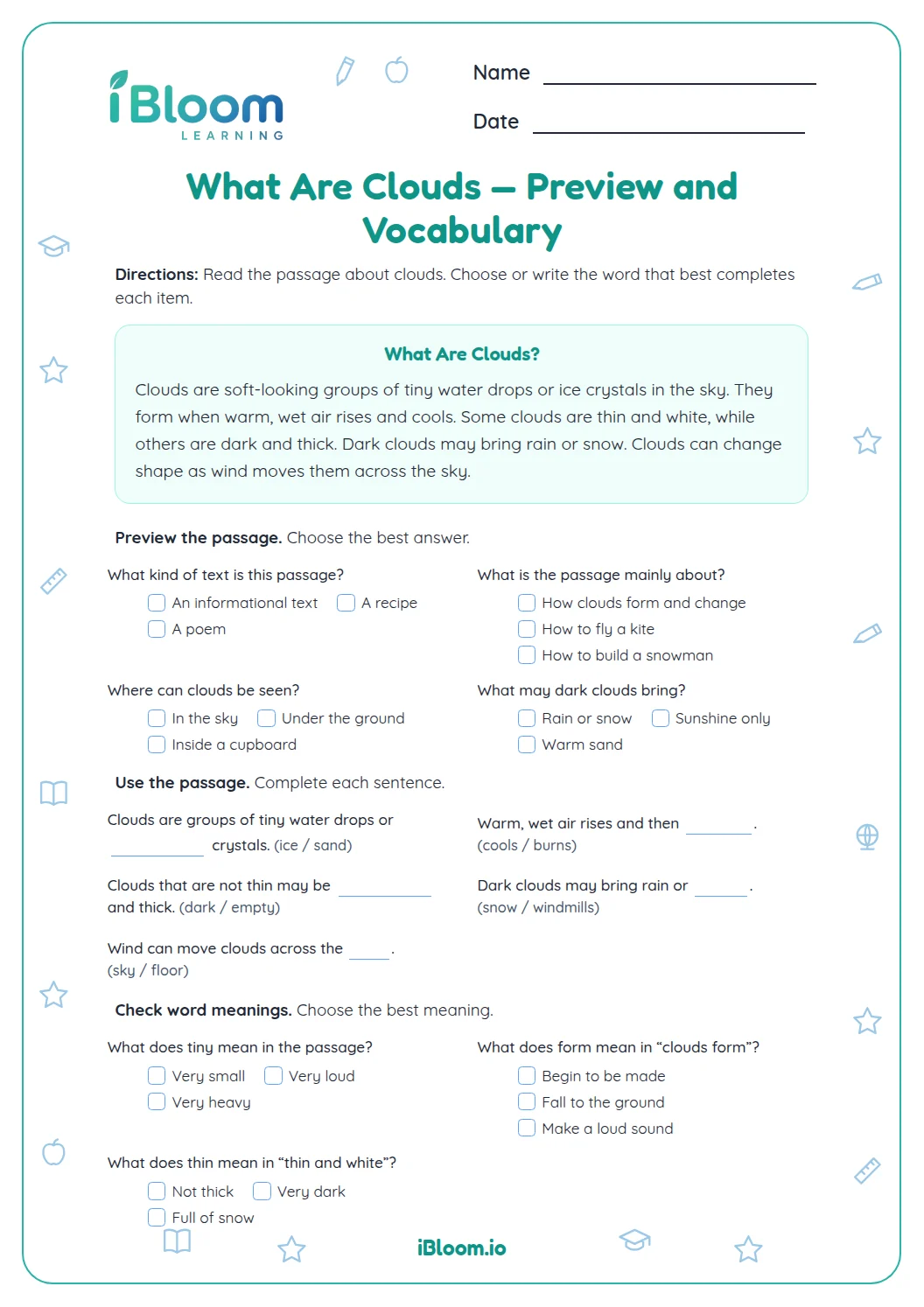
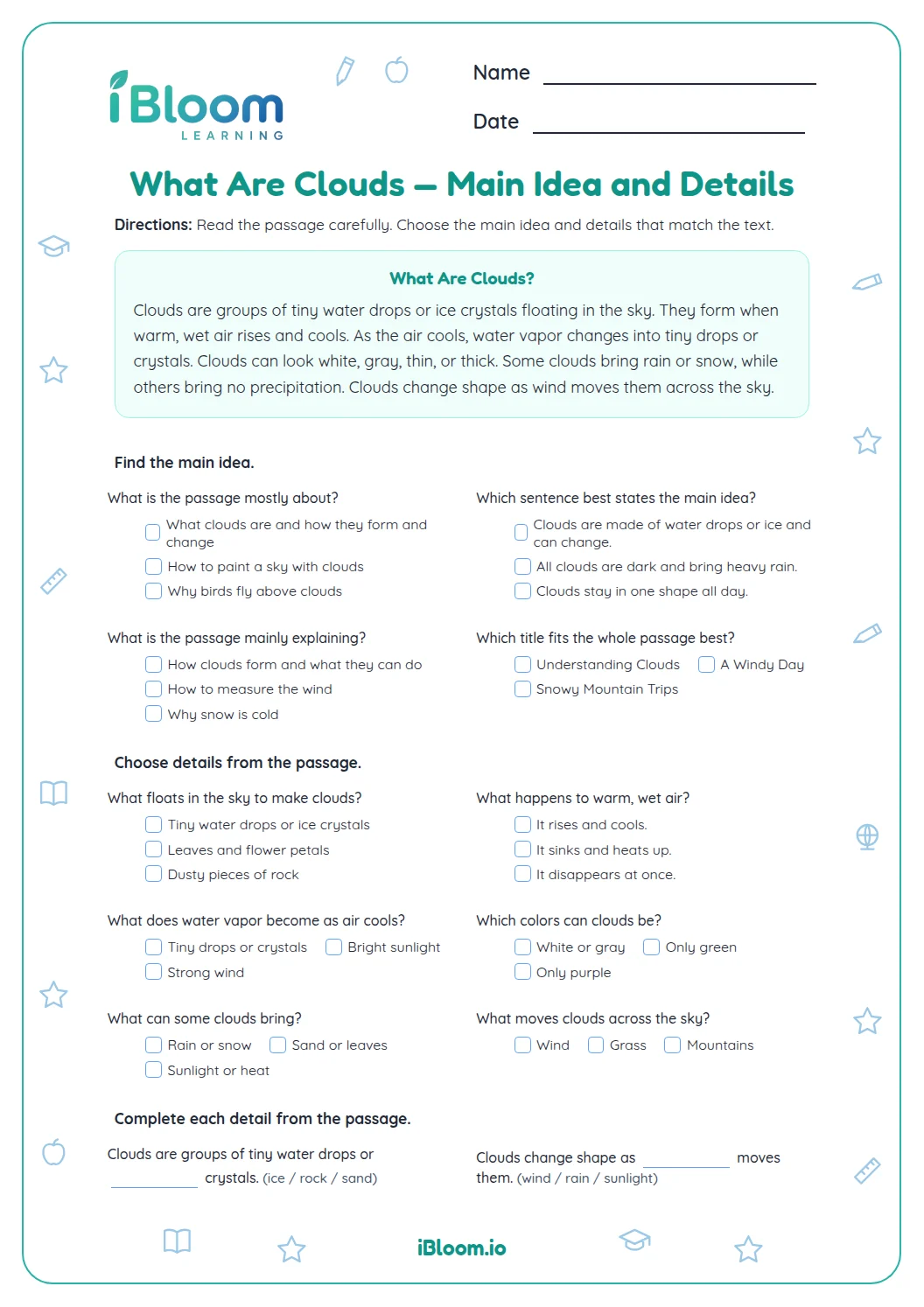
Fourteen questions move from previewing the topic to identifying meanings and explaining clues. Terms include landform, plain, plateau, valley, peninsula, and scanned.
- Part A: read “The Map Walk”
- Part B: preview the topic and scan the first paragraph
- Part C: use context clues for landform vocabulary
- Part D: connect details to word meanings
How to use this worksheet at home or in class
- 1Read the title and predict the topic before reading the passage.
- 2During the first read, underline each landform name.
- 3For a vocabulary item, reread the sentence and look for a definition or description nearby.
- 4Ask the child to point to the exact clue before answering questions 13–14.
- 5Use the key to check each selected answer against the passage clue.
Common mistakes and quick fixes
The mistake
Calling a plateau a mountain because both are raised.
The fix
Use the specific clue: a plateau is raised land with a broad, level top.
The mistake
Guessing a word meaning from only its first sound.
The fix
Reread the sentence and nearby details, such as “low area between higher slopes” for valley.
The mistake
Thinking a peninsula is surrounded by water on every side.
The fix
The passage says a peninsula has water on three sides; an island is surrounded on all sides.
Common Core alignment
This page practices the listed Common Core skill with examples drawn from the worksheet.
Determine meanings of general academic and topic-specific words in grade-level text.
On this sheet: Questions 4–11 use definitions and context clues for landform vocabulary.
Show the official wordingHide the official wording
Determine the meaning of general academic and domain-specific words and phrases in a text relevant to a grade 3 topic or subject area.
What to practice next
Make more practice
Further reading
Questions parents and teachers ask
What landforms appear in “The Map Walk”?
Nora’s class studies a mountain, valley, river, plain, plateau, peninsula, and hill on a map and then sees nearby land from a hill. The questions use the passage’s descriptions to help children connect each word with its meaning. That connects each definition to Nora’s walk.
How does the passage explain the word plateau?
It describes a plateau as raised land with a broad, level top. Those details tell readers that a plateau is both higher than nearby land and flat across its top, which helps distinguish it from a mountain or valley. Those clues come directly from the passage.
What does previewing a passage mean?
Previewing means using clues such as the title and repeated topic words to get an early idea of what the text will cover. This worksheet asks children to preview “The Map Walk,” then read and use context clues. It is a quick way to build a useful prediction.
Is there an answer key for the vocabulary questions?
Yes. The separate answer key marks the correct choices for all 14 questions. Children can check their vocabulary selections and return to Nora’s map walk to find the clue that supports each answer. Children can show the matching sentence on the page.
What is the difference between a plain and a plateau?
A plain is a broad area of mostly flat land. A plateau is also broad and flat on top, but it is raised above nearby land. The passage gives those clues so children can distinguish the two landform words.