




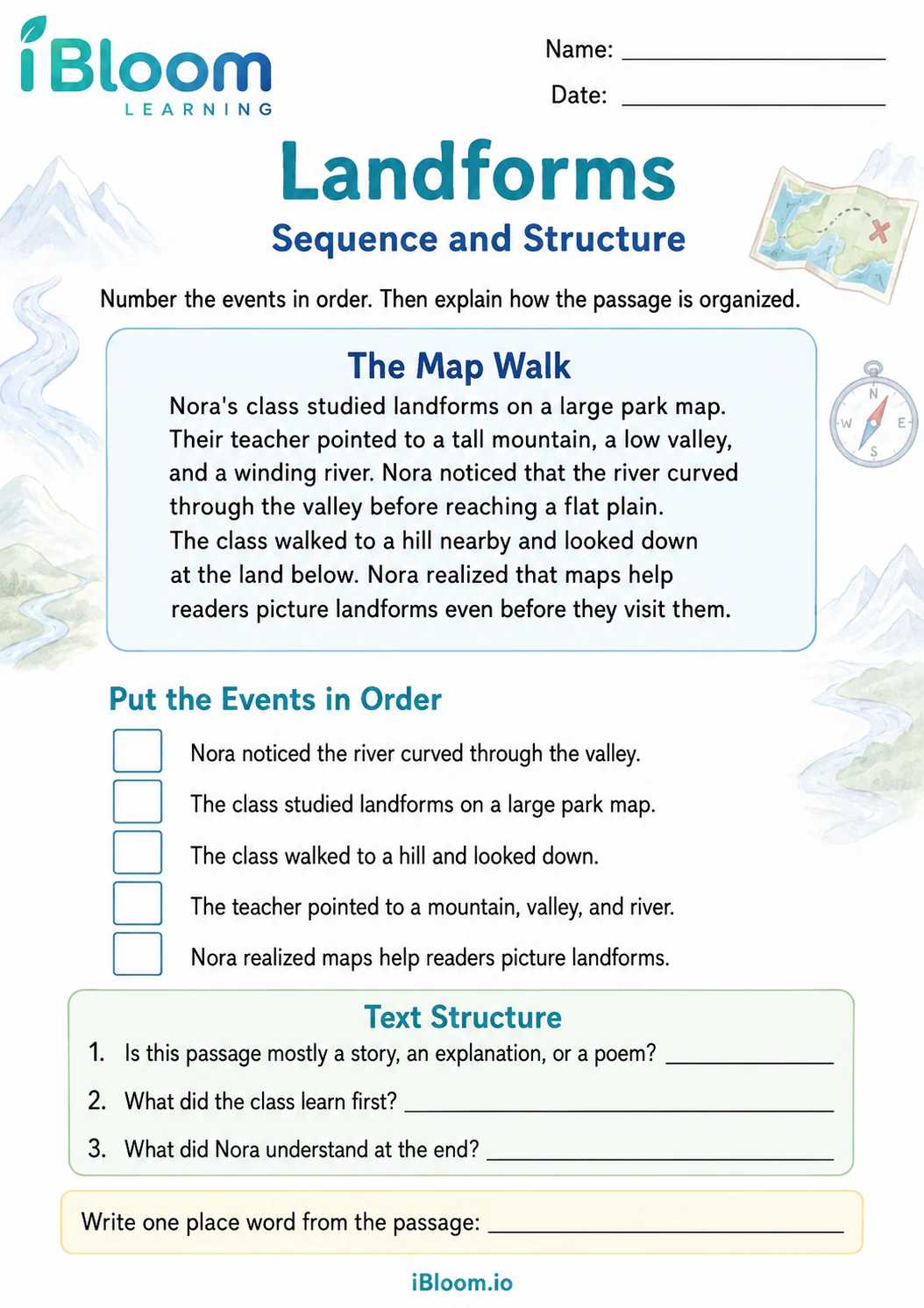
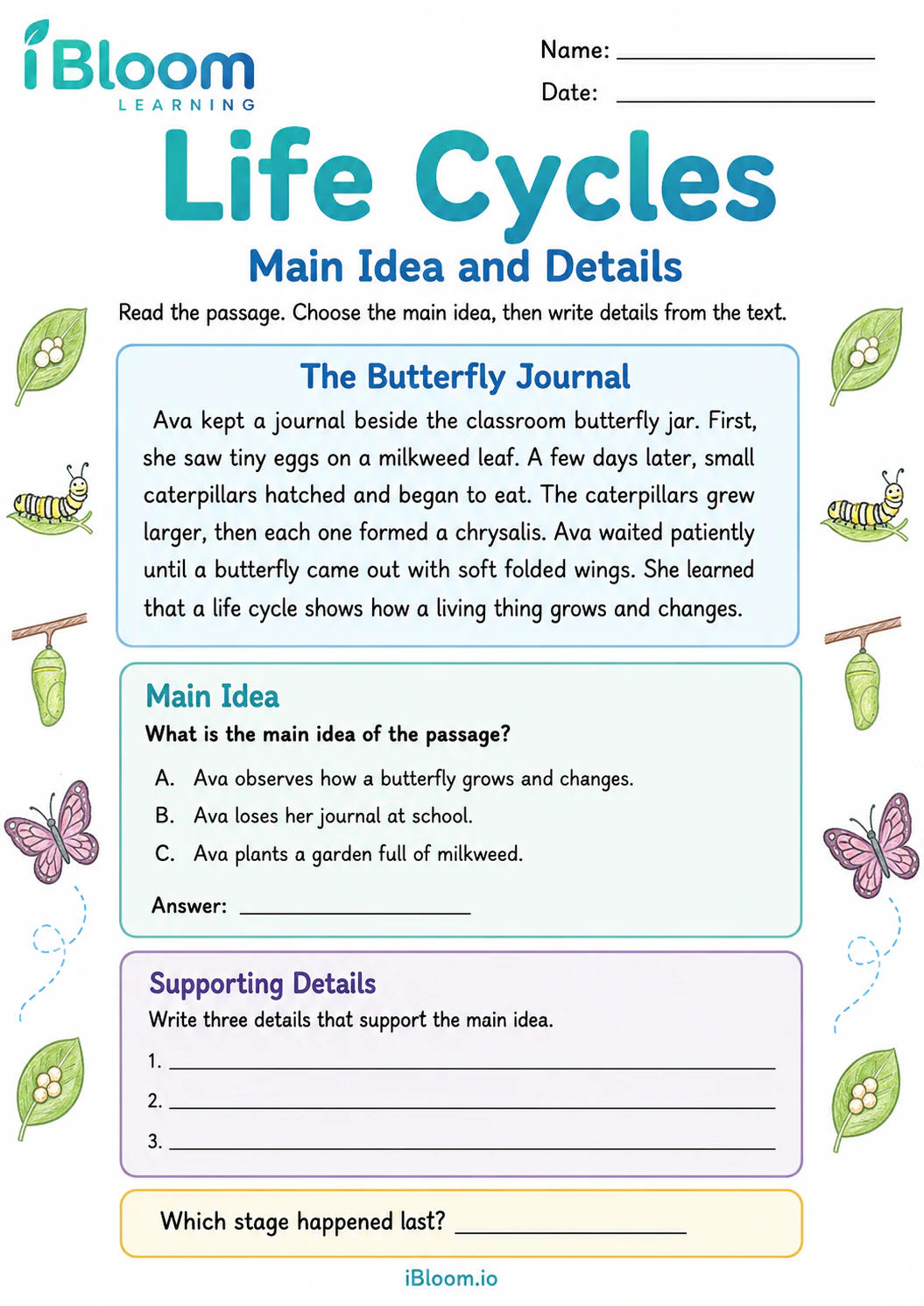
About this worksheet
This Grade 3 reading worksheet pairs an original story about Nora and Eli with 14 multiple-choice questions. Readers infer how characters interpret changing weather, then select details that support those conclusions. The passage also explains cloud formation, giving students a chance to connect an idea to evidence in an informational paragraph. It practices Common Core standard RL.3.1.
Aligned to RL.3.1
What does the worksheet practice?
The story follows Nora and Eli as the weather changes outside their school. Fourteen multiple-choice questions ask readers to infer from events, identify supporting details, and connect the passage’s cloud explanation to an idea.
The worksheet has a three-page passage-and-question layout and a matching three-page answer key. Students can return to the passage as they look for evidence.
- Part B: infer from character actions and observations
- Part C: connect ideas to details in the passage
- Part D: interpret conclusions and science details
How is an inference different from a fact?
A fact is stated directly in the passage. An inference is a reasonable conclusion made by combining details with what a reader already knows. The text says a cool drop lands on Nora’s hand; readers infer that rain may be near when they combine that clue with the darkening sky and moving leaves.
Good readers can point to the words that support an inference. If no detail supports it, the idea is only a guess.
How to use this worksheet
- 1Read the passage once to follow Nora and Eli’s observations.
- 2Reread the relevant paragraph before choosing an answer.
- 3Ask the student to point to the sentence or event that supports the choice.
- 4Use the answer key to review how each clue supports the inference.
Common mistakes and quick fixes
The mistake
Choosing a detail that is true but does not support the inference.
The fix
Ask which passage detail connects most directly to the idea in the question.
The mistake
Treating Nora’s prediction as a guaranteed fact.
The fix
Notice words such as “likely” and remember that an inference can be reasonable without being certain.
The mistake
Using a science detail that does not answer the story question.
The fix
Match each piece of evidence to the exact idea in the question.
Curriculum alignment
The questions ask readers to answer from the passage and identify supporting details.
Ask and answer questions, referring explicitly to the text as the basis for answers.
On this sheet: Questions ask students to infer from the story and identify details that support each answer.
Show the official wordingHide the official wording
Ask and answer questions to demonstrate understanding of a text, referring explicitly to the text as the basis for the answers.
What to practice next
Make more practice
Further reading
Questions parents and teachers ask
What does inference mean?
An inference is a reasonable idea a reader reaches by combining clues in the text with what the reader already knows. Here, the darkening sky, wind, and a cool drop help Nora expect rain. Students should be able to point to one or more details that support an inference.
Is every prediction a fact?
No. A prediction is a conclusion about what may happen, based on clues. Nora has good reasons to expect rain, but she cannot know exactly when it will begin. A fact is stated or directly observed; an inference is a supported idea that may still be uncertain.
What grade is this worksheet for?
This printable is designed for Grade 3 readers. It includes an original passage about changing weather and 14 multiple-choice questions about inference, evidence, and the passage’s cloud explanation. The answer key marks the intended choice for each question.
How can I help a child find evidence?
Ask the child to reread the sentence that seems connected to the idea, then explain the link in their own words. For example, a cool drop and windblown leaves support Nora’s prediction of rain. A detail may be true but still fail to support a particular inference.
How many pages are in the printable?
The worksheet has three pages, including the passage and its questions. The answer key also has three pages, with the correct choice marked for every item. Readers can keep the passage nearby as they answer questions that refer to details from both paragraphs.