


About this worksheet
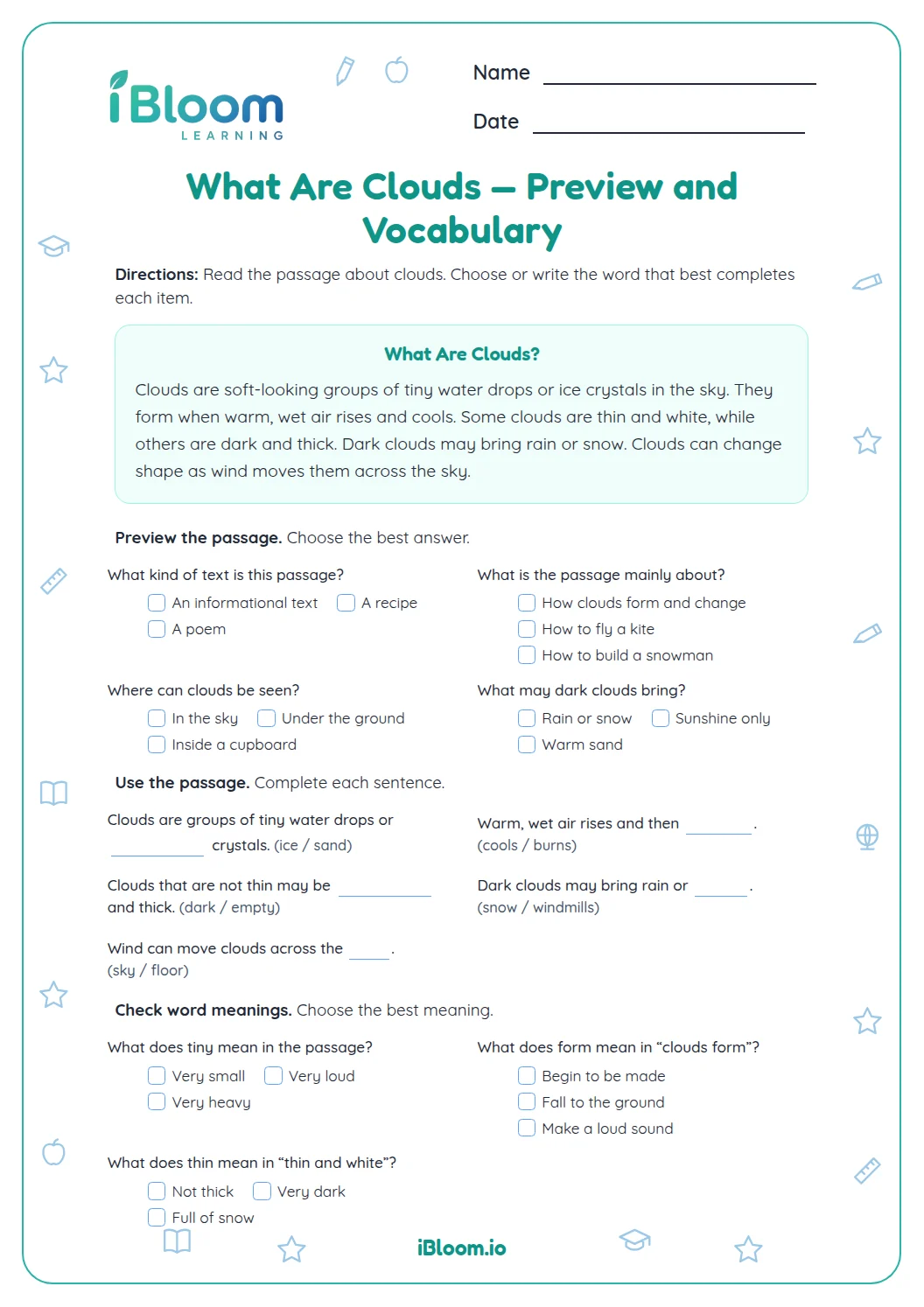
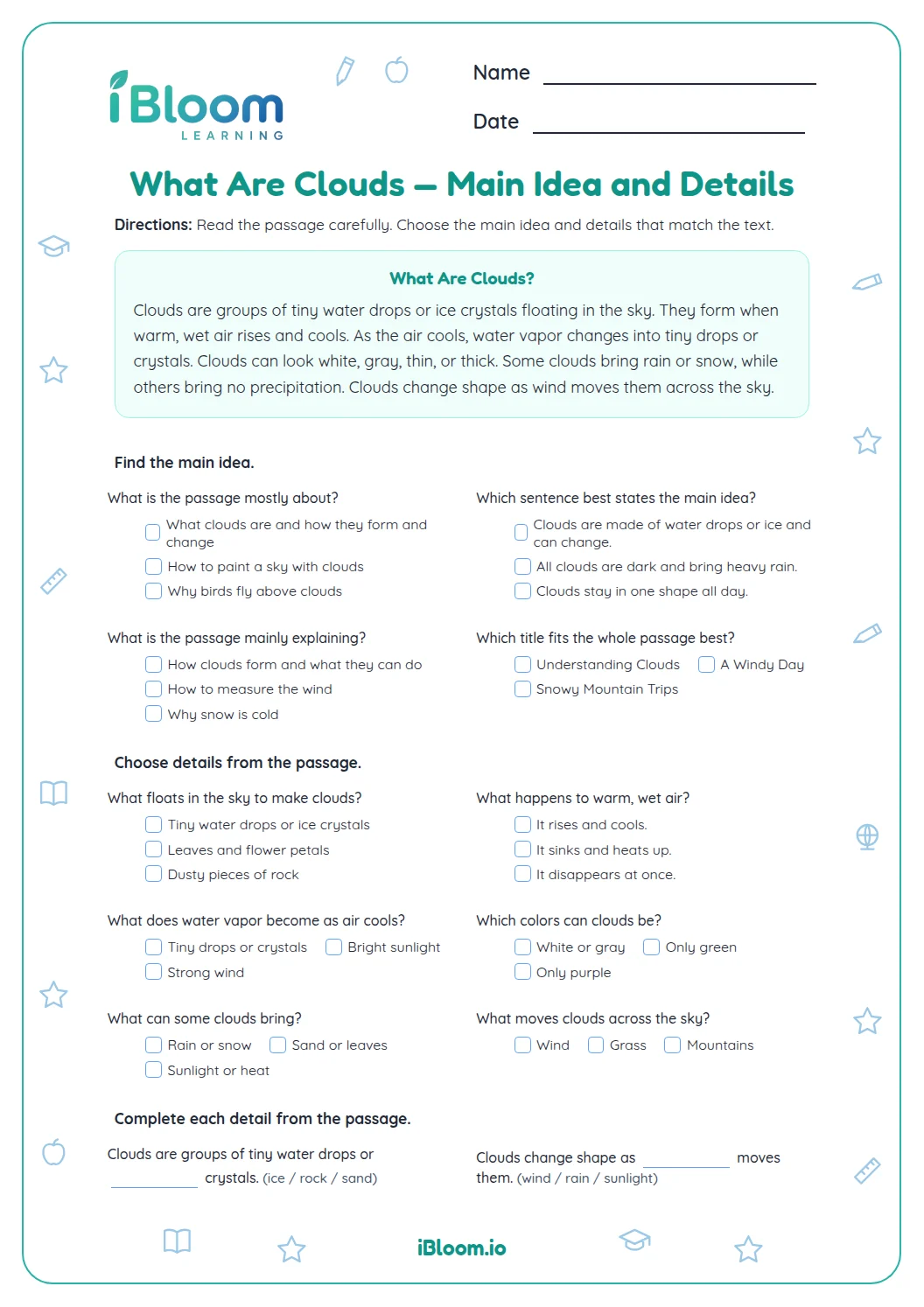
This free Grade 3 reading worksheet explains cloud formation through a short informational passage called “What Are Clouds?” Part A introduces the process from warming water to falling rain. Part B has four choices about event order and signal words. Part C has four short answers about steps and connections, and Part D asks for two written explanations of structure. The ten questions practice Common Core RI.3.3 by connecting scientific ideas with time, sequence, and cause-and-effect language. A separate answer key includes sample explanations that refer directly to the passage.
Aligned to RI.3.3
What sequence does the passage explain?
The passage follows water as it warms and becomes vapor. Air carrying that vapor rises and cools, allowing tiny drops to form. It then explains how drops can join and fall as rain. Children follow that order to answer the before-and-after questions.
Each paragraph has a job. The first introduces the topic, the second begins the process, the third explains cloud formation, and the last describes rain.
- 1Which step comes just before tiny drops form?
- 2The third paragraph says the rising air cools.
- 3Answer: The rising air cools.
How do sequence words help a reader?
First, next, then, and finally point to different stages. Question 6 asks for the word introducing the change to vapor. Question 7 asks for the word introducing the rain step.
Children should connect the word to the event it marks. Memorizing a list of transition words alone will not answer what happens immediately before tiny drops form.
How should children explain the passage’s structure?
An explanation should name the order and give an example. For question 9, a child might say the author follows the steps of cloud formation, from the sun warming water to drops forming a cloud.
The last question asks how two middle paragraphs connect. A strong response explains that water becomes vapor and air carrying it rises in one paragraph, then the rising air cools and tiny drops form in the next.
How to work through this sheet
- 1Read the passage once to learn the overall process.
- 2Reread and underline first, next, then, and finally.
- 3Answer the four choices by matching each to a passage sentence.
- 4Use the short-answer questions to connect neighboring steps.
- 5Check both final explanations for an accurate event and a clear relationship.
Mistakes to discuss
The mistake
Putting falling rain before cloud formation.
The fix
Follow the passage from the warming-water paragraph through the final paragraph.
The mistake
Writing finally for every sequence-word question.
The fix
Match the requested event to the word that introduces that event.
The mistake
Calling the passage a story because it has a beginning and ending.
The fix
Notice that it explains a natural process in order; its paragraphs develop steps rather than character actions.
Common Core alignment
Connect steps in cloud formation using sequence and cause-and-effect language.
On this sheet: Children order the process and explain how each paragraph develops the cloud-formation sequence.
Show the official wordingHide the official wording
Describe the relationship between a series of historical events, scientific ideas or concepts, or steps in technical procedures in a text, using language that pertains to time, sequence, and cause/effect.
What to practice next
Make more practice
Further reading
Questions parents and teachers ask
Is “What Are Clouds?” a story or an informational passage?
It is an informational passage explaining how clouds can form and produce rain. Although this worksheet belongs to the children’s stories collection, the reading follows scientific ideas rather than fictional characters. Children use the order of the explanation and the signal words to identify its structure.
Which signal words should my child look for?
Look for first, next, then, and finally in the passage. Each introduces a stage in the explanation. Ask the child to name the event after each word, such as the sun warming water after first, so the word is connected to a meaningful step in the process.
How are the short-answer questions different from the choices?
The four short-answer questions ask children to retrieve a preceding step, two signal words, and the result of drops becoming too heavy to stay in the air. Children write their own brief responses. The final two questions then ask them to explain how the whole passage and its paragraphs are organized.
Does my child need to know cloud facts before reading?
No, the passage supplies the information needed for all fourteen answers. Invite the child to return to it whenever a question feels uncertain. The main reading task is to follow connections between ideas, so answers should come from the printed explanation rather than remembered facts about weather.
What makes a good answer to the paragraph-connection question?
A good answer connects the rising-air step with the cooling step. The second paragraph explains that water becomes vapor and air carrying it rises; the third explains that the air cools and tiny drops form. Accept a shorter paraphrase when it preserves that order and links the two paragraphs.