

About this worksheet
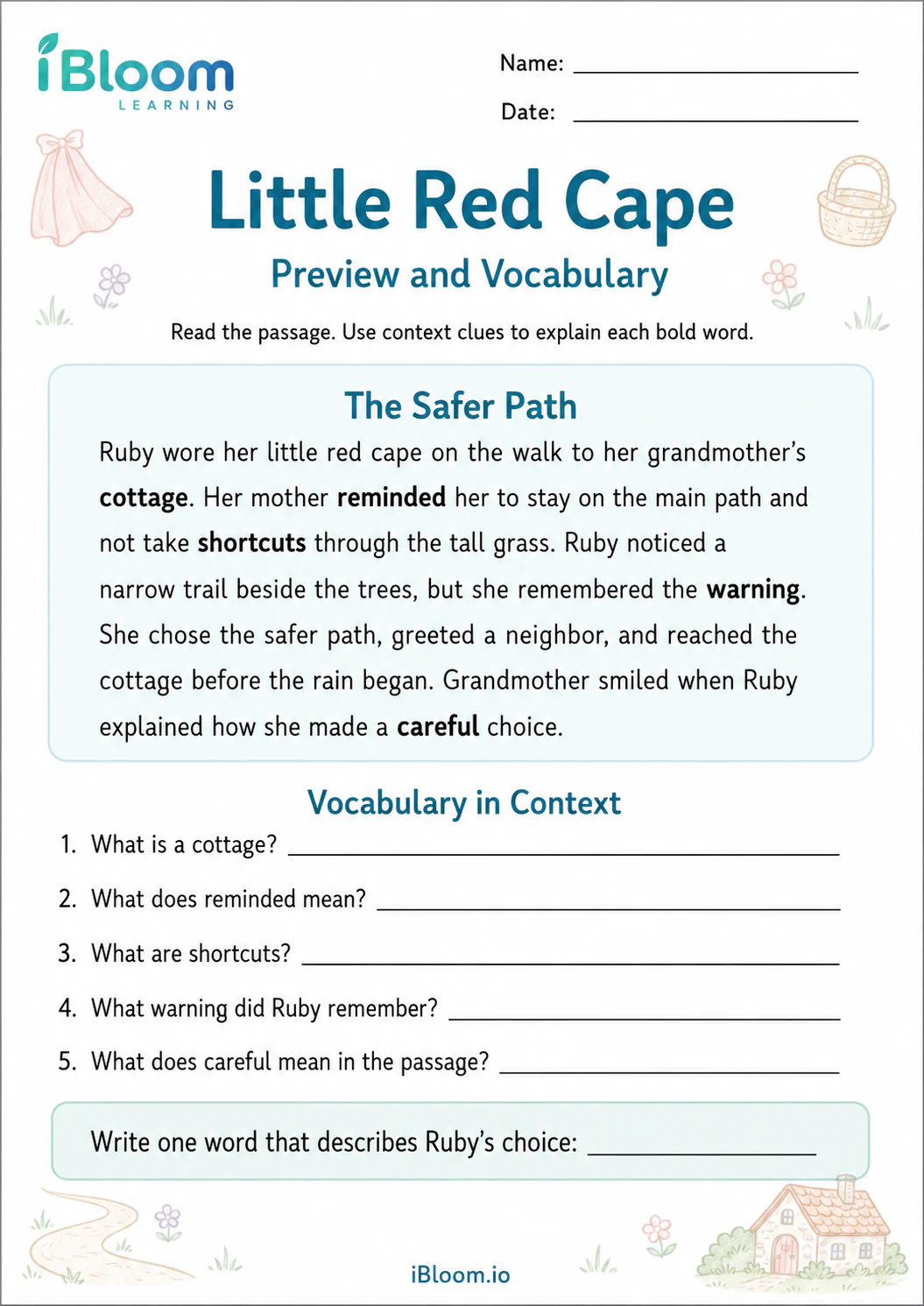
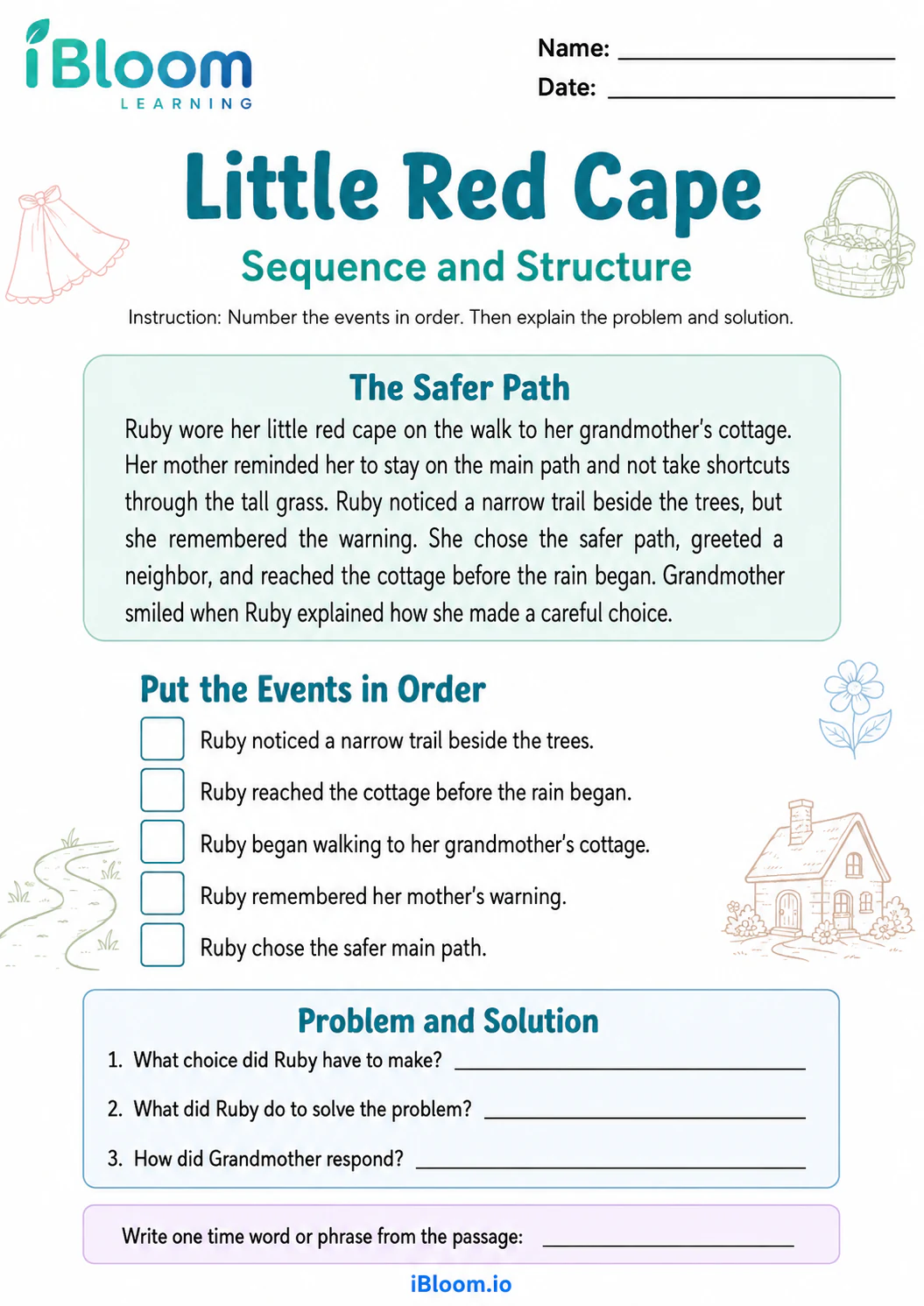
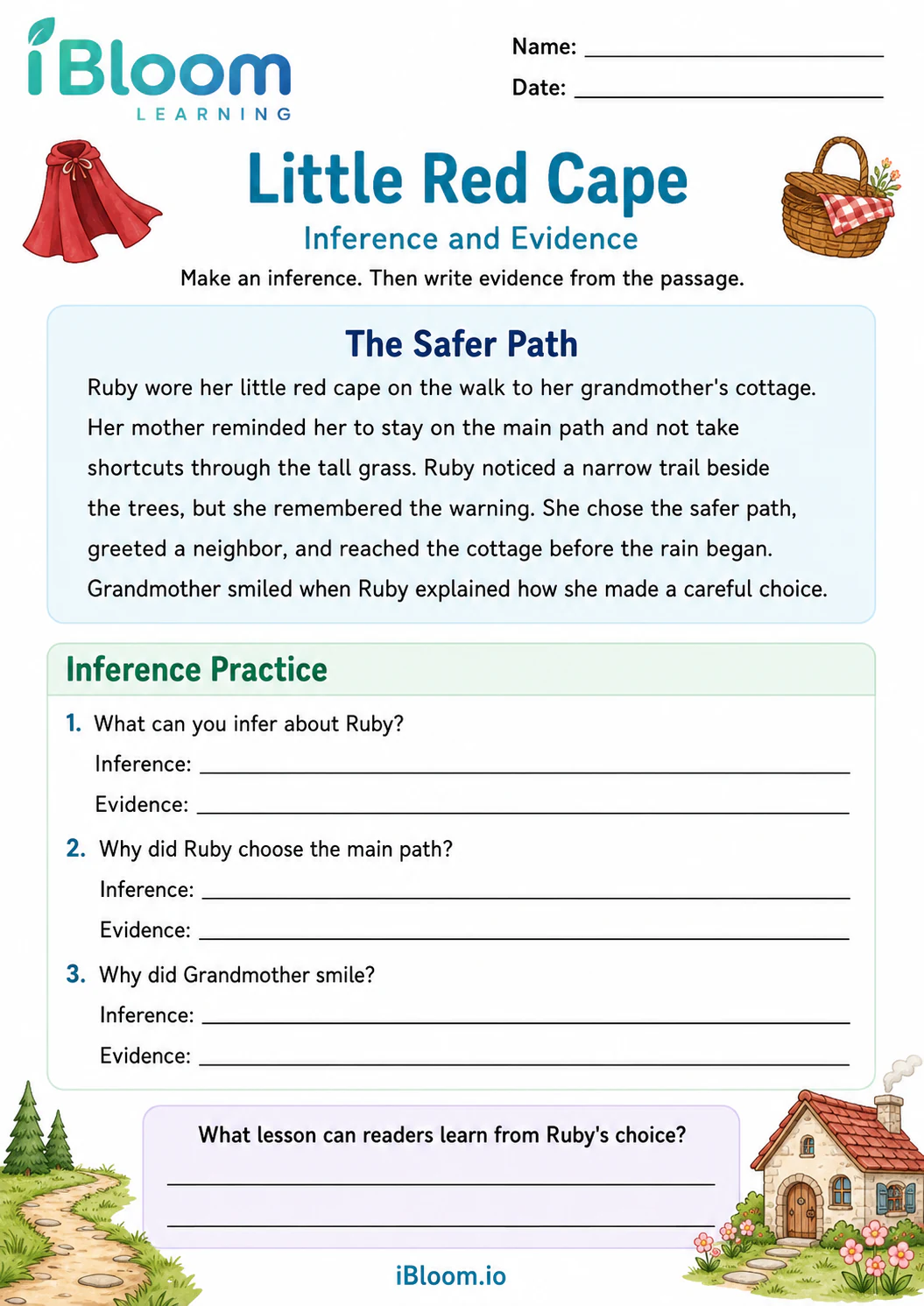
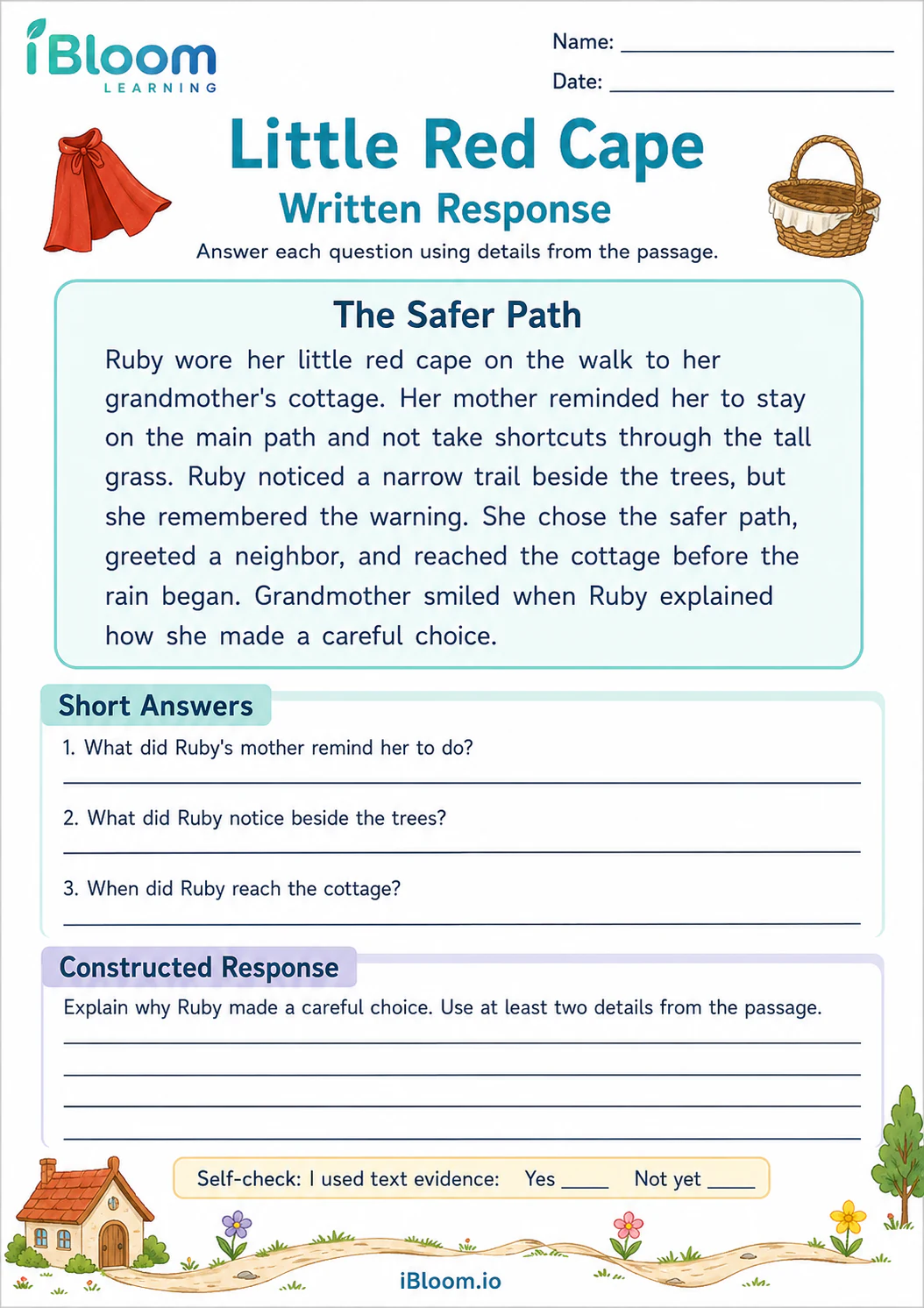
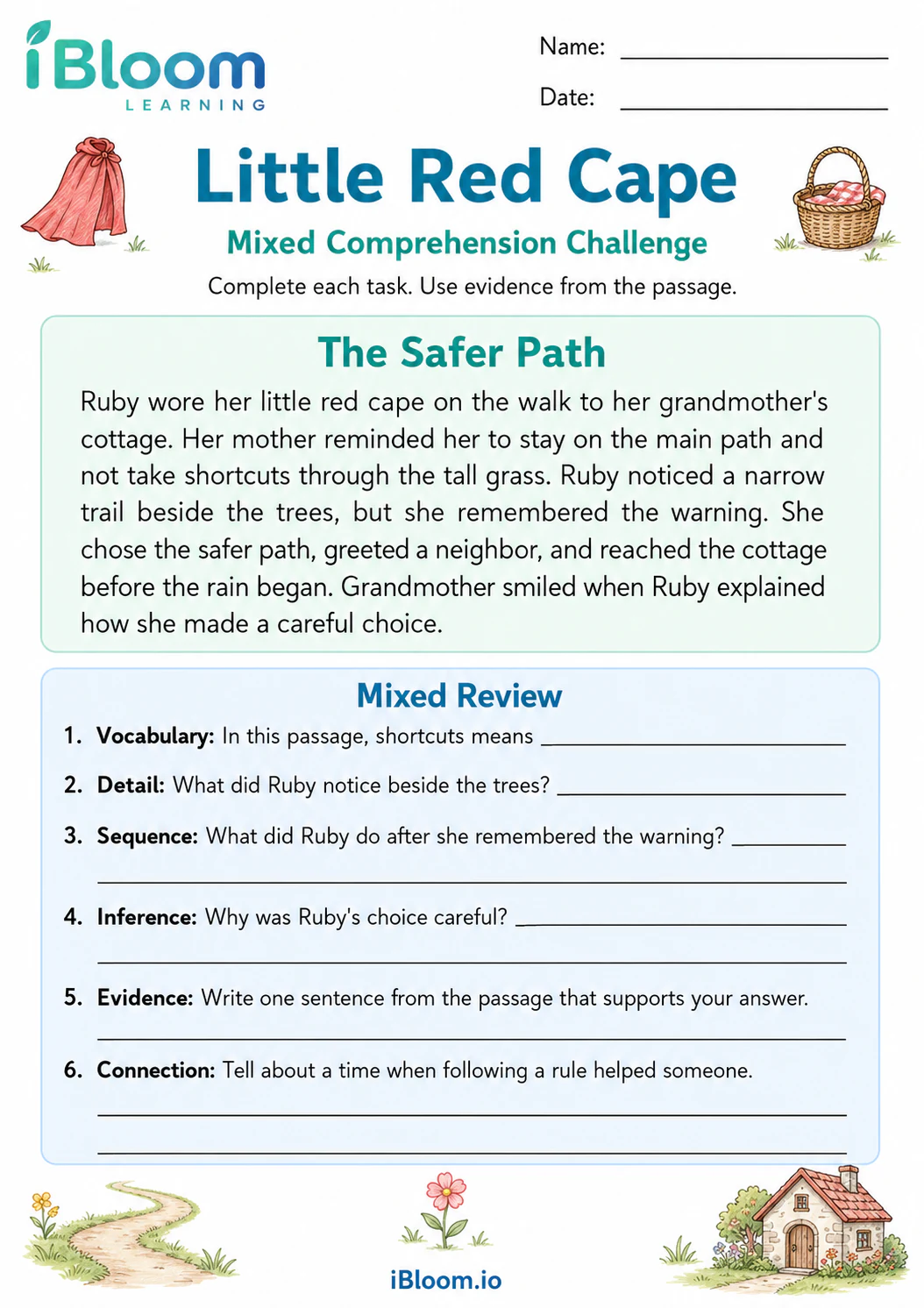
This free printable Grade 3 reading worksheet pairs Little Red Cape with 14 questions about its main idea, details and central message. Part A is the passage. Part B has six choices that help readers find important events. Part C has six choices connecting those events to the whole story. Part D asks for two brief explanations supported by the passage. The questions practice Common Core RL.3.1 and RL.3.2 by asking children to refer to the passage and explain how events convey a lesson. The separate answer key includes sample responses for the written questions.
Aligned to RL.3.1 and RL.3.2
What makes a main idea stronger than a single detail?
A useful main idea accounts for several important events. Ask your child to test a possible answer against the beginning, middle and ending. A choice that fits only one descriptive sentence will be too narrow.
The worksheet separates finding details from deciding what they mean together. Children can first locate an answer in Part B, then use that evidence to judge the choices in Part C.
How should children check a supporting detail?
Start with the selected idea and ask whether the detail helps explain it. A detail can be true without being the strongest support for that particular idea. Question 6 asks for the event that connects most directly to question 5.
- 1Question 5: Kindness is returned.
- 2Question 6: The fairy sends a gift.
- 3The second answer supports the first because it shows a response to earlier help.
What belongs in a written explanation?
A useful response names a relevant action and connects it to the question. One complete sentence is enough for each Part D item. Encourage children to point to the passage before writing, so their answers come from this version of the story.
The key gives model responses, and different wording is welcome when the same idea is supported. Check both the event named and the explanation of why it matters.
Move from an event to an idea
- 1Read Part A once for the whole story.
- 2Reread as needed to locate details in Part B.
- 3For question 7, test each main-idea choice against Ruby’s careful walk and helpful visit.
- 4Use question 8 to find a detail that supports the idea about careful choices.
- 5Answer Part D with one supported sentence for each question.
- 6Compare the explanations with the sample answers and discuss equivalent wording.
Reading mistakes to discuss
The mistake
Choosing an idea because it fits one sentence about the garden.
The fix
Check whether it also explains the main action and the ending.
The mistake
Selecting any true detail as evidence for kindness being returned.
The fix
Look for a detail that shows the return of kindness specifically.
The mistake
Giving a lesson without using a story event in Part D.
The fix
Name one action and explain how it supports the lesson.
Common Core alignment
Use details from Little Red Cape to answer questions about the story.
On this sheet: Questions ask readers to locate supporting events and explain their choices.
Show the official wordingHide the official wording
Ask and answer questions to demonstrate understanding of a text, referring explicitly to the text as the basis for the answers.
Identify the lesson about kindness and explain which events support it.
On this sheet: Children connect the central message to the grandmother’s help and the fairy’s response.
Show the official wordingHide the official wording
Recount stories, including fables, folktales, and myths from diverse cultures; determine the central message, lesson, or moral and explain how it is conveyed through key details in the text.
What to practice next
Make more practice
Further reading
Questions parents and teachers ask
Is the passage included on the worksheet?
Yes, Little Red Cape is printed as Part A, before the questions. Children can return to it whenever they need evidence. Read the whole passage first, then reread selected sentences while working through the choices and the two written explanations near the end.
Are the main idea and the lesson the same thing?
They are closely connected here, but the questions give them different jobs. The main idea connects what happens across the story. The lesson expresses a broader message a reader can take from those events. Ask your child to support both answers with details from the passage.
Why can a true detail be a weak answer?
A true detail may describe the setting without supporting the idea being discussed. In Part C, children must decide which detail best fits a particular claim. Have them read the claim and their chosen detail together, then explain the connection in their own words.
How long should the written answers be?
One complete sentence for each written question is enough. The response should address the question and name a relevant event from Ruby’s walk or visit. Children may use wording different from the answer key. Check that the evidence comes from the printed passage.
Can I read the passage aloud to my child?
Yes, you can read the passage aloud and then let your child use the printed text to answer. Pause at paragraph breaks to check understanding. During the questions, encourage your child to point to supporting sentences so the discussion stays connected to the actual story.