




About this worksheet
This printable Grade 3 reading worksheet pairs an original forest story with 14 questions. Students identify the story’s main idea and lesson, recall details about Will and the animals, and use a detail to support a response. The answer key includes the multiple-choice answers and sample responses. The story’s lesson and supporting details connect to CCSS.ELA-Literacy.RL.3.2.
Aligned to CCSS.ELA-Literacy.RL.3.2
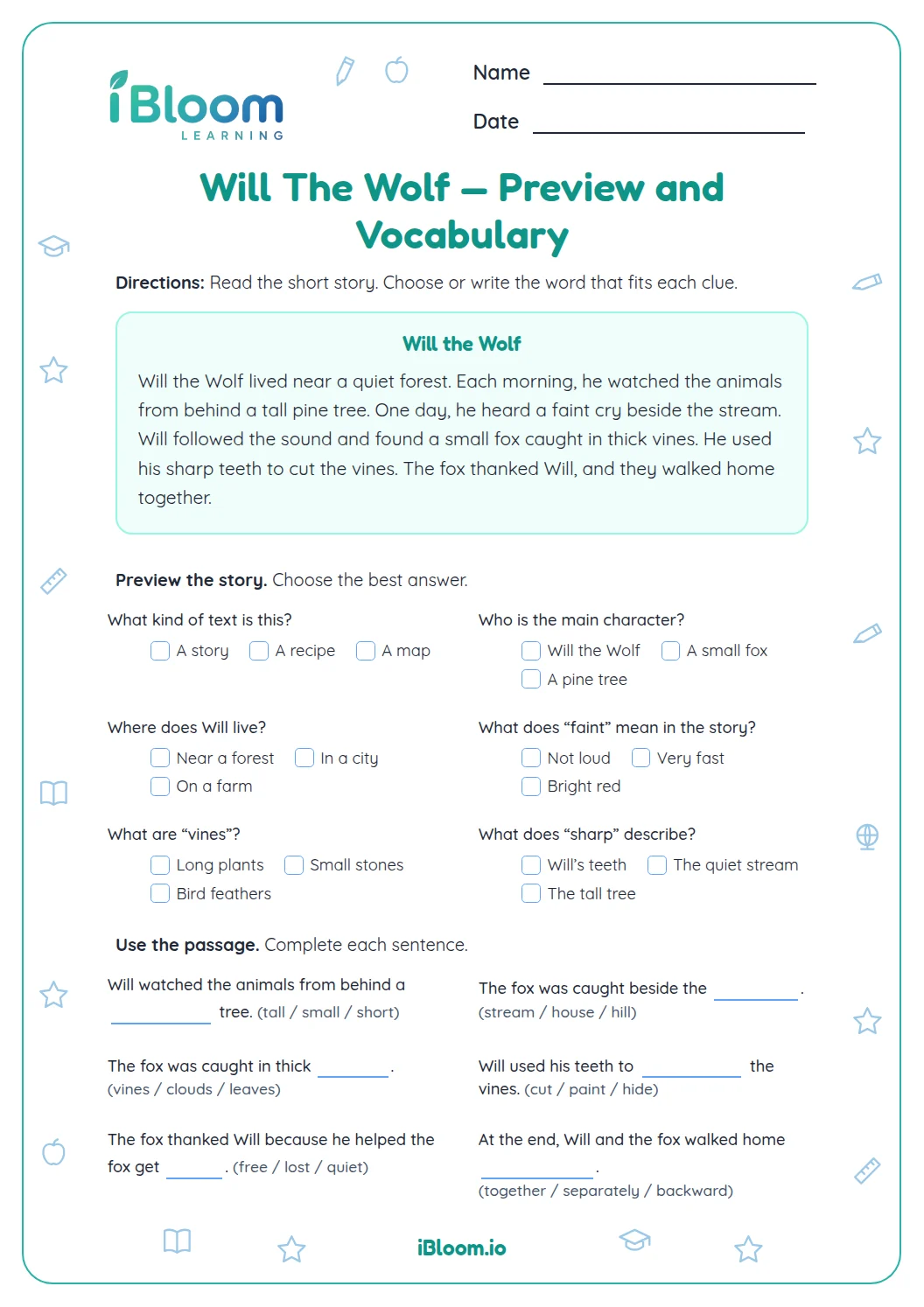
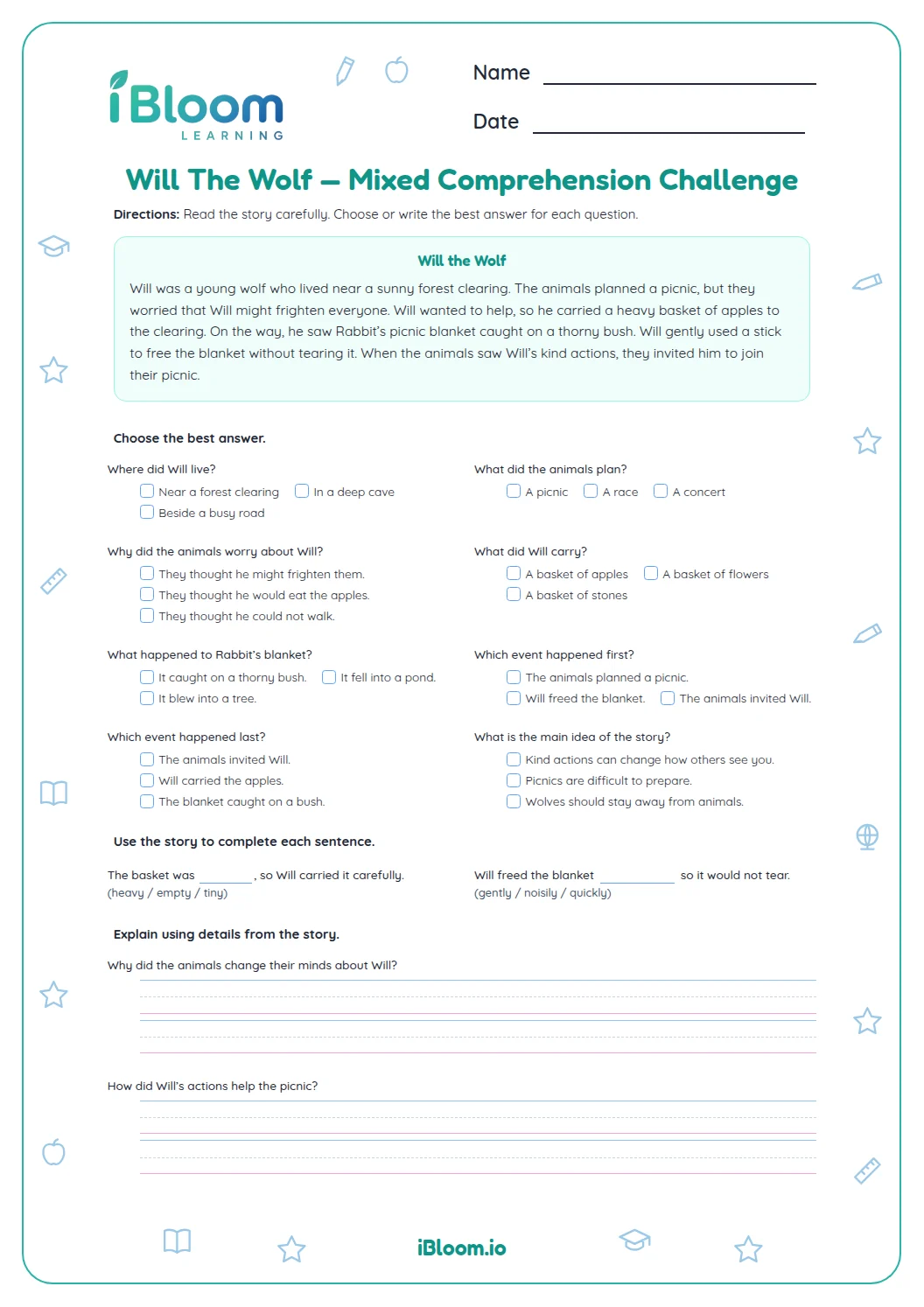
What happens in Will’s story?
Will wants the forest animals to think he is fierce, so he practices a loud growl. When he sees that the rabbit is frightened, he feels bad. Later, he uses his strength to move a branch blocking the path and learns that helping is more useful than scaring others.
How do the questions build comprehension?
The first twelve items ask students to choose answers about the main idea, characters, events, and lesson. The last two invite students to explain how Will helps and what he learns.
- Return to the passage for names and events.
- Use a detail to support an idea about the story.
How can a student support an answer?
A useful response names an action from the passage and connects it to the question.
- 1How do you know Will was helpful? → He pushed a fallen branch off the path so the animals could pass.
How to use this worksheet
- 1Read the story once to follow the events.
- 2Reread the question and note its focus.
- 3Look back for a matching action or detail.
- 4Choose the best answer for questions 1–12.
- 5Write a complete response for questions 13–14.
- 6Check responses with the separate answer key.
Mistakes to watch for
The mistake
Choosing a detail instead of the main idea.
The fix
Ask which idea connects Will’s actions across the whole story.
The mistake
Mixing up what Will wanted at first with what he learned.
The fix
Check whether the question asks about the beginning or ending.
The mistake
Giving an opinion without story evidence.
The fix
Name an event from the passage that supports the response.
Curriculum alignment
Students determine the story’s lesson and connect it to details about Will’s choices.
Students identify the story’s lesson and connect it to Will’s actions and key details.
On this sheet:
Show the official wordingHide the official wording
Recount stories, including fables, folktales, and myths from diverse cultures; determine the central message, lesson, or moral and explain how it is conveyed through key details in the text.
What to practice next
Further reading
Questions parents and teachers ask
What is the main idea of Will the Wolf?
Will learns that helping others is better than trying to scare them. His actions show the change: he first practices a growl, then notices the rabbit’s fear and moves a branch so the animals can pass. Students choose the main idea and revisit details that support it.
What kinds of questions are on this worksheet?
There are 14 questions. The first 12 are multiple choice and ask about the main idea, characters, events, and lesson; the final two ask for short written responses using story details. A separate key lists the choices and sample written answers.
How can a student find evidence in the passage?
Have the student reread the lines around the event named in the question. For example, the passage says Will pushed the fallen branch off the path. That detail supports an answer about how he helped the rabbit, squirrels, and deer.
Is this worksheet appropriate for Grade 3?
The passage is a short narrative with a clear sequence, a character change, and a lesson. Students answer direct detail questions as well as questions about the main idea. The written items ask for a brief, text-based response rather than a long essay.
How should I use the answer key?
Let the student attempt all 14 questions before checking. Compare selected answers directly with the key. For the two written responses, accept different wording when it states the same idea and includes a detail that fits the story. A specific story detail makes the response easier to check.