


About this worksheet
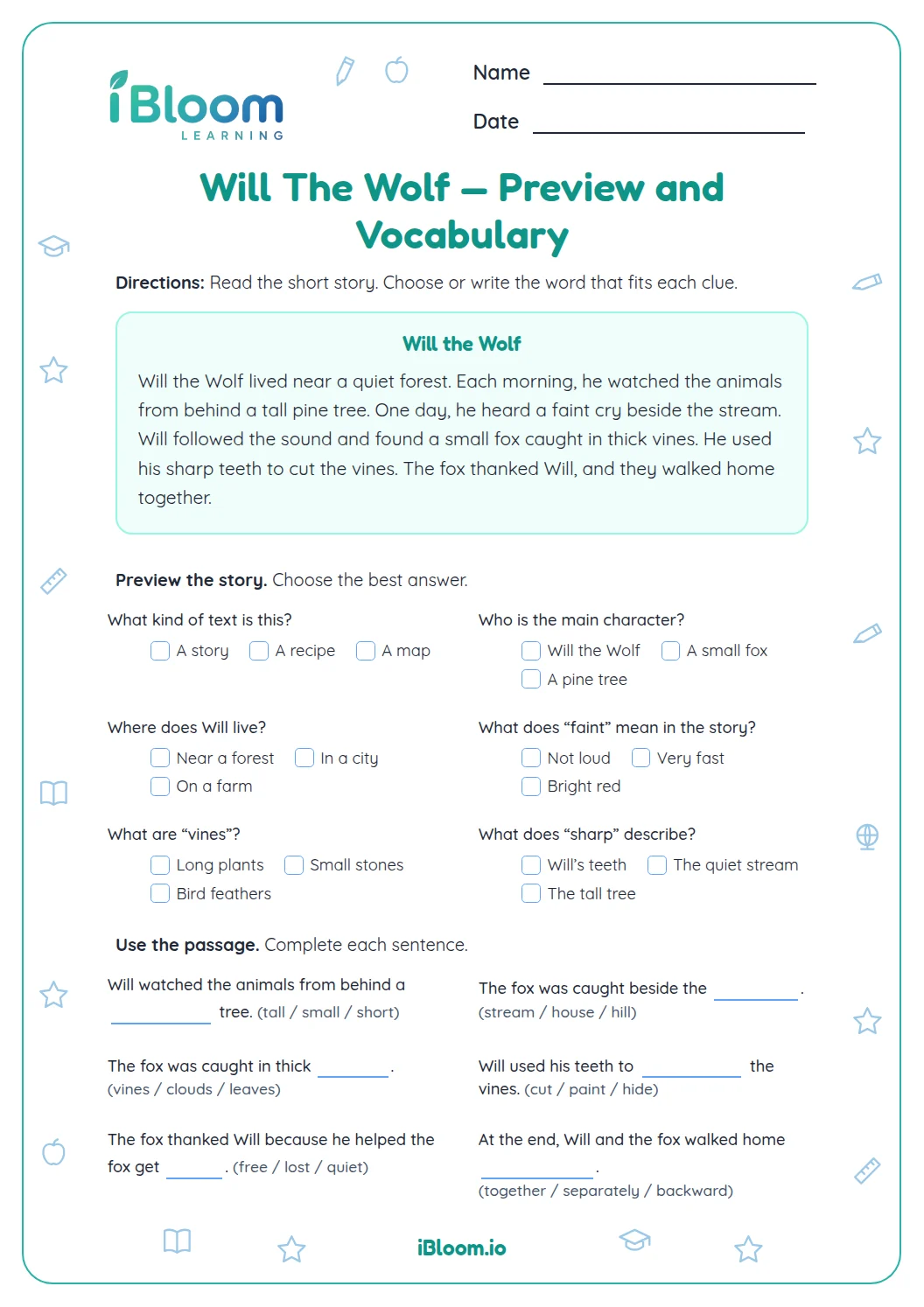
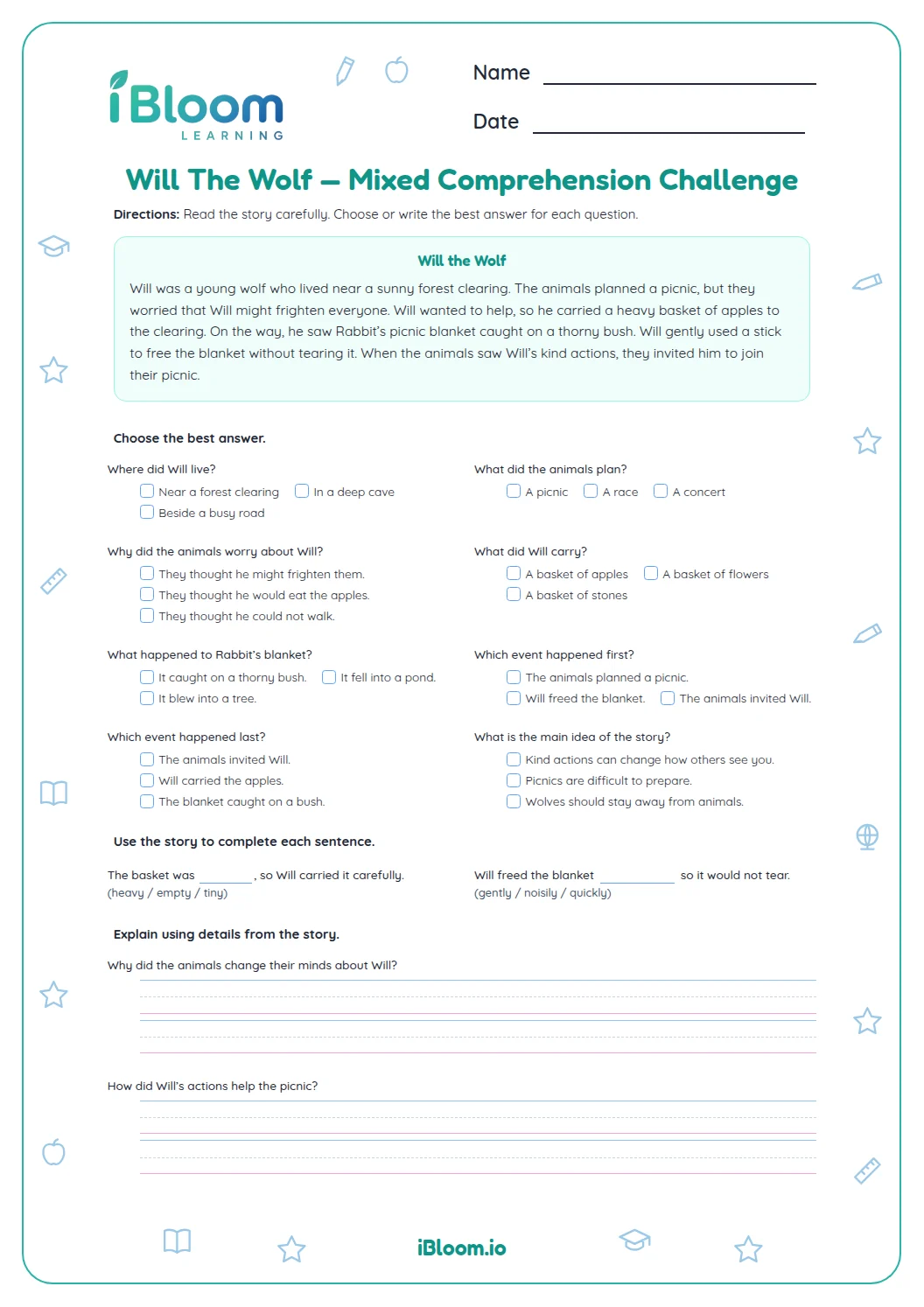
This Grade 3 reading worksheet returns to Will the Wolf, the kind wolf who helps an injured bird. The original passage follows Will as he cares for the bird, discovers hidden apple trees, and shares the fruit with the other wolves. Fourteen questions move from recalling story details to explaining character choices and the lesson with evidence. It practices Common Core standard RL.3.1.
Aligned to RL.3.1
What details should readers notice first?
The first five questions check details such as where Will lived, what happened to the bird, and what Will brought it. For example, the passage says the bird had an injured wing and Will brought it berries each day.
How do written answers use evidence?
Questions in the next part ask learners to explain events and support an answer with a story detail. For example, the bird’s recovery is shown when it can fly again after a week.
What can readers infer about Will?
The final questions ask readers to consider Will’s choices and the lesson the wolves learn. A strong response connects an idea, such as kindness, to something Will does in the passage.
How to use this worksheet
- 1Read the whole passage once.
- 2Return to the relevant paragraph for a detail.
- 3Answer the question directly in your own words.
- 4For an inference, connect an idea to a specific action or event.
- 5Reread your response and check that the story supports it.
Common mistakes and quick fixes
The mistake
Giving an answer that is not stated or supported in the passage.
The fix
Point to a sentence or event that supports the answer.
The mistake
Retelling the whole story instead of answering the question.
The fix
Start with a direct answer, then add one useful detail.
The mistake
Treating an inference as a fact the narrator stated.
The fix
Use words such as “suggests” or “may” and explain the clue.
This page practices a skill named in the Common Core State Standards.
Answer questions about a story using details stated in the text and supported inferences.
On this sheet:
Show the official wordingHide the official wording
Ask and answer questions to demonstrate understanding of a text, referring explicitly to the text as the basis for the answers.
What to practice next
Make more practice
Further reading
Questions parents and teachers ask
What does this Will the Wolf reading worksheet practice?
This printable has five detail questions and nine written responses about the story for Grade 3 learners. It moves from spotting the skill to using it in context, with an answer key for checking fixed answers and comparing open responses. Use the prompts to talk through the choices and the evidence behind them.
How should we use the answer key?
Have the learner finish a part before checking its key page. For a written response, compare the child’s idea with the sample and the story or sentence; the wording does not need to match exactly. Invite the learner to revise one answer after checking.
Can I use this printable at home or in class?
Yes. Print the worksheet pages for independent practice, a small group, or a short lesson. The key pages are for the adult or teacher. A pencil is enough for the activities, and the writing prompts can be completed at the learner’s own pace.
How long will the worksheet take?
Plan for about 20 minutes, allowing extra time for the open-response items. The page is divided into short parts, so a learner can pause after a section and return to the remaining questions later. Time will vary with reading and writing speed.
What if a written answer differs from the key?
Check whether the response meets the prompt and uses the relevant sentence or story detail. The key gives a sample for answers that can vary, so equivalent wording may be correct. For a fixed answer, revisit the item together and look for the clue that settles it.