





About this worksheet
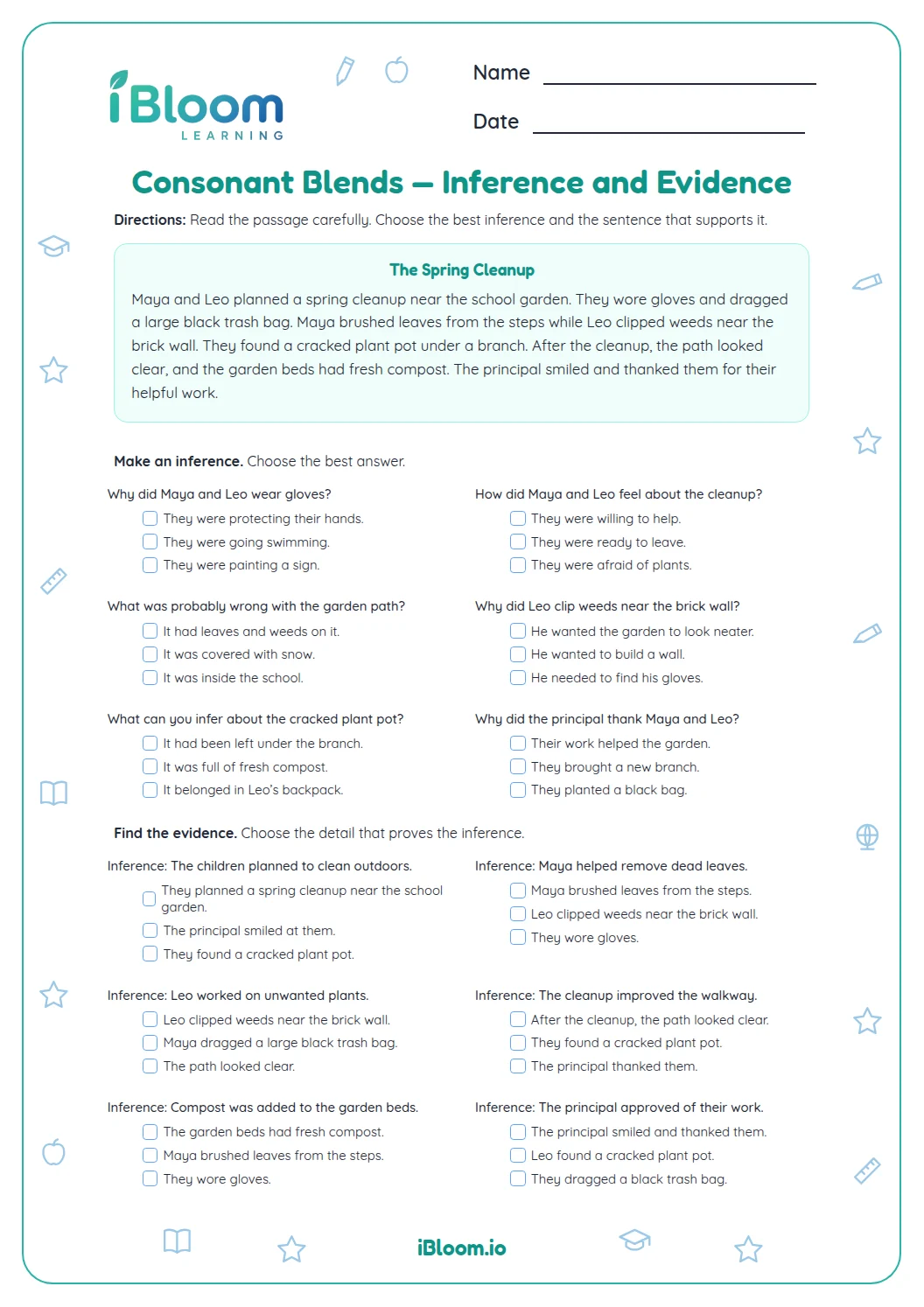
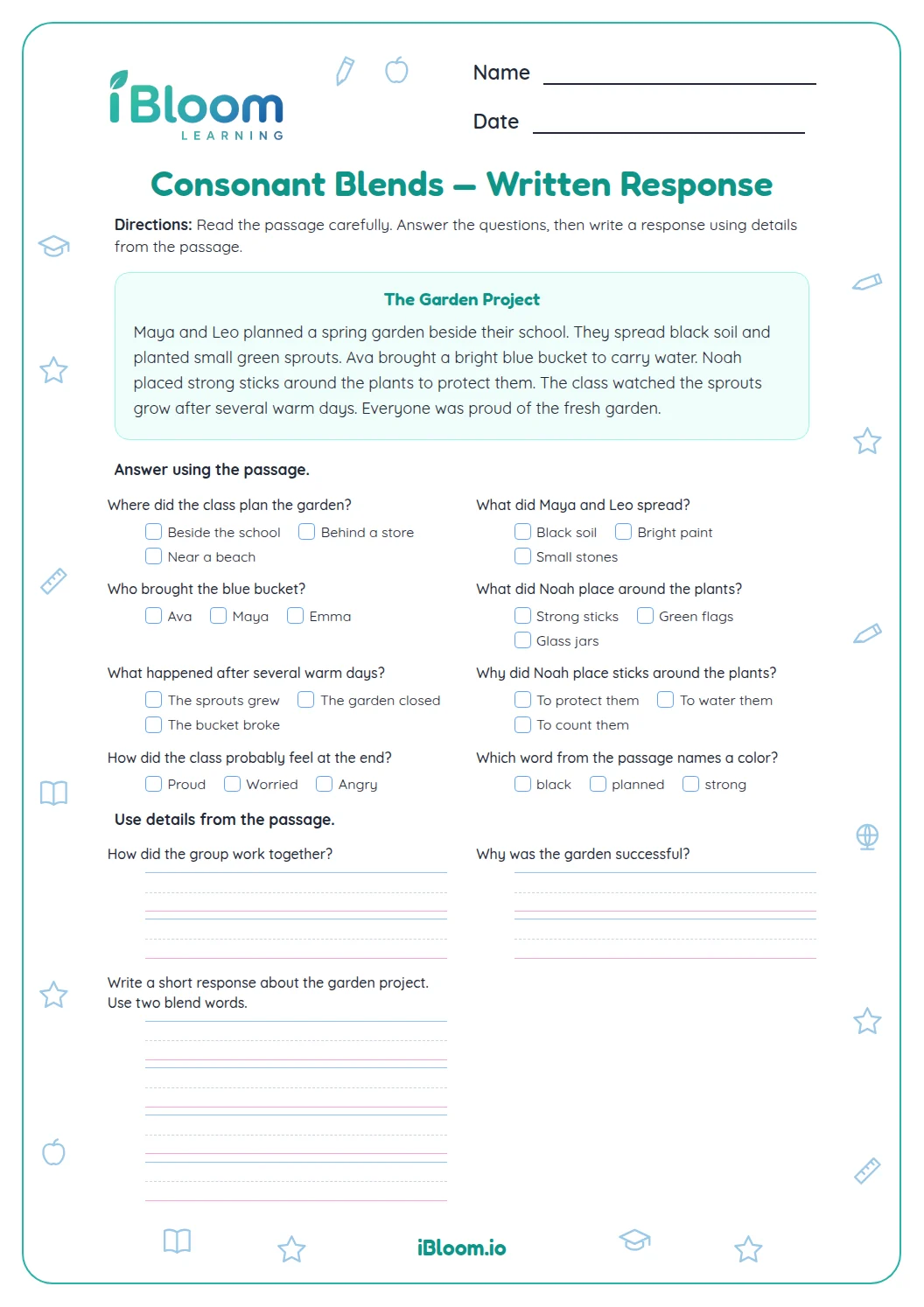
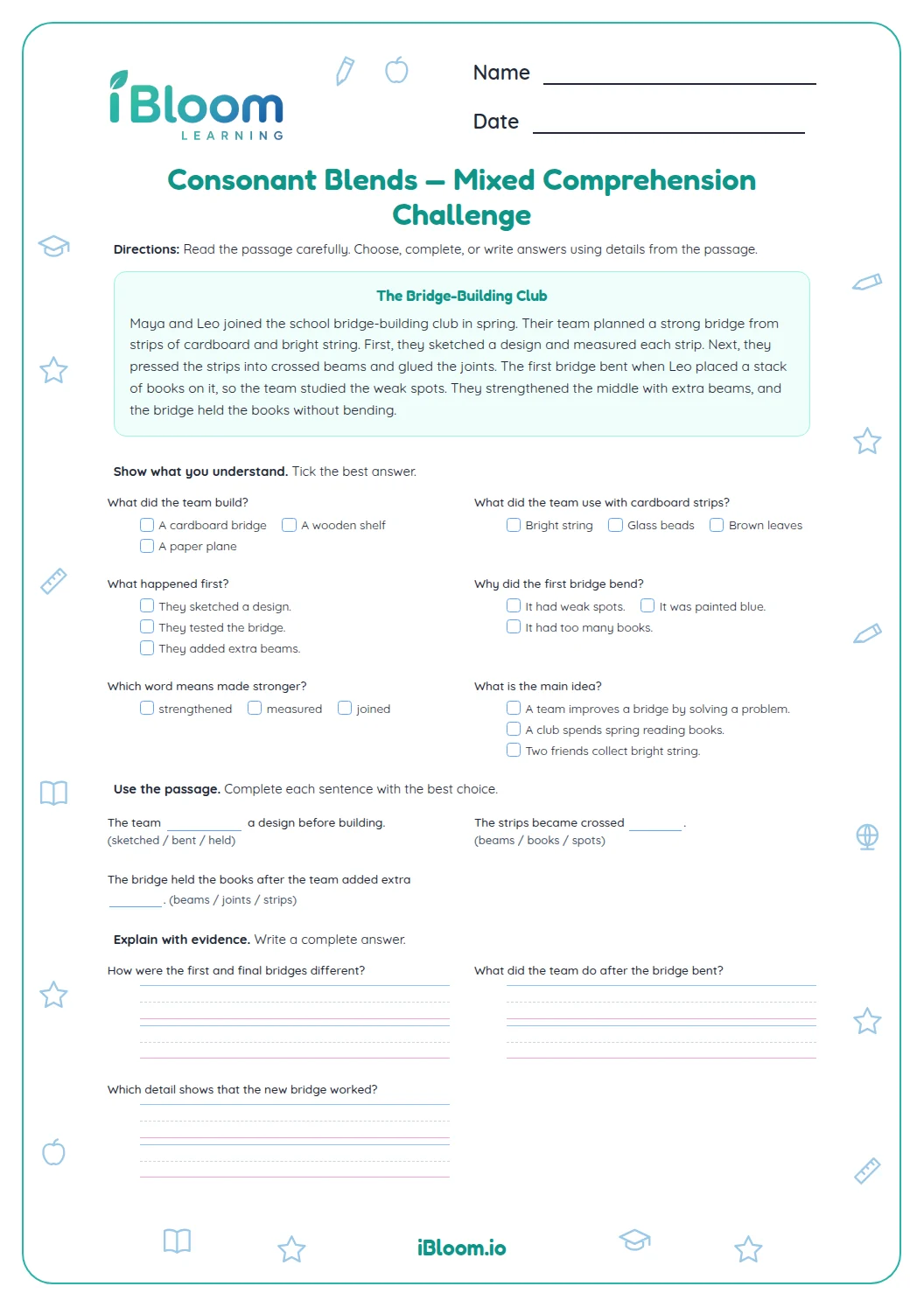
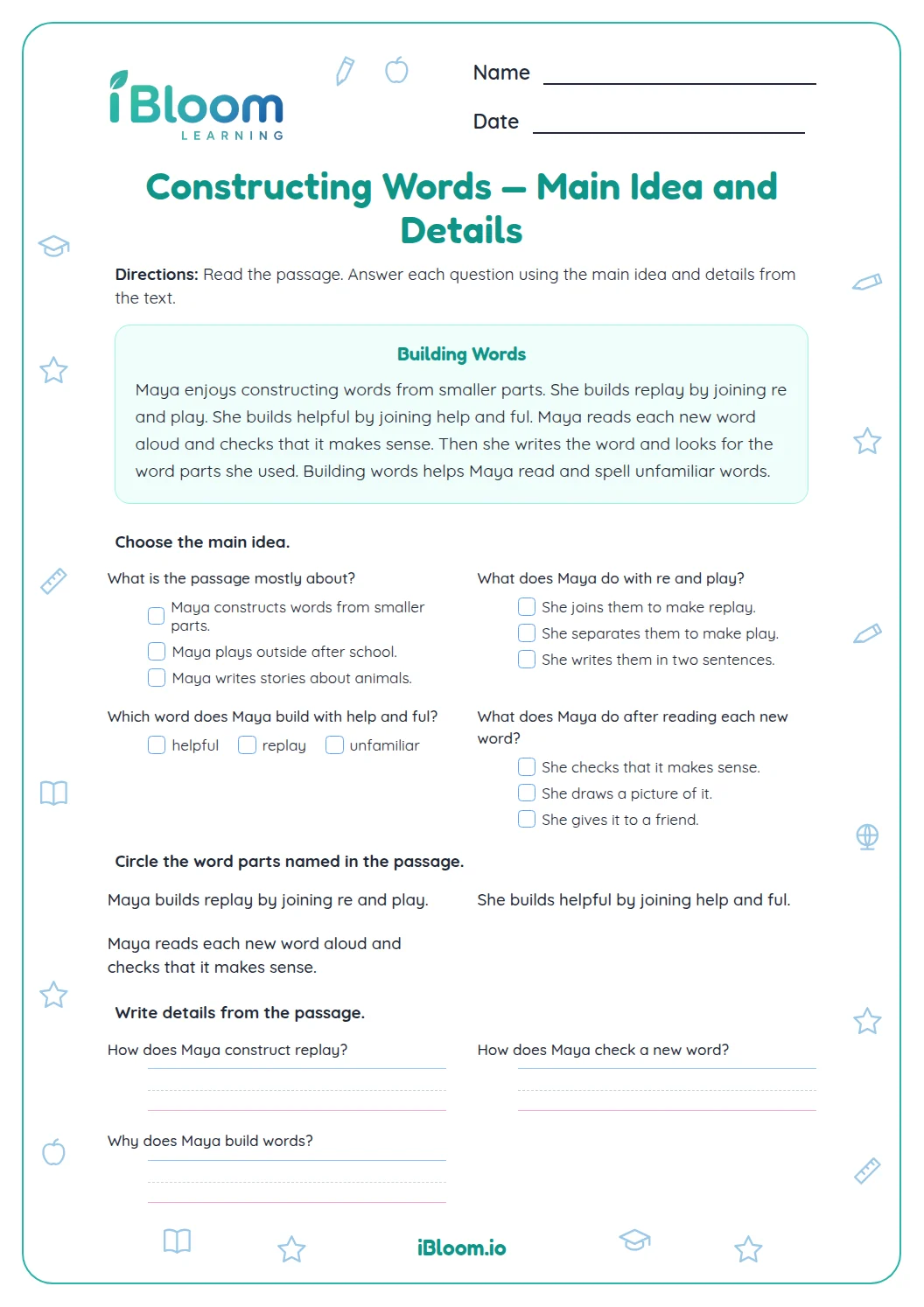
This free Grade 3 printable pairs a school-garden story with consonant-blend, main-idea, and detail questions. Children find blends in story words, explain what the class is doing, and support answers with passage evidence. It supports CCSS RF.3.3 through word analysis and RL.3.2 through retelling and key details. The 15 questions include an answer key with sample written responses.
Aligned to RL.3.2 and RF.3.3
How does the passage support consonant-blend practice?
The garden story includes words such as class, breeze, strong, plan, hand, and sprouts. Questions 1–5 direct attention to consonant sounds that stay together at the beginning or end of a word.
- 1Which word has the blend /br/?
- 2Choices: breeze, leaves, soil
- 3In breeze, b and r are both heard.
- 4Answer: breeze
How do readers find the story’s main idea?
Ask what the class does across the whole passage. The children plant seeds, protect sprouts, and make a plan for ongoing care. The main idea should cover those connected actions rather than just one chart or one windy moment.
Which details help explain the main idea?
Specific details show how the class works together: one team pulls weeds, another checks the soil, and Maya records the jobs. The last question asks readers to connect a detail to the larger point.
How to use this worksheet
- 1Read the whole story once for what the class is doing.
- 2Reread words in the blend questions and listen for both consonant sounds.
- 3For the main idea, think about the beginning, middle, and ending together.
- 4Use a named action or event as evidence for each detail question.
- 5Write a short response in your own words, then check the key.
Common mistakes and quick fixes
The mistake
Choosing a detail as the main idea.
The fix
Ask whether the choice covers the whole story or only one moment.
The mistake
Naming only the first action in a retelling.
The fix
Include the later care plan as well as planting.
The mistake
Treating a blend as one sound.
The fix
Say each consonant in sequence; /br/ keeps both /b/ and /r/.
Common Core alignment
These activities connect short, focused practice with the reading skills named in the standards.
Explain how key story details support its central message or main idea.
On this sheet: Questions 6–15 ask readers to identify the story’s main idea, retell it, and select details that support it.
Show the official wordingHide the official wording
Recount stories, including fables, folktales, and myths from diverse cultures; determine the central message, lesson, or moral and explain how it is conveyed through key details in the text.
Use grade-level phonics and word analysis to decode words.
On this sheet: Questions 1–5 identify consonant blends in words drawn from the passage.
Show the official wordingHide the official wording
Know and apply grade-level phonics and word analysis skills in decoding words.
What to practice next
Make more practice
Further reading
Questions parents and teachers ask
How many questions are included?
There are 15 questions. Five focus on consonant blends in passage words, six use multiple choice for main idea and details, and four ask for short written answers. The answer key gives sample wording for open-ended items and a concise retell to use after the work.
What is the main idea of “The Garden Team”?
The class plants seeds and works together to care for its school garden. The sticks, watering can, weekly jobs, and chart are details that show how the children protect the plants and keep the garden growing through the season. The story ends with the class ready to continue caring for the garden.
Which consonant blends appear in the questions?
The questions focus on /cl/, /br/, /st/, /pl/, and /nd/. Readers can find examples in the passage: class, breeze, strong, plan, and hand. In a blend, each consonant sound can still be heard when the word is spoken.
Can I read the passage aloud to my child?
Yes. You can read it aloud together, then ask the child to find the blend words and explain the story’s main idea. Rereading is useful because the questions ask children to connect specific details with what happens across the entire passage.
What should a written answer include?
A good answer names an accurate fact from the passage and uses enough words to explain it. For the weekly jobs question, “pull weeds and check the soil” is enough. The answer key offers a sample for the final explanatory response.