



About this worksheet
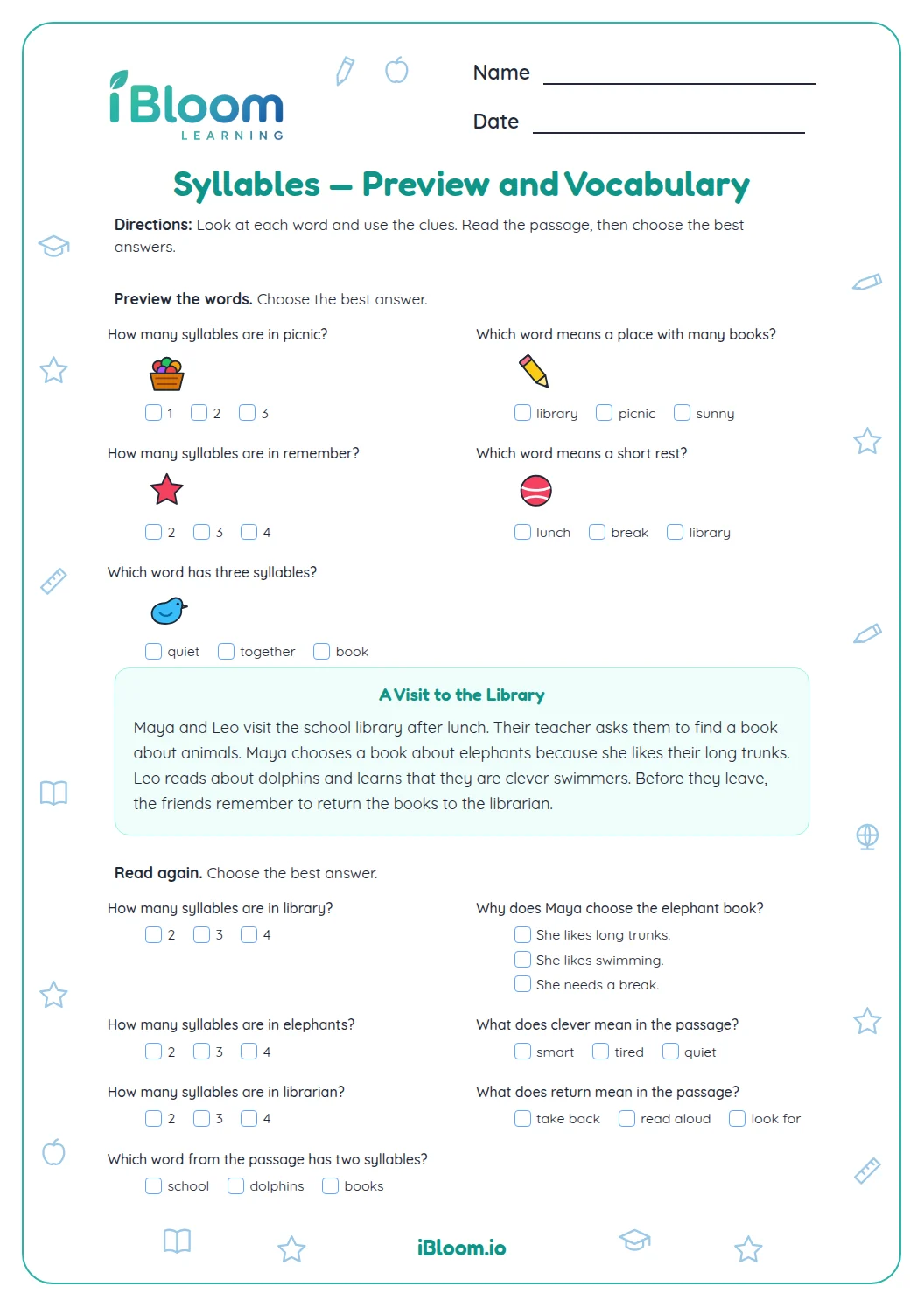
This free Grade 3 reading worksheet combines syllable practice with following a procedure. An original passage explains how to say a word slowly, clap its syllables, mark the printed parts, and blend them in order. Twelve questions ask children to identify the sequence, rebuild six words from syllables, and complete sentences about the steps. The work practices Common Core RF.3.3c for decoding multisyllable words and RI.3.3 for describing steps in a text. Read the rebuilt words aloud as well as writing them. A separate key includes the choice answers, complete words, and sentence-completion answers.
Aligned to RF.3.3c and RI.3.3
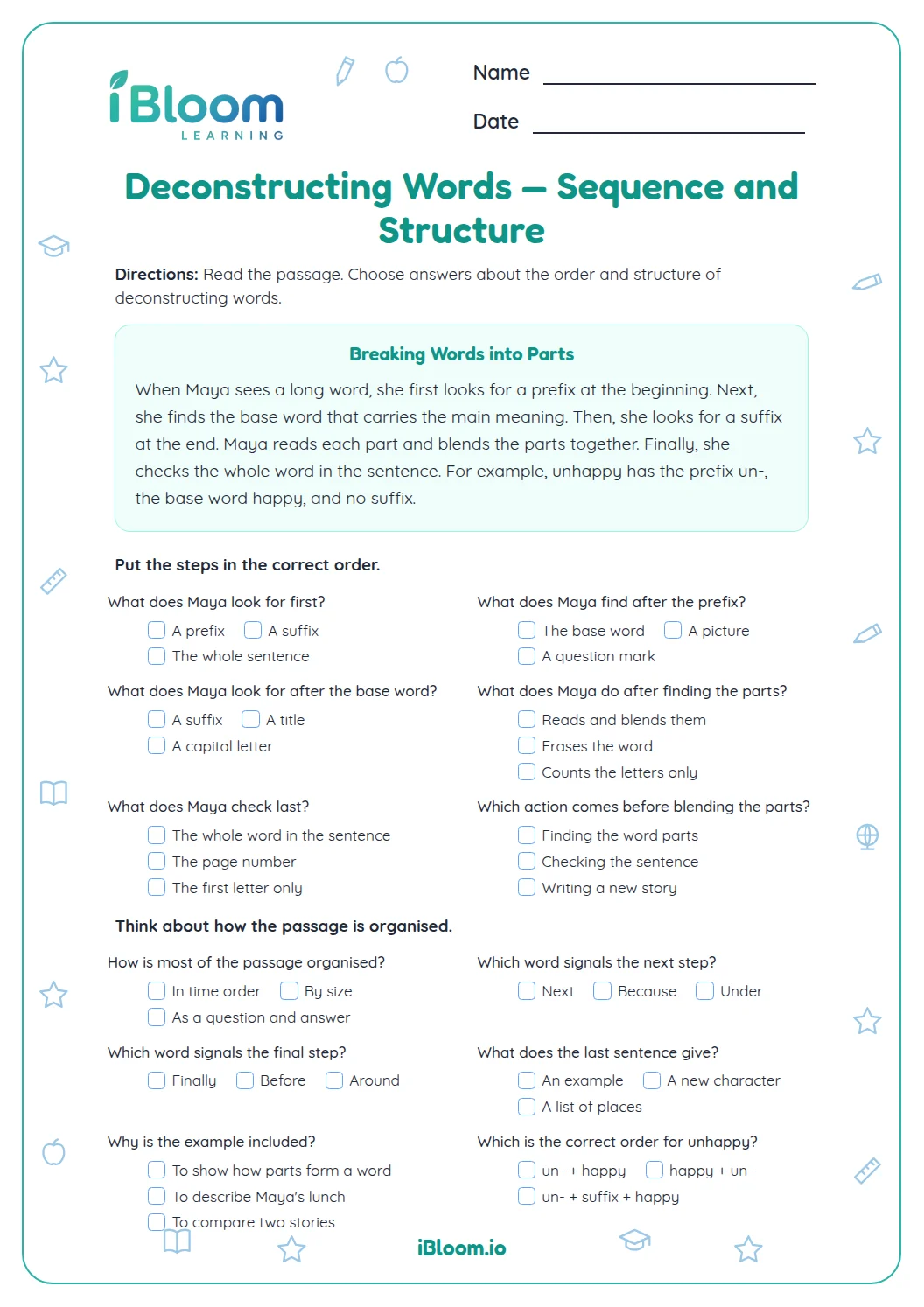
What does the passage teach children to do?
Part A presents Maya’s four-step routine for reading words in syllables. First, say the word slowly. Next, clap its syllables. Then mark the parts in print. Finally, blend them and reread the sentence to check the meaning.
The passage models pic/nic in “We had a picnic” and then tries fan/tas/tic. The slashes show where one syllable ends and the next begins. Children follow the sequence and explain how the steps work together.
How do children put syllables back in order?
Part C gives the syllables in a mixed order. Children try the parts aloud, find a familiar word, write it as one word, and read it again. Each item supplies all the parts needed, so no letters have to be added or removed.
- 1Parts: nic • pic
- 2Try the beginning pic, then add nic.
- 3pic + nic makes picnic.
- 4Write picnic, then read the two syllables smoothly together.
What do the last two sentences review?
Part D returns to two important actions in the procedure. Children name what Maya marks after clapping, then identify what she checks by rereading the sentence. The word bank supplies syllables and meaning; children use each once.
Look back at the paragraph beginning with “Then” to check both answers. Read each completed sentence aloud and connect it to Maya’s example, pic/nic in “We had a picnic.”
How to work through this worksheet
- 1Read Part A aloud once, then let your child reread it and point to First, Next, Then, and Finally.
- 2Try the routine together with picnic, clapping twice as you say its parts.
- 3Complete Part B with the passage available for checking the order.
- 4In Part C, say the mixed syllables, rearrange them aloud, and write each complete word.
- 5Complete the two Part D sentences, using the passage to check the marking step and meaning check.
Mistakes to notice and ways to help
The mistake
Counting vowel letters as if each letter made a syllable.
The fix
Return to the passage’s instruction to listen for spoken beats, then say picnic slowly and clap twice.
The mistake
Writing “nicpic” because nic is printed first.
The fix
Try pic first and nic second. Say the result and check whether it is the familiar word picnic.
The mistake
Naming blending as the step immediately after clapping.
The fix
Find “Then” in the passage. Marking the printed syllables comes between clapping and blending.
Common Core alignment
Put syllables in order and read the complete words aloud.
On this sheet: Part C asks children to rebuild and read two- and three-syllable words.
Show the official wordingHide the official wording
Decode multisyllable words.
Describe the order and purpose of steps in a word-reading procedure.
On this sheet: Parts B and D ask about the procedure’s order, structure, marking step, and meaning check.
Show the official wordingHide the official wording
Describe the relationship between a series of historical events, scientific ideas or concepts, or steps in technical procedures in a text, using language that pertains to time, sequence, and cause/effect.
What to practice next
Make more practice
Further reading
Questions parents and teachers ask
Does my child need to clap every word?
Clapping is part of the passage’s routine and is useful when trying its examples. For the word-building questions, have your child say the syllables clearly and then blend them. If the parts are already easy to hear, a quiet finger tap can mark the beats just as well.
Why does the sheet include a passage about reading?
The passage gives children a procedure whose order they can describe. That makes the sequencing questions directly connected to syllable practice. Children follow Maya as she says, claps, marks, and blends a word. The final completions return to the marking step and the purpose of rereading a sentence.
What are the six words children build?
The words are picnic, basketball, fantastic, sunset, napkin, and insect. Basketball and fantastic have three syllables; the other four words have two. Each question gives all the needed parts in a mixed order. Have your child write each complete word and read it aloud, blending its syllables smoothly.
Should children answer from memory?
They can look back at the passage for every question. Following the printed sequence is part of the task, so encourage them to find the words that support an answer. For the written responses, pointing to the relevant sentence first can help a child explain the step accurately.
How do I check the last two completions?
The missing words are syllables and meaning. Question 11 names the parts Maya marks after clapping. Question 12 names what she checks by rereading the sentence. Ask your child to find both ideas in the paragraph beginning with “Then,” and read each completed sentence aloud to check it.