




About this worksheet
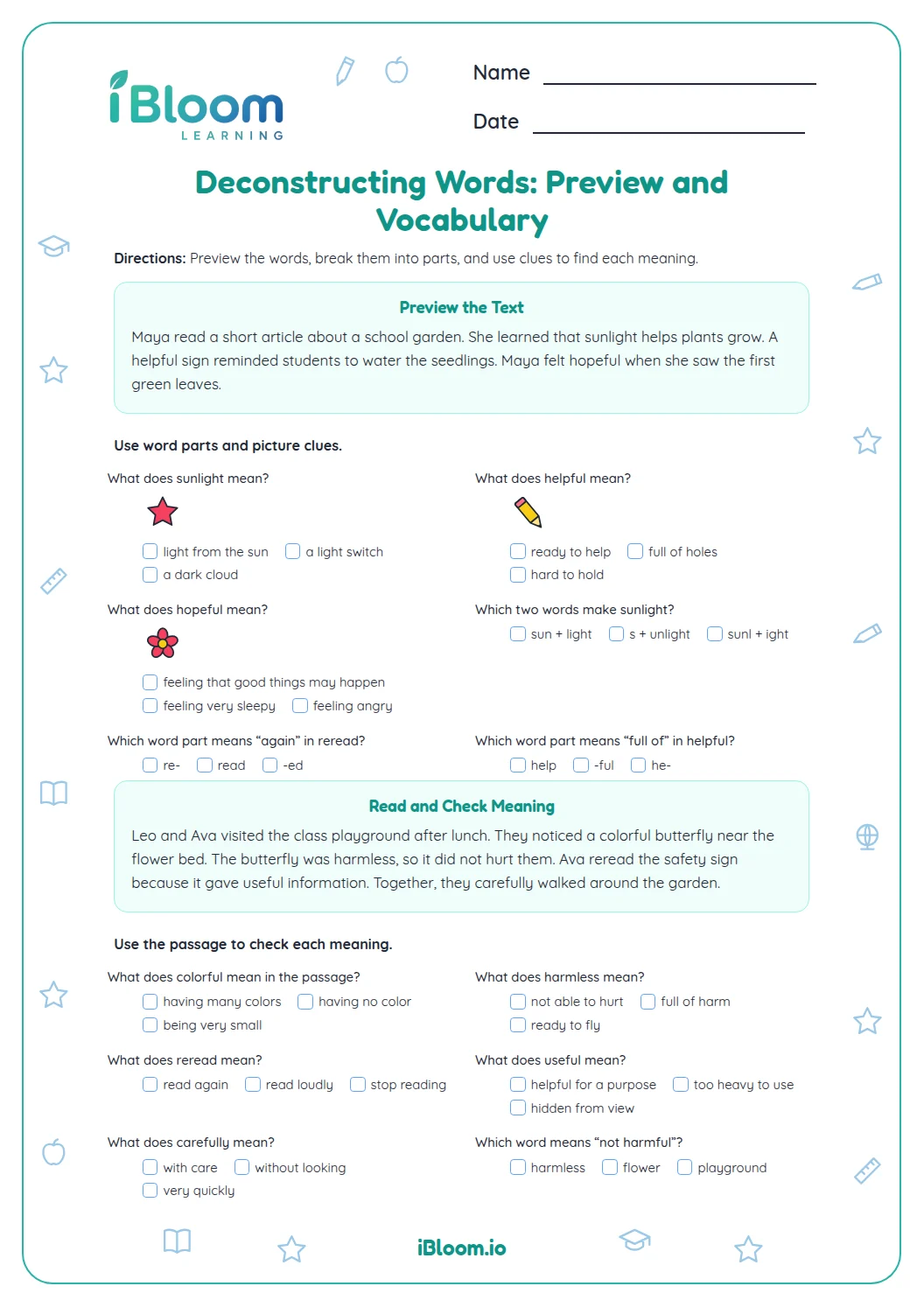
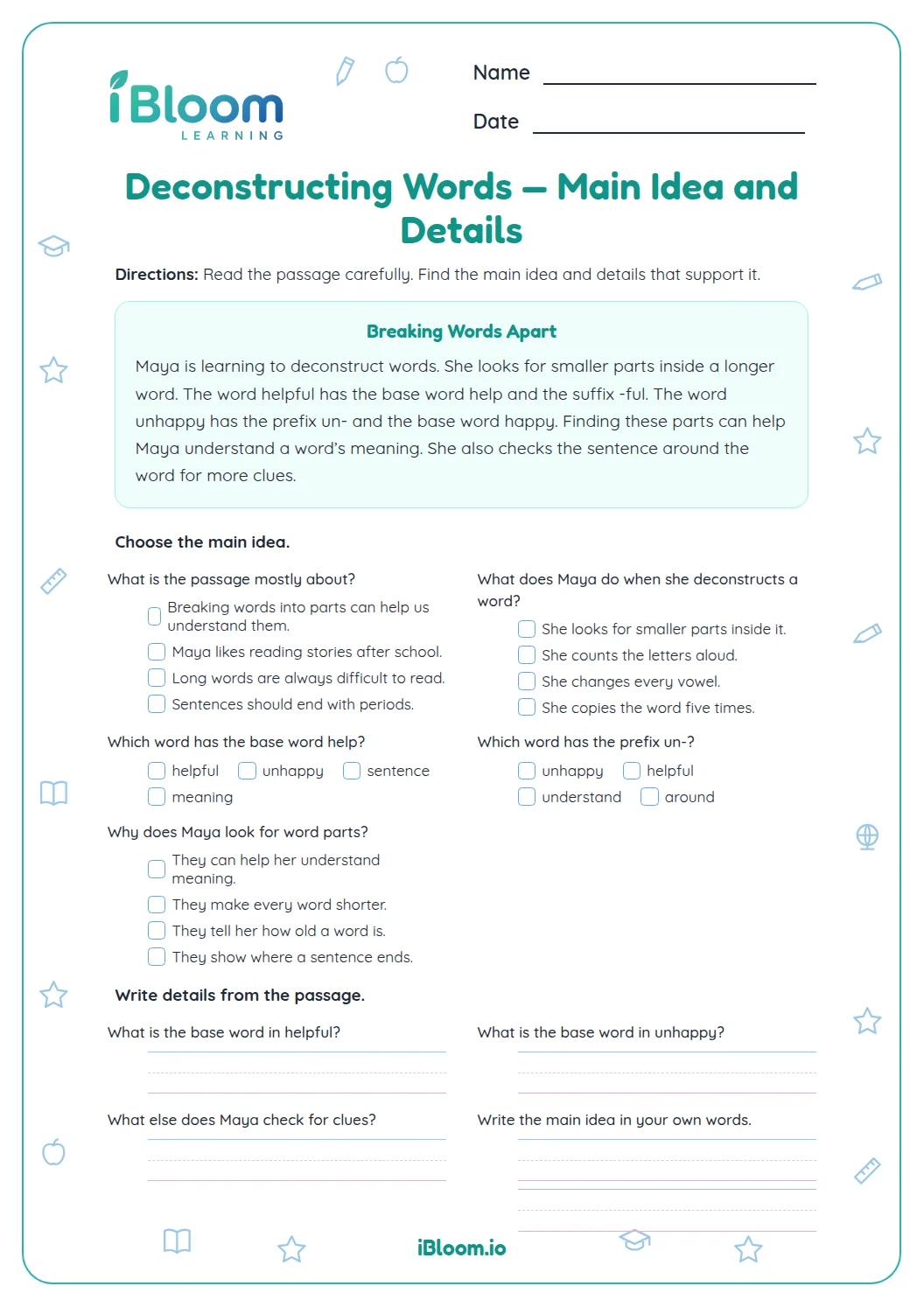
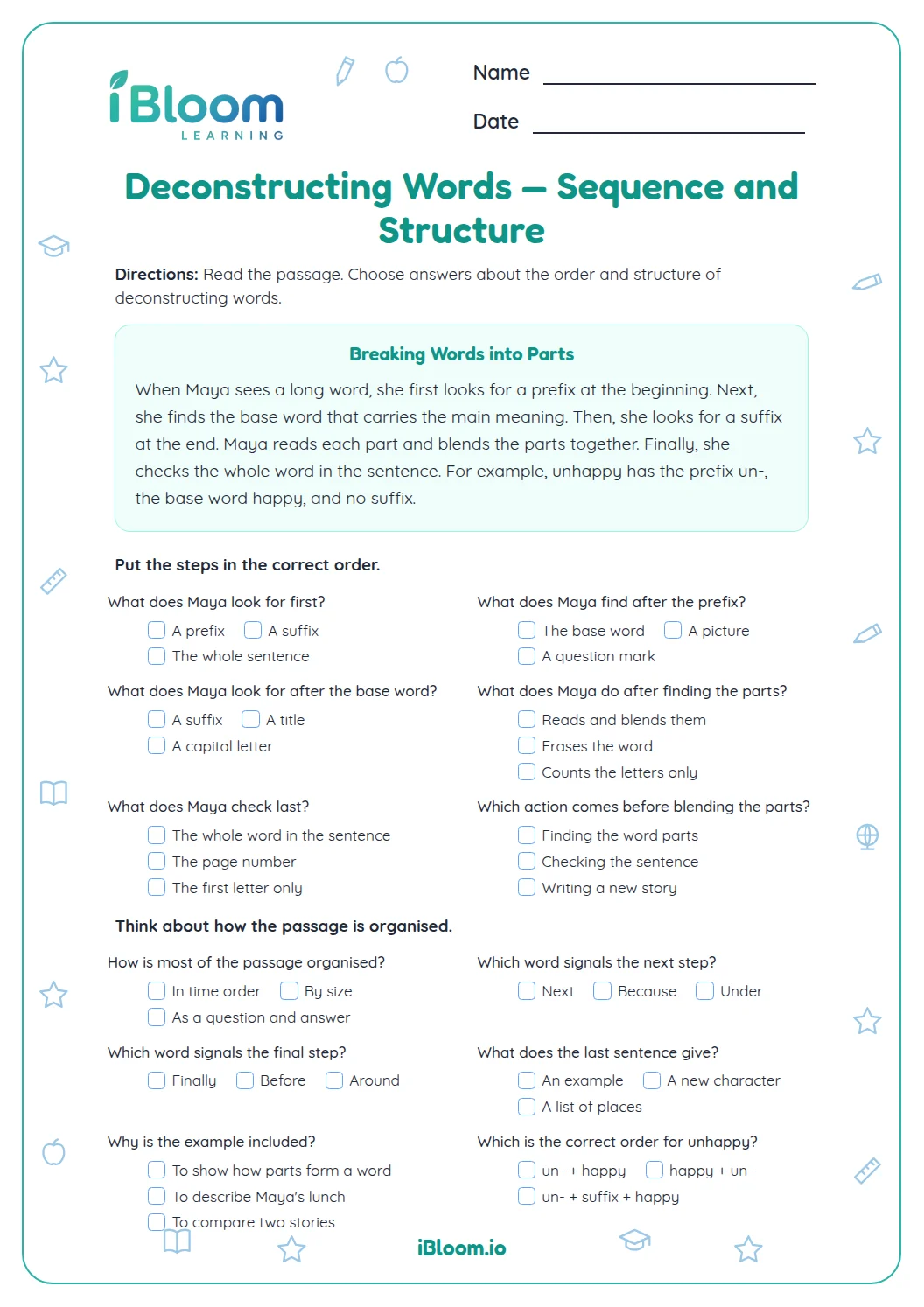
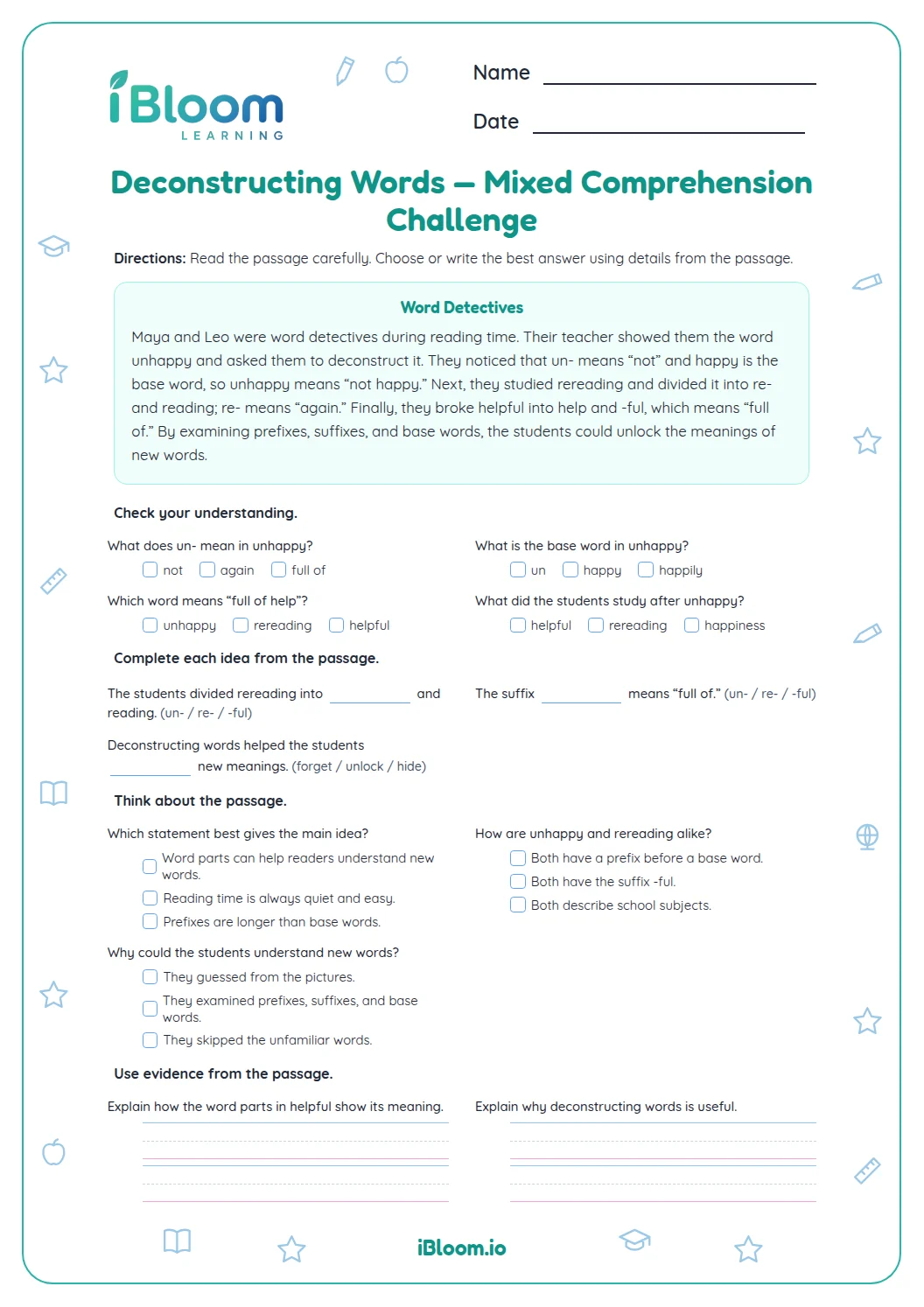
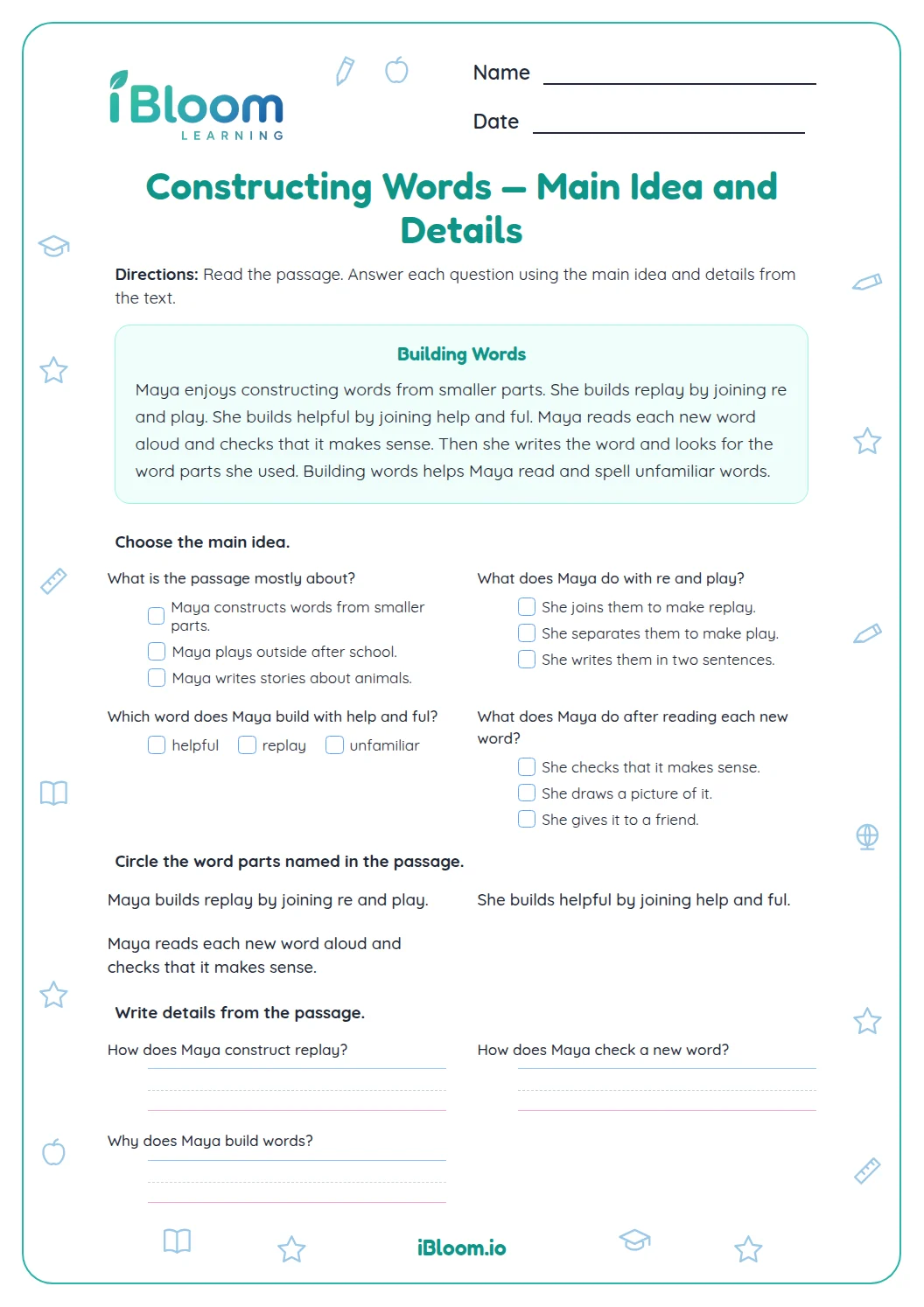
This Grade 3 printable pairs a short garden story with practice using prefixes and suffixes to infer word meanings. Children work with re-, un-, -ful, and -less in words such as rewrite, unhappy, helpful, and careless, then support answers with details from the passage. The 15 questions move from choosing meanings to explaining how a word part changes a base word. A separate answer key is included. The word study practices Common Core L.3.4b.
Aligned to L.3.4b
Which word parts appear in the story?
The passage uses re- in rewrite, un- in unhappy, and -ful in helpful and colorful. Children use these familiar parts to make a first guess, then check whether that meaning fits the sentence.
How can a reader check an inferred meaning?
Read the whole sentence and nearby details. For example, Maya makes an early sample so readers can see what to expect; the context clarifies that the word refers to a look beforehand.
How does one question work?
For question 1, remove re- from rewrite to find write. The prefix re- means again, so rewrite means write again.
- 1rewrite = re- + write
- 2re- means again
- 3Answer: again
How to use this worksheet
- 1Read the passage once for the main events.
- 2Underline a prefix, suffix, or unfamiliar word in each prompt.
- 3Use the word part to predict a meaning.
- 4Reread the sentence to see whether the meaning fits.
- 5Use a passage detail to support written answers.
- 6Check the key after completing all three parts.
Common mistakes and quick fixes
The mistake
Treating a prefix as the base word.
The fix
Separate the beginning word part, as in re- + write.
The mistake
Guessing from a word part without checking context.
The fix
Reread the sentence and test whether the meaning fits.
The mistake
Giving an inference without evidence.
The fix
Add a detail Maya does or says from the passage.
Curriculum alignment
Use a known prefix or suffix to determine the meaning of a new word.
On this sheet: Questions use re-, un-, and -ful/-less to determine meanings in the passage.
Show the official wordingHide the official wording
Determine the meaning of the new word formed when a known affix is added to a known word (e.g., agreeable/disagreeable, comfortable/uncomfortable, care/careless, heat/preheat).
What to practice next
Make more practice
Further reading
Questions parents and teachers ask
What prefixes does this worksheet practice?
It practices re- and un- in the passage. Children use re- to understand rewrite and un- to understand unhappy, then check each meaning against the surrounding sentence. The other questions focus on suffixes and passage evidence. Ask the child to point to the prefix or suffix before giving the meaning.
Which suffixes appear?
The passage includes -ful in helpful and colorful, and -less in careless. Children connect each ending with a meaning, then explain how it changes the base word. The answer key includes sample wording for open responses. Reread the full sentence together and compare its clue with the guessed meaning.
How many questions are included?
There are 15 questions across three parts: six multiple-choice items, six short answers, and three written responses. The first part focuses on meanings; later items ask learners to locate evidence and explain their reasoning. The passage supports answers about both word meaning and character actions.
Is the passage included?
Yes. The worksheet includes an original passage about Maya revising a garden story for a class display. Learners use its context to interpret words and answer evidence questions. Use the sentence around each word to check its meaning.
What is the answer key for?
The separate key lists answers for all 15 questions. For open responses, it gives sample answers so an adult can compare the reasoning while accepting other responses supported by the passage. Accept another example when the word part and passage detail support it.