





About this worksheet
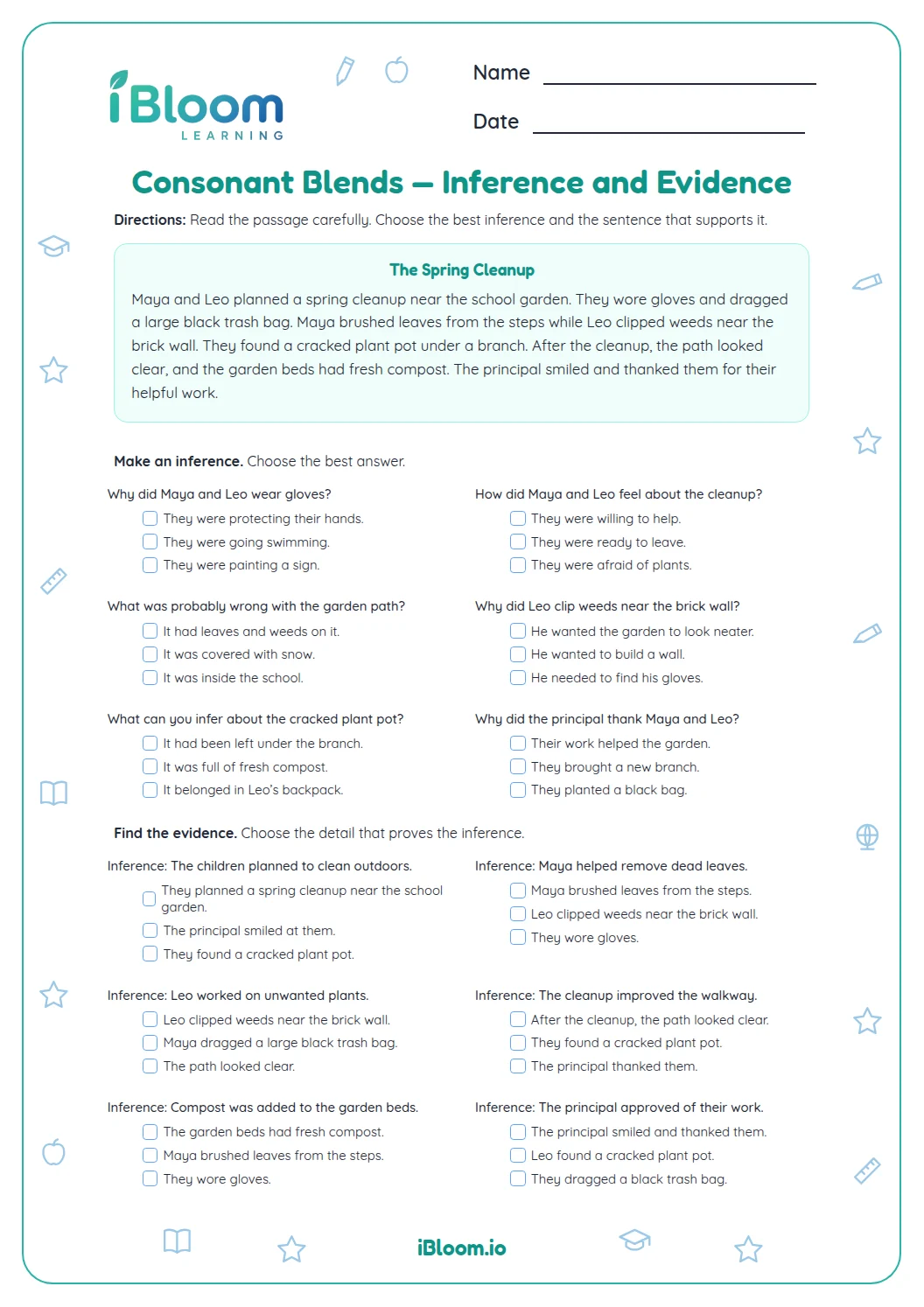
This free printable Grade 3 worksheet connects consonant blends with reading for meaning. Children read an original story about Mia and a garden club, identify the letters in blends, and use nearby words to understand sprouts, clump, crisp, and sturdy. The passage is Part A; Parts B through D contain fourteen questions, including two short written responses. It practices phonics and word analysis in CCSS RF.3.3 and sentence context in L.3.4a. The printed directions ask children to say spring, plant, and crisp before reading the story. A separate answer key includes sample responses.
Aligned to RF.3.3 and L.3.4a
What makes spr in sprouts a blend?
A consonant blend has neighboring consonants whose sounds can still be heard. In sprouts, children say the sounds for s, p, and r together before finishing the word. The story also uses beginning blends in spring and crisp, and ending blends in plant and clump.
Before reading, say spring, plant, and crisp slowly together. Then say each word at a normal speaking pace. This gives children a brief sound warm-up without taking away the vocabulary questions that follow.
How does the story explain unfamiliar words?
The passage places helpful wording close to each target word. Sprouts are described as tiny new plants. A clump is a group of plants growing close together. For crisp, the crunch of the carrot gives a sensory clue.
- 1Question: What does sprouts mean here?
- 2Story clue: “tiny new plants”
- 3Answer: tiny new plants
- 4Read the sentence again with that meaning in place of sprouts.
How are the reading tasks arranged?
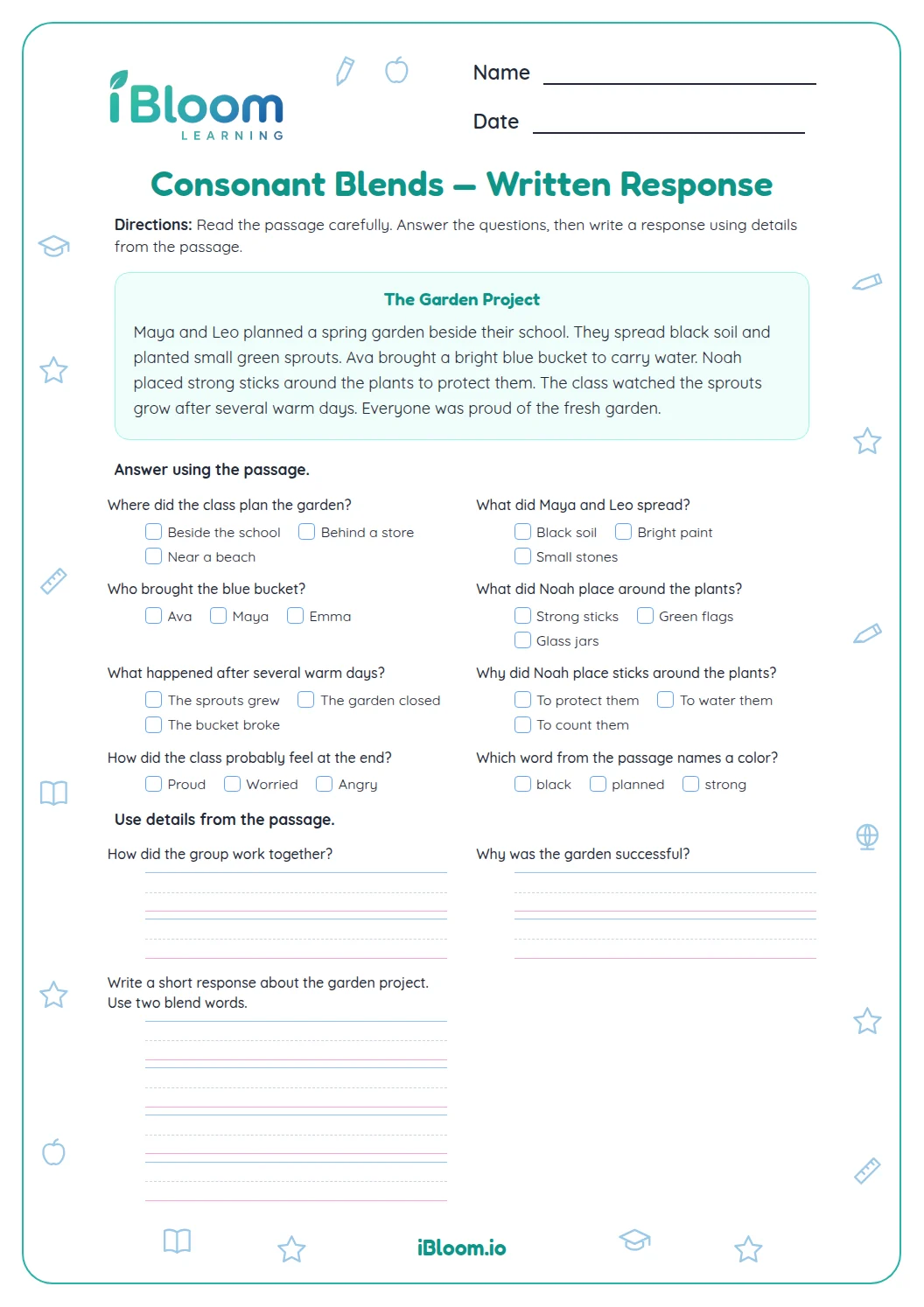
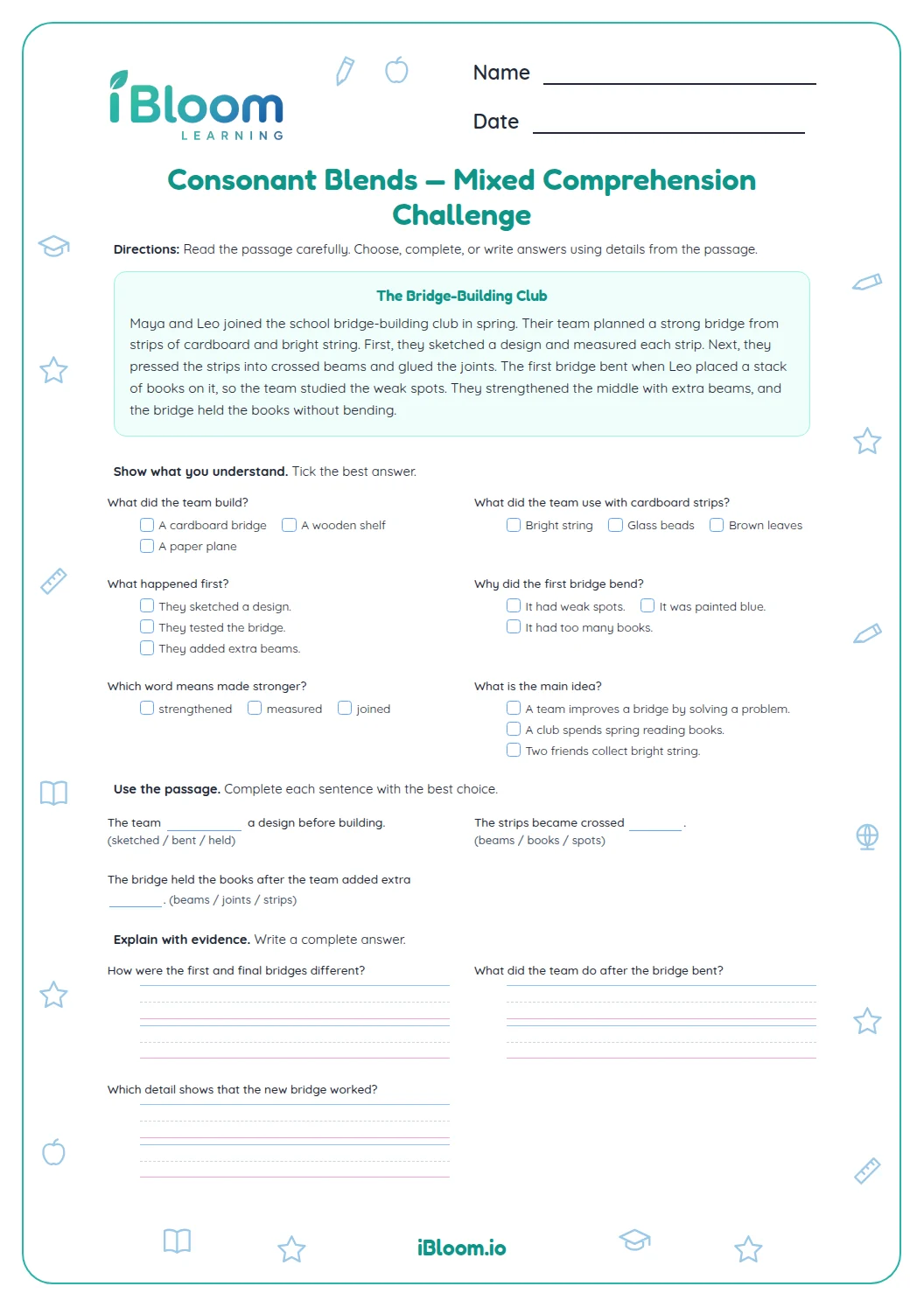
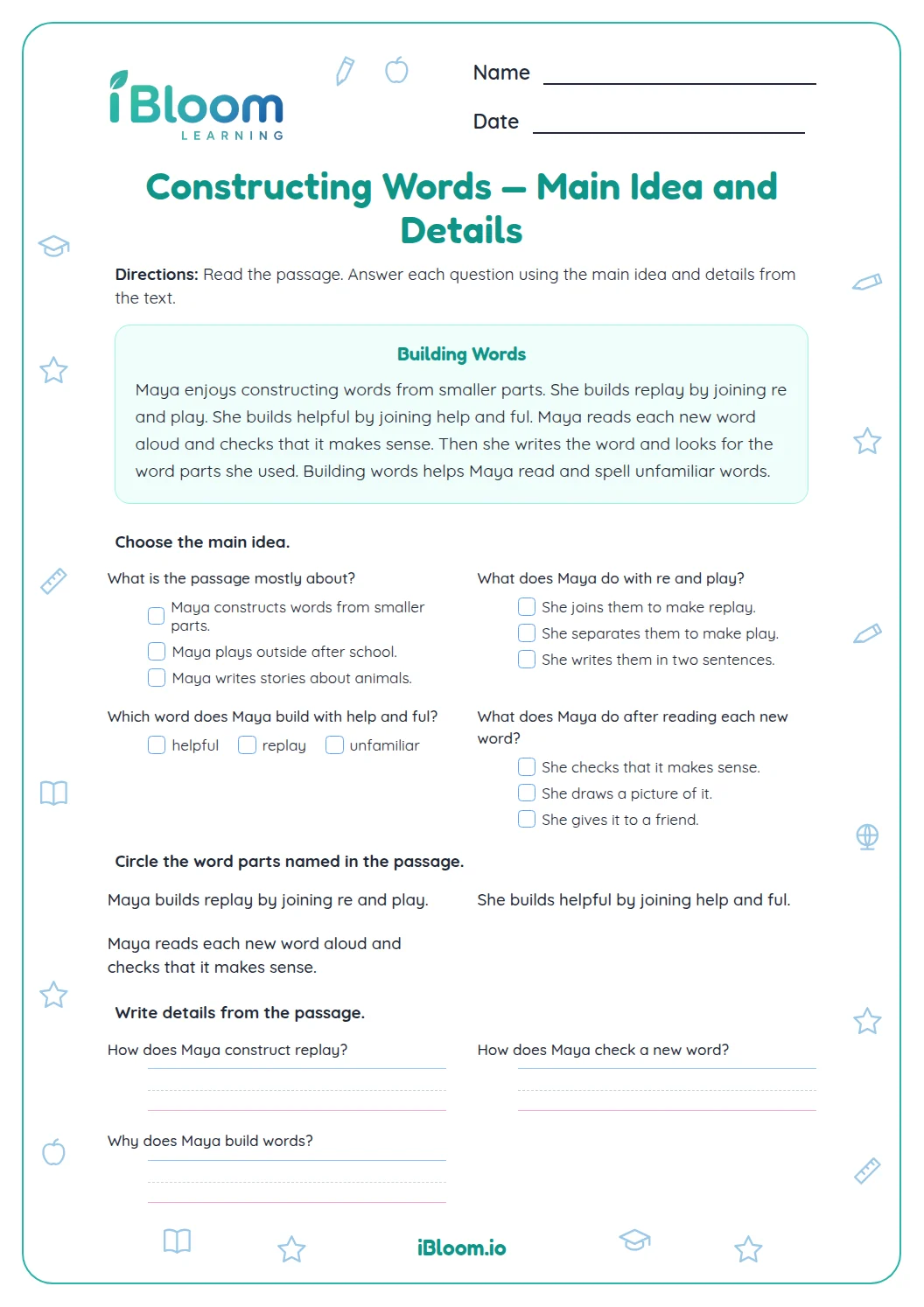
Part A presents the garden-club story. Part B has seven multiple-choice questions about beginning and ending blends. Part C asks children to choose four word meanings and one story detail using clues in the text.
Part D asks children to copy the clue that explains sturdy and to write a sentence using sprouts with its garden meaning. The answer key gives a model for both tasks; a new sentence can differ from the model and still be correct.
Read, listen, and check meaning
- 1Read the title, then say spring, plant, and crisp aloud.
- 2Read Part A, pausing at each paragraph to picture what Mia and the club do.
- 3For Part B, say each target word slowly before choosing its blend.
- 4In Part C, find each vocabulary word in the passage and reread its sentence.
- 5Check Part D for an accurate clue and a sentence in which sprouts means young plants.
Mistakes to notice and how to help
The mistake
Choosing sp as the complete beginning blend in spring.
The fix
Say all three beginning consonant sounds: s, p, r. The complete beginning blend is spr.
The mistake
Treating clump as one plant.
The fix
Reread the explanation that a clump is a group of plants close together.
The mistake
Using sprouts as a verb in the final sentence.
The fix
The prompt asks for the garden meaning from the story. Use sprouts as the name for young plants, such as “The sprouts need water.”
Common Core alignment
Read words with beginning and ending consonant blends.
On this sheet: Children read blend words in the passage and identify their consonant patterns.
Show the official wordingHide the official wording
Know and apply grade-level phonics and word analysis skills in decoding words.
Use clues in the garden story to work out word meanings.
On this sheet: Questions about sprouts, clump, crisp, and sturdy require sentence-level context.
Show the official wordingHide the official wording
Use sentence-level context as a clue to the meaning of a word or phrase.
What to practice next
Make more practice
Further reading
Questions parents and teachers ask
Does this sheet include a story?
Yes, Part A contains an original story about Mia helping a garden club. The story supplies the words and details used in the questions, so children can return to the same text to check both spelling patterns and meanings. Its three paragraphs follow planting, thinning, and caring for young plants.
Which consonant blends do children identify?
Children identify spr, cl, nt, st, gr, sp, and str in seven sound-pattern questions. These appear at the beginning or end of words such as spring, clump, plant, sticks, green, crisp, and straight. Saying the whole word slowly helps children hear each consonant before they choose the letters.
What should children do before reading?
Say the title and a few target words aloud together. Spring, plant, and crisp give practice with a three-letter beginning blend and two ending blends. After this brief warm-up, let children read the passage and use its explanations to solve the vocabulary questions themselves.
How should I mark the written responses?
Check whether the first response copies the clue that explains sturdy and whether the second uses sprouts to mean young plants. The key gives examples, but the final sentence can be different. A sentence such as “We watered the sprouts” uses the intended meaning correctly.
Can I read the passage aloud to my child?
Yes, you can read it aloud once and then ask your child to reread the target sentences. Keep the blend work active by having your child say the words and identify their letters. For vocabulary, ask which nearby words helped rather than supplying the meaning immediately.