







About this worksheet
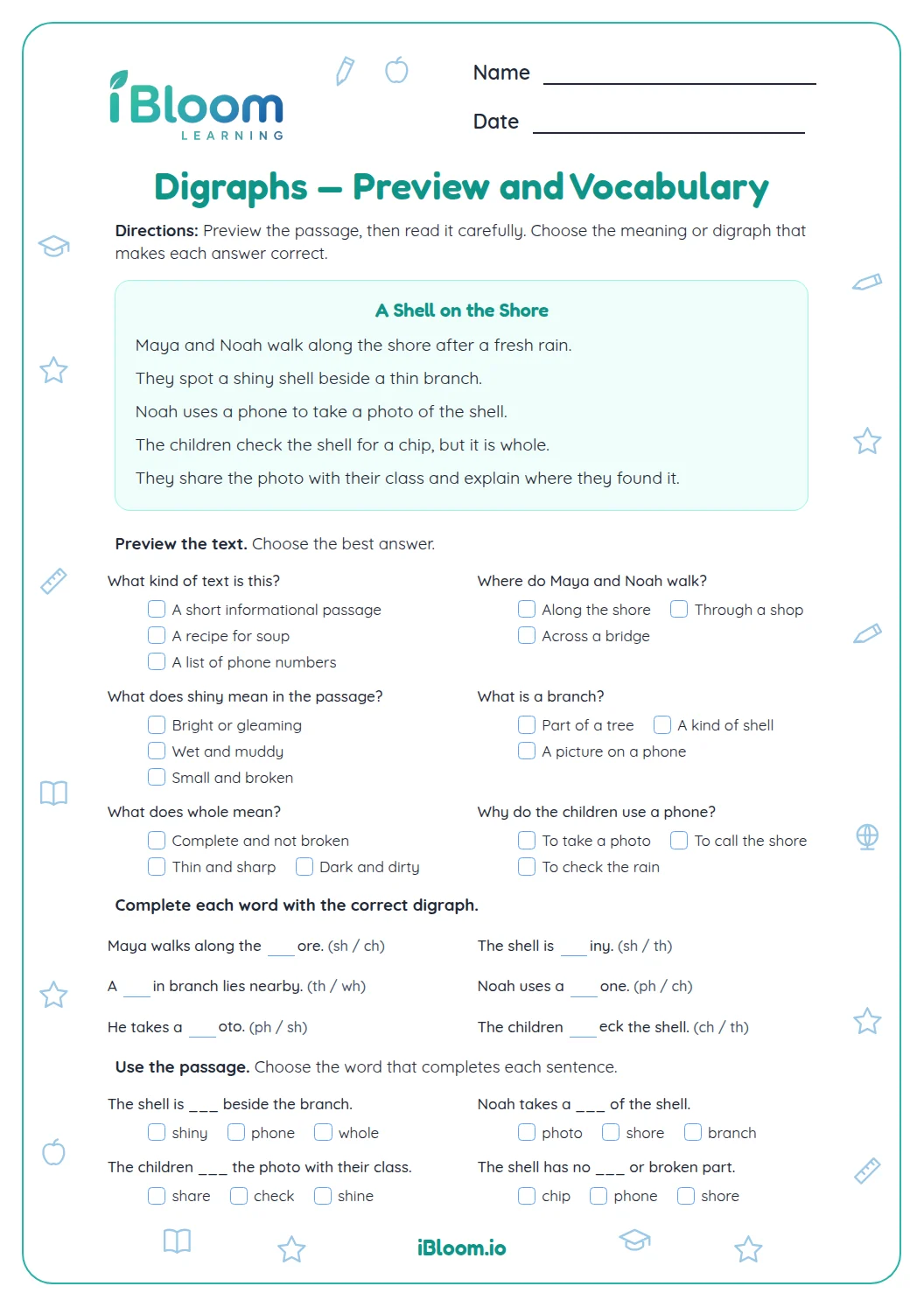
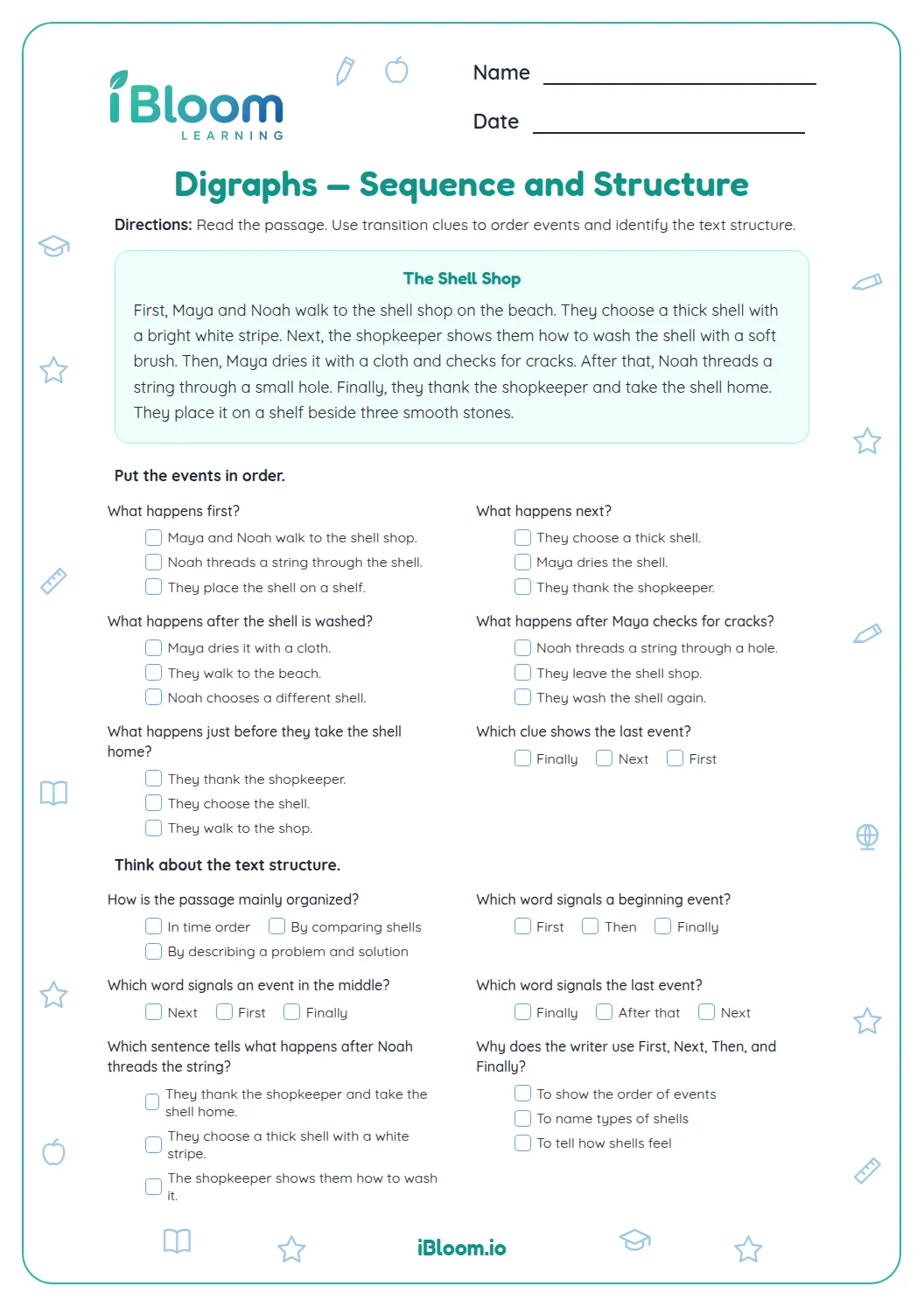
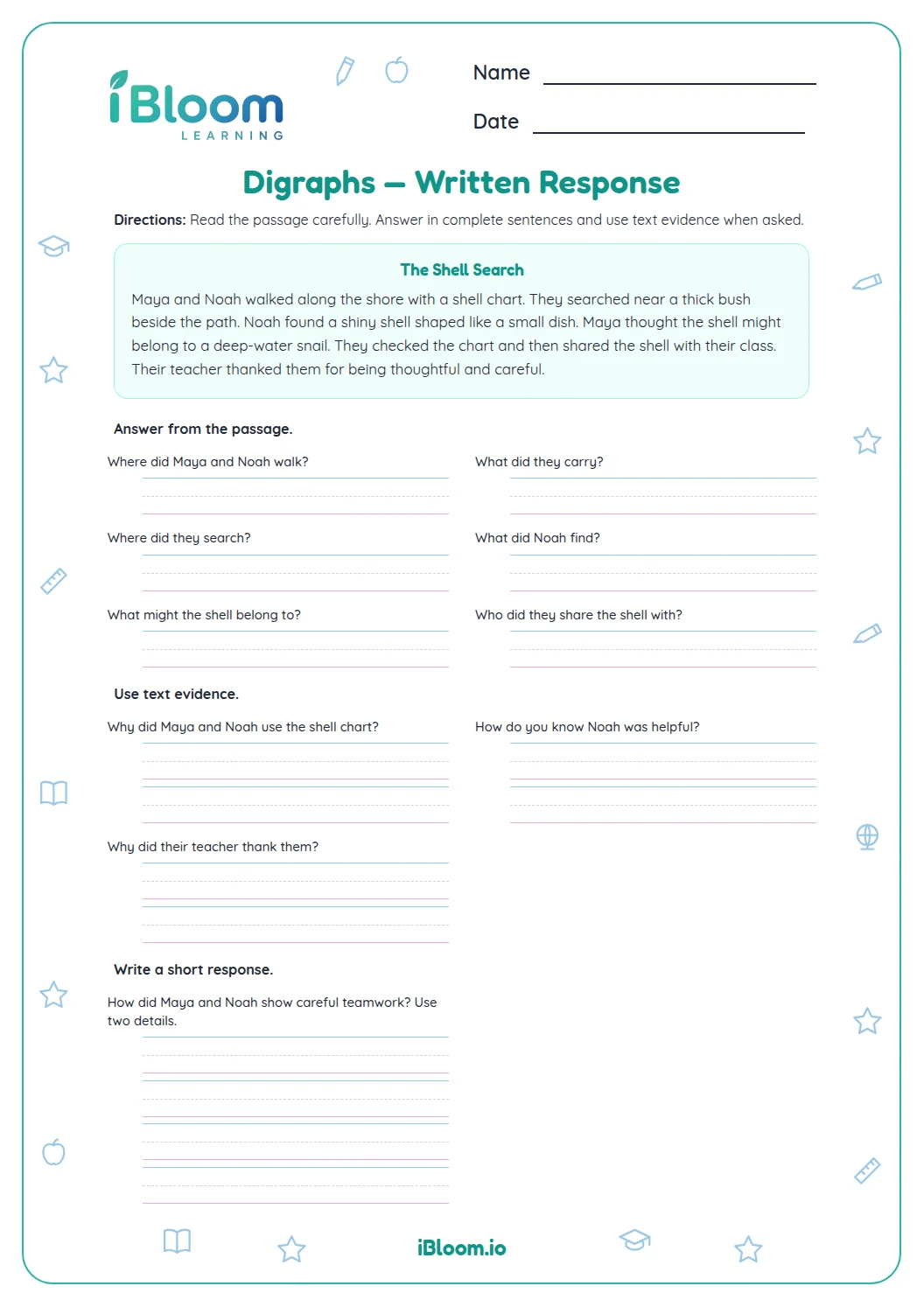
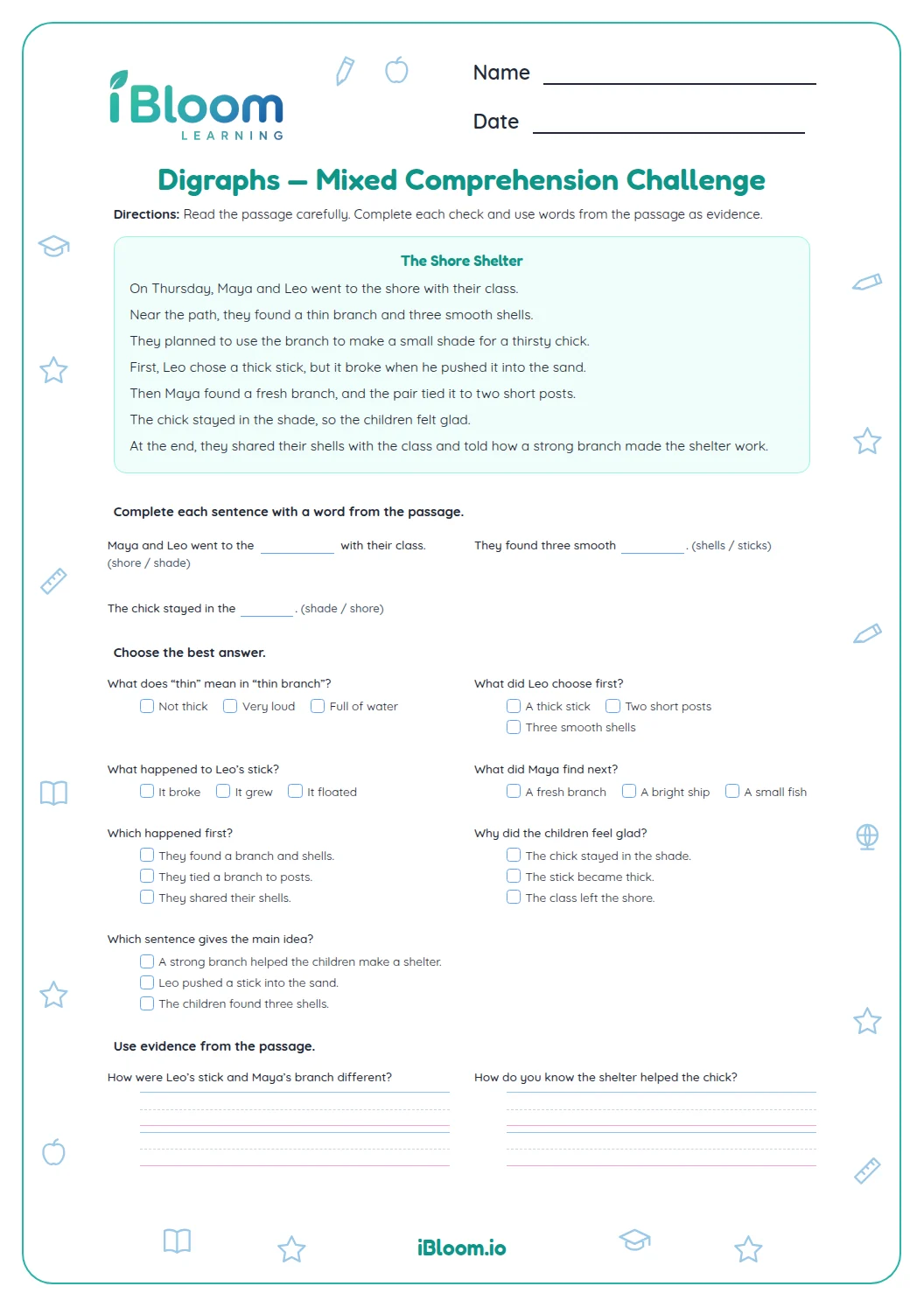
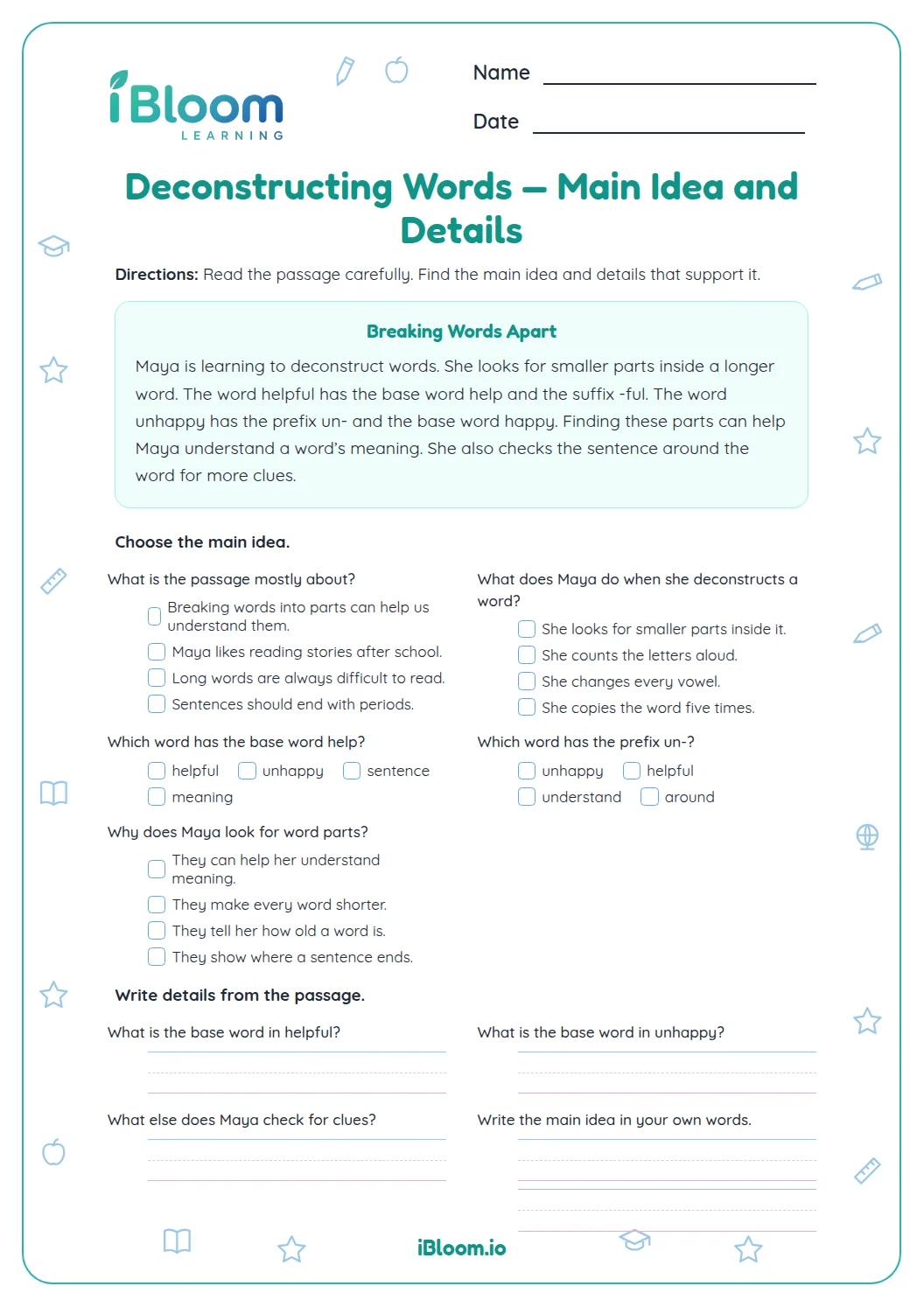
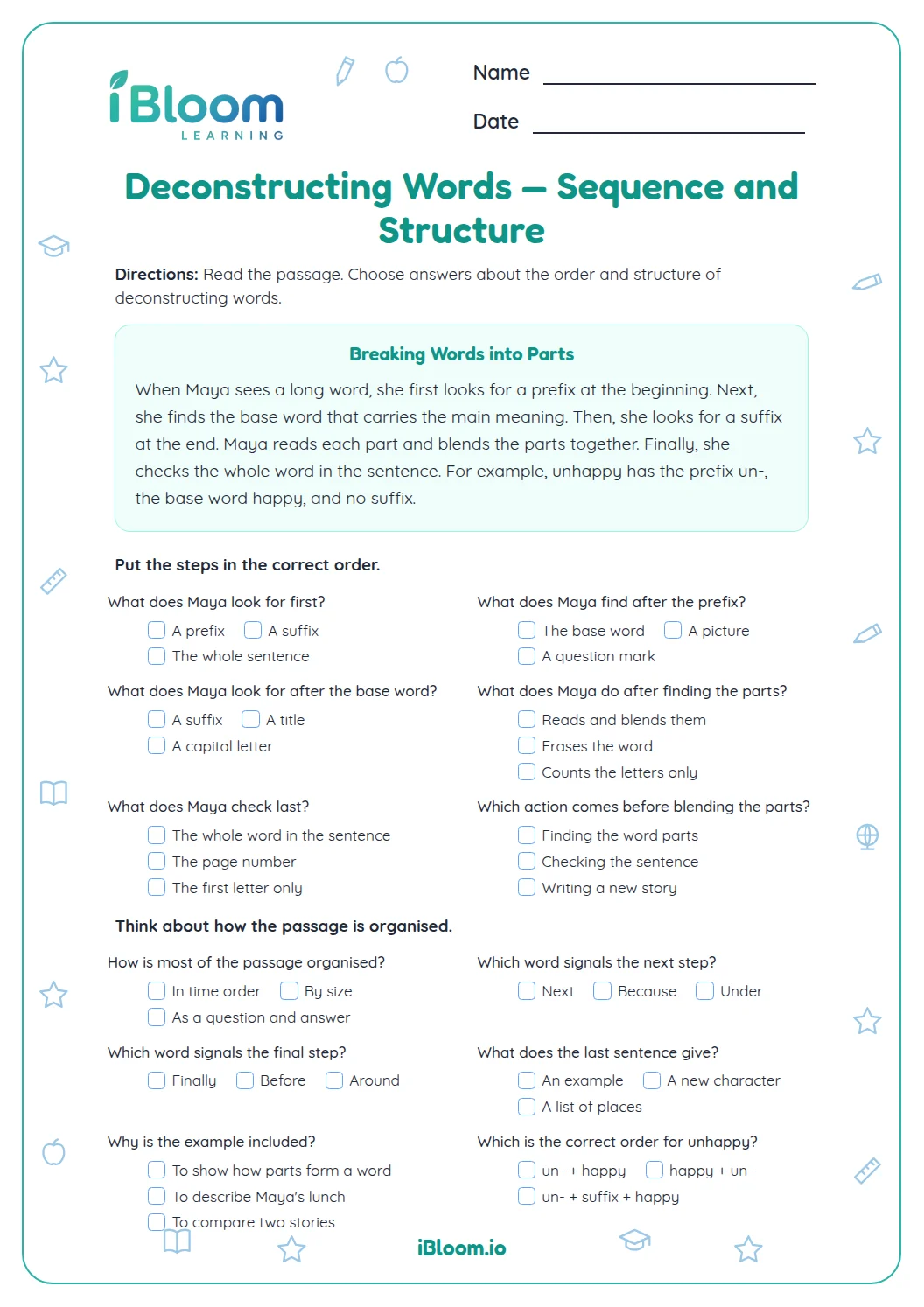
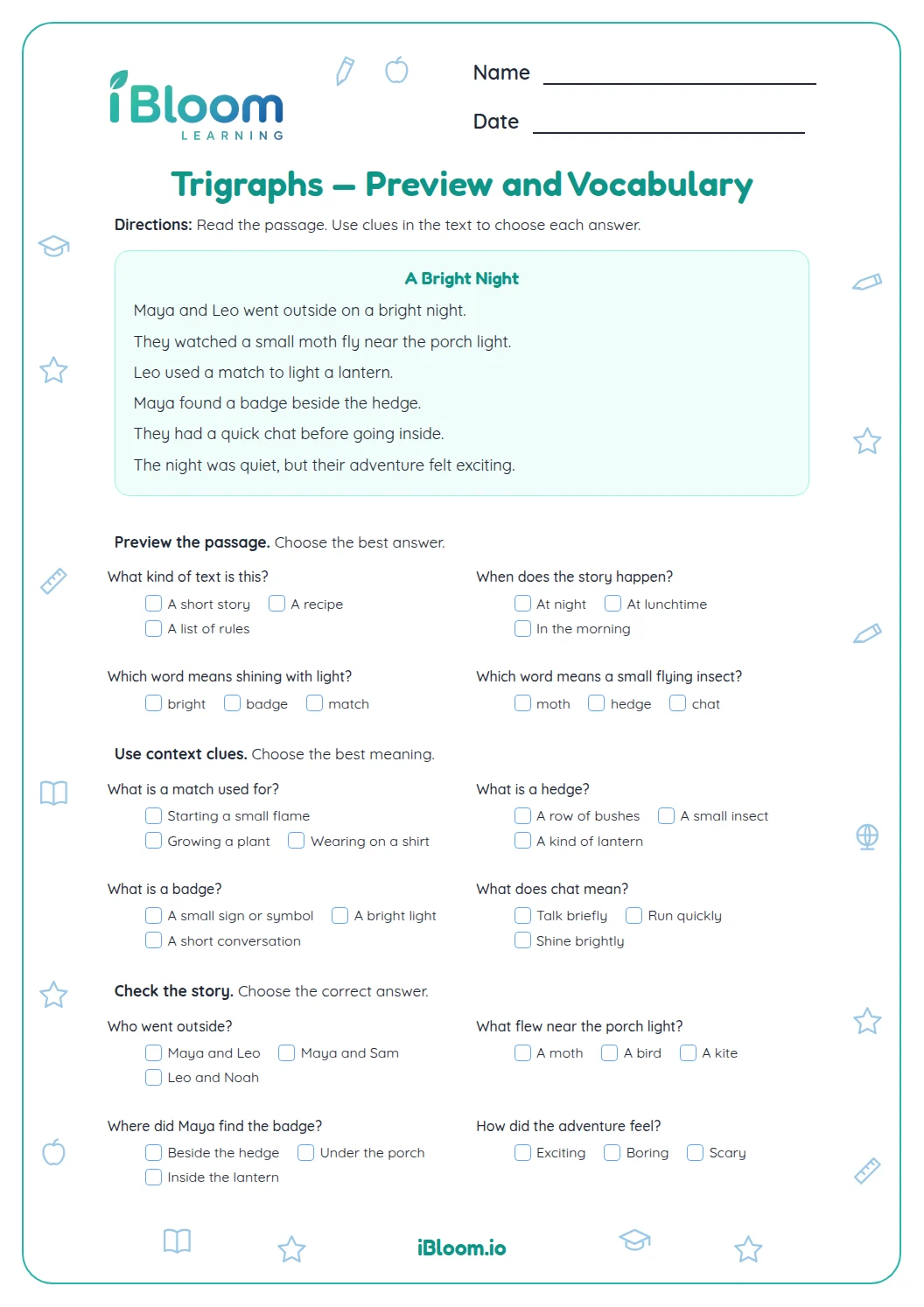
This free Grade 3 printable pairs a short informational passage with questions about its main idea and supporting details. Students follow a class as it collects words with sh, ch, th, and wh, then uses sound clues to sort them. Parts B and C ask readers to choose evidence and explain the passage in their own words. The work practices CCSS RI.3.2 by determining a main idea, recounting details, and explaining how details support it. A separate answer key includes sample responses for the written questions.
Aligned to RI.3.2
What is on this worksheet?
A new informational passage follows students as they search books, signs, and classroom materials for words with sh, ch, th, and wh. The passage connects the phonics focus to a clear reading purpose: gather examples, sort them, and check their sounds.
Part A is the passage. Part B has ten multiple-choice questions about its central idea, events, vocabulary, and useful evidence. Part C has four written responses that ask students to state the main idea and support it with details.
- Part A: Read the original passage, “The Digraph Hunt.”
- Part B: Answer 10 selected-response questions.
- Part C: Write 4 evidence-based responses.
- Use the separate answer key to check selections and compare written answers with samples.
How can a reader find the main idea?
Ask what the whole passage is mostly teaching or explaining. The main idea should fit more than one sentence; a detail such as finding a word at the fish tank is too narrow.
For question 1, the best choice is “A class charts digraph words.” It covers the word search, sorting, and sound checking across the passage.
- 1Question 1: How a class made a chart to study digraphs.
- 2Why it fits: The class collects words, sorts them by spelling, and checks their sounds.
Which details support the main idea?
A supporting detail tells what the students did or learned while making the chart. Question 10 asks for evidence of careful checking. The passage says they said each word slowly and pointed to the two letters that made one sound.
The word school is another useful example. Students listen again and leave it off the ch list because its first sound is /sk/. This event shows the class applying the check described in its rule: look at the letters, then listen to the sound.
- 1Question 10: They said each word slowly.
- 2The passage adds that they pointed to the two letters that made one sound.
How does the passage connect digraphs to comprehension?
Readers need to understand both what a text says and how its examples fit together. Here, the digraph examples are details in a larger explanation about the class’s search and sorting process.
Invite students to point out the letters and say the sound as they reread. This keeps the phonics detail tied to the passage rather than turning the task into a disconnected word list.
How to use this worksheet
- 1Read the passage once for the overall event: what the class is trying to do.
- 2Reread and mark the words with sh, ch, th, or wh.
- 3Answer Part B by crossing out choices that describe just one detail or a different topic.
- 4For Part C, answer in complete sentences and include passage details.
- 5Compare responses with the key; accept other accurate wording that uses evidence.
Common mistakes and quick fixes
The mistake
Choosing one interesting event, such as the fish tank, as the main idea.
The fix
Check whether the choice covers the whole passage, including collecting, sorting, and checking words.
The mistake
Treating every word with two neighboring consonants as a digraph.
The fix
Read the sound: the two letters in a digraph work together for one sound. In school, s and c represent separate sounds /s/ and /k/.
The mistake
Giving an answer without pointing to a passage detail.
The fix
Ask which sentence proves the answer. Include a concrete example, such as the class finding shell in a sea story.
Common Core alignment
The questions ask students to determine the passage’s main idea and use details to explain it.
Name the passage’s main idea and explain it with details about the class digraph hunt.
On this sheet: Parts B and C identify the central idea, recall events, and connect examples to that idea.
Show the official wordingHide the official wording
Determine the main idea of a text; recount the key details and explain how they support the main idea.
What to practice next
Make more practice
Further reading
Questions parents and teachers ask
What is a digraph?
A digraph is a pair of letters that works together to spell one sound, as sh does in ship. The passage includes sh, ch, th, and wh examples. Students also consider school, which begins with /sk/ rather than a ch sound, so they compare spelling with what they hear.
What is the main idea of the passage?
The main idea is that a class searches for words with digraphs, sorts them, and checks their sounds to make a useful chart. Details include finding shell in a sea story and leaving school off the ch list after listening again.
How many questions are on the worksheet?
There are 14 questions: ten multiple-choice questions and four written responses. The multiple-choice section checks comprehension of the passage, while the written section asks students to state the main idea and use details as evidence from the text.
Does the answer key include sample written answers?
Yes. The key gives one sample response for each written question. Students may phrase an answer differently as long as it matches the passage, answers the question, and includes an accurate detail from the digraph hunt. It is a model, not a required script.
How should students answer the written questions?
Use a complete sentence and include a detail from the passage when the question asks for evidence. For example, students can say the class found splash on a fish-tank sign. The key’s samples show one clear way to respond.
What can students practice next?
After this page, students can compare digraphs with consonant blends, build and break apart words, or study diphthongs and trigraphs. These related phonics pages continue practice noticing how letters work together to represent sounds in words. Choose a topic your reader is ready to explore.