





About this worksheet
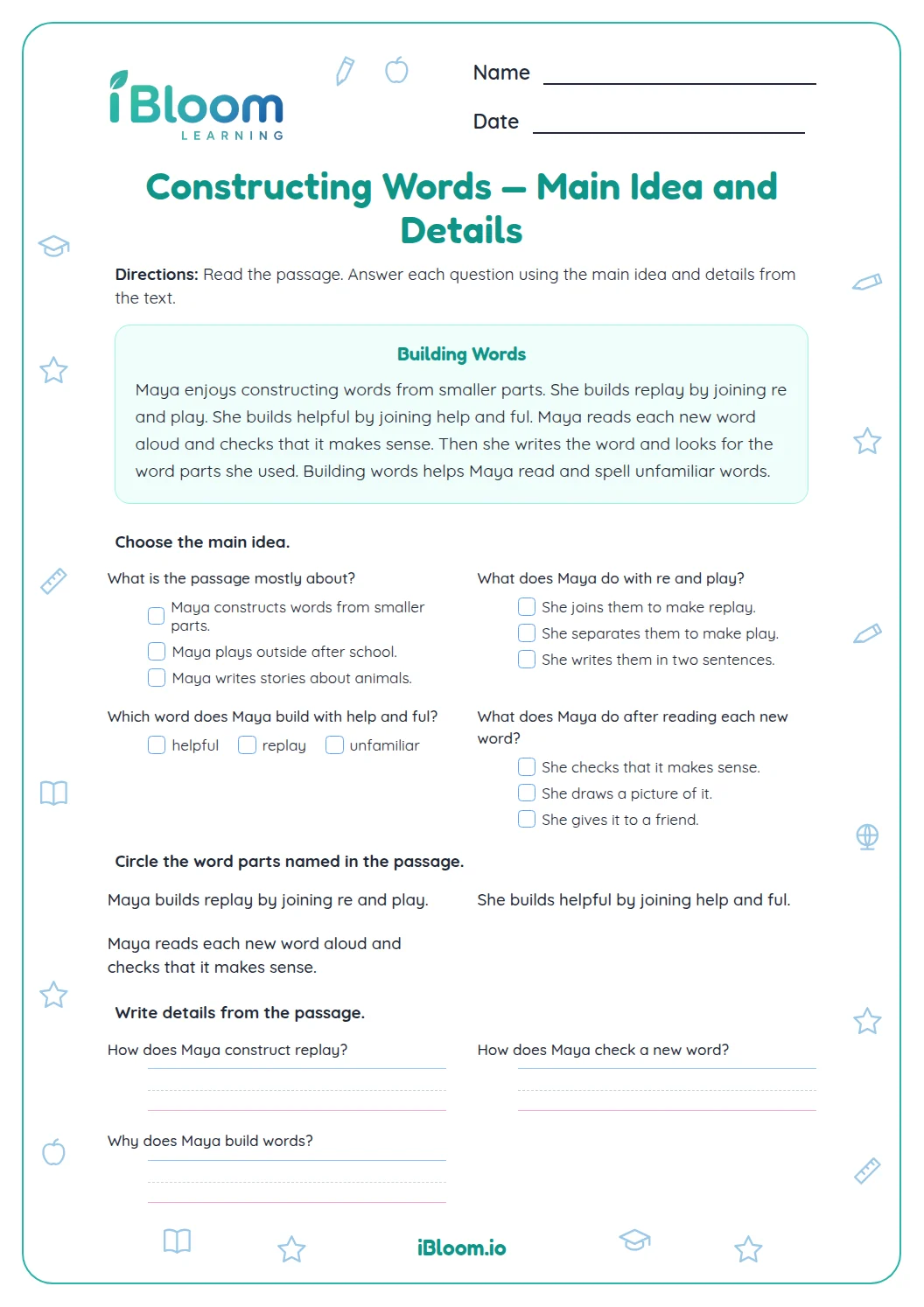
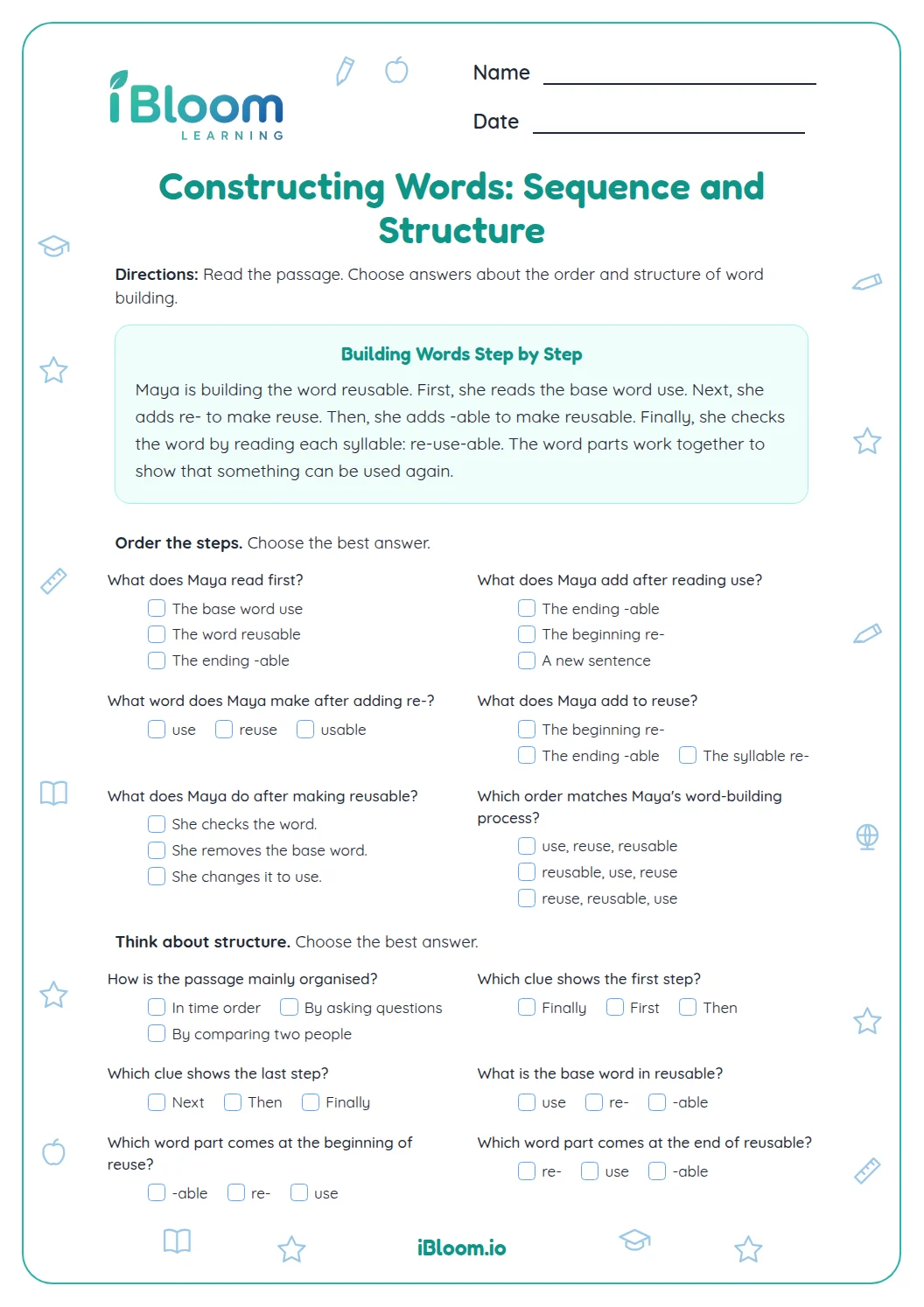
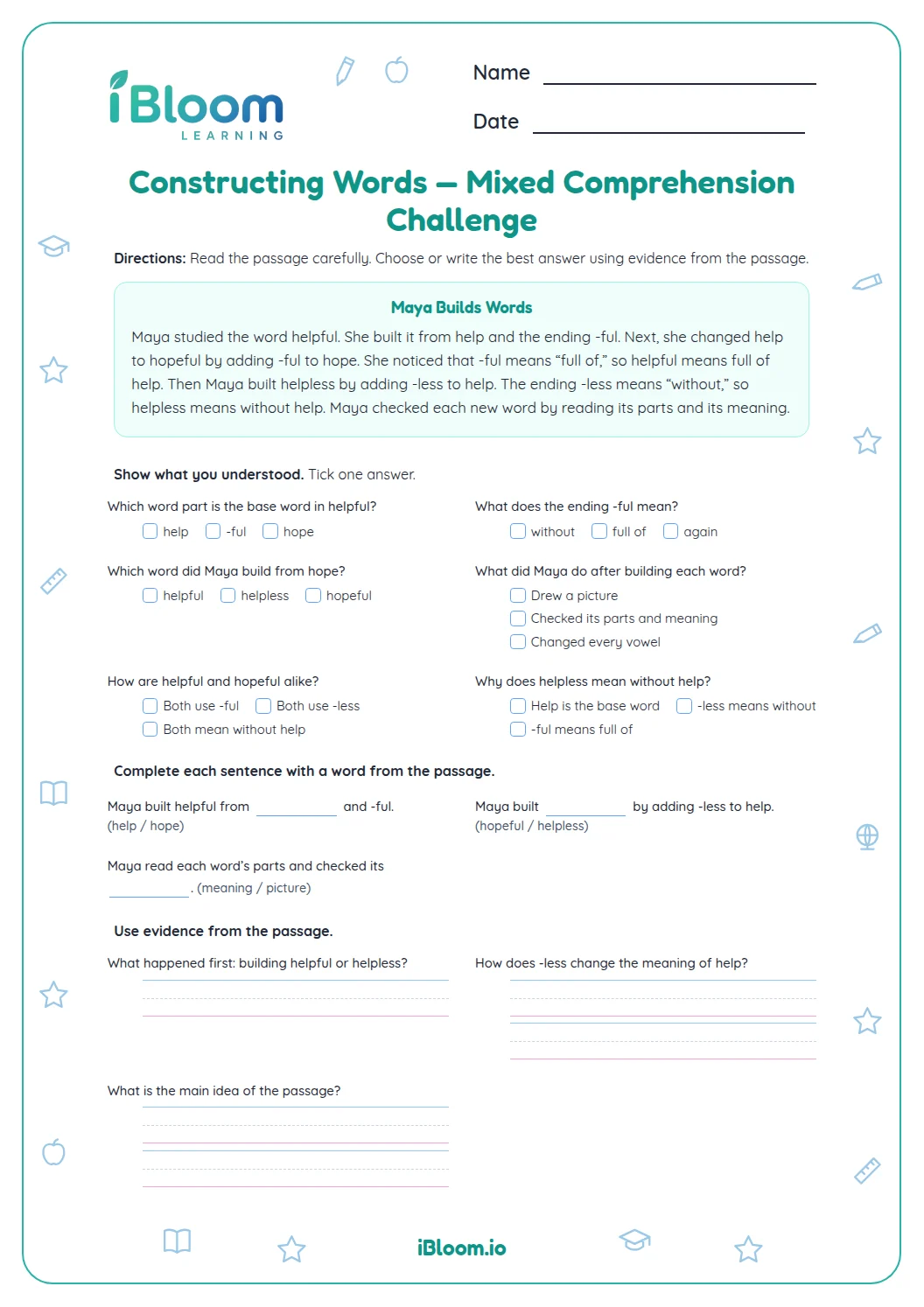
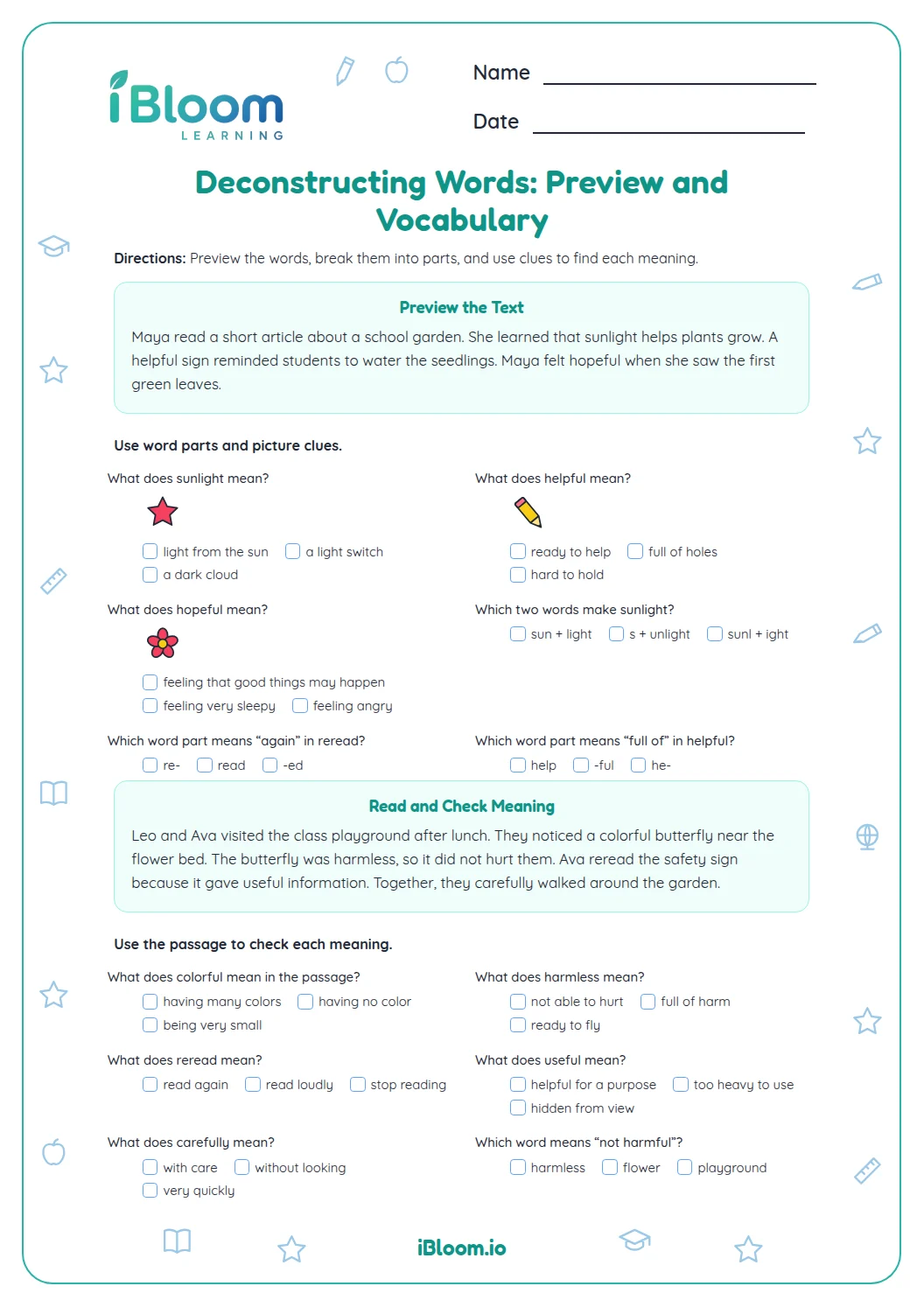
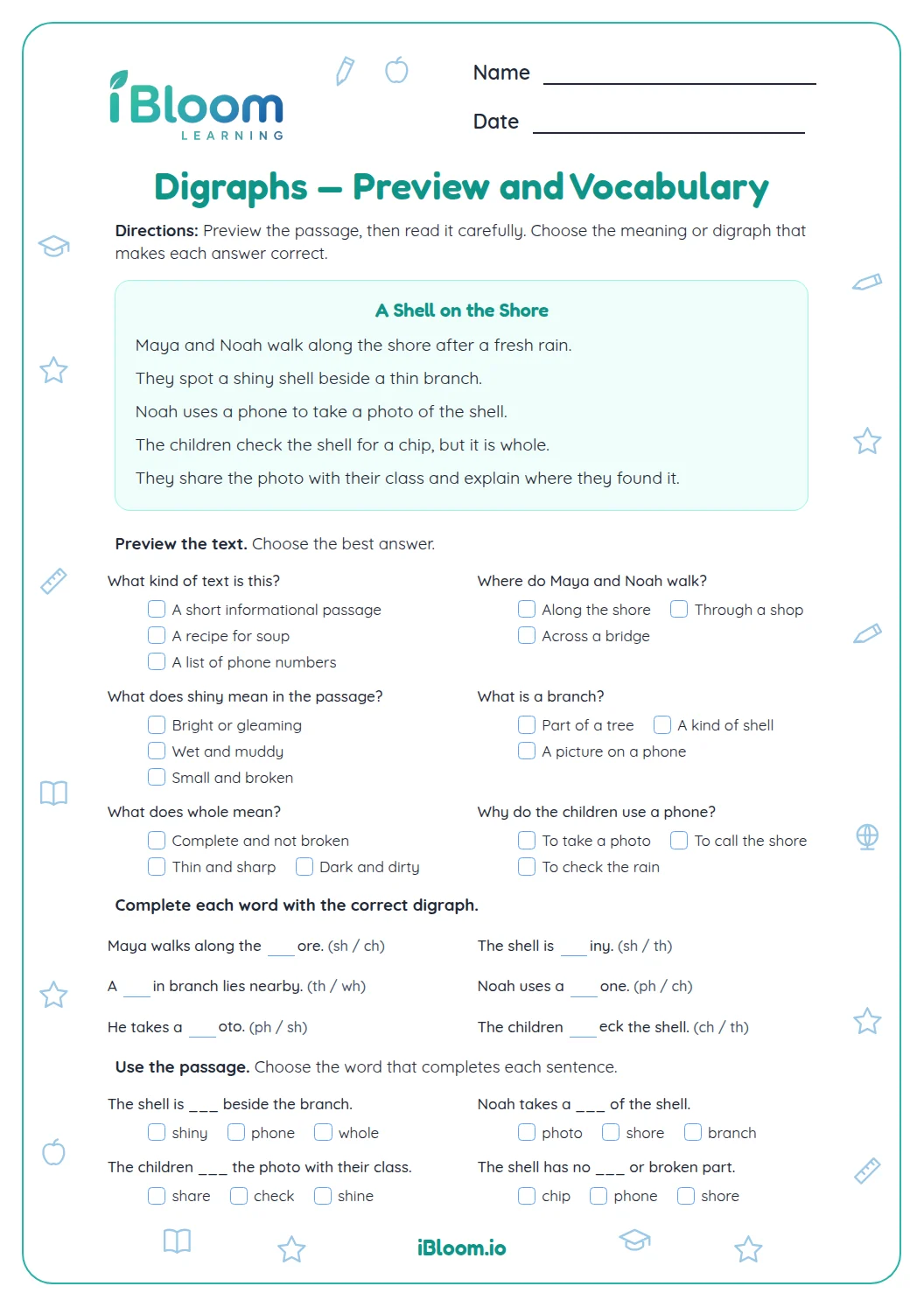
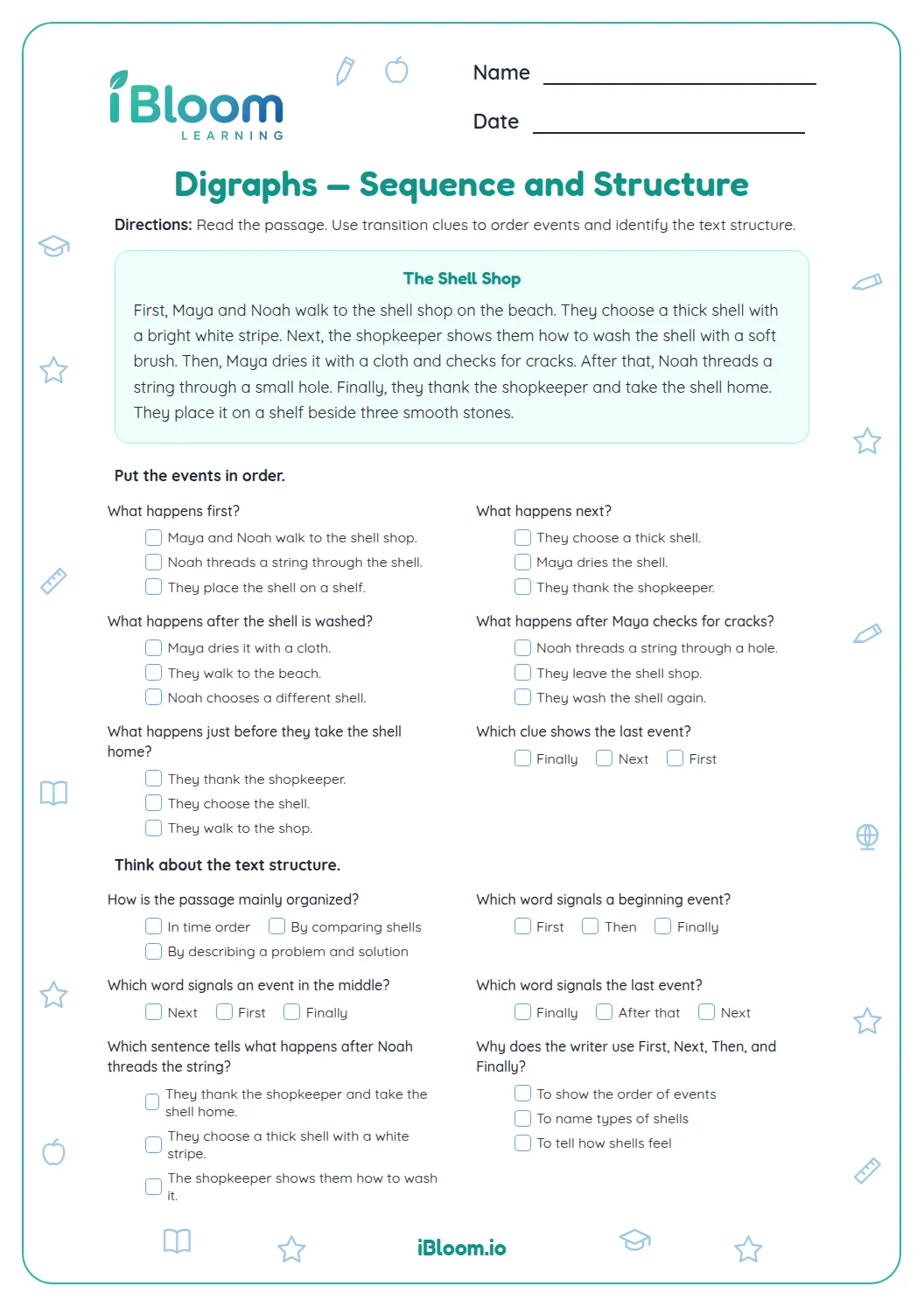
This free Grade 3 reading worksheet pairs an original passage about Maya and Leo’s Build-a-Word Club with practice in prefixes, suffixes, and vocabulary. Children identify base words and affixes, explain how a word part changes meaning, and build two new words. It includes 15 questions on three worksheet pages and a separate three-page answer key. The word-analysis work practices RF.3.3.
Aligned to RF.3.3 and L.3.4a
How do prefixes and suffixes build words?
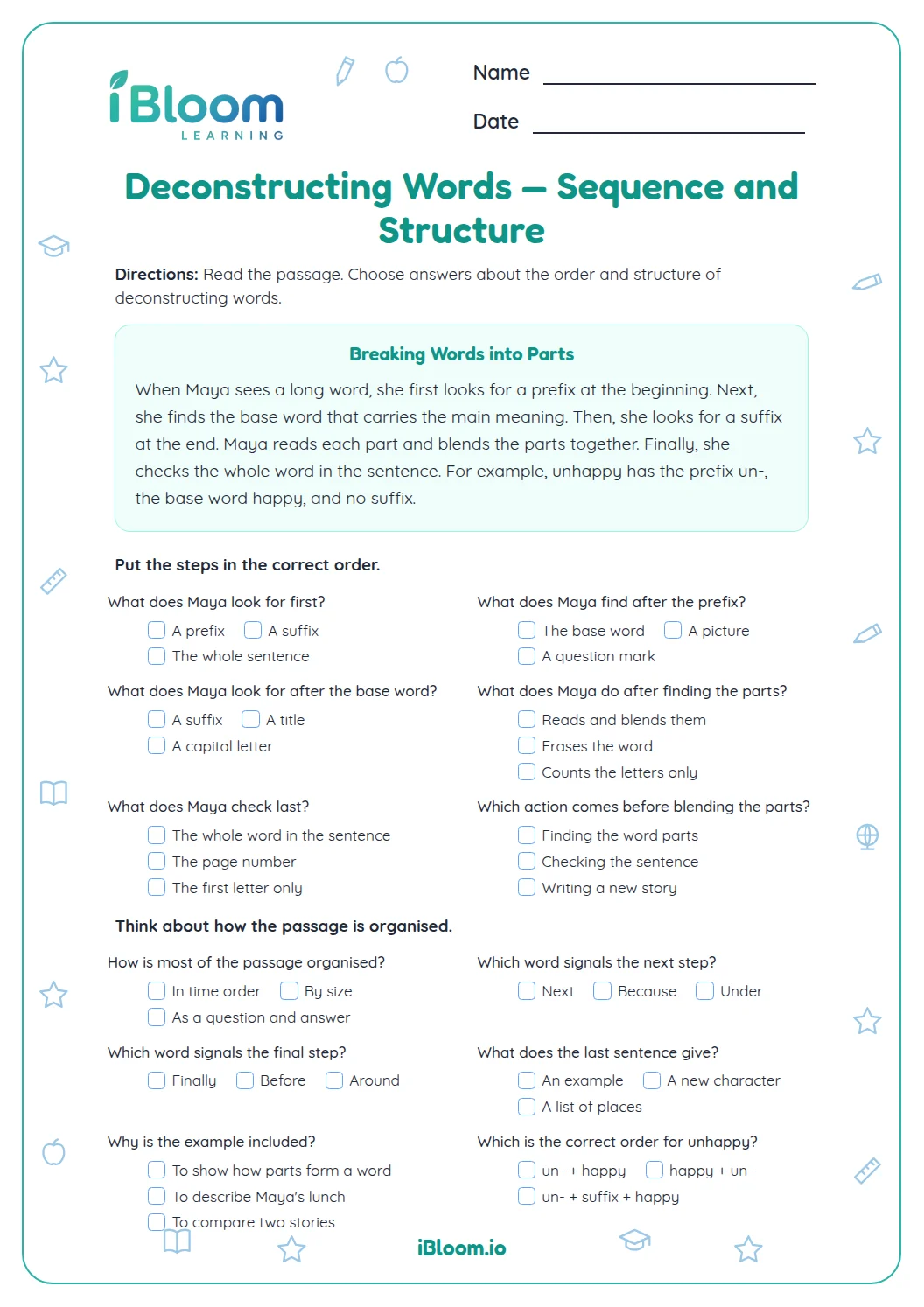
A prefix comes before a base word and a suffix comes after it. The passage shows how re- changes play to replay and how -ful changes help to helpful.
How does replay show the meaning of re-?
The prefix re- means again. Joining it to play makes replay, a word that means to play again.
- 1re- + play = replay
- 2re- means again.
- 3Replay means play again.
What does the passage and worksheet include?
The passage follows Maya and Leo as they build and explain words. Questions 1–9 check passage details and word-part meanings, Questions 10–13 ask for short explanations, and Questions 14–15 apply the parts to new words.
How can a reader check a new word?
Separate the prefix or suffix from the base word. Use the word-part meaning and the sentence together, then see whether the full word makes sense.
How to work with word parts
- 1Read the passage once to follow Maya and Leo’s activity.
- 2Reread the sentence containing the target word.
- 3Mark the base word and any prefix or suffix.
- 4Use the word part and sentence context to explain the meaning.
- 5For the last two items, join the given parts and read the new word.
Common word-part mix-ups
The mistake
Treating re- as an ending.
The fix
A prefix comes before the base word: re- + play.
The mistake
Leaving out the base word when explaining a suffix.
The fix
Name both parts, as in help + -ful = helpful.
The mistake
Guessing a word meaning from its ending alone.
The fix
Combine the word-part clue with the sentence where the word appears.
Common Core alignment
Recognize and use common prefixes and suffixes to read and build words.
On this sheet: Questions identify prefixes, suffixes, and base words, then combine word parts to form words.
Show the official wordingHide the official wording
Know and apply grade-level phonics and word analysis skills in decoding words.
Use sentence context together with word parts to clarify word meaning.
On this sheet: The passage and questions use sentence context to confirm the meanings of constructed words.
Show the official wordingHide the official wording
Use sentence-level context as a clue to the meaning of a word or phrase.
What to practice next
Make more practice
Further reading
Questions parents and teachers ask
What word parts appear in the passage?
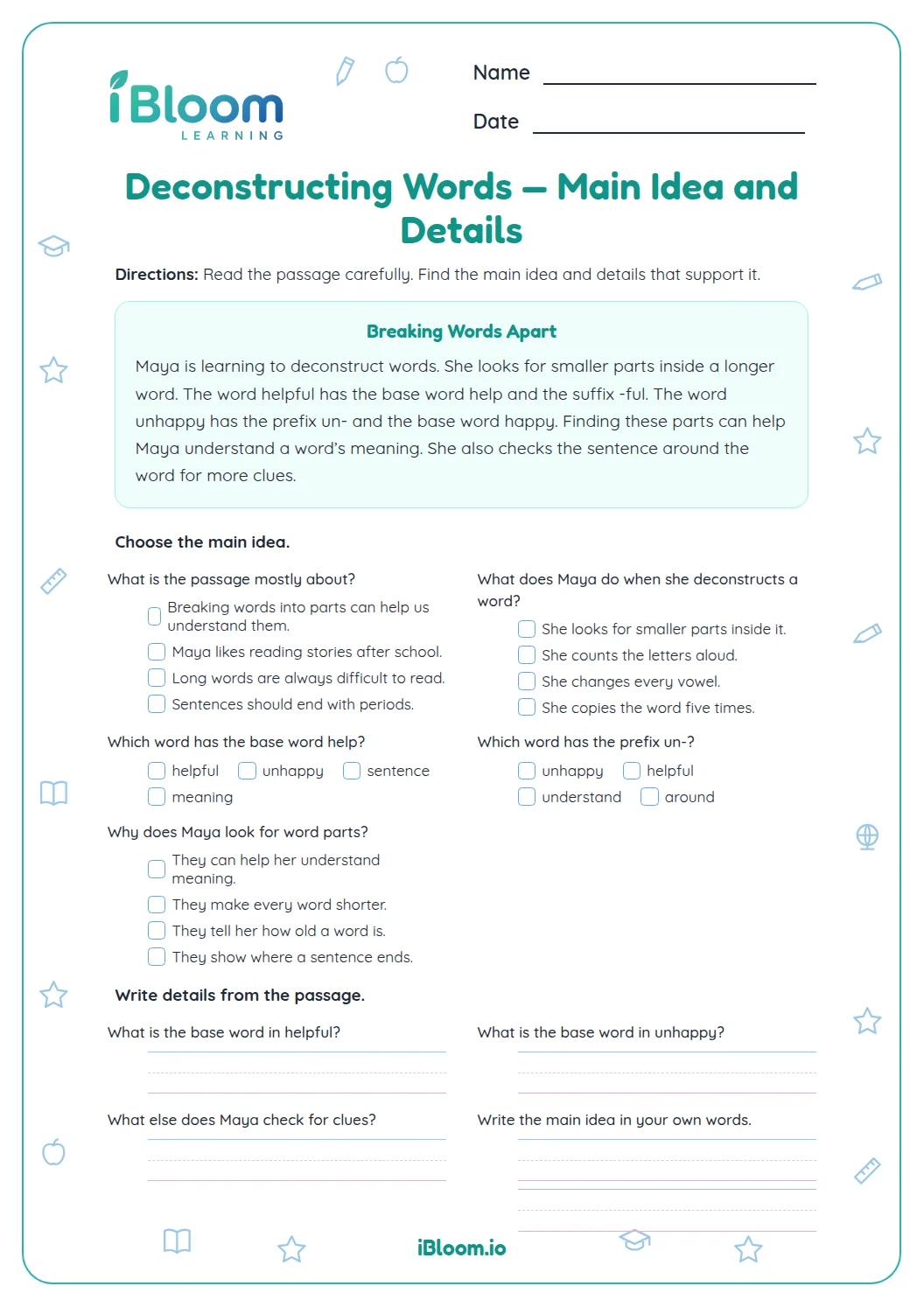
Maya and Leo work with re-, un-, -ful, -less, and -ness. The passage uses replay, unhappy, helpful, colorless, and kindness to show how a prefix or suffix joins a base word and affects meaning. Ask the learner to point to the clue in the question before answering.
What is on this Grade 3 worksheet?
The printable includes an original Build-a-Word Club passage and 15 questions across three worksheet pages. Children answer passage questions, explain word-part meanings, and build two new words. A separate three-page key follows. Ask the learner to point to the clue in the question before answering.
What does re- mean in replay?
In the passage, re- means again. Maya joins it to play to make replay, meaning to play again. The worked example models identifying the prefix before explaining the whole word. Ask the learner to point to the clue in the question before answering.
How do suffixes help build words?
A suffix is added after a base word. In the passage, -ful joins help to make helpful, while -less joins color to make colorless. Children use the base word, suffix, and sentence to explain each result. Ask the learner to point to the clue in the question before answering.
Are the last questions based on the passage?
Questions 14 and 15 extend the passage’s word-building idea with new combinations: re- with read, and cheer with -ful. The key gives sample responses, and equivalent clear spellings are acceptable. Ask the learner to point to the clue in the question before answering.