





About this worksheet
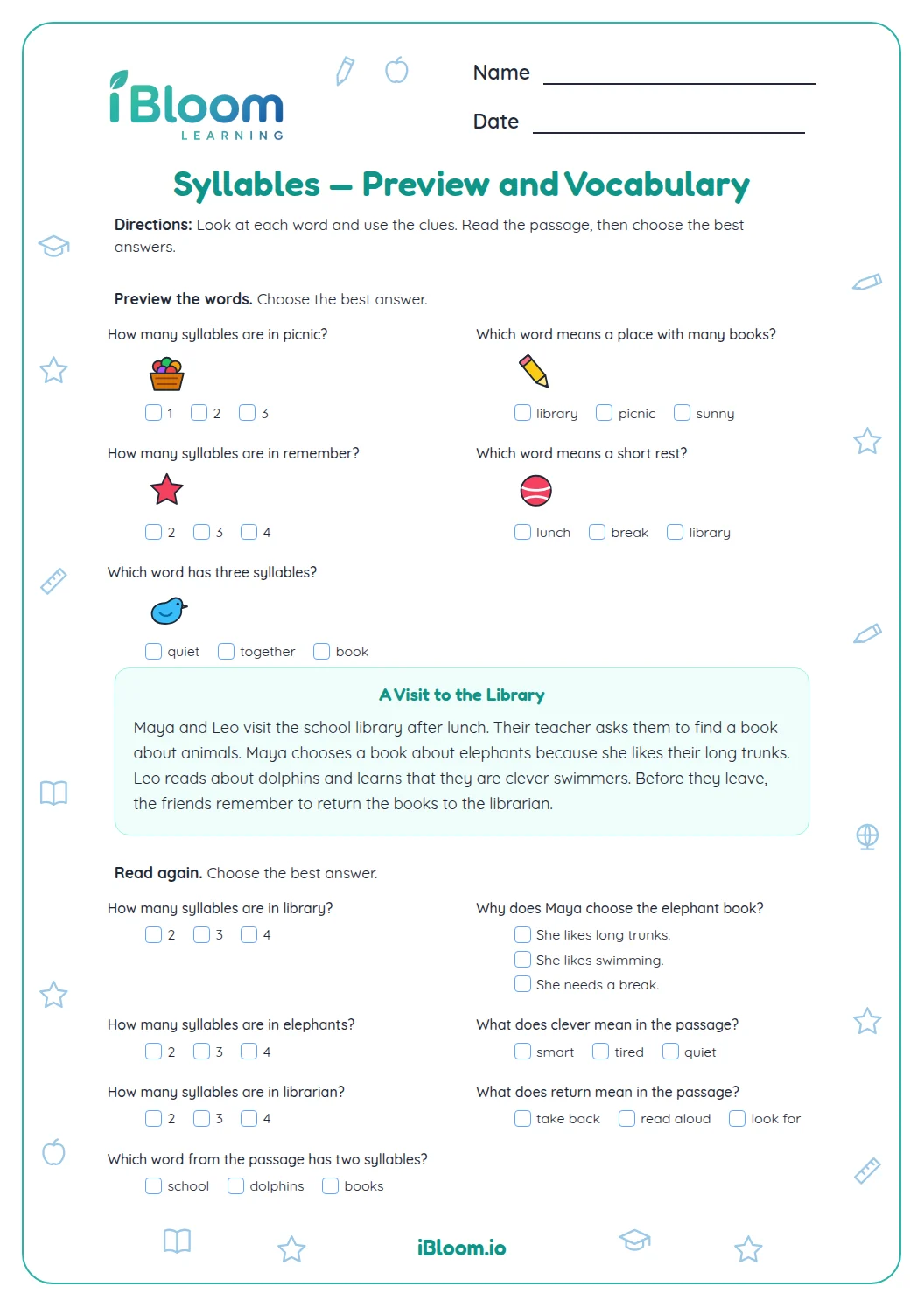
This Grade 3 printable follows Maya and Leo as they use syllables to read longer words. Children read a short passage, divide four multisyllabic words, answer four checks about the story and word parts, then write four brief responses. It practices Common Core RF.3.3.c, decoding multisyllable words. The separate key includes sample responses.
Aligned to RF.3.3.c
How can readers divide a multisyllabic word?
Maya and Leo listen for spoken vowel sounds, mark the syllable parts, and blend them back into a word. The passage shows how this routine can support reading an unfamiliar word.
- 1butterfly
- 2but / ter / fly
- 3Say the parts and blend them back together.
How does the worksheet use syllable knowledge?
The worksheet asks children to divide words from the passage, identify syllable counts, and explain how the characters check their reading. The final prompts apply the same strategy in writing.
How can a reader check a syllable count?
Say the word naturally, listen for its vowel sounds, and blend the parts back together. A written split should keep the spoken word recognizable.
How to use this worksheet
- 1Read each word aloud before marking it.
- 2Say the word slowly without adding extra vowel sounds.
- 3Mark the spoken syllable break with a slash.
- 4Blend the parts to check that they still make the printed word.
- 5For written responses, explain your thinking in a complete sentence.
Common mix-ups
The mistake
Counting letters instead of spoken syllables.
The fix
Say the word and listen for its vowel sounds.
The mistake
Adding an extra vowel sound to a consonant.
The fix
Keep the word’s usual spoken pronunciation.
The mistake
Splitting a word but not blending it back together.
The fix
Read the parts, then say the complete word aloud.
Common Core alignment
This worksheet gives focused practice with the standard below.
Decode multisyllabic words by identifying their spoken syllable parts.
On this sheet: Children divide familiar multisyllabic words and explain how the syllable parts support reading.
Show the official wordingHide the official wording
Decode multisyllable words.
What to practice next
Make more practice
Further reading
Questions parents and teachers ask
What is a syllable?
A syllable is a spoken beat in a word, usually organized around a vowel sound. On this page, children say each word, mark its spoken parts with a slash, and blend the parts to confirm the word still sounds right.
Should children count vowel letters or vowel sounds?
Listen for vowel sounds in the spoken word rather than counting written vowel letters. A sound may be spelled with more than one letter, and some written vowels are quiet. The worksheet asks children to pronounce the whole word as a check.
What does the answer key show for written prompts?
The key gives one sample answer for open-ended items, including a marked word and a short explanation. Other answers can be correct when the word has the stated syllable count and the response explains or marks its syllables accurately. The goal is an accurate split and a clear explanation, not matching one exact sentence.
How can I help if a child gets stuck?
Read the word together at a natural pace, then say it slowly and tap one time for each spoken part. Avoid stretching the word so far that an extra vowel sound appears. Blend the parts afterward to check. Tapping once for each spoken part makes the count easier to track.
Why are there both division questions and writing questions?
The first part gives children several chances to mark syllable breaks in words from Maya and Leo’s story. Later questions ask them to count, explain and apply the skill, so they practice both recognizing parts and using them while reading.
Is this worksheet about spelling?
The page focuses on decoding multisyllabic words by recognizing spoken syllables. Some questions ask children to write a word or explanation, but the main practice is dividing and blending words so a reader can work through longer words. Children read, divide, and blend multisyllabic words throughout the practice.