

About this worksheet
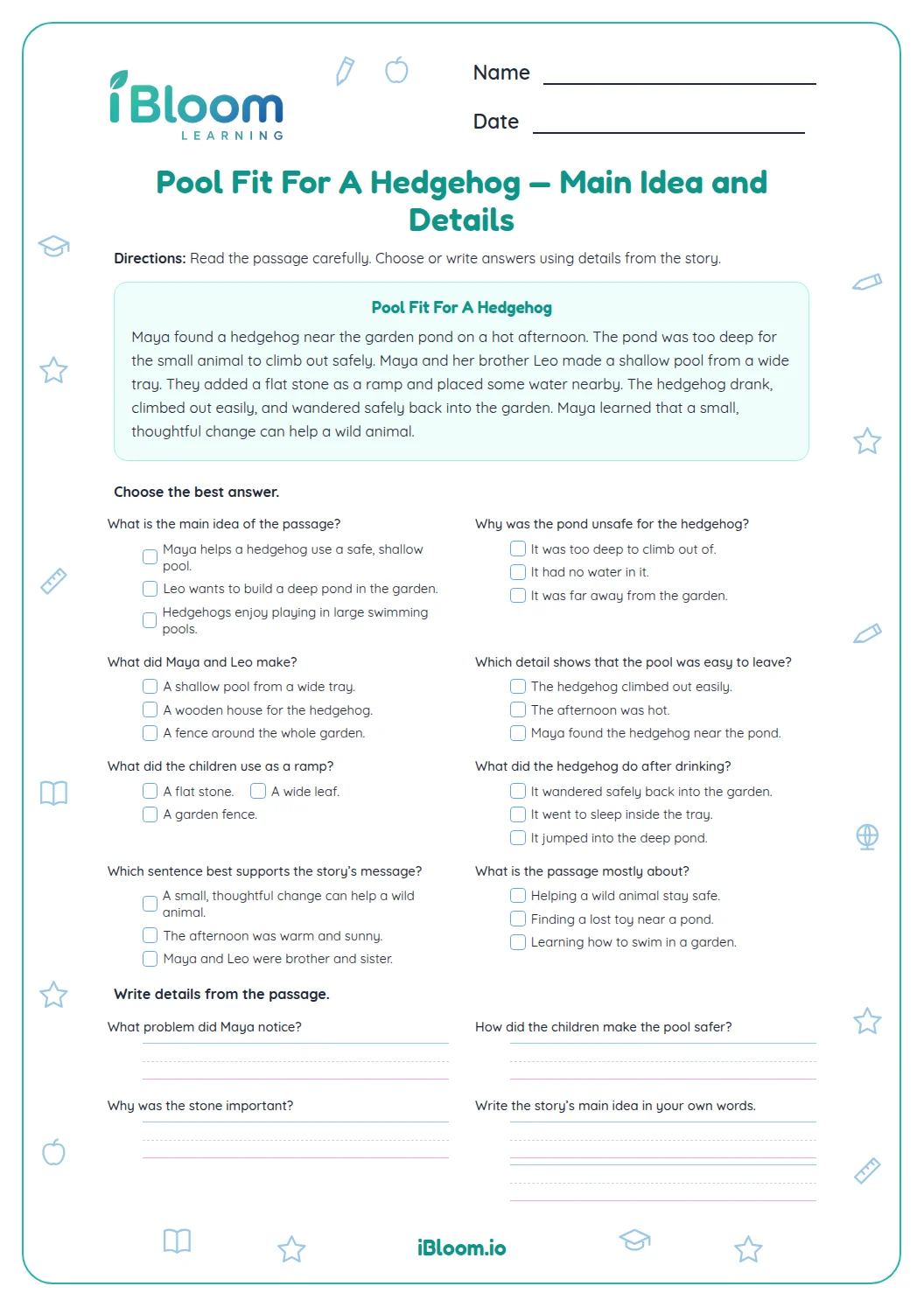
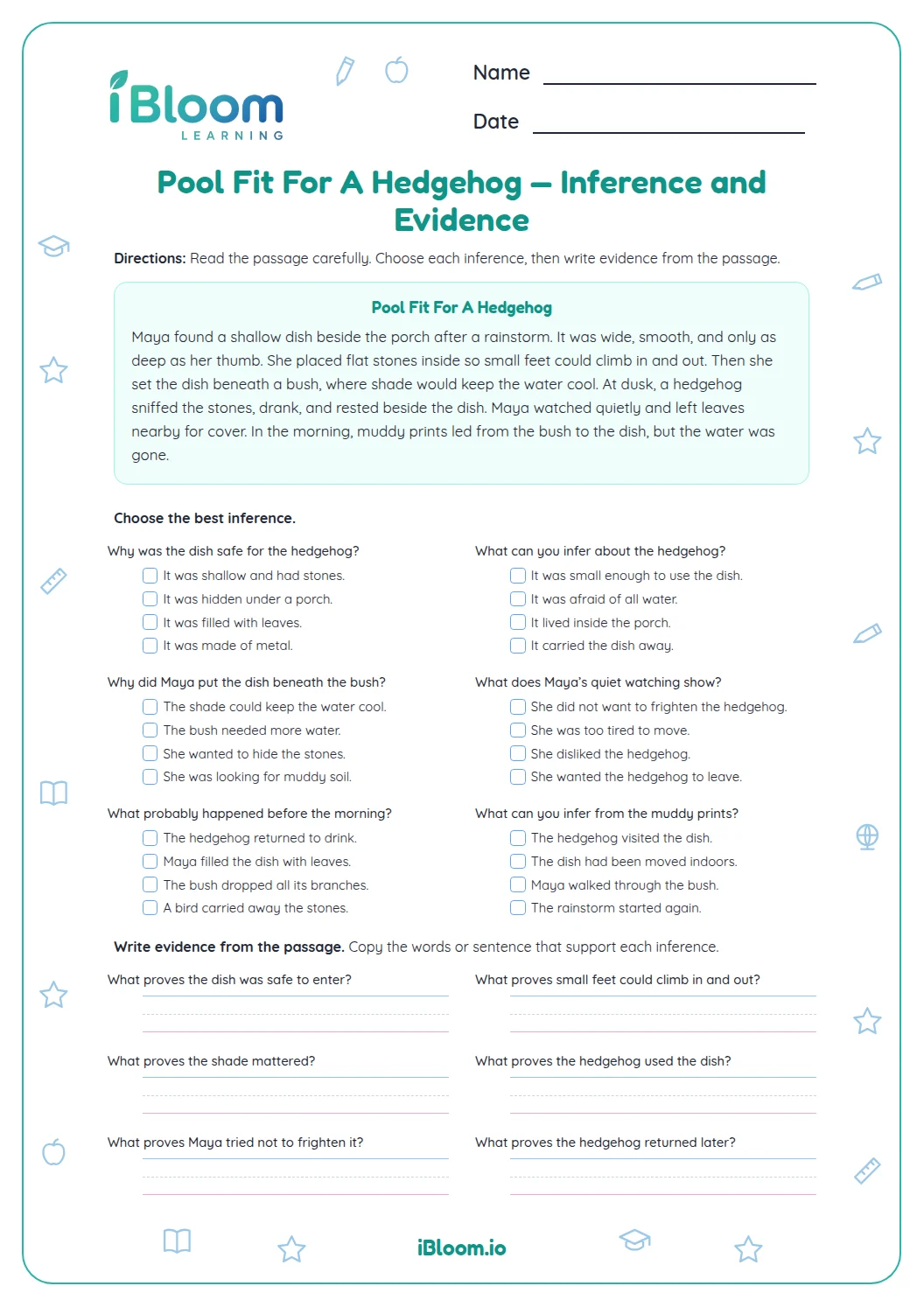
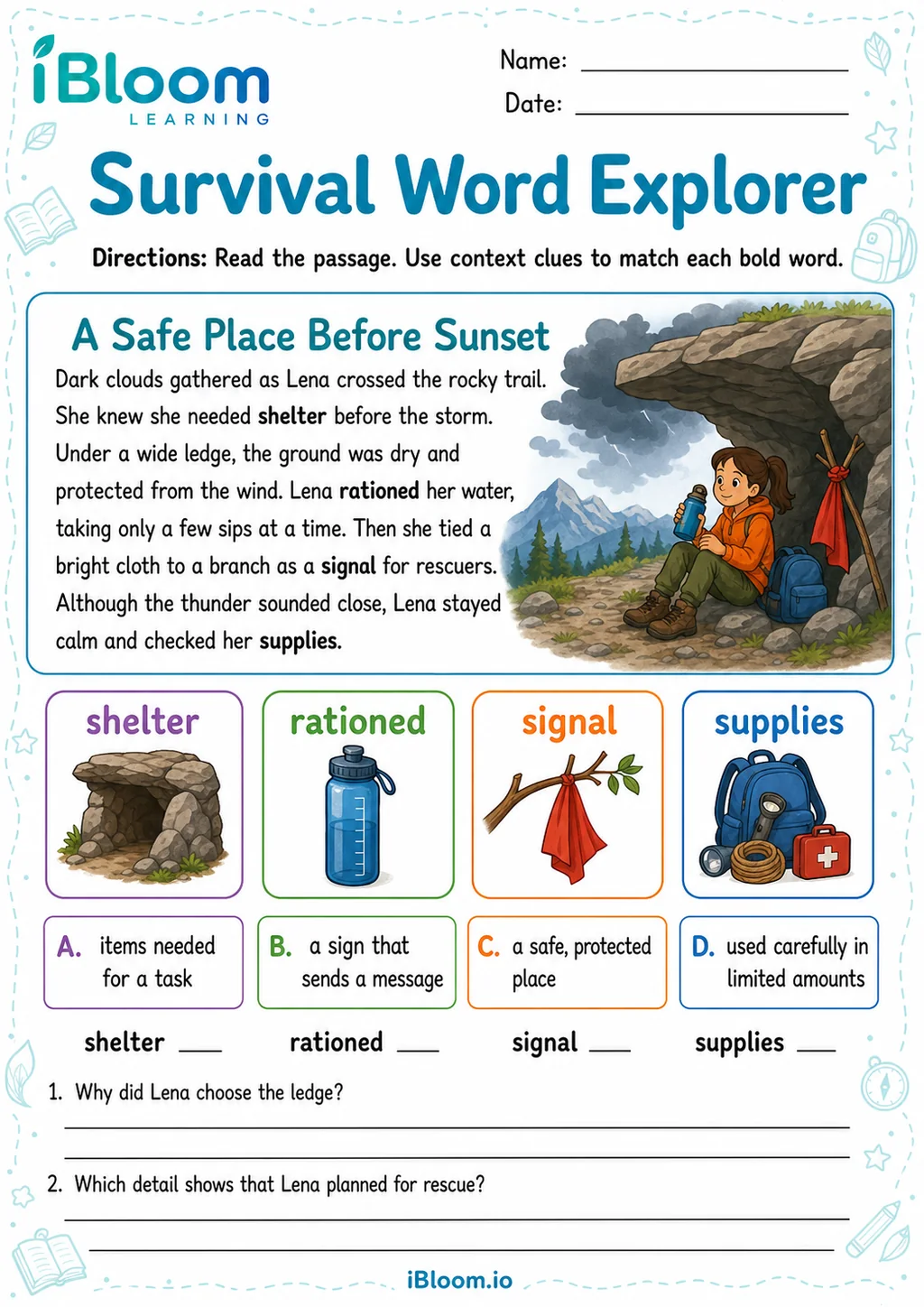
This Grade 4 printable pairs the story of Maya and Leo helping a hedgehog out of their pool with 15 questions. Students use context to interpret words such as “shallow” and “steady,” find explicit details, and support an explanation with evidence. The work practices CCSS L.4.4.a and RL.4.1. A separate key lists the choices and details and gives sample written responses.
Aligned to L.4.4.a and RL.4.1
What happens in “Pool Fit for a Hedgehog”?
Maya and Leo find a hedgehog beside their garden pool. Maya lays a wide, rough board as a ramp, and Leo checks that it stays steady. They let the hedgehog climb out and wander away on its own.
How can context help explain an unfamiliar word?
Read the sentence and the nearby details together. When Leo checks that the board will stay in place, that action helps explain “steady.”
In question 3, the board makes a sloping path from pool to ground, so “ramp” means a way up or down.
- 1In question 4, Leo checks that the ramp stays steady. The board must stay in place, so steady means firm and not likely to move.
How can a reader support an answer with evidence?
Find a sentence that answers the question or supports an inference. The board gives the hedgehog a safe way out, while the children wait until it moves away. A response can name a detail and explain what it suggests.
How to use this worksheet
- 1Read the story once to understand how Maya and Leo help the hedgehog.
- 2Reread the sentence around each vocabulary word.
- 3Choose the meaning that fits both the word and its context.
- 4Return to the story for detail questions.
- 5Use a specific detail to support the final written responses.
Context-clue and evidence slips
The mistake
Choosing a familiar meaning without checking the sentence.
The fix
Reread the sentence and test whether that meaning fits the action around the word.
The mistake
Giving an inference without naming its clue.
The fix
Add the story detail that led to the idea, such as the children waiting at the path.
The mistake
Retelling the whole story instead of answering one question.
The fix
Use one or two relevant details that directly answer the prompt.
Common Core alignment
Students use story context to infer word meanings and return to details to support their answers.
Use story context as a clue to a word’s meaning.
On this sheet: Part B asks students to infer word meanings from details in the story.
Show the official wordingHide the official wording
Use context (e.g., definitions, examples, or restatements in text) as a clue to the meaning of a word or phrase.
Refer to story details when answering explicit and inference questions.
On this sheet: Parts C and D ask students to answer and explain with text details.
Show the official wordingHide the official wording
Refer to details and examples in a text when explaining what the text says explicitly and when drawing inferences from the text.
What to practice next
Make more practice
Further reading
Questions parents and teachers ask
What does “ramp” mean in this story?
A ramp is a sloping path that helps someone move up or down. Maya places a board in the pool so the hedgehog can climb from the water to the ground. Reread the prompt and use the answer key to check how the clue supports the response.
How do Maya and Leo help the hedgehog safely?
Maya makes a ramp from a rough board, and Leo checks that it stays steady. They watch from a distance and let the hedgehog leave by itself. Reread the prompt and use the answer key to check how the clue supports the response.
Why is “suitable” a good word for the board?
The board is suitable because it gives the hedgehog a way to get out of the pool. Its size and rough surface make it useful as a ramp. Reread the prompt and use the answer key to check how the clue supports the response.
How many questions are included?
There are 15 questions: six context-clue choices, six multiple-choice questions about story details, and three short written responses. The passage and its questions are arranged for a reading worksheet with a separate key. Reread the prompt and use the answer key to check how the clue supports the response.
Why does the answer key use sample answers?
The final three questions ask students to explain an idea using evidence. A correct response can use different words, so the key gives one model answer and identifies the kind of detail to include. Reread the prompt and use the answer key to check how the clue supports the response.
What is the main idea of Maya’s experience?
Maya helps a hedgehog by offering water and making the spot safe, while giving it room. The pawprints and Maya’s choice not to pick the hedgehog up support the idea that thoughtful help can respect an animal’s space. Reread the prompt and use the answer key to check how the clue supports the response.