

About this worksheet
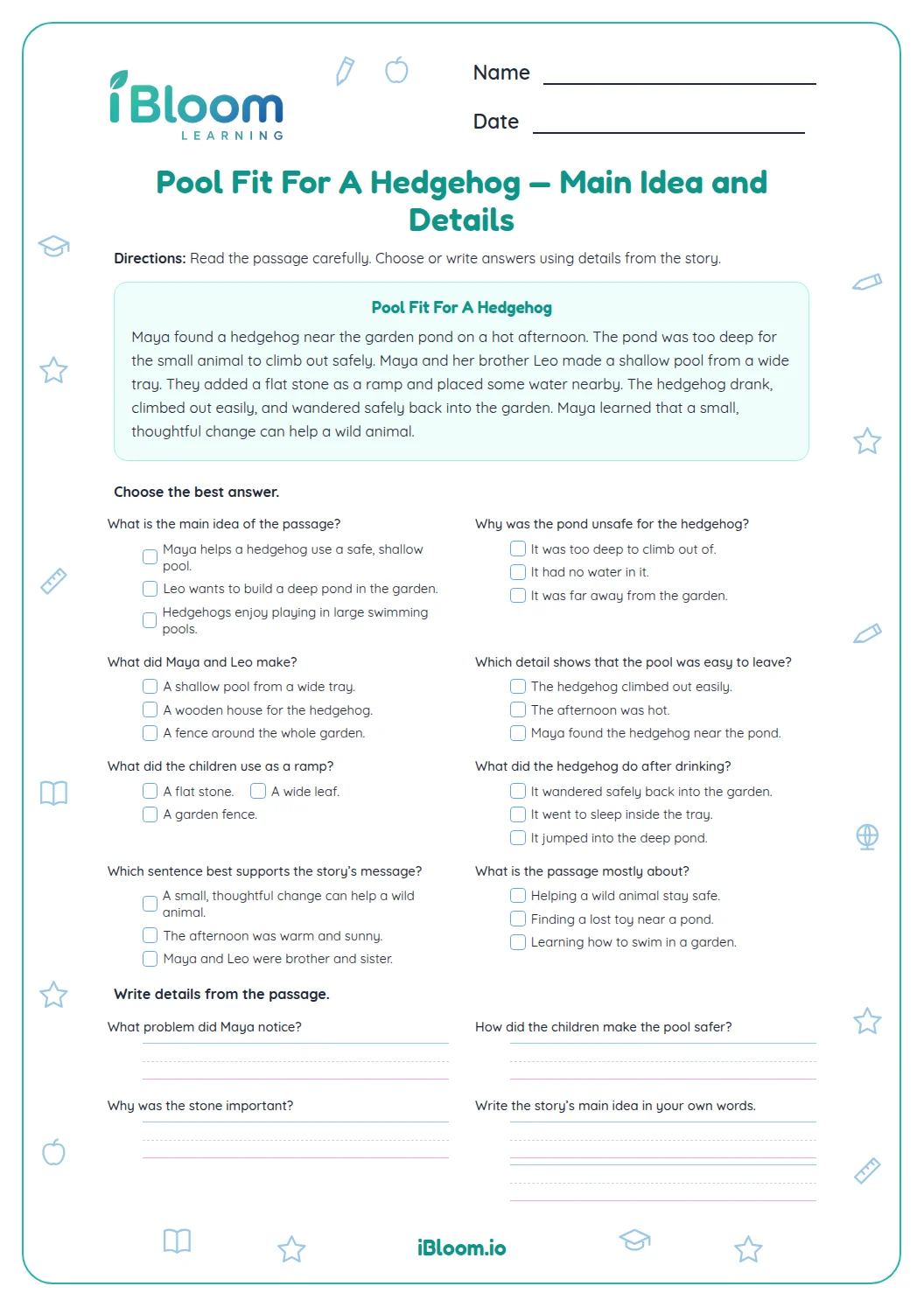
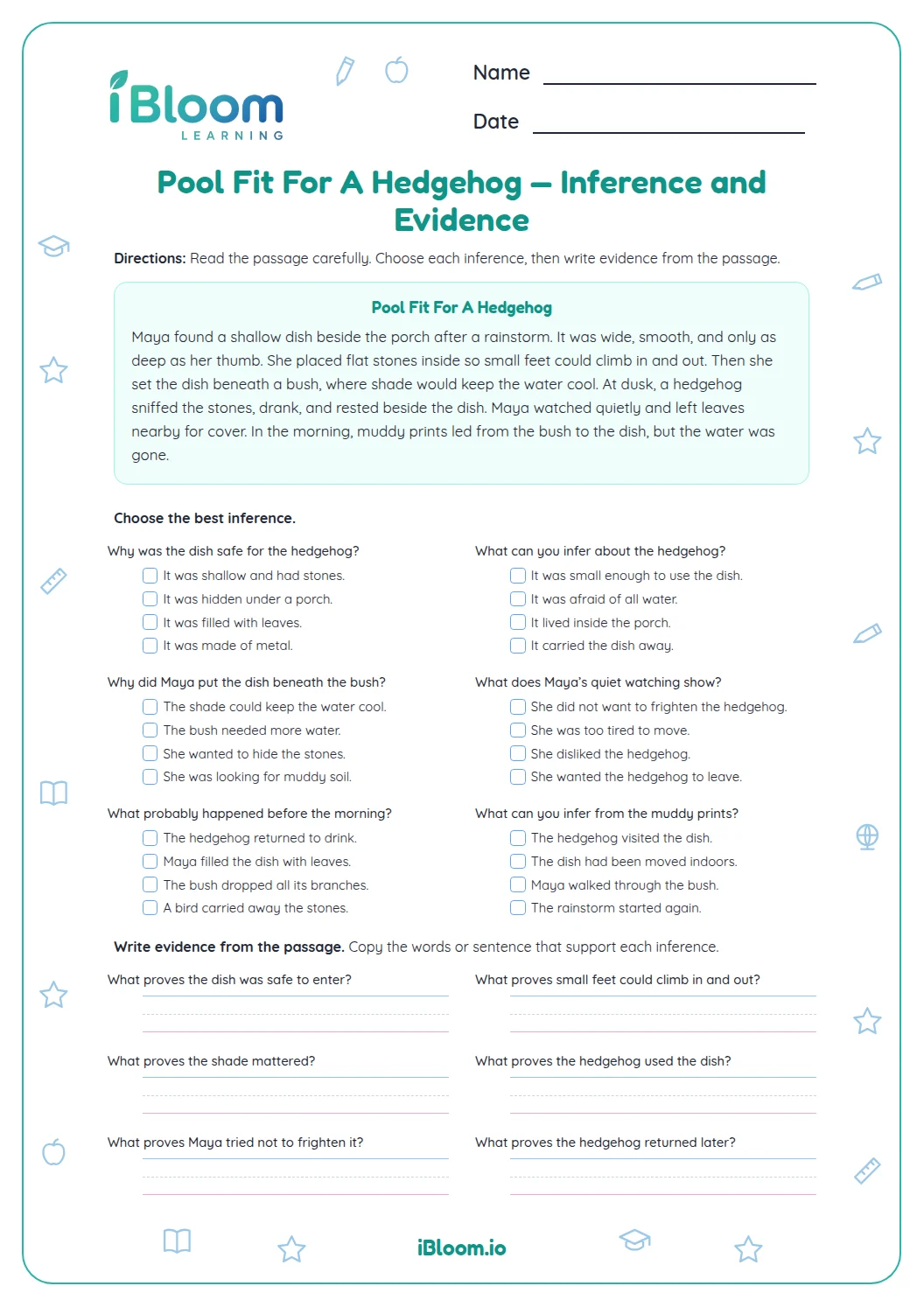
Read “Pool Fit for a Hedgehog,” then answer 14 questions about details, vocabulary, main idea, and evidence. Two extended responses and concise answers keep the practice focused; the separate key includes sample wording.
Aligned to RL.4.1 and RL.4.2
What details explain Maya’s choices?
The story gives reasons for the shallow dish, the flat stone and the shady spot. Find the sentence that describes each choice before explaining it.
- 1Why did Maya add a stone to the dish?
- 2The passage says the stone gave the hedgehog a way to climb out if it slipped.
How can the surrounding words explain a vocabulary word?
Use nearby words and the sentence’s action. “Climb out if it slipped” points to a stone that the animal can step onto, while “shallow” contrasts with deep water.
How do you find the main idea of a story?
Choose an idea that covers the important events, not just one detail. Maya’s safe way of offering water is central from the first dish to her daily checks.
- 1Question 10 asks what the passage is mainly about.
- 2The best answer includes Maya helping the hedgehog get water safely.
How do you support an inference with evidence?
State what you infer, then name the detail that supports it. Maya likely wanted to keep water available because she checked the dish each morning; that repeated action is evidence.
How to use this worksheet
- 1Read the story once to understand what Maya does.
- 2Reread the relevant sentence before answering a detail question.
- 3For vocabulary, use the neighboring words as clues.
- 4For the main idea, choose an answer that covers the whole story.
- 5In written answers, state the idea and include the supporting detail.
- 6Compare open-ended responses with the sample answers in the key.
Common mistakes and quick fixes
The mistake
Using one event as the main idea of the whole story.
The fix
Choose an answer that covers Maya’s safe help from beginning to end.
The mistake
Giving an inference without a story detail.
The fix
Add the action or sentence that supports what you think.
The mistake
Confusing the hedgehog’s return to the hedge with Maya taking it away.
The fix
Reread the ending: the hedgehog rests near the dish and later shuffles toward the hedge.
Common Core alignment
Use story details to answer questions and support inferences.
On this sheet: Students answer explicit questions and support written inferences with details from the story.
Show the official wordingHide the official wording
Refer to details and examples in a text when explaining what the text says explicitly and when drawing inferences from the text.
Identify the story’s main idea and summarize its important events.
On this sheet: Students select the central idea and write a short summary of Maya’s actions.
Show the official wordingHide the official wording
Determine a theme of a story, drama, or poem from details in the text; summarize the text.
What to practice next
Make more practice
Further reading
Questions parents and teachers ask
Why did Maya put a stone in the dish?
The stone gave the hedgehog a way to climb out if it slipped. The passage says Maya added it inside the dish for that reason. A strong response explains the purpose rather than only repeating that the stone was there.
Why was the dish a safer choice than the family pool?
The dish was shallow and had a low edge, so the hedgehog could reach the water and climb out. Those details explain why the smaller dish was a better fit for a wild animal than the family pool.
What is the story’s main idea?
Maya finds a safe way to help a hedgehog get water. The story follows her choice of a shallow dish, the stone that helps the animal climb out, and her morning checks of the water. It includes the story’s important choice and outcome in one idea.
What makes a written response evidence based?
It answers the question and includes a detail from the story. To explain how Maya was careful, for example, mention that she offered water and never tried to pick up the wild hedgehog. A relevant detail might be the dish’s shallow shape or low edge.
Are written answers required to match the key exactly?
No. The key gives sample responses for questions where wording may vary. A student’s response is sound if it answers the question accurately and uses a relevant detail from the passage. The passage supports accurate paraphrases as well as quoted details.