

About this worksheet
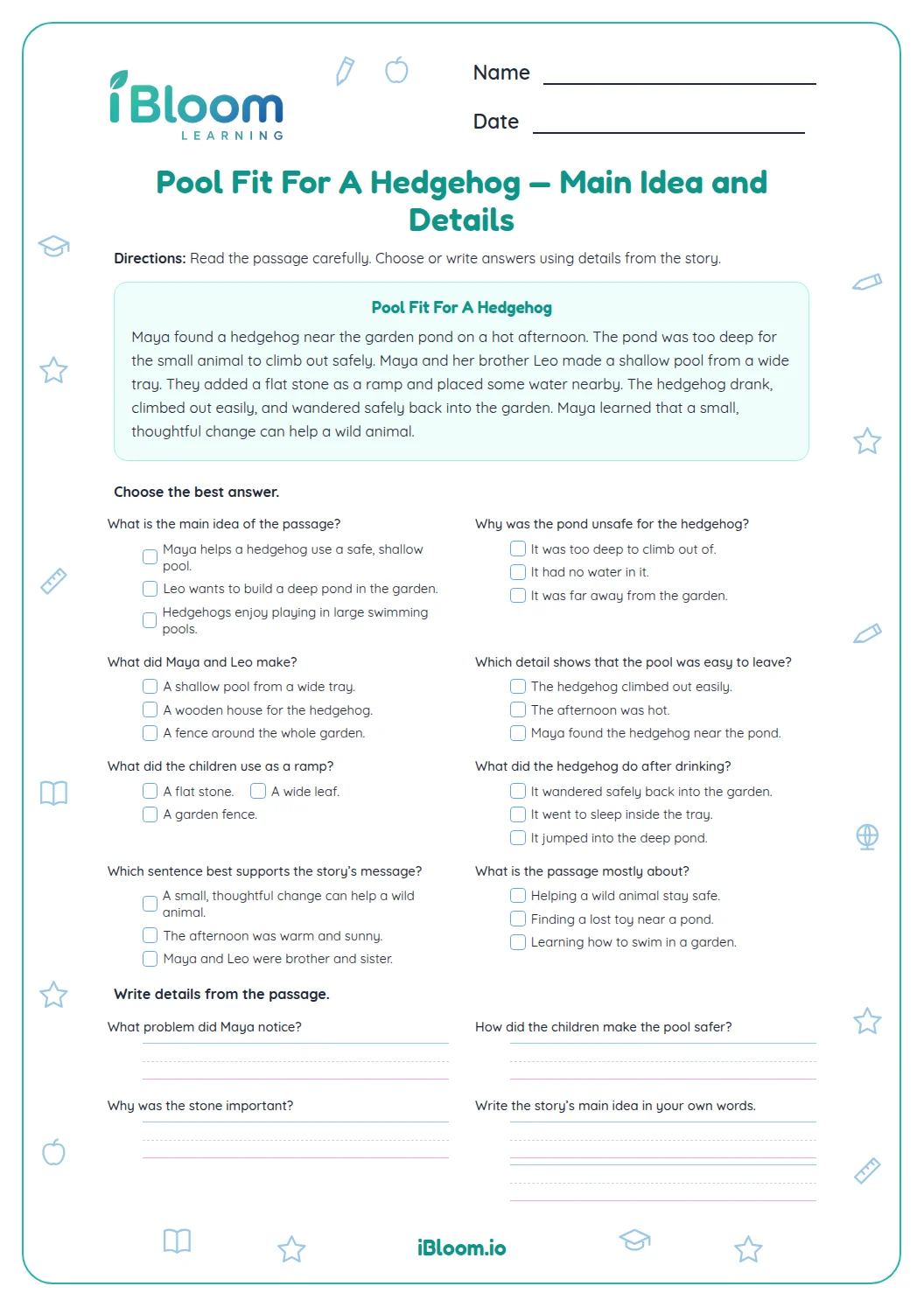
This free Grade 4 printable uses a story about Maya helping a thirsty hedgehog. Students answer 10 short questions about details, sequence, vocabulary and Maya’s choices, then write four full-sentence responses using evidence. The work supports CCSS RL.4.1 and W.4.9.a by asking readers to explain the story with specific details. A separate key gives concise sample responses.
Aligned to RL.4.1 and W.4.9.a
What details help explain Maya’s problem?
Maya finds a thirsty hedgehog beside the garden fence and sets out a shallow dish. Questions 1 and 3–11 ask readers to locate details and explain Maya’s choices. Question 2 asks for a complete sentence about what the hedgehog was doing.
For question 3, the detail is that Maya added flat stones to the dish. The stones give the hedgehog a safe way out.
How can readers infer what Maya is like?
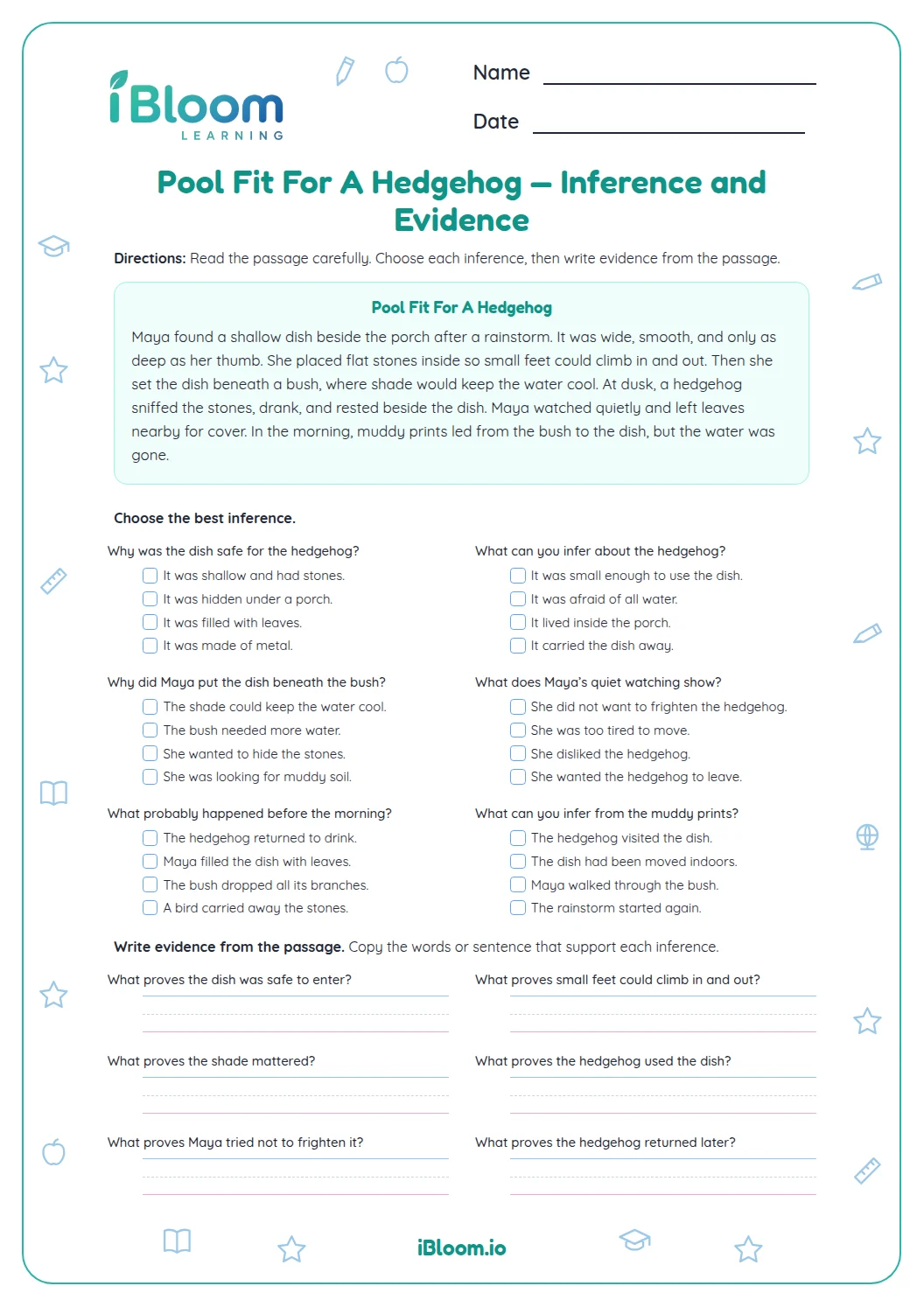
Readers can infer a character trait from actions and words. Maya sets out water, adds flat stones and watches from a distance. Those actions suggest she is thoughtful about helping a wild animal safely.
- 1Question 14 asks why the stones mattered.
- 2Evidence: The hedgehog used them to climb out.
- 3Response: They made a safe way out of the dish.
What belongs in a strong written response?
A useful response answers the prompt and names a story detail. For question 13, explain that Maya stays back because the hedgehog may be frightened by a person coming too close.
How can a student check the answer?
Reread the prompt and underline its task word, such as explain or why. Then check that the response names a detail from the passage and connects it to the answer. The key offers sample wording; a student’s wording can differ if it is accurate and supported.
How to use this worksheet
- 1Read the story once to understand Maya’s problem and solution.
- 2Underline a detail in the passage before answering a question about why.
- 3For sequence questions, look for words that show what happened first or next.
- 4Write a direct answer before adding evidence in Part D.
- 5Reread each response and check that its detail comes from the story.
Mistakes to watch for
The mistake
Retelling a detail without answering the question.
The fix
Start with a direct answer, then add the detail that supports it.
The mistake
Choosing an action that happened later for a first-event question.
The fix
Reread the beginning and trace the events in order.
The mistake
Naming a character trait without evidence.
The fix
Point to an action, such as measuring or testing, that supports the trait.
Common Core alignment
These standards describe the reading and writing work on this page.
Use story details and examples to explain and infer.
On this sheet: Questions ask students to explain explicit details and draw supported inferences.
Show the official wordingHide the official wording
Refer to details and examples in a text when explaining what the text says explicitly and when drawing inferences from the text.
Support a response about a story with specific details.
On this sheet: Three written responses explain a character’s solution with story evidence.
Show the official wordingHide the official wording
Apply grade 4 Reading standards to literature (e.g., “Describe in depth a character, setting, or event in a story or drama, drawing on specific details in the text [e.g., a character’s thoughts, words, or actions].”).
What to practice next
Make more practice
Further reading
Questions parents and teachers ask
How many questions are on the Hedgehog Pool worksheet?
There are 14 questions: 10 short-answer items and four full-sentence responses. They check story details, the order of events, Maya’s choices and why her water dish is safe. The final responses ask students to explain ideas with evidence.
What does the answer key include?
The separate key lists an answer for every question and gives sample wording for the four full-sentence responses. A student may phrase a response differently when it still answers the prompt and uses accurate evidence from Maya’s story.
What does “use evidence” mean here?
It means pointing to a specific action, statement or event in the passage. A response that Maya wanted to help is stronger when it adds that she set out cool water, placed flat stones in the dish and watched from a distance.
Can students answer the short questions in complete sentences?
Yes. Short-answer spaces accept a few words, but complete sentences are welcome. The full-sentence items ask for a fuller explanation and call for details from the story, such as how the stones helped the hedgehog. The separate key can help check each answer.
How can I help without giving away an answer?
Ask the student to find the sentence or event that relates to the question. For a character inference, ask what Maya’s action suggests and which story clue led to that idea, then let the student put the answer in their own words. The written answer can then be checked against that clue.