



About this worksheet
This Grade 5 reading worksheet pairs an original story about Tessa’s art display with practice interpreting personification and supporting inferences. Part B examines the way the wind and clouds are described. Part C asks readers to infer what characters feel or intend and point to a detail that supports each idea. The questions connect to CCSS RL.5.4 and RL.5.1; an answer key includes sample responses.
Aligned to RL.5.4 and RL.5.1
How does personification change a description?
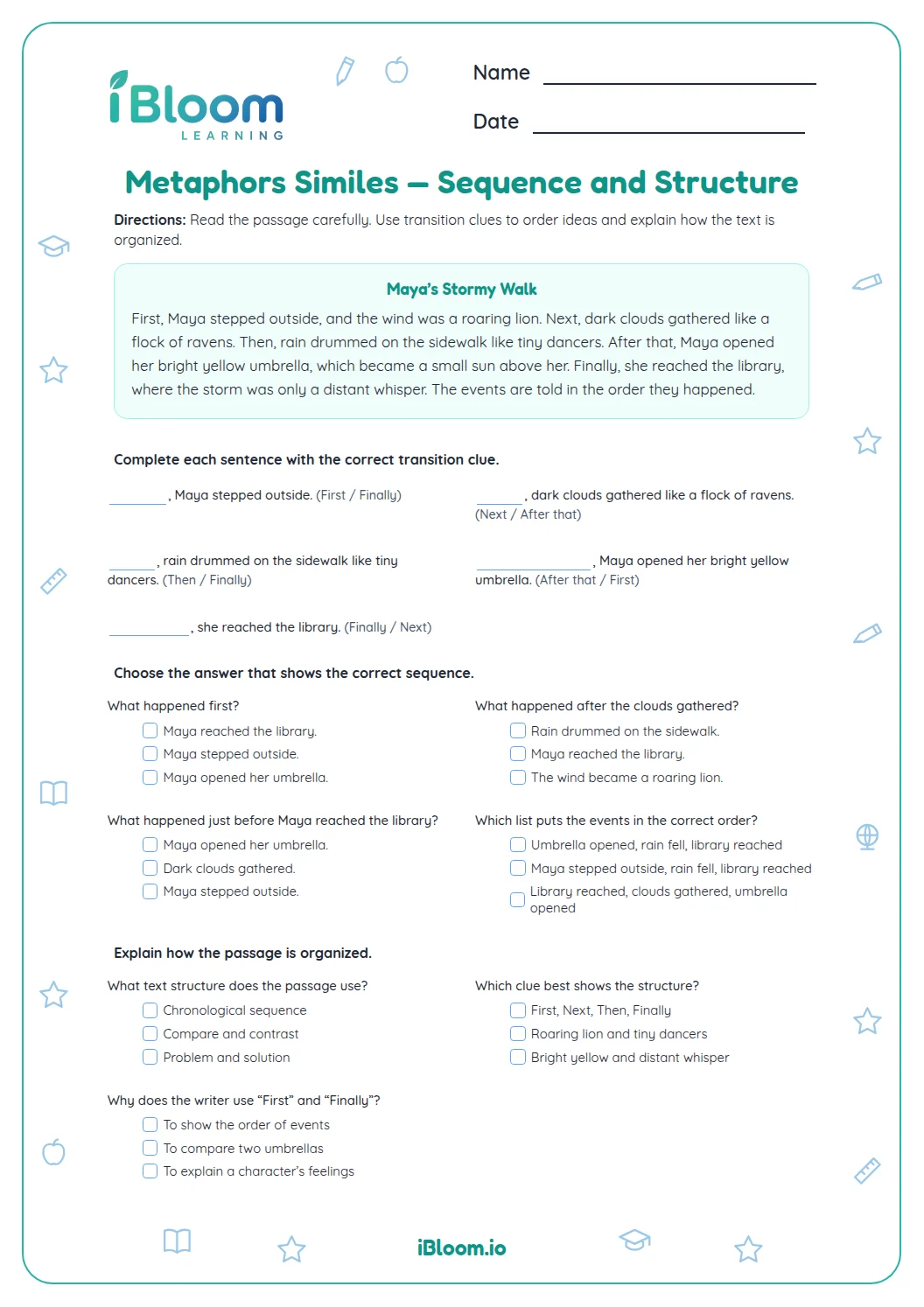
Personification gives a nonhuman thing an action or feeling associated with people. Authors use it to help readers picture movement, sound or mood. The phrase “the wind tugged at her scarf” describes the effect of a gust in an active way.
Part B asks what these phrases mean in this story. A strong answer explains the real event the figurative words help readers imagine.
- 1“The wind tugged at her scarf.”
- 2The wind is not a person pulling on purpose.
- 3The phrase helps the reader picture a strong breeze pulling the scarf.
How can a reader make an inference?
An inference combines a text detail with what the reader knows. It should fit the events in the passage rather than guess at a character’s thoughts without evidence.
Part C asks students to support each inference with a brief, accurate quotation from the passage. The words they choose should match the idea they explain.
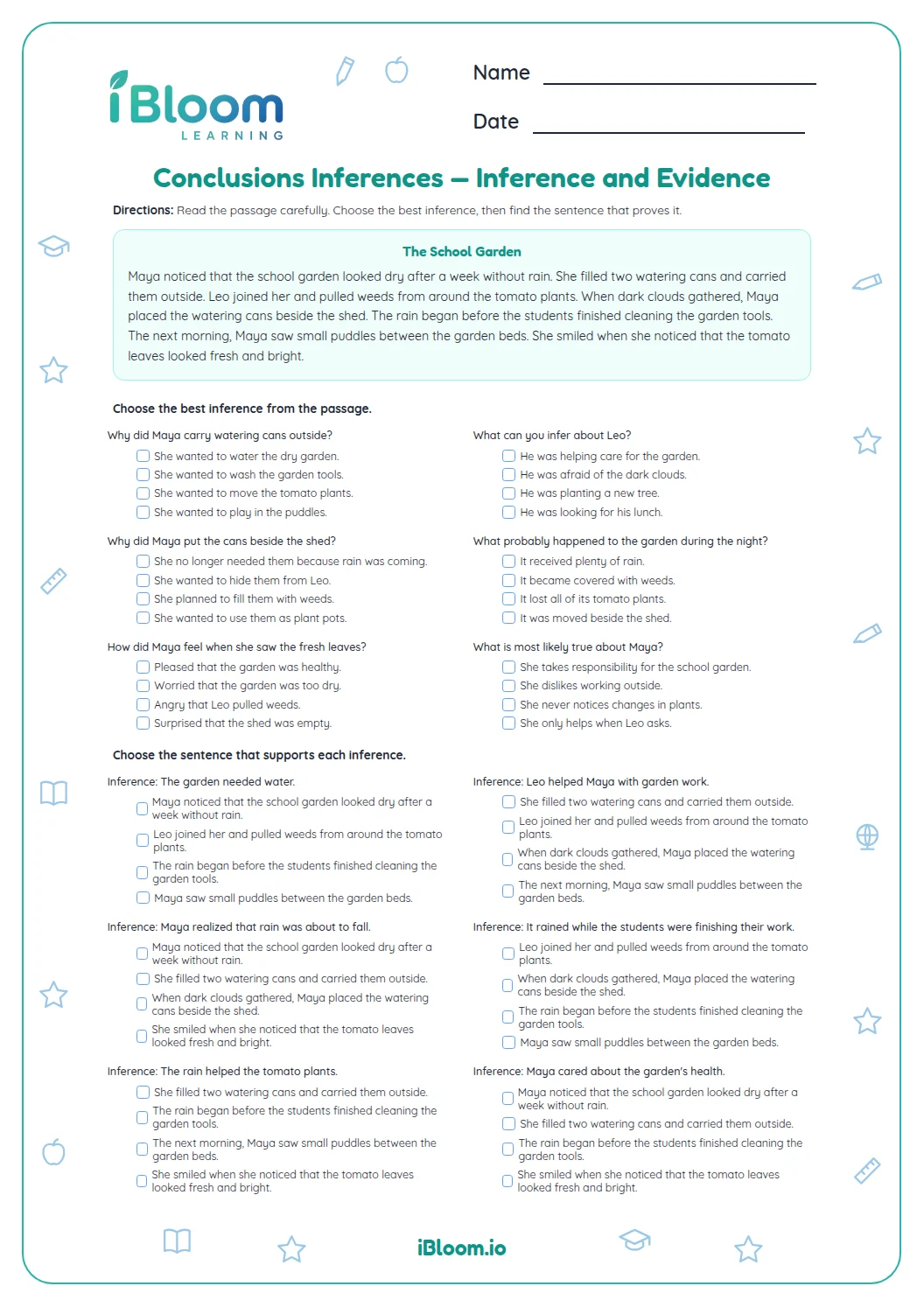
- 1Question 7 asks what Tessa’s chase suggests.
- 2Detail: she catches the cloud just before it reaches the drain.
- 3Inference: she cares about saving the display.
What counts as evidence for an answer?
Evidence is a specific event, action or phrase from the passage that supports the answer. Part C asks for a sentence response, so include both the inference and the detail that led you to it.
How to use this worksheet
- 1Read the story once to follow Tessa’s problem and solution.
- 2In Part B, locate each personifying phrase in the story.
- 3Explain the ordinary event or image the phrase suggests.
- 4In Part C, answer the question with a reasonable inference.
- 5Quote one accurate story detail to support each written answer.
Common mistakes and quick fixes
The mistake
Treating personification as a literal event, such as a cloud really racing.
The fix
Ask what the nonhuman thing could do in real life and what action the words help you picture.
The mistake
Making an inference that does not fit the story.
The fix
Point to an action or phrase in the passage that supports the idea.
The mistake
Giving evidence without explaining what it shows.
The fix
State the inference first, then connect the detail to that idea.
Common Core alignment
The questions on this page practice the listed Common Core skill.
Determine word and phrase meaning in context, including figurative language.
On this sheet: Part B interprets the passage’s personifying phrases in context.
Show the official wordingHide the official wording
Determine the meaning of words and phrases as they are used in a text, including figurative language such as metaphors and similes.
Use accurate text details when explaining explicit meaning and inferences.
On this sheet: Part C asks students to support inferences with passage evidence.
Show the official wordingHide the official wording
Quote accurately from a text when explaining what the text says explicitly and when drawing inferences from the text.
What to practice next
Make more practice
Further reading
Questions parents and teachers ask
What is personification?
Personification describes a nonhuman thing as if it can act or feel like a person. In the story, “the wind tugged at her scarf” gives the wind a human-like action. Readers use the surrounding details to understand that the phrase describes a strong breeze.
How is an inference different from a detail?
A detail is stated directly in the passage, such as Tessa chasing the paper cloud. An inference is a reasonable idea drawn from that detail, such as Tessa caring about her display. The written questions ask students to connect both parts.
How many questions are on this reading page?
There are 14 questions after the story. Six multiple-choice questions focus on personification and its meaning. Eight written questions ask for inferences and supporting details. A separate answer key gives the choices and sample written answers for review at home or school.
Do students need to quote the passage exactly?
A short exact phrase or a carefully described event can support an answer. The important step is making the evidence specific enough to show where the inference came from. The answer key models concise responses and uses passage details from this story.
What should I do if two answers seem possible?
Invite the student to answer in a sentence and copy a short phrase from the story that supports it. For example, “She caught it just in time” supports an inference that Tessa is persistent. The key models brief quotations; a different accurate quote may also work.