
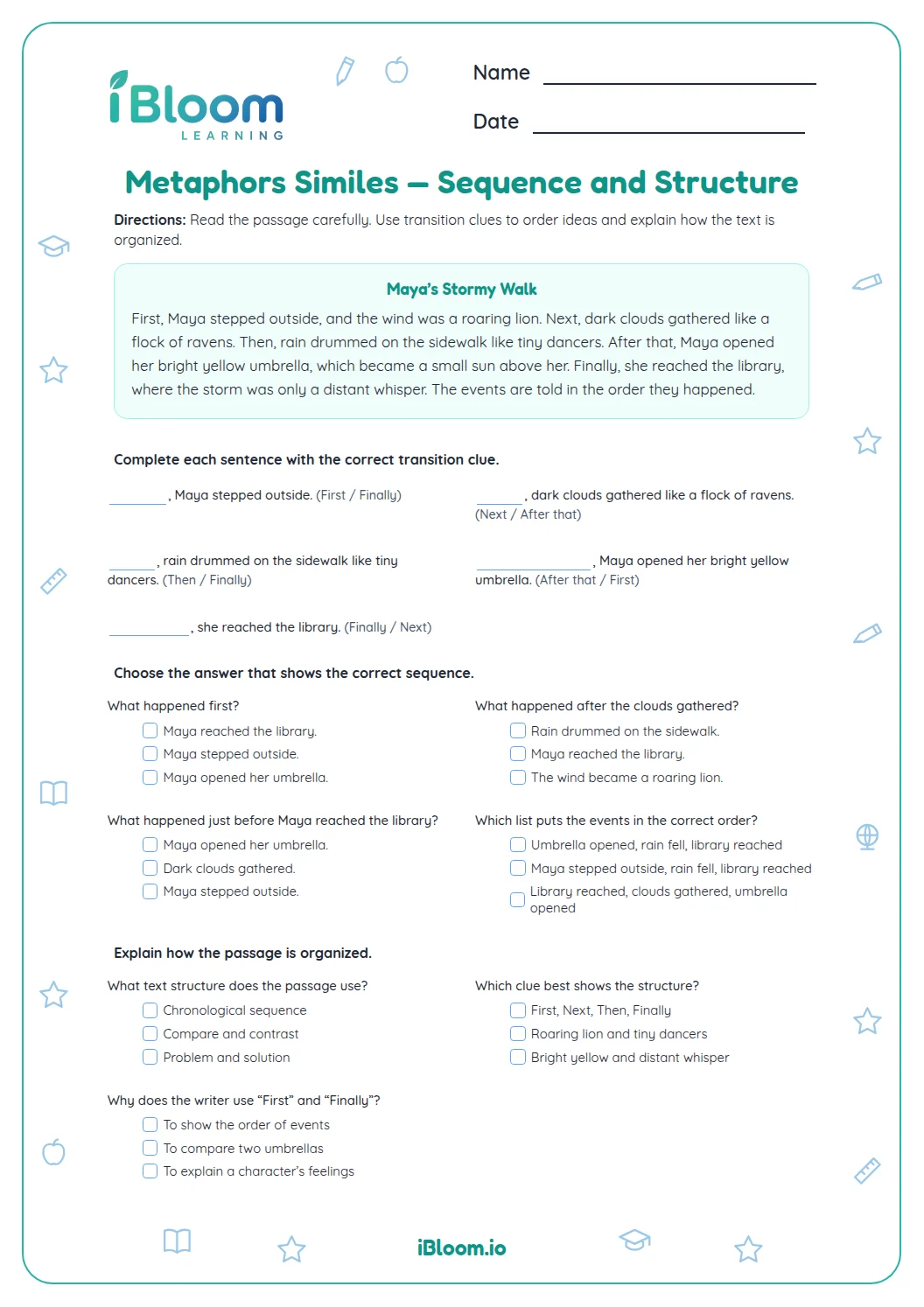
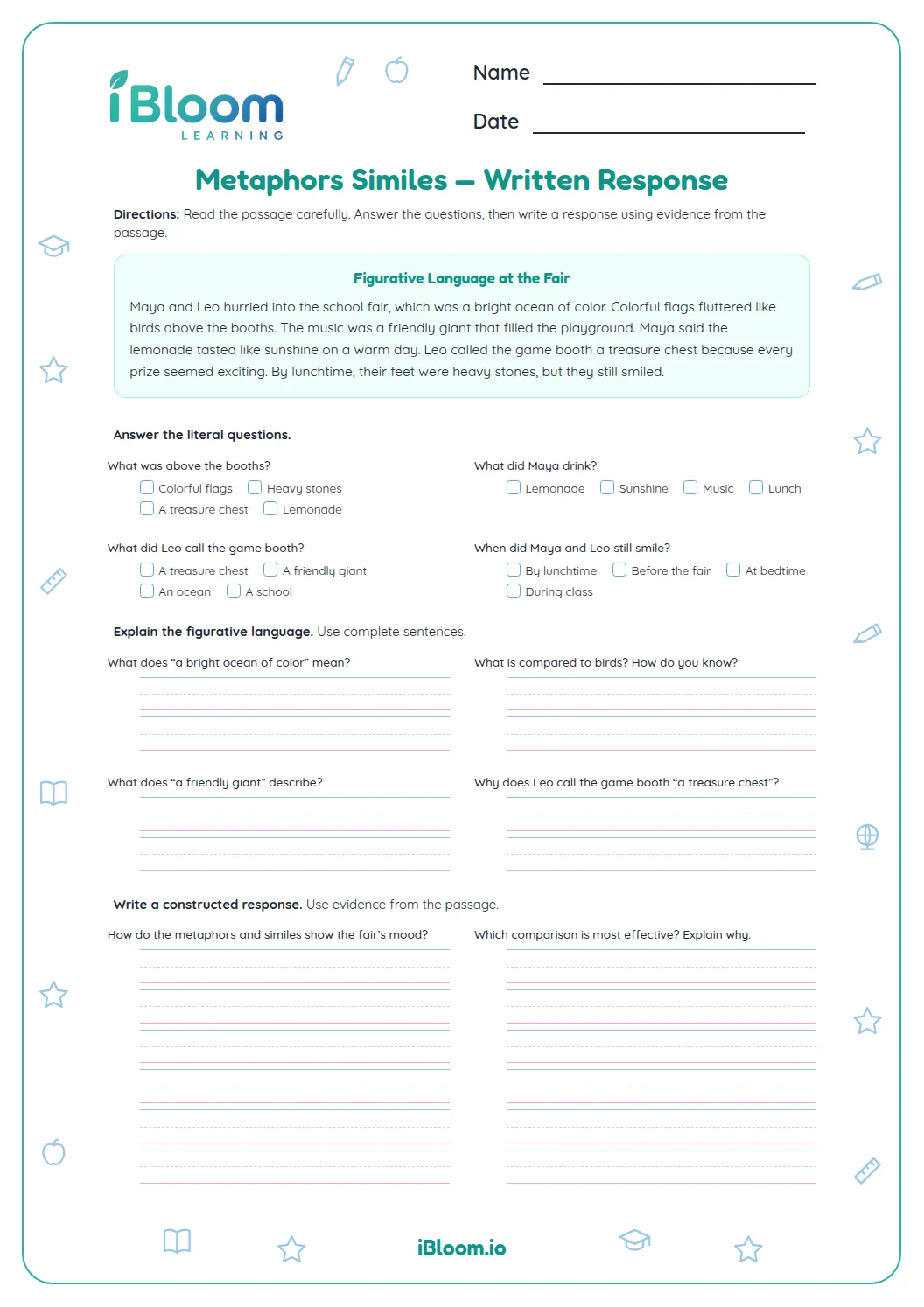
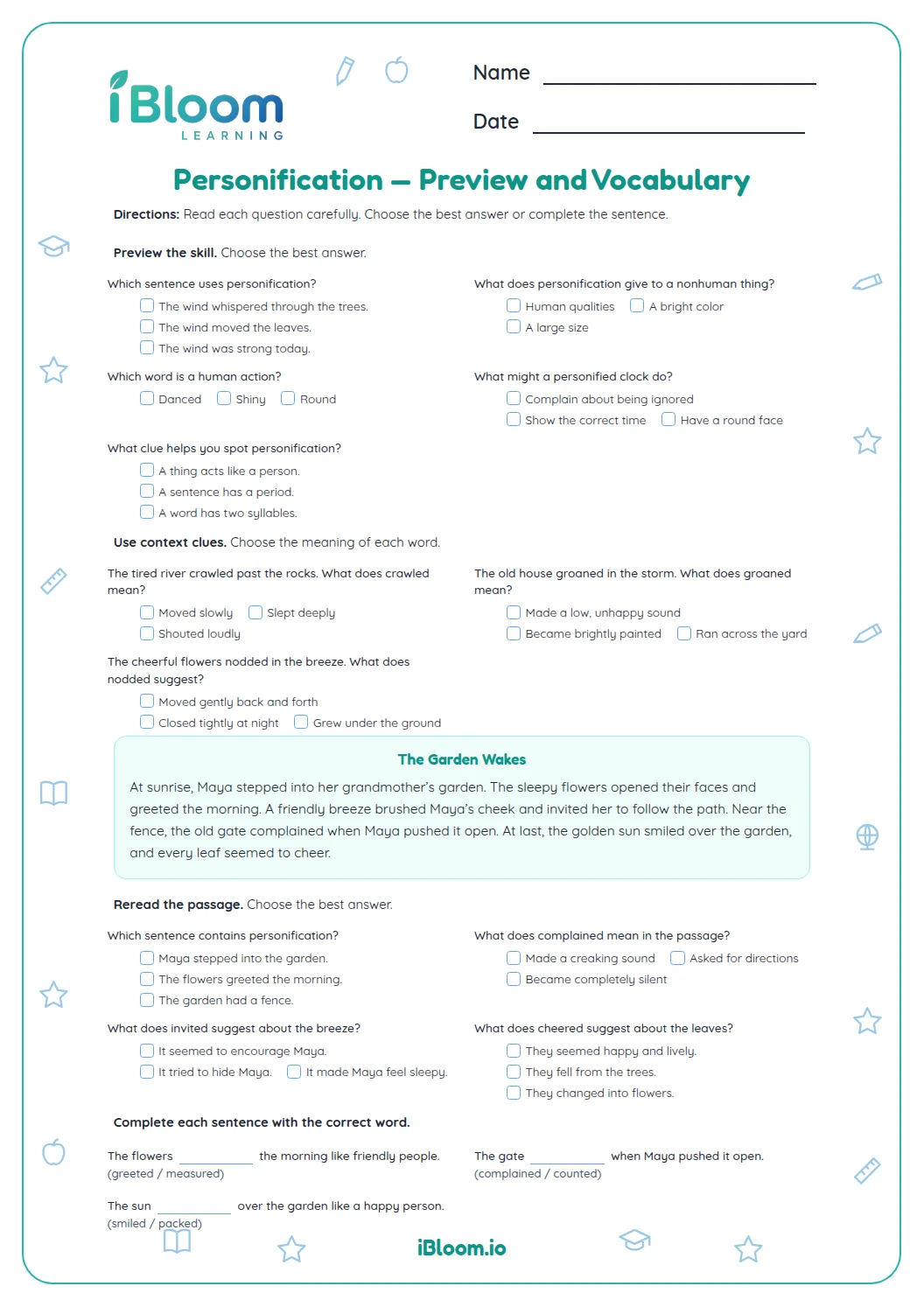
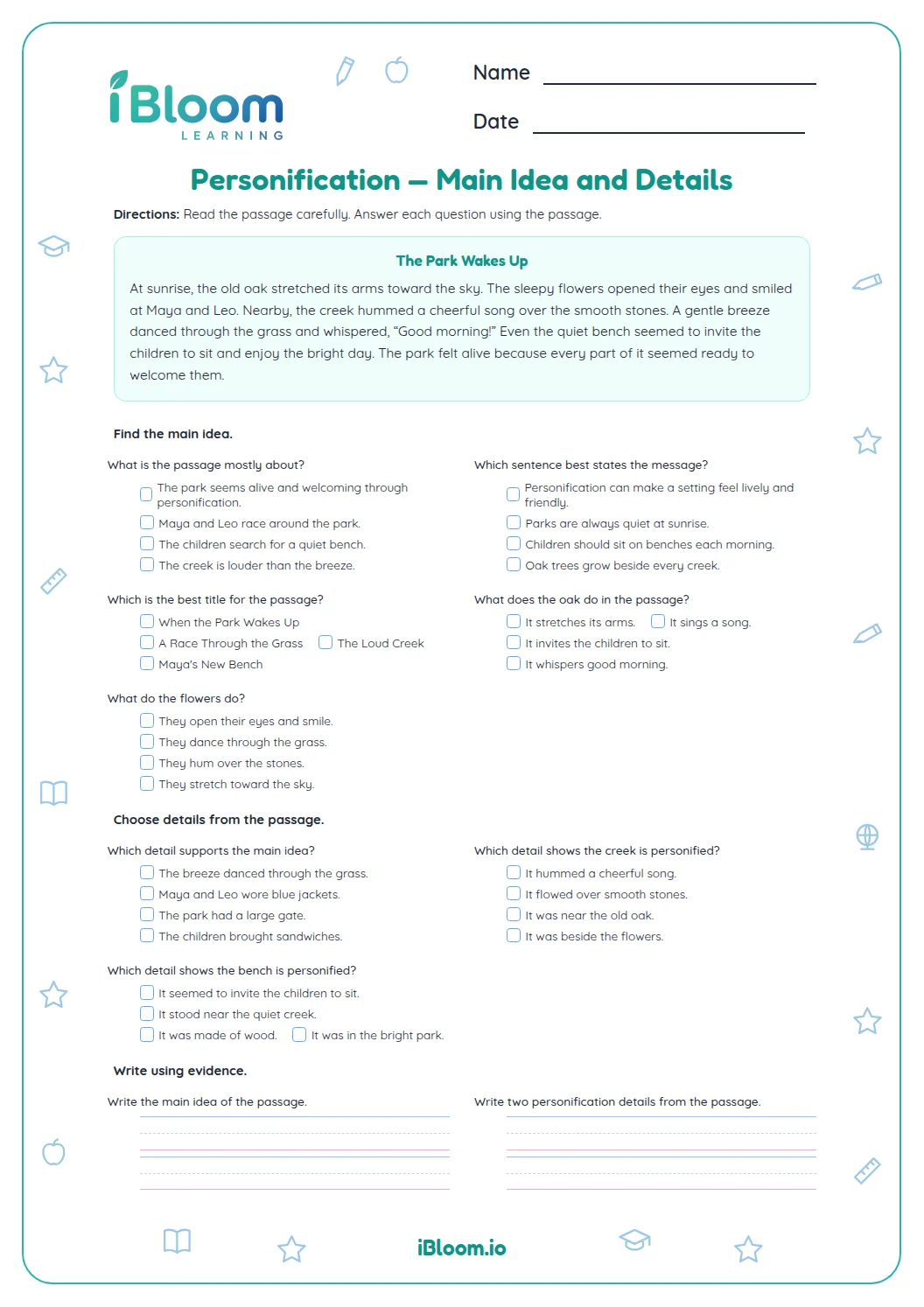




About this worksheet
This free printable worksheet helps Grade 5 students recognize similes and metaphors and explain what they mean. Part B introduces the terms, so students know what to look for, and it can be done before the story is read. The story is a short original one, "Grandpa's Workshop," which holds five similes and four metaphors, and Part C asks what some of those comparisons tell them. Part D turns to vocabulary: three words whose meaning the sentence around them gives away. It practices Common Core L.5.5.a, interpreting figurative language in context, along with RL.5.4 and L.5.4.a. A three-page answer key is included.
Aligned to L.5.5.a and RL.5.4
What is the difference between a simile and a metaphor?
Both compare two different things so a reader can picture one of them more clearly. A simile uses the word like or as: "the blade glided like a skater on smooth ice." A metaphor skips those words and says one thing is the other: "Grandpa's workshop was a treasure chest."
At Grade 5, students go past labeling. They are expected to say what the comparison means in the text. A workshop is not really a chest of treasure, but the metaphor tells us it is full of things that seem wonderful to Nia.
How do students work out what a comparison means?
Teach three questions. What two things are being compared? What do they have in common? What happens in the story that supports it? The story always gives a clue, so students do not have to guess.
Watch out for answers that are true about the object but miss the point. A mule is brown and heavy, but the author compares the saw to a mule because both refuse to do what they are told.
- 1"At first, the saw was a stubborn mule in her hands."
- 2Compared: a saw and a mule. There is no like or as, so it is a metaphor.
- 3A mule that digs in its feet will not do what you want.
- 4The story says the saw jumped, twisted and refused to follow the line.
- 5Meaning: the saw would not do what Nia wanted.
Why preview the terms and vocabulary around a story?
Part B takes a couple of minutes and gives students the words they need: simile, metaphor, and the signal words like and as. If students do Part B before they read the story, they read knowing what to look for, and the story questions are easier to answer.
Part D works on three words from the story: glittered, glided and ached. Each has a nearby clue, such as "like tiny stars" for glittered and "like a skater on smooth ice" for glided. Figurative language and context clues work together, because a vivid comparison often explains an unfamiliar word.
What is on this worksheet?
One original story of about 240 words, followed by 12 multiple-choice questions in three parts, labeled B to D on the sheet. The story is about a girl building a birdhouse with her grandfather. Its comparisons are everyday: a mule, a skater, a lake, a palace.
- Part A, Read: the story "Grandpa's Workshop" on the first page
- Part B, Preview the terms: spot a simile, spot a metaphor and name the signal words (questions 1 to 3)
- Part C, Find them in the story: name one simile and say what five comparisons mean (questions 4 to 9)
- Part D, Words in context: glittered, glided and ached (questions 10 to 12)
- A matching three-page answer key
How to use this worksheet at home or in class
- 1Start with Part B, before the story. Ask your child to give an example of each term before choosing answers.
- 2Then read "Grandpa's Workshop" aloud together once, and let your child read it again silently and underline every comparison.
- 3Have your child do Part C alone. For each question, ask which two things are being compared and what they share.
- 4In Part D, ask your child to point to the clue in the sentence before choosing a meaning.
- 5Check with the answer key and talk about any miss. Ask, "What does the story say that supports your answer?"
- 6Extend it: ask your child to write one new simile and one new metaphor about the same workshop.
Common mistakes and quick fixes
The mistake
Calling every comparison a simile because it compares two things. "The hinges groaned like a tired giant" is a simile, but "the saw was a stubborn mule" is a metaphor.
The fix
Look for like or as first. If neither word is there and one thing is said to be another, it is a metaphor.
The mistake
Reading a metaphor literally. In question 5, a child may choose "Made of metal" because a chest is a metal or wooden box.
The fix
Ask, "Is the workshop really a chest?" Then ask what a treasure chest makes people feel, and what Nia feels in the workshop.
The mistake
Choosing an answer that is true of the object but not the point, such as "They were very heavy." for "as steady as stone" in question 6.
The fix
Ask what a stone does that matters here. It does not shake or move, which fits hands that stay still while they work. Heavy is true of stone but is not what the comparison is about.
Common Core alignment
Most US states use the Common Core Language and Reading standards or a close state version. These two Grade 5 standards name what this sheet practices.
Tell similes from metaphors and explain what each comparison means in the story.
On this sheet: Main standard: Parts B and C ask students to identify similes and metaphors and say what they mean in the story.
Show the official wordingHide the official wording
Interpret figurative language, including similes and metaphors, in context.
Work out what phrases in a story mean, including comparisons like a stubborn mule.
On this sheet: Part C works with phrases from a short story and their meaning in that text.
Show the official wordingHide the official wording
Determine the meaning of words and phrases as they are used in a text, including figurative language such as metaphors and similes.
What to practice next
Make more practice
Further reading
Questions parents and teachers ask
What is the difference between a simile and a metaphor?
A simile compares two things using like or as, such as "her smile was as wide as the lake." A metaphor says one thing is another, such as "the saw was a stubborn mule." Both help readers picture something, but only the simile uses a signal word.
How many similes and metaphors are in the story?
"Grandpa's Workshop" has five similes: groaned like a tired giant, glittered like tiny stars, as steady as stone, glided like a skater, and as wide as the lake. It has four metaphors: a treasure chest, a whirlwind of ideas, a stubborn mule, and a small wooden palace. Parts C and D use all five similes and three of the metaphors.
What are the answers to Part B?
The simile is "Snow fell like feathers," and the metaphor is "The class was a beehive." The signal words are like and as. None of the three questions needs the story, so students can do them first. The answer key lists the answers to all 12 questions in order.
Why do students do Part B before reading the story?
Part B gives students the terms and signal words first, and its three questions do not need the story. Doing it first means students read the story knowing what to look for. It is optional, and students can also read first and then use Part B to check the terms.
Is this worksheet hard for Grade 5?
It is about right for most Grade 5 students, and a good review for Grade 4. The comparisons are everyday ones, and the story is about 240 words. Struggling readers can read it aloud with a partner. Part C, which asks what a comparison means, is the hardest.
How long does it take, and is there an answer key?
Most Grade 5 students finish in about 20 to 25 minutes, including the reading. Yes. A three-page answer key is included. You can print the worksheet by itself for students, keep the key for checking, and use the story again later for a writing activity.