


About this worksheet
This Grade 5 printable uses an original story about Maya preparing a banner for a school art show. Fourteen questions ask readers to interpret metaphors and a simile, infer character feelings and ideas, and select evidence. Two open responses invite an explanation in the learner’s own words; a separate answer key provides model answers.
Aligned to 5.RL.1
How do readers interpret comparisons?
A metaphor describes one thing as another; a simile compares using like or as. In Maya’s story, the “locked door” describes her difficulty finding ideas, while a brushstroke feels like a step across a bridge as she makes progress.
How does evidence support an inference?
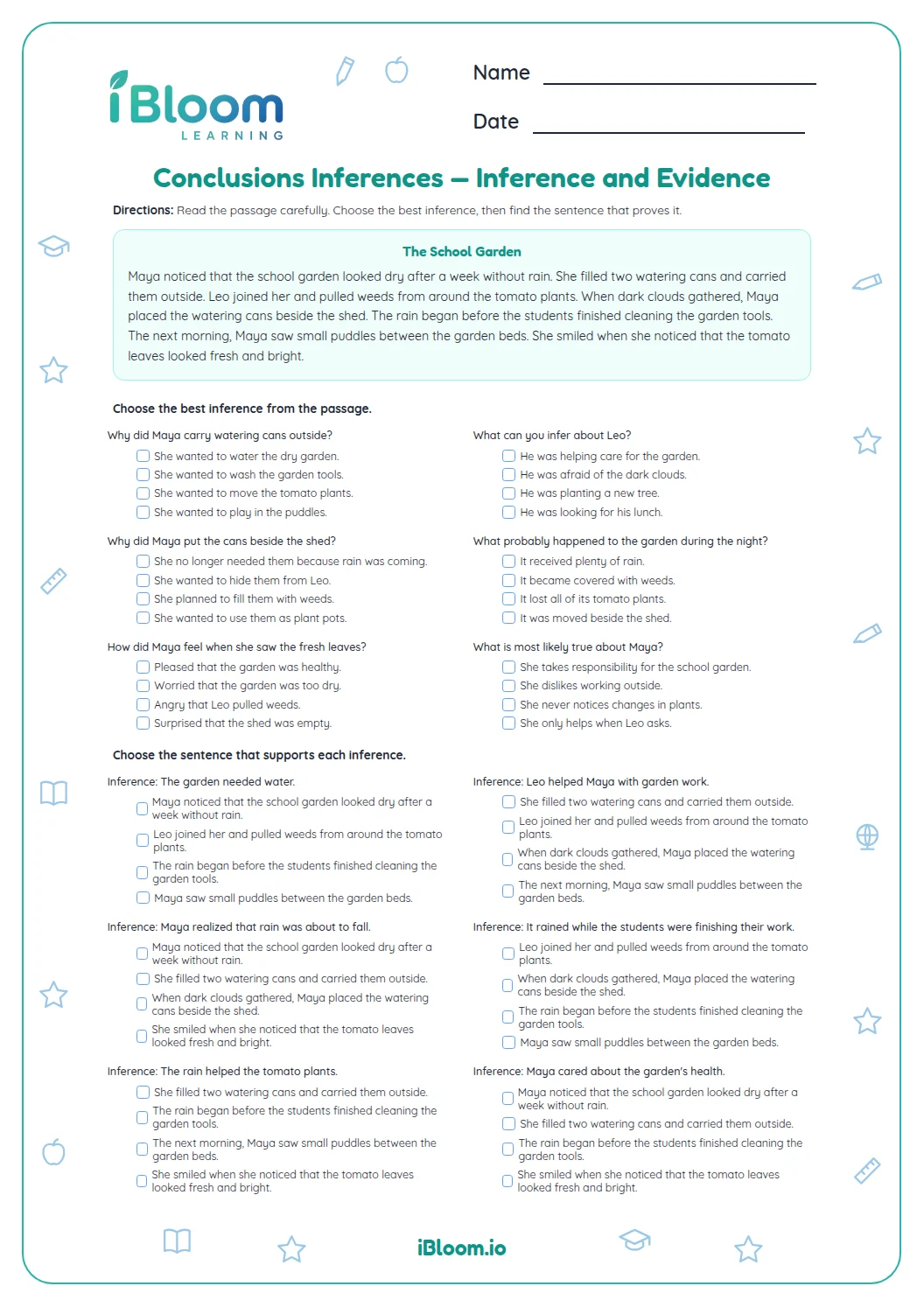
An inference connects textual clues. Maya observes garden colors before changing her design, then solves the lighting problem with lanterns. Those actions support conclusions about her persistence and growing confidence.
How to use this worksheet
- 1Read the story to understand Maya’s challenge.
- 2Underline a comparison and notice whether it uses like or as.
- 3Reread the surrounding events to infer what the phrase means.
- 4For evidence questions, choose a detail that directly supports the idea.
- 5Write complete explanations for the two open responses, then check the key.
Check the reasoning
The mistake
Taking a metaphor literally.
The fix
Ask what the comparison suggests in the scene.
The mistake
Calling every comparison a simile.
The fix
Look for like or as in the comparison.
The mistake
Giving an inference without a story clue.
The fix
Name an action or sentence that supports it.
Common Core alignment
This worksheet practices the following Common Core skill.
Interpret figurative language and support inferences with textual evidence.
On this sheet: Interpret figurative language and support inferences with textual evidence. is practiced in the worksheet.
Show the official wordingHide the official wording
Quote accurately from a text when explaining what the text says explicitly and when drawing inferences from the text.
What to practice next
Further reading
Questions parents and teachers ask
What figurative language appears in the story?
Maya describes her ideas as a locked door, and Eli calls the garden a color wheel. The story also compares each brushstroke to a small step across a bridge. Ask the learner to point to the relevant sentence or number relationship before checking the key; that makes the reasoning visible and helps distinguish a supported answer from a guess.
How many questions are included?
The worksheet has 14 questions. They cover comparison meanings, evidence, inferences, context clues, and the story’s theme. Ask the learner to point to the relevant sentence or number relationship before checking the key; that makes the reasoning visible and helps distinguish a supported answer from a guess.
What does the answer key include?
The separate key lists answers in question order and gives sample responses for the two open questions. Other well-supported wording may also show clear understanding. Ask the learner to point to the relevant sentence or number relationship before checking the key; that makes the reasoning visible and helps distinguish a supported answer from a guess.
How can a learner tell a simile from a metaphor?
A simile makes a comparison using like or as. A metaphor describes one thing as another, as when Maya calls her ideas a locked door. Ask the learner to point to the relevant sentence or number relationship before checking the key; that makes the reasoning visible and helps distinguish a supported answer from a guess.
What is a strong inference answer?
A strong answer states a reasonable idea about a character or event and points to a story detail that supports it. The questions ask learners to connect clues rather than guess. Ask the learner to point to the relevant sentence or number relationship before checking the key; that makes the reasoning visible and helps distinguish a supported answer from a guess.