


About this worksheet
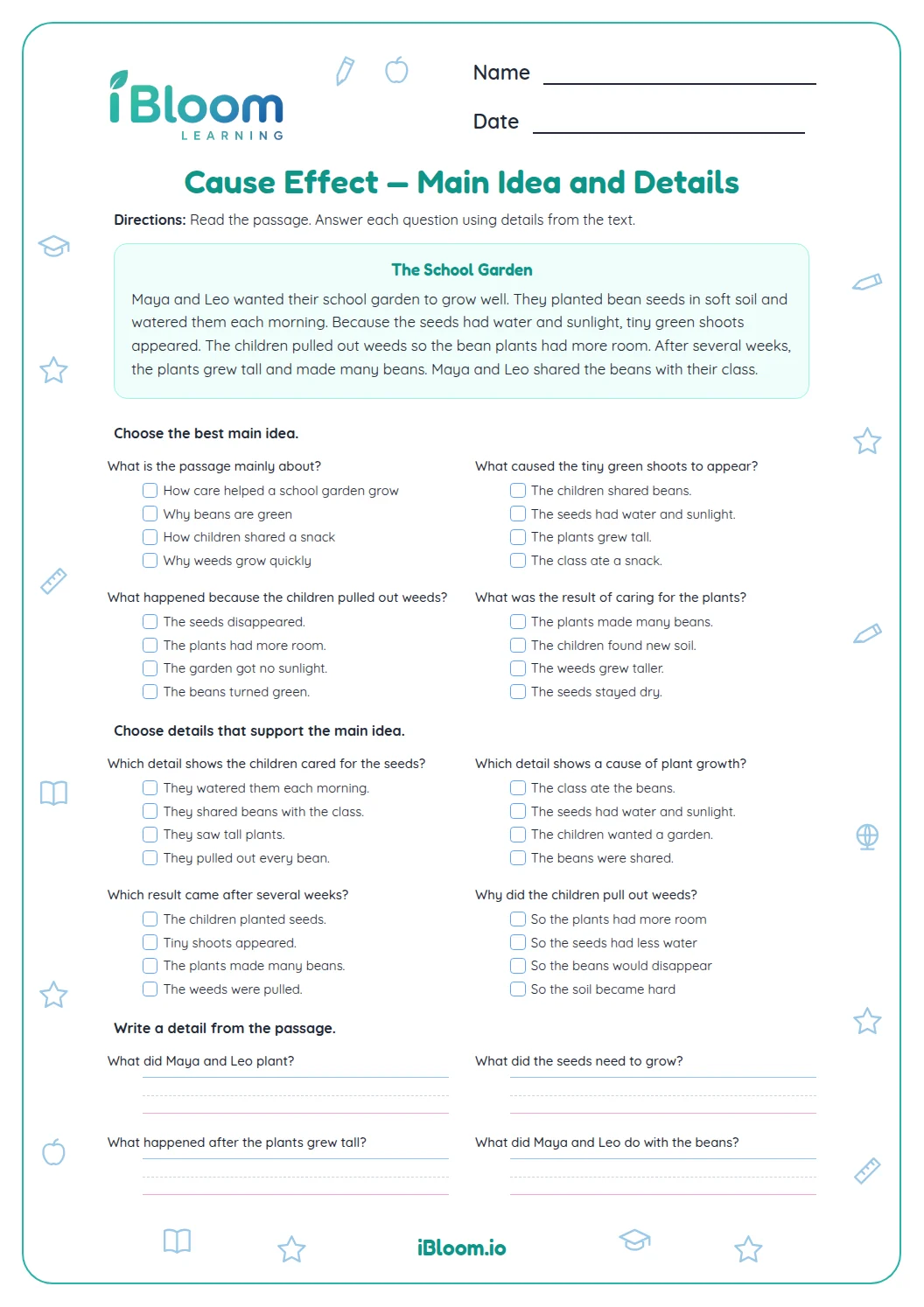
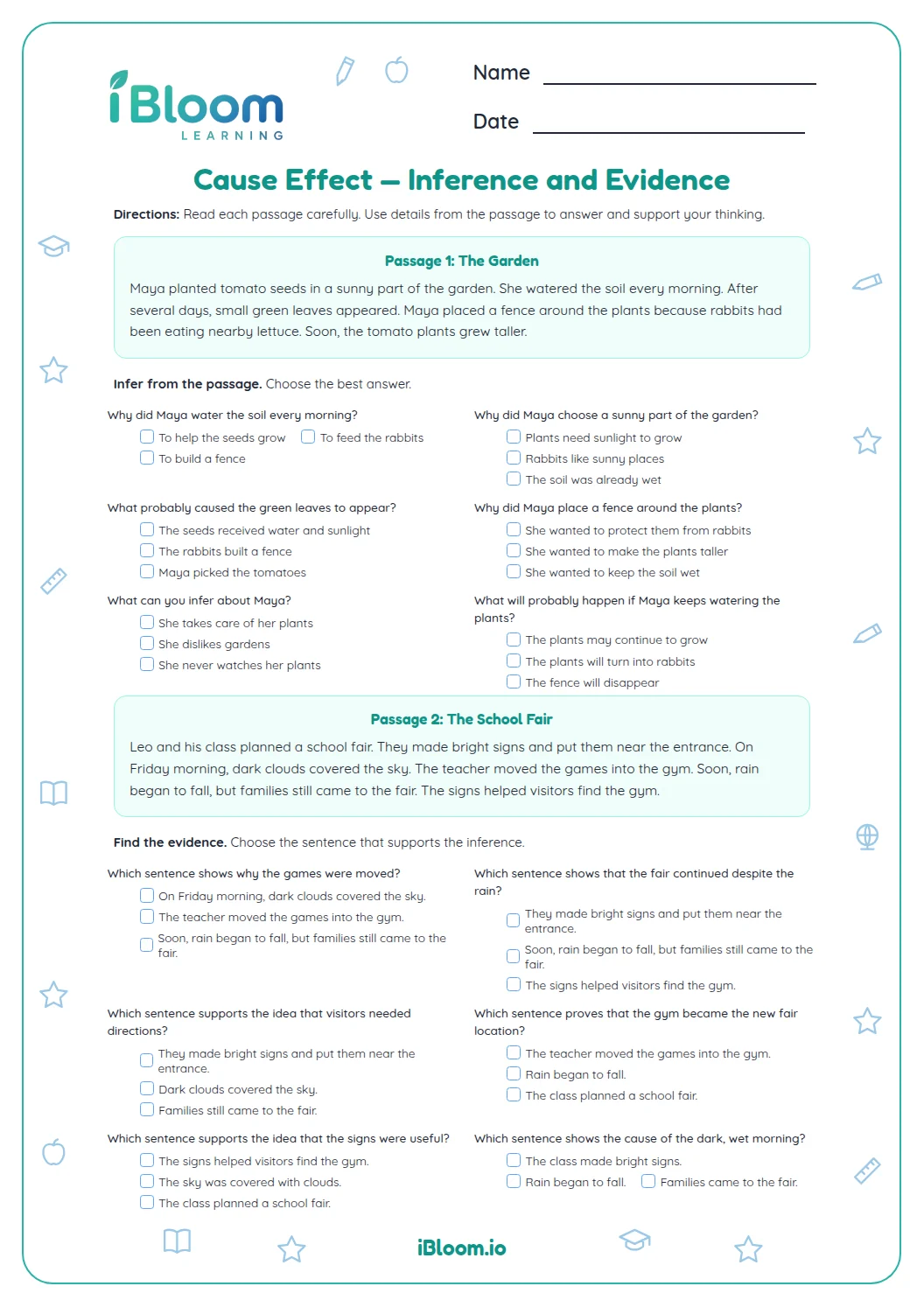
This free printable cause and effect worksheet uses a school garden story to help readers explain why events happen. It is written for a Grade 3 reading level, and an adult can read it aloud to younger children using this topic collection. Part A is the passage; Parts B through D contain fourteen written questions about watering seeds, protecting plants, and responding to a storm. Children move from naming a cause or effect to explaining a chain of events with evidence. The character decisions and their consequences practice Common Core RL.3.3. The separate answer key provides sample responses.
Aligned to RL.3.3
How do you tell a cause from an effect?
A cause answers why. An effect answers what happened as a result. In the garden story, the seeds need moisture, so Maya and Leo water the soil. Later, rain supplies enough water, so the children skip watering the next morning.
Ask children to point to the words that connect the two ideas before they write. Because introduces a reason; so can introduce a result.
- 1Why did Maya and Leo water the soil every morning?
- 2Text detail: the seeds needed moisture to grow.
- 3Response: They watered the soil because the seeds needed moisture to grow.
How does the writing become more demanding?
Part B asks four why questions with answers stated in the passage. Part C asks for four effects, including one prediction grounded in the rabbits’ behavior. Part D joins events into a chain and asks children to compare two helpful actions.
Each answer can be one clear sentence. For the final two questions, a sentence with two connected clauses is enough if it includes both required ideas.
What counts as evidence in a short response?
Evidence is a specific detail from this story: rabbits nibble leaves, wind bends stems, and sticks support plants. Children may use their own wording while keeping those facts.
A response such as “They helped the garden” is too broad for the fence question. Ask what the fence changed. “The fence kept rabbits from eating the young plants” names a result that can be checked against the passage.
How to work through this sheet
- 1Read the passage aloud once, then let the child reread it.
- 2For question 1, identify the action and underline its reason.
- 3Complete Part B using because when it helps connect the ideas.
- 4For Part C, return to the sentence about each action and find its result.
- 5Check that the final storm response connects wind, bent stems, and sticks.
Mistakes to discuss
The mistake
Reversing the relationship: the plants bent because children tied them.
The fix
Reread the storm paragraph. Wind bent the stems first; tying them was the response.
The mistake
Writing only “because of the storm.”
The fix
Name the storm detail that mattered: wind bent the stems.
The mistake
Predicting that rabbits will water the garden.
The fix
Use what the story says rabbits already did: nibble the young leaves.
Common Core alignment
Explain how Maya and Leo’s choices affect events in their garden.
On this sheet: Readers explain the reasons for the children’s actions and the results of those actions.
Show the official wordingHide the official wording
Describe characters in a story (e.g., their traits, motivations, or feelings) and explain how their actions contribute to the sequence of events.
What to practice next
Make more practice
Further reading
Questions parents and teachers ask
Which reading level is this cause and effect sheet written for?
The passage and questions target Grade 3 readers. This topic collection can also be used with younger children when an adult reads the passage and helps rehearse answers aloud. Older readers can work independently and focus on making each explanation precise, with a detail that supports it.
Does every answer need the word because?
No, but because is a useful way to introduce a cause. Children can also use so to introduce an effect, as in “The stems bent, so the children tied them to sticks.” Check the relationship between the ideas rather than requiring one sentence frame for every answer.
How much should children write for each question?
One complete sentence is enough for most questions on this sheet. Question 9 about the wind needs all three linked events: wind, bent stems, and tying plants to sticks. Children may use two short sentences if that makes their explanation easier to follow and keeps the events connected.
Can children use different wording from the answer key?
Yes, the key gives sample responses rather than wording to memorize. Accept an answer when it names the correct cause or effect and agrees with the passage. For example, “The fence stopped rabbits from reaching the plants” expresses the same relationship as “The fence kept rabbits out.”
How should I check the prediction about removing the fence?
Look for a prediction about rabbits reaching or eating the young plants. The story says rabbits had nibbled the leaves before the fence went up, so that detail supports the prediction. Ask the child to explain that connection aloud if the written response gives only the predicted event.