




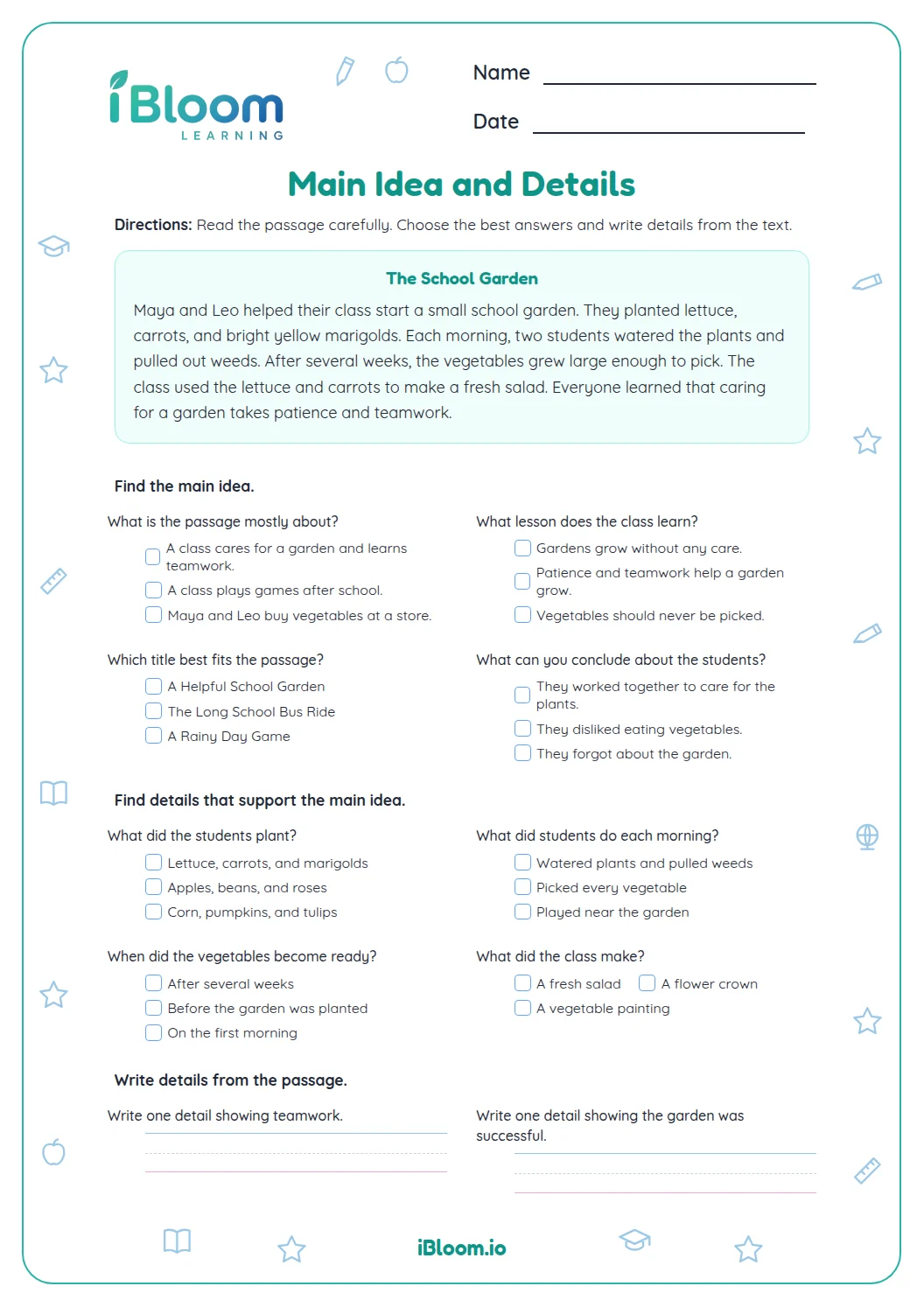
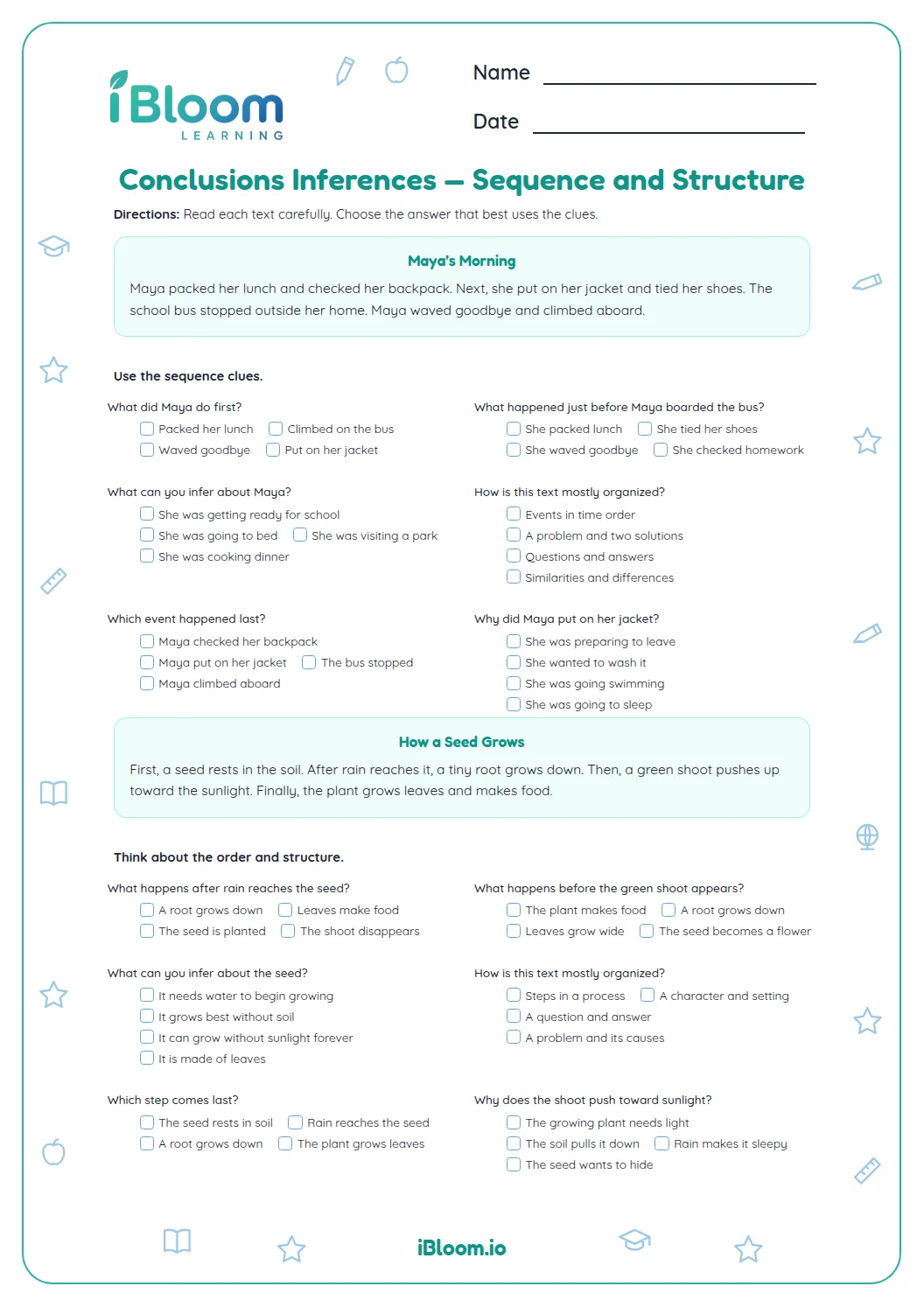
About this worksheet
This free Grade 3 reading worksheet pairs the story The School Garden with 14 mixed comprehension questions. Maya and Leo help a dry garden by loosening soil, watering roots, and using dry leaves to hold moisture. Part A contains the passage, Part B has eight choices, and Part C has six written responses. Students practice Common Core RL.3.1 and RL.3.3 by returning to the text and explaining the children’s choices. A separate answer key includes sample responses for questions that allow different wording.
Aligned to RL.3.1 and RL.3.3
What happens in The School Garden?
After a hot week, Maya and Leo notice drooping leaves and hard soil in the school garden. They loosen the soil, water the roots slowly, and cover the ground with dry leaves. By Friday, the plants look stronger, and Maya plans a watering schedule for the class.
How do students support an answer with evidence?
Start with the question, then locate the sentence or action that helps answer it. For an inference, name the idea and explain which detail makes it reasonable. A clear paraphrase is enough; students do not need to copy a full sentence.
- 1Question: Why did the children loosen the hard soil before watering?
- 2Detail: They wanted water to reach the roots.
- 3Answer: Loosening the soil helped water reach the plants’ roots.
How do the question parts work together?
Part B checks six details and vocabulary clues, then asks students to identify the main idea and Maya’s plan. Part C asks students to explain why the children loosened the soil, name helpful actions, cite clues that the garden was dry, describe the change by Friday, and make a supported prediction.
Accept different wording when an answer fits the story. For written questions, look for a clear connection to something Maya, Leo, or Ms. Chen did.
How to use this worksheet
- 1Read the complete passage before looking at the questions.
- 2Reread the story for the Part B choices and notice the words that support each answer.
- 3Write brief Part C answers using a detail from the passage when it helps.
- 4For a prediction, connect a likely next step to something Maya or Leo did.
- 5Check against the key and return to the relevant sentence for any answer you revise.
Mistakes to notice and fix
The mistake
Choosing a familiar gardening fact instead of a story detail.
The fix
Reread the passage and find what these characters actually did.
The mistake
Assuming the children tried the first idea that came to mind.
The fix
Reread the order: they loosened soil, watered slowly, and added dry leaves.
The mistake
Making a prediction without using an event from the story.
The fix
Connect the next step to Maya’s plan for a class watering schedule.
Common Core alignment
Use story details to answer literal and inference questions.
On this sheet: Students identify details and support a prediction with evidence from the passage.
Show the official wordingHide the official wording
Ask and answer questions to demonstrate understanding of a text, referring explicitly to the text as the basis for the answers.
Explain how Maya and Leo’s actions help the school garden.
On this sheet: Questions connect the children’s actions to the garden’s improvement and Maya’s plan.
Show the official wordingHide the official wording
Describe characters in a story (e.g., their traits, motivations, or feelings) and explain how their actions contribute to the sequence of events
What to practice next
Make more practice
Further reading
Questions parents and teachers ask
What grade is The School Garden for?
This worksheet is written for Grade 3 reading practice. The short story follows one problem and the children’s actions to help the garden. Students should be able to follow several connected events and answer questions by returning to details in the passage.
Is the passage included on the printable?
Yes, The School Garden is included as Part A. Students can return to the passage while answering fourteen questions in Parts B and C. Keeping the story with the questions makes it possible to point to evidence and reread the exact event being discussed.
What makes the questions mixed comprehension practice?
The questions combine several reading moves within one story. Students find details, connect actions and results, interpret vocabulary, explain why the children loosened the soil, and describe how the garden changed. The final questions ask for evidence and a prediction supported by the passage.
Can I accept a written answer different from the key?
Yes, accept different wording when it answers the question and fits the passage. The key gives sample responses for six written explanations. For the prediction, a student should connect a likely next step to Maya’s plan to make a watering schedule for the class.
How can I help without giving away an answer?
Direct the child back to a relevant sentence and ask which detail helps. For example, ask what happened after the children loosened the soil and watered the roots. Let the child explain how that result supports an answer before checking the key.