



About this worksheet
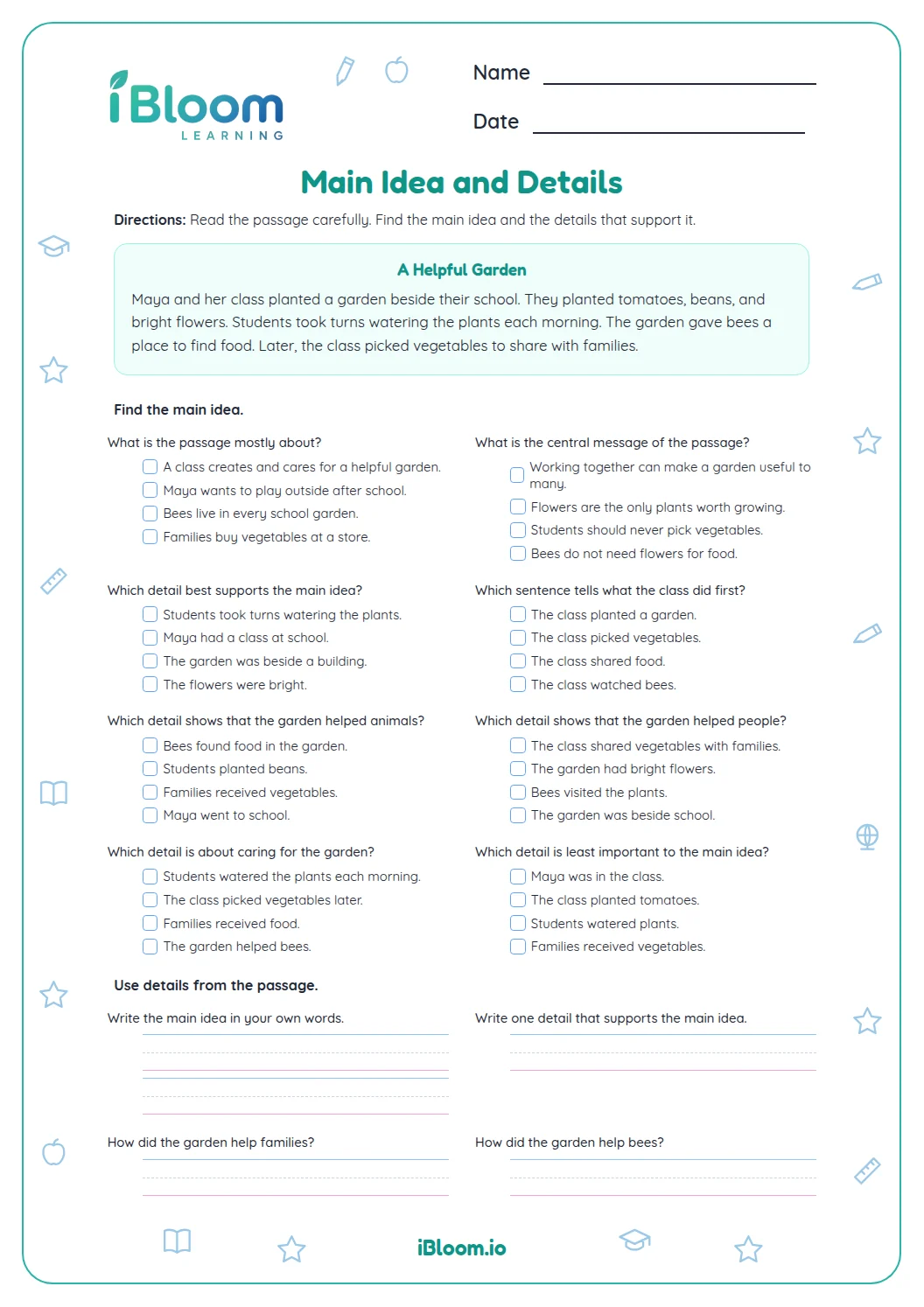
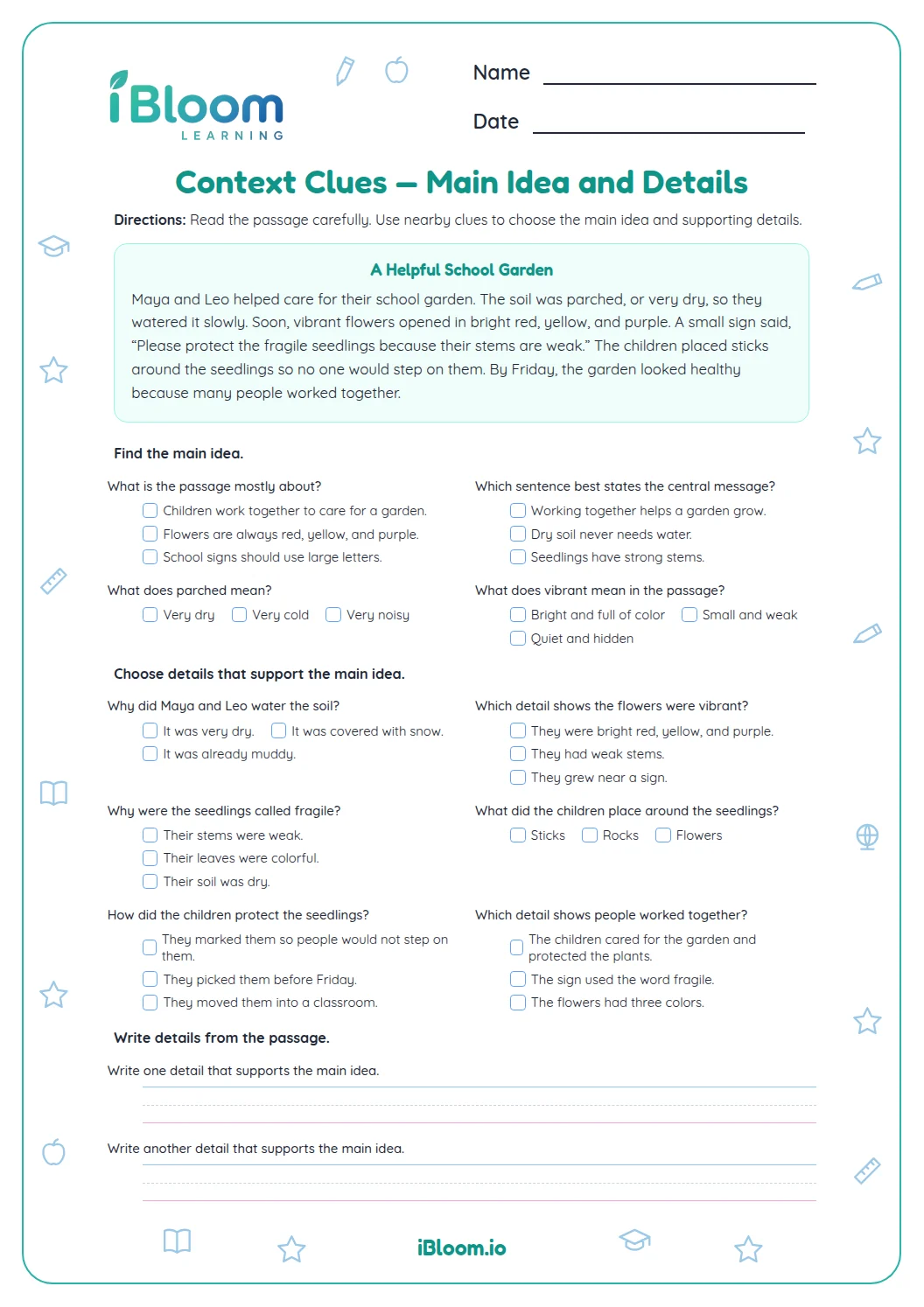
This Grade 3 reading worksheet pairs an original passage about a library seed shelf with questions on main idea and supporting details. Students first choose what the whole passage is mostly about, then find specific facts about the seed packets, care cards, and families’ gardens. The final questions ask them to explain how details support the central idea in complete sentences. The practice aligns with Common Core RI.3.2, determining a text’s main idea and explaining how key details support it. An answer key includes sample responses for the written questions.
Aligned to RI.3.2
What is the passage and what will students do?
The passage describes a library seed shelf, the care cards students prepared, and the families who grew plants at home. Part B asks what the whole passage is mostly about. Part C checks whether readers can locate particular facts. Part D asks them to explain how those details connect to the main idea.
The answer key includes models for written responses. Students may use different wording if they explain the same relationship with evidence from the passage.
How is the main idea different from one detail?
A main idea covers the whole passage. A detail gives one piece of information that supports it. “One family grew lettuce in a window box” is a detail; the passage’s larger idea is that sharing seeds and growing advice helped a library project reach families.
- 1Question 1 asks what the passage is mostly about.
- 2“A library seed shelf helps families garden” covers the whole passage, while the window-box lettuce is one supporting detail.
How do details support the main idea?
Look for facts that show what happened and why it matters. The care cards explained sunlight and water, and more families borrowed seeds afterward. Those details show how clear directions helped the seed shelf work. A strong answer names a detail and connects it to the larger idea.
How to read for the main idea
- 1Read the whole passage before choosing a main idea.
- 2Ask what the passage says across all its paragraphs.
- 3Mark details that explain the project and its results.
- 4Use a specific fact for each detail question.
- 5For the written responses, name a detail and explain its connection.
- 6Reread the passage to check that the answer is supported.
Common reading slips and quick fixes
The mistake
Choosing “one family grew lettuce” as the main idea.
The fix
That is one detail; look for an idea that covers the whole passage.
The mistake
Picking a choice that names a seed but misses the library project.
The fix
Check whether the choice includes the passage’s shared-seed effort and result.
The mistake
Giving a detail without explaining how it supports the idea.
The fix
Add a phrase that connects the fact to how the project helped families.
Common Core alignment
Students identify a passage’s central idea and use its details to explain how the idea is developed.
Find a passage’s main idea and explain how key details support it.
On this sheet: Questions ask readers to identify the passage’s central idea, recall details, and explain how details support it.
Show the official wordingHide the official wording
Determine the main idea of a text; recount the key details and explain how they support the main idea.
What to practice next
Make more practice
Further reading
Questions parents and teachers ask
What is the main idea of “Seeds to Share”?
The passage’s main idea is that a library seed shelf helped families try gardening and helped students share useful instructions. The chart, care cards, family plantings, and display are details that show how the project worked and grew across the whole passage.
How is a main idea different from a supporting detail?
A main idea tells what the whole passage is mostly about. A supporting detail gives a particular fact from the passage. The family growing lettuce in a window box is one detail; the seed-sharing project helping families garden is the larger idea.
Where can students find answers to the detail questions?
The answers come directly from the passage. Readers can look back for the sign beside the packets, the seed types, the care-card information, and the families’ garden examples. Returning to the text helps them check each choice before answering. They should reread before choosing.
What should a written response include?
A strong response uses a complete sentence, names a relevant fact, and explains what that fact shows when the question asks for a connection. The key provides sample wording, but another answer can be correct if it is supported by the passage.
Why does the worksheet ask about both the main idea and details?
Details help readers understand how a passage develops its main idea. Finding one fact checks understanding of a sentence, while connecting several facts helps readers see the project and its result across the whole passage. Both parts build understanding of the text.