




About this worksheet
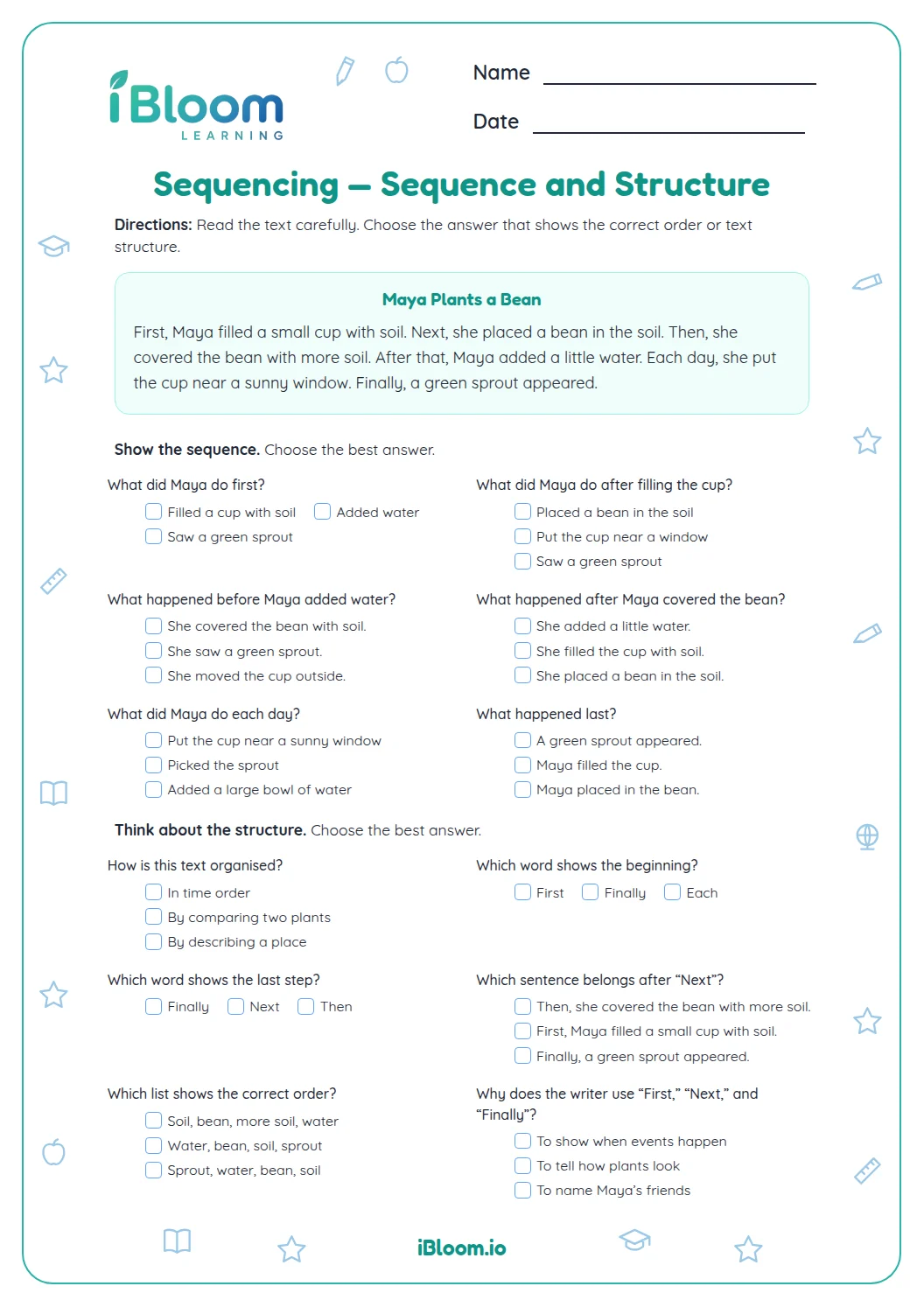
This free printable worksheet helps Grade 3 readers follow the order of events in a story and see how its parts fit together. Children read a short original story, Omar and the Stuck Kite, and then answer fifteen questions. Part A is the story. In Part B, they put events in order and spot the signal word that marks the last step. In Part C, they place four events in the beginning, middle or end, and name the problem, the solution, the reason Omar needed help and what the ending tells us. Part D asks for a three-sentence retelling. It supports Common Core RL.3.5 and RL.3.3. A separate answer key covers every question.
Aligned to RL.3.5 and RL.3.3
What is on this worksheet?
One story of about 190 words and fifteen questions in four parts. The story has a clear beginning, a middle where the problem gets worse, and an ending that wraps up the action. Signal words such as then, just then, finally and before are used on purpose, so children have something to look for.
Most questions are multiple choice, so children can focus on thinking about the story. The last question asks for writing, because retelling is the real test that a child understands the order.
- Part A: the story, about 190 words in four short paragraphs
- Part B, questions 1 to 6: put events in order, including one signal word
- Part C, questions 7 to 14: place four events in the beginning, middle or end, then name the problem, the solution, the reason for help and what the ending shows
- Part D, question 15: retell the story in three sentences
- Answer key on separate pages
How do signal words help children follow the order of events?
Words like then, just then, finally and before tell the reader where each event sits in time. Children can underline them as they read, and then use them to answer questions about what happened before or after something else.
Question 5 asks which word signals the last step. Then and Just then are both in the story, but they come earlier; only Finally signals that the rescue is ending.
- 1Question 3: What did Omar do before help came?
- 2Find "Just then, he noticed his neighbor" in the story
- 3Look at the sentences just before it: "Omar tugged on the string... He tugged again and again."
- 4Answer: He tugged on the string
What are the beginning, middle and end of a story?
The beginning introduces the character and the setting. The middle is where the problem grows and the characters try to fix it. The ending shows how the problem is solved and how things are afterward. In Omar's story, the beginning shows his new kite flying, the middle is the crash and the rescue, and the end is the kite landing and the ribbon.
Questions 7 to 10 in Part C ask children to sort events by these parts. A useful hint is to ask whether the sentence is before the problem, during the problem or after the problem is solved.
- 1Question 8: Omar tugs on the string.
- 2In the story, he tugs after the kite is already stuck, and the problem is not solved yet
- 3Answer: Middle
How does each part of a story build on the part before it?
RL.3.5 asks Grade 3 students to describe how each successive part builds on earlier sections. The best way to practice is with "because" questions. Omar asks Mr. Park for help because tugging did not work, and the tug came after the crash, which came after the gust.
Question 13 asks exactly this: why did Omar ask for help? Children who can say what caused the next event are no longer just listing the order. They are explaining the story.
How to use this worksheet at home or in class
- 1Read the story aloud once, then let your child read it silently. Ask them to underline the signal words, such as then, just then and finally.
- 2Do question 1 together. Have your child point to the sentence in the story that proves the answer.
- 3Let your child finish Part B alone, then check the six answers with the key.
- 4For Part C, use this hint: the beginning comes before the problem, the middle is while the problem is happening, and the end is after it is solved.
- 5Ask your child to say the retelling aloud before they write it in Part D. They should use the words first, next and last.
- 6Move on to the story elements or cause and effect worksheets when ordering feels easy.
Common mistakes and quick fixes
The mistake
Choosing Beginning for question 8 because Omar is still at the park.
The fix
The beginning only introduces Omar and his kite. By the time he tugs at a stuck kite, the problem has already started, so the sentence belongs in the middle.
The mistake
Choosing Then in question 5 because it is the word children know best.
The fix
Have your child find every signal word in the story and mark where each one sits. Then is used when the gust comes, Just then when Mr. Park appears, and Finally when the kite is free. Only one marks the ending.
The mistake
Listing events but not saying why, so the retelling in question 15 is a list of unrelated sentences.
The fix
Ask "because" or "so" after each event: the kite got stuck, so Omar tugged; tugging did not work, so he asked for help. Add those words to the retelling.
Common Core alignment
These two Grade 3 reading literature standards ask students to describe parts of a story and how they connect. This worksheet practices both with one story.
Describe the beginning, middle and end of a story and how each part leads to the next.
On this sheet: Part C asks students to name the beginning, middle and end of a story, and to name its problem and solution.
Show the official wordingHide the official wording
Refer to parts of stories, dramas, and poems when writing or speaking about a text, using terms such as chapter, scene, and stanza; describe how each successive part builds on earlier sections.
Explain how what a character does leads to the next event in the story.
On this sheet: Questions 3, 12 and 13 ask how Omar's and Mr. Park's actions move the events along.
Show the official wordingHide the official wording
Describe characters in a story (e.g., their traits, motivations, or feelings) and explain how their actions contribute to the sequence of events
What to practice next
Make more practice
Further reading
Questions parents and teachers ask
What is the difference between sequence and structure?
Sequence is the order of events, such as first, next and last. Structure is how the story is built, with a beginning that sets things up, a middle where the problem grows and an ending that solves it. Part B of this worksheet asks about sequence, and Part C asks about structure.
Why does this worksheet use a short story and not a paragraph about facts?
Sequence and structure belong to stories, where events cause each other. A story about a stuck kite lets children see a problem start, grow and get solved. Informational texts have order too, but that is a different skill, and it is covered by other worksheets on the site.
What reading level is the story?
The story has about 190 words, short paragraphs and mostly simple sentences, which suits Grade 3 readers. It does include a few harder words, such as sudden, gust and fetched. If your child is a stronger or weaker reader, read it aloud once together before they answer.
Can my child use the story to find the answers?
Yes, and they should. Every question can be answered from the story, and RL.3.1 asks children to refer to the text. Encourage them to point to the sentence that proves their answer, or to underline signal words before they begin Part B.
What makes a good retelling in Part D?
A good retelling has three events in order, uses first, next and last, and connects them. For example: First, Omar's kite hit a tree. Next, Mr. Park used a rake. Last, the kite came down. The answer key has a sample, but any three events in the right order are correct.
What if my child puts events in the wrong order?
Ask them to read the story one paragraph at a time and say what happened in each. Then go back to the question. Most order mistakes come from reading the answer choices before the story, so have your child find the event in the story first and look at the sentences around it.