







About this worksheet
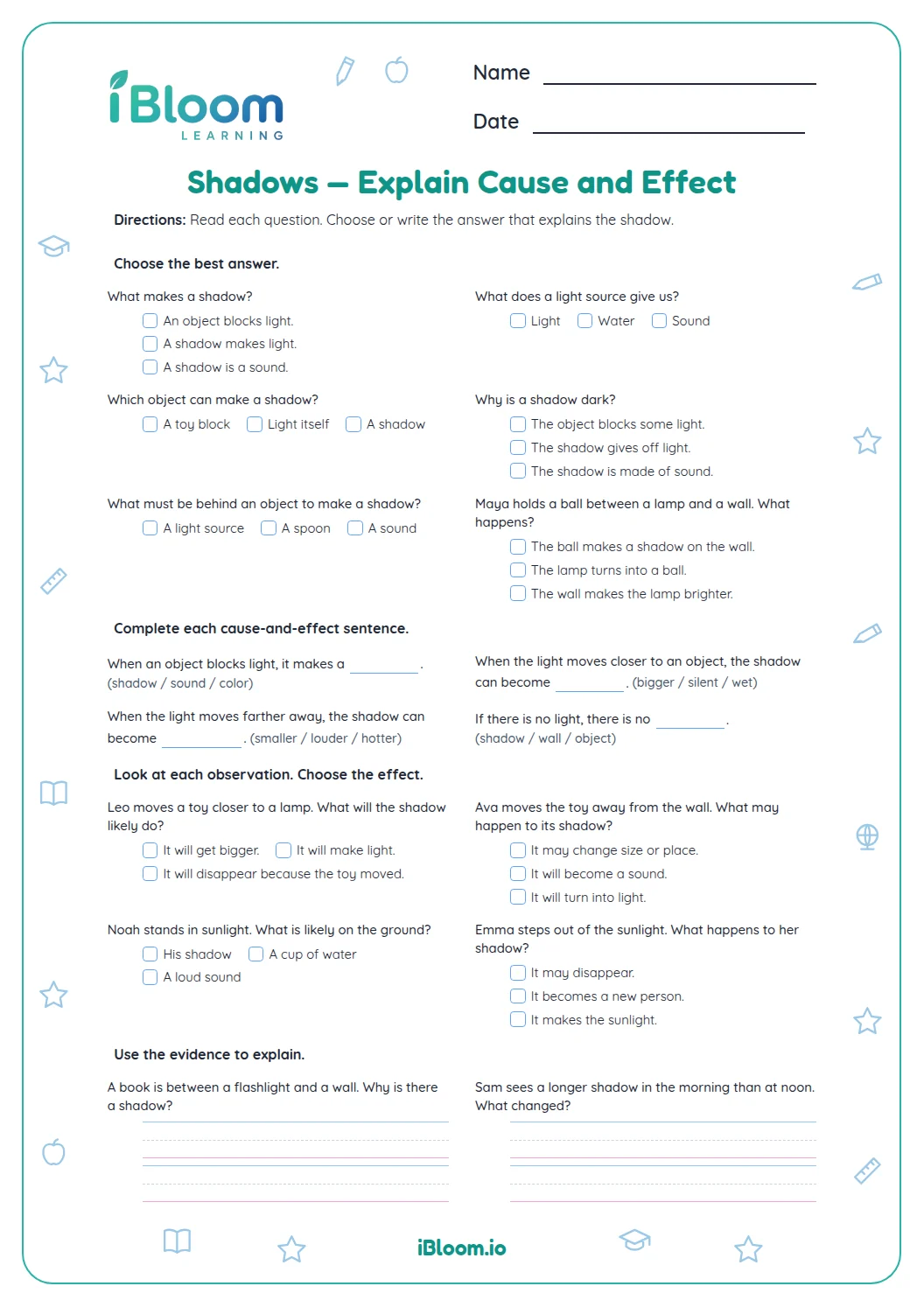
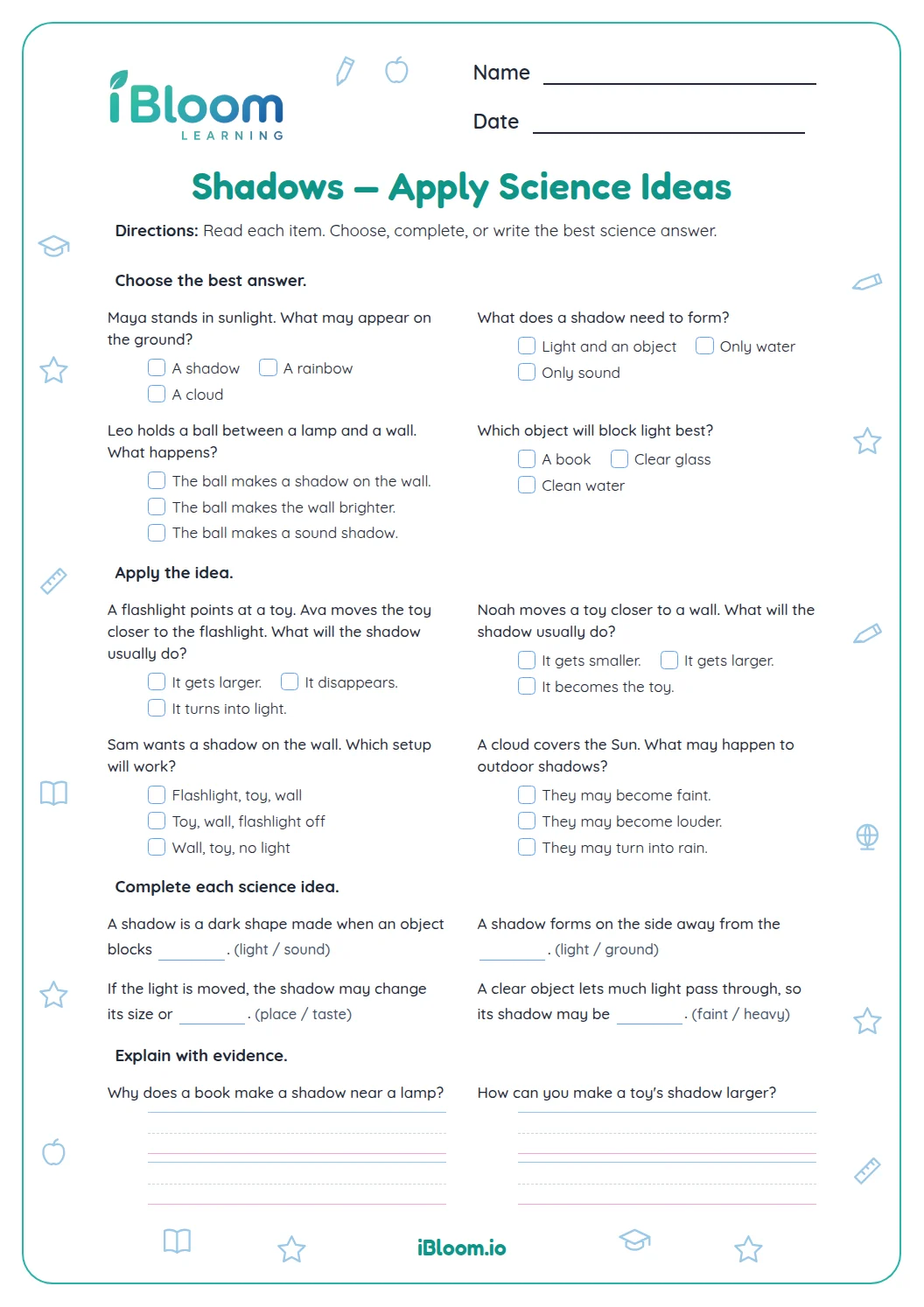
This free printable science worksheet reviews what first graders know about shadows and asks them to explain why. Part A asks what a shadow needs, which object is a light source and what happens when a flashlight is switched off. Part B asks where a shadow falls and what happens when a toy moves closer to a lamp. Part C asks children to check an idea, such as whether a shadow can form in total darkness, and to say what a book is doing when a dark shape appears on a wall. It practices NGSS 1-PS4-3, finding out what happens when objects are placed in a beam of light. There are 9 multiple-choice questions on 2 pages, with a 2-page answer key.
Aligned to 1-PS4-3
What is on this shadows worksheet?
Part A has four questions about what makes a shadow: what a shadow needs, what an object does to light, which picture is a light source, and what happens to a ball’s shadow when the flashlight is off. Part B has three questions about where a shadow falls: behind or in front of you when the Sun is behind you, which side of a toy it lands on, and what happens when the toy moves closer to a lamp.
Part C has two questions that ask children to use evidence. Maya says a shadow can form in total darkness, and Sam holds a book between a flashlight and a wall.
- Part A: 4 questions on what makes a shadow
- Part B: 3 questions on where a shadow falls and how it changes
- Part C: 2 questions that check an idea
- Pictures of a flashlight, a cup, a shoe and a teddy bear on two questions
Why does a shadow fall away from the light?
Light travels from the source, past the object. The object blocks some of it, so the dark shape lands on the other side of the object from the light. That is why the shadow is always on the side away from the light, never on the side the light comes from.
A good way to explain it to a first grader is to trace the light with a finger from the light source to the object and keep going. The place where the finger would hit next is where the shadow lands.
- 1The Sun is behind you. Where is your shadow?
- 2The light travels from the Sun, from behind you, toward the front.
- 3Your body blocks some of the light.
- 4The dark shape lands on the other side of you, in front.
- 5Answer: In front of you
How can you show that a shadow gets bigger?
Try it with a flashlight, a small toy and a wall in a dim room. Hold the toy far from the flashlight and notice the size of the shadow, then move the toy closer to the light. The shadow grows. This is what question 7 asks: a toy moves closer to a lamp and its shadow gets bigger.
Moving the toy away from the light shrinks the shadow again. Letting children make the change themselves helps the idea stick better than hearing it.
What happens to a shadow when the light is off?
With no light, there is nothing for the object to block, so there is no shadow. Question 4 asks what happens to a ball’s shadow in a dark room when Sam turns his flashlight off. Question 8 asks whether Maya is right that a shadow can form in total darkness. Both lead to the same idea: a shadow needs light.
How to use this worksheet at home or in class
- 1Try it first: in a dim room, shine a flashlight on a toy and a wall and let your child see the shadow.
- 2Read question 1 aloud together and ask your child what they noticed in the experiment.
- 3Let your child answer Part A, then talk about the light source in question 3: the one that gives off its own light.
- 4For Part B, repeat the experiment with the toy close to the flashlight and then far from it.
- 5In Part C, read Maya’s idea aloud and ask your child to test it by turning the flashlight off.
- 6Check with the answer key and ask your child to explain one answer in their own words.
Common mistakes and quick fixes
The mistake
Thinking a shadow is a thing, like a dark paint or a toy.
The fix
Show that you can wave a hand through a shadow. A shadow is the place where light is blocked, not an object.
The mistake
Putting the shadow on the same side as the light.
The fix
Trace the light with a finger from the source to the object. The shadow is where the finger would land next, on the far side.
The mistake
Thinking a toy’s shadow gets smaller as it moves closer to the lamp.
The fix
Test it with a flashlight and a wall. Moving the toy closer to the light makes the shadow bigger, and moving it away makes it smaller.
Science standards alignment
Find out what happens when an object is put in a beam of light, such as a book that makes a shadow.
On this sheet: Children reason from simple light tests: a book in a flashlight beam, a toy moved closer to a lamp, a light switched off.
Show the official wordingHide the official wording
Plan and conduct investigations to determine the effect of placing objects made with different materials in the path of a beam of light.
What to practice next
Make more practice
Further reading
Questions parents and teachers ask
What is a shadow for first graders?
A shadow is the dark shape that appears where an object blocks light. It needs a light source, such as the Sun or a flashlight, and an object in the way. This worksheet asks what makes a shadow, where it falls, and why it changes when the object or the light moves.
Why does a toy’s shadow get bigger near a lamp?
When the toy is close to the lamp, it blocks a wider part of the light, so the dark shape on the wall grows. Moving the toy away from the lamp shrinks the shadow. Question 7 asks this, and a flashlight, a toy and a wall let children see it for themselves.
What does light source mean?
A light source is something that gives off its own light, like the Sun, a lamp or a flashlight. A cup or a shoe does not make light, so it is not a light source. Question 3 asks children to pick the flashlight from three pictures.
What are the answers to Part C?
Question 8 is “Shadows need light,” because Maya is not right that a shadow can form in total darkness. Question 9 is “Blocking the light,” because the book stops the flashlight’s light from reaching the wall. The answer key lists all nine answers on two pages.
Do we need a flashlight to use this worksheet?
No. The worksheet works on its own, and the questions use pictures and short sentences. A flashlight and a small toy make a good warm-up, though, because children can see a shadow grow, shrink and disappear. Try it in a dim room or with the curtains closed.
How long does the worksheet take, and who is it for?
Most first graders finish in about 15 minutes. It suits a science review after a lesson on light and shadows, or practice at home. A grown-up can read the questions aloud for children who are still learning to read, and the answer key is a separate two-page document.