


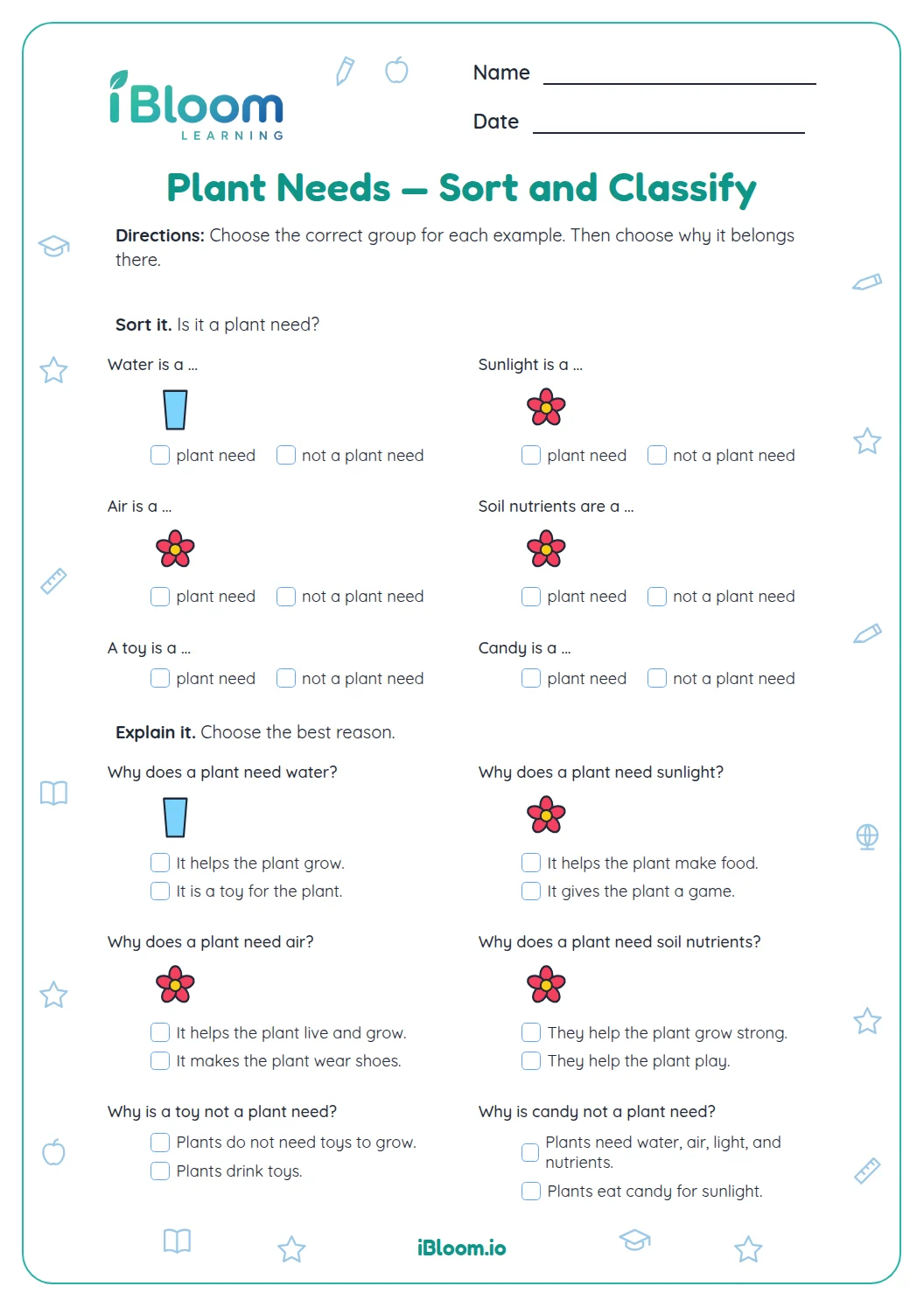

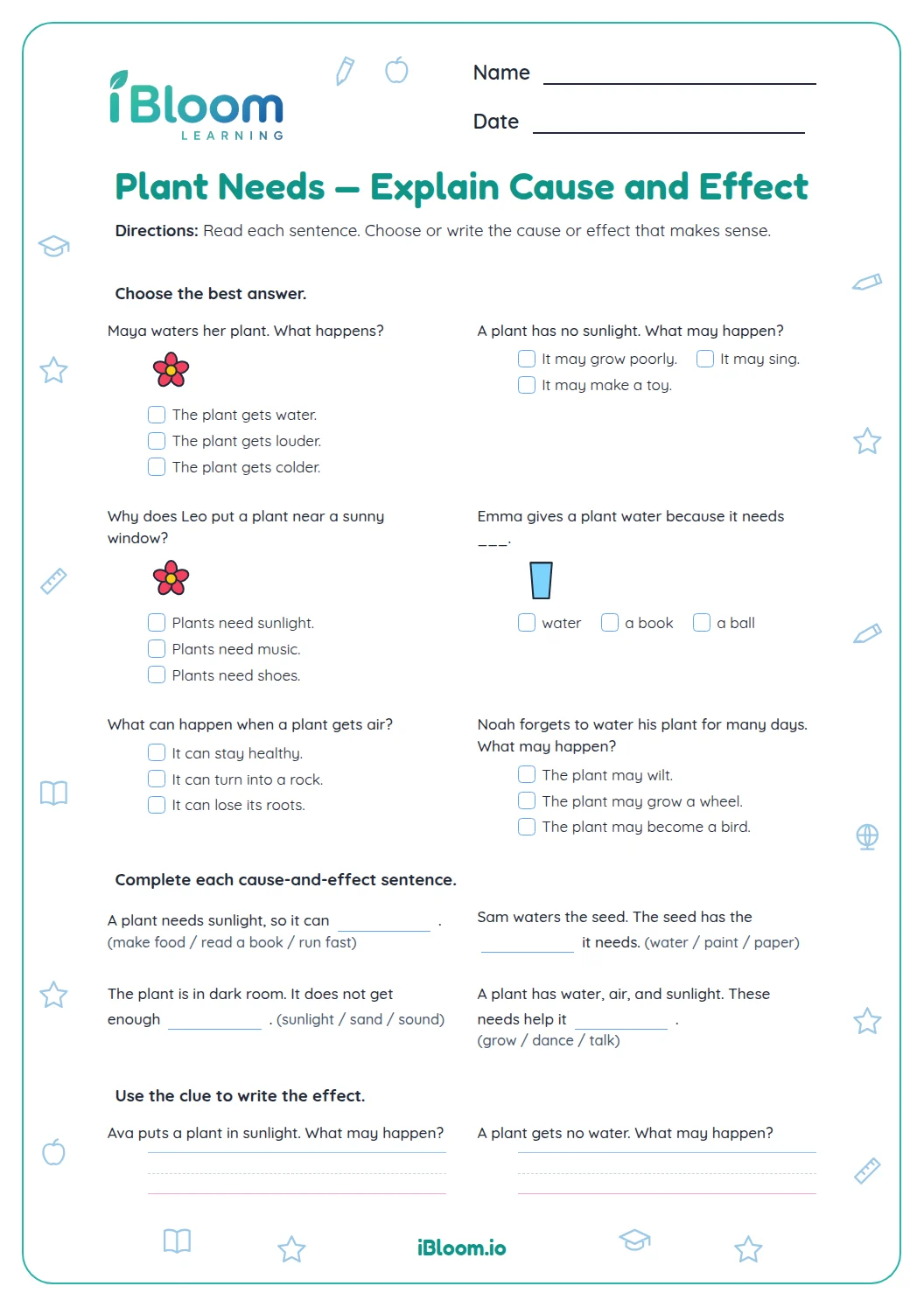


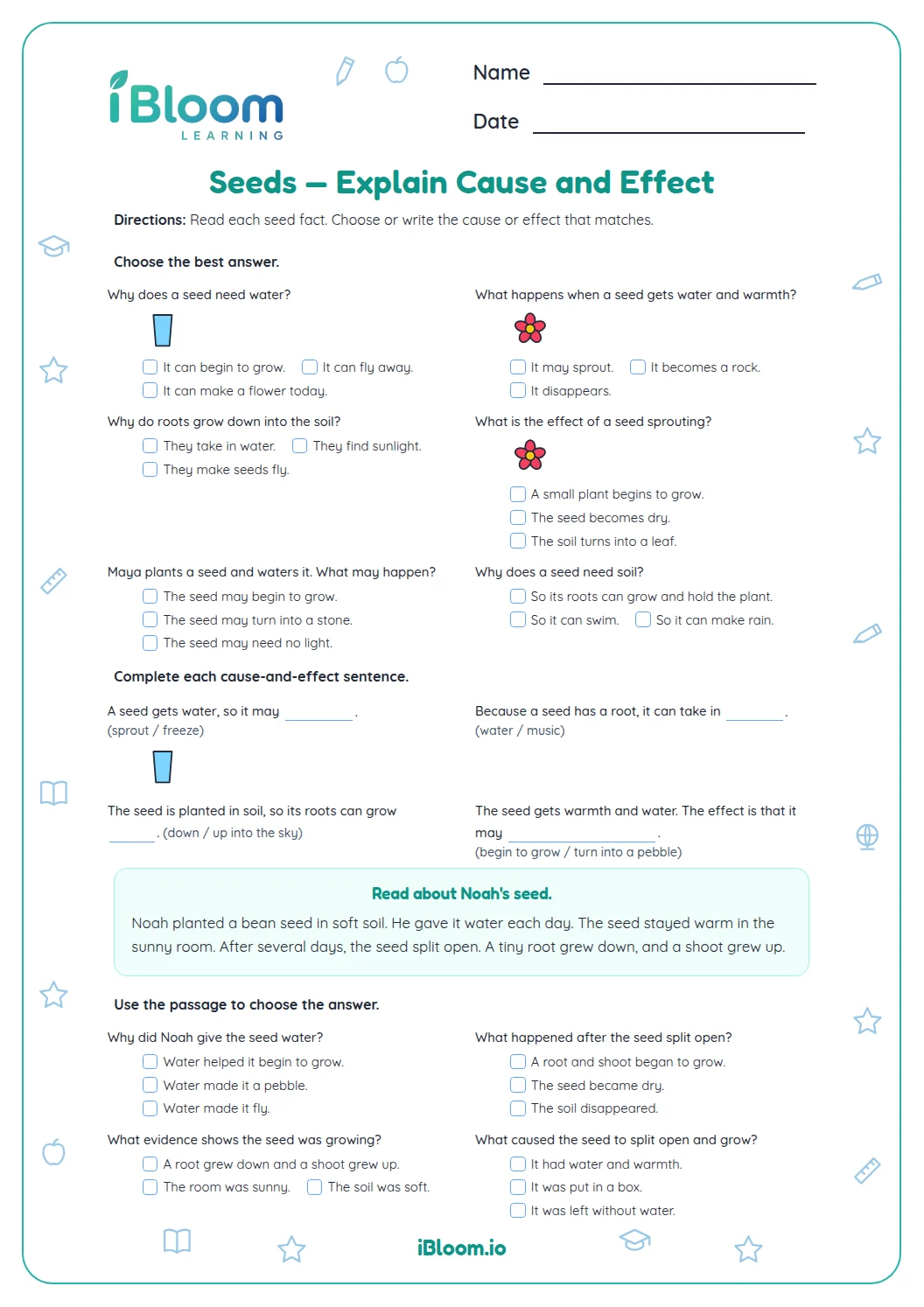

About this worksheet
This Grade 1 plant adaptations worksheet asks children to connect structures such as a cactus stem, water lily leaves, roots, spines, and hooked or feathery seeds with what they help a plant do. Fourteen questions move from choosing and completing ideas to explaining evidence in a sentence. A separate answer key gives sample responses for the open questions.
Which plant features appear on the sheet?
The questions use familiar examples: a cactus stem that stores water, broad water lily leaves that reach sunlight, roots that take in water and anchor a plant, and seeds that travel by attaching to fur or catching the wind. Each example asks children to connect a structure to a useful job.
How can a child connect a feature to its job?
Read the plant clue first, then ask what the feature helps the plant do. Keep the explanation close to the evidence in the prompt. In Part B, complete the sentence with the need named by the clue.
- 1Which plant part helps a cactus hold water?
- 2A thick stem is the part described as holding water, so choose “thick stem.”
What makes a strong explanation?
Name the feature and state its job. For a seed with hooks, for example, explain that the hooks can catch on fur and carry the seed to another place. The answer key offers sample wording; children can use different words when the science idea is accurate.
How to use this worksheet
- 1Read one plant clue aloud and ask what job the feature might do.
- 2Complete Parts A and B by matching each feature with the plant need in the prompt.
- 3For Parts C and D, name the feature and explain its helpful effect in a complete sentence.
- 4Use the key to check the science idea, not to require the exact sample wording.
Common mix-ups and a quick fix
The mistake
Saying that a cactus stem makes water.
The fix
Explain that its thick stem can store water the plant takes in.
The mistake
Calling a seed’s trip the same thing as growing.
The fix
Separate the steps: a hook or feathery top helps the seed travel; suitable conditions help it grow.
The mistake
Naming a feature without saying how it helps.
The fix
Add the job, such as “strong roots hold the plant in place.”
What to practice next
Make more practice
Questions parents and teachers ask
What is a plant adaptation?
A plant adaptation is a feature that helps a plant meet a need in its surroundings. A cactus’s thick stem can store water, while broad water lily leaves can reach sunlight at the water’s surface. On this worksheet, children connect each feature to a job the plant can do.
How can roots help a plant?
Roots can take in water from soil and help hold a plant in place. Deep roots may reach water farther below the surface, while strong roots can anchor a plant in windy conditions. The worksheet asks children to use the clue in each question to choose or explain a root’s job.
Why do some seeds have hooks?
Hooks can catch on animal fur and carry a seed away from its parent plant. If the seed falls in a place with suitable growing conditions, it may sprout there. A written response can name both steps: the hook helps the seed travel, and a new place may give it room to grow.
How do broad leaves help a water lily?
Broad leaves that float at the water’s surface can help a water lily reach sunlight. The worksheet contrasts that feature with cactus structures that help in dry places. Children should connect the leaf clue to light, rather than to storing seeds or hiding underground.
Does the answer key require the same sentence?
No. The key gives sample responses for questions where more than one clear explanation can be correct. A child may use different wording as long as the answer connects the plant feature to a sensible job, such as hooks catching on fur or wind carrying a light seed.