







About this worksheet
This Grade 1 science page explores loud and soft sounds and how vibrations make sound. Children label familiar examples, compare louder and softer sounds, and answer questions about a vibrating drum skin and paper near a speaker. A final drawing prompt asks them to label a source, vibration, and sound. The answer key includes sample labels for the model.
What makes a sound loud or soft?
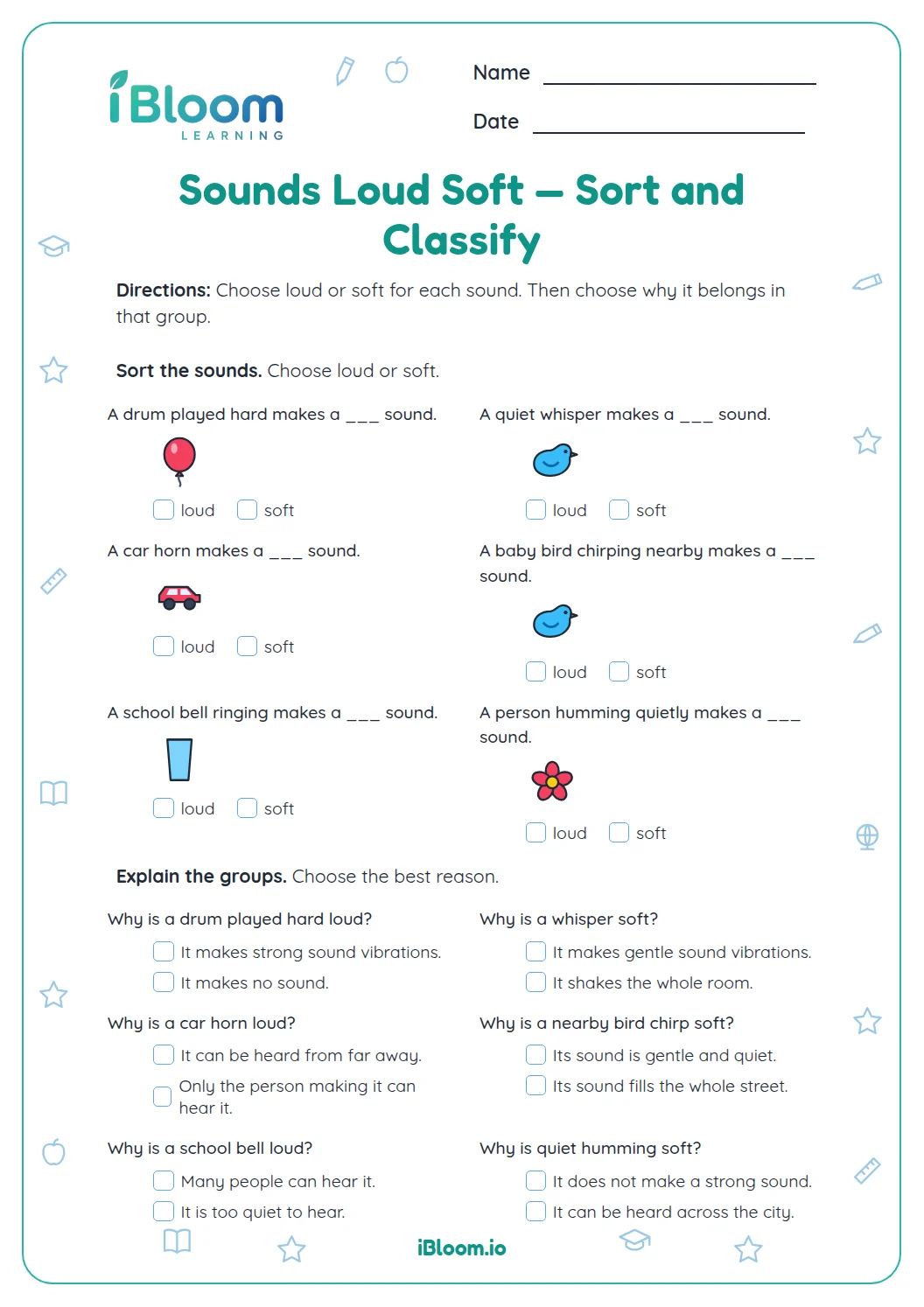
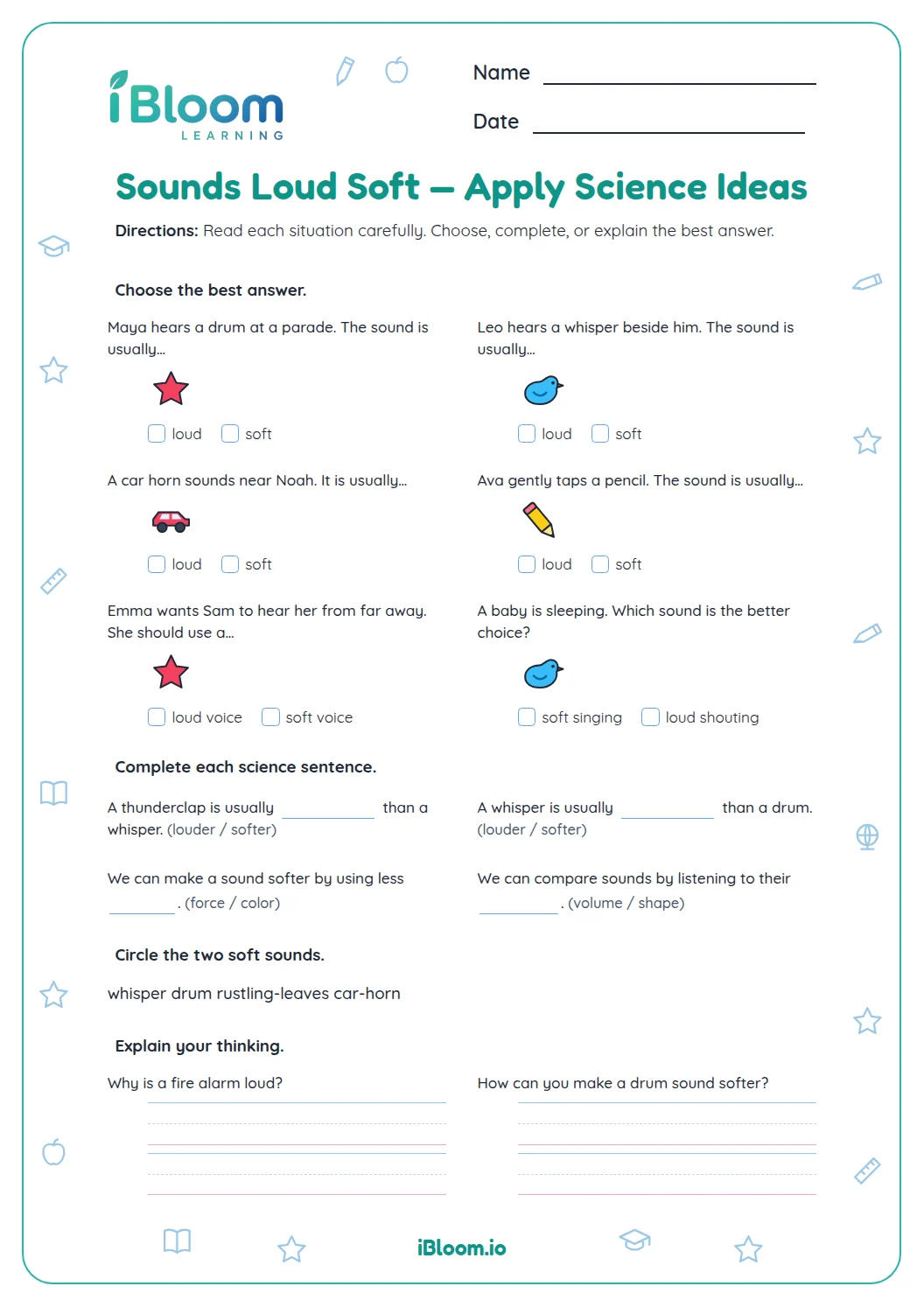
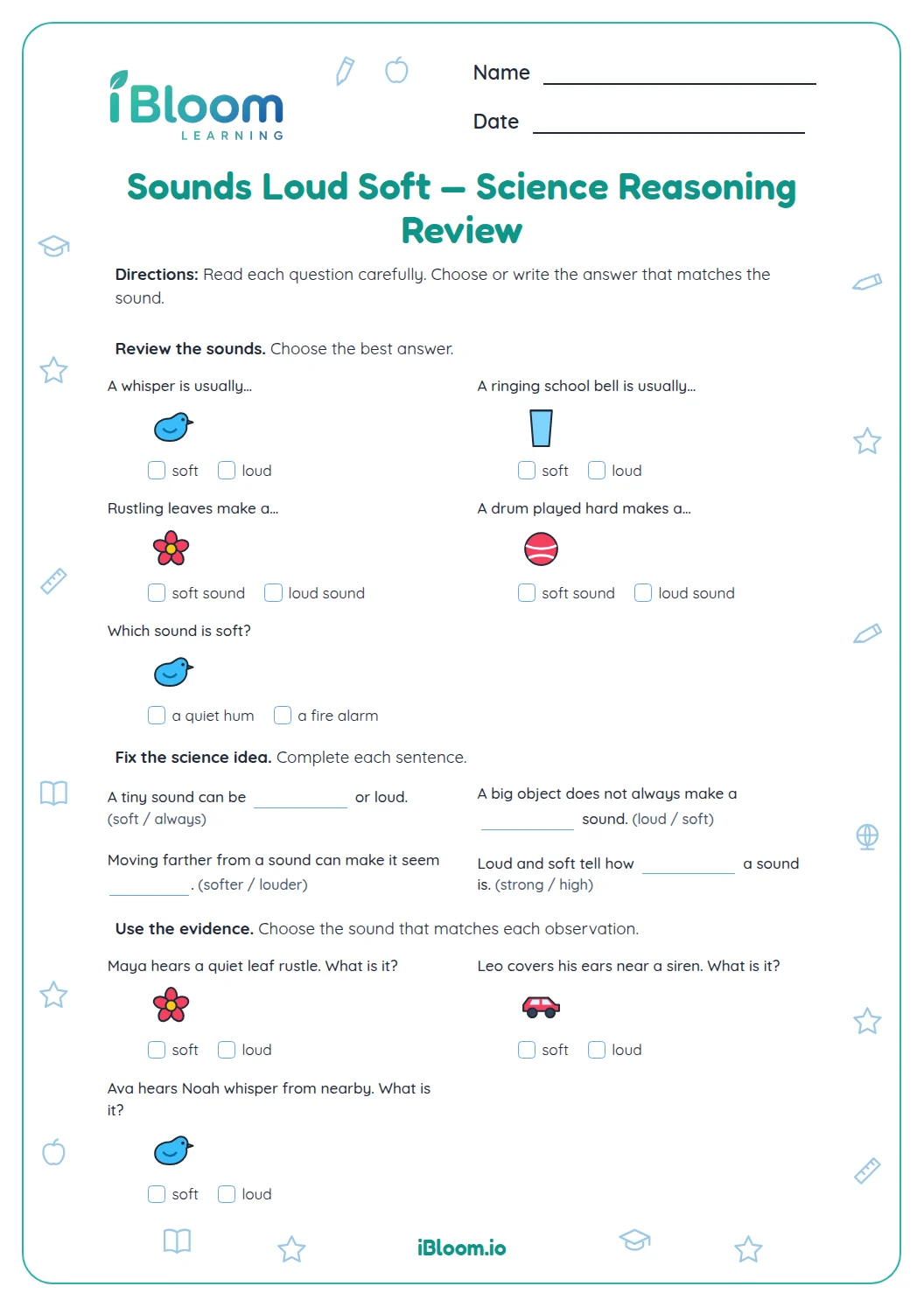
Loud and soft describe how strong a sound seems. A hard drum hit can sound loud, while a whisper or gentle hum can sound soft. The same source can make different sound levels when it is used with different force.
- 1Strike the drum harder.
- 2A stronger strike can make a louder sound.
How do vibrations make sound?
A vibration is a quick back-and-forth movement. A drum skin vibrates when struck, and that movement makes sound. Sound can also cause nearby materials, such as a loose paper strip, to vibrate.
What belongs in a sound model?
Show the source, what moves, and the sound result. For example, label the drum skin as vibrating and draw sound waves leaving the drum. Use loud or soft to describe the sound in the example.
How to use this worksheet
- 1Read each sound example carefully.
- 2Choose loud or soft based on the description.
- 3For vibration questions, identify what moves back and forth.
- 4Draw a sound source and label its vibration and sound.
- 5Check the choices with the key and compare the model labels.
Common mistakes and quick fixes
The mistake
Assuming one source always makes the same loudness.
The fix
Notice how the source is used; a gentle tap and hard strike differ.
The mistake
Calling a sound loud because its source is large.
The fix
Use the described sound level, not the object’s size.
The mistake
Showing a sound without its source in the model.
The fix
Label what vibrates and connect it to the sound it makes.
What to practice next
Make more practice
Questions parents and teachers ask
What is the difference between a loud and a soft sound?
Loud and soft describe how strong a sound seems to a listener. A shout is usually louder than a whisper, and a page turning is usually softer than a hard drum hit. The worksheet uses familiar examples so children can compare sound levels.
Can one object make both loud and soft sounds?
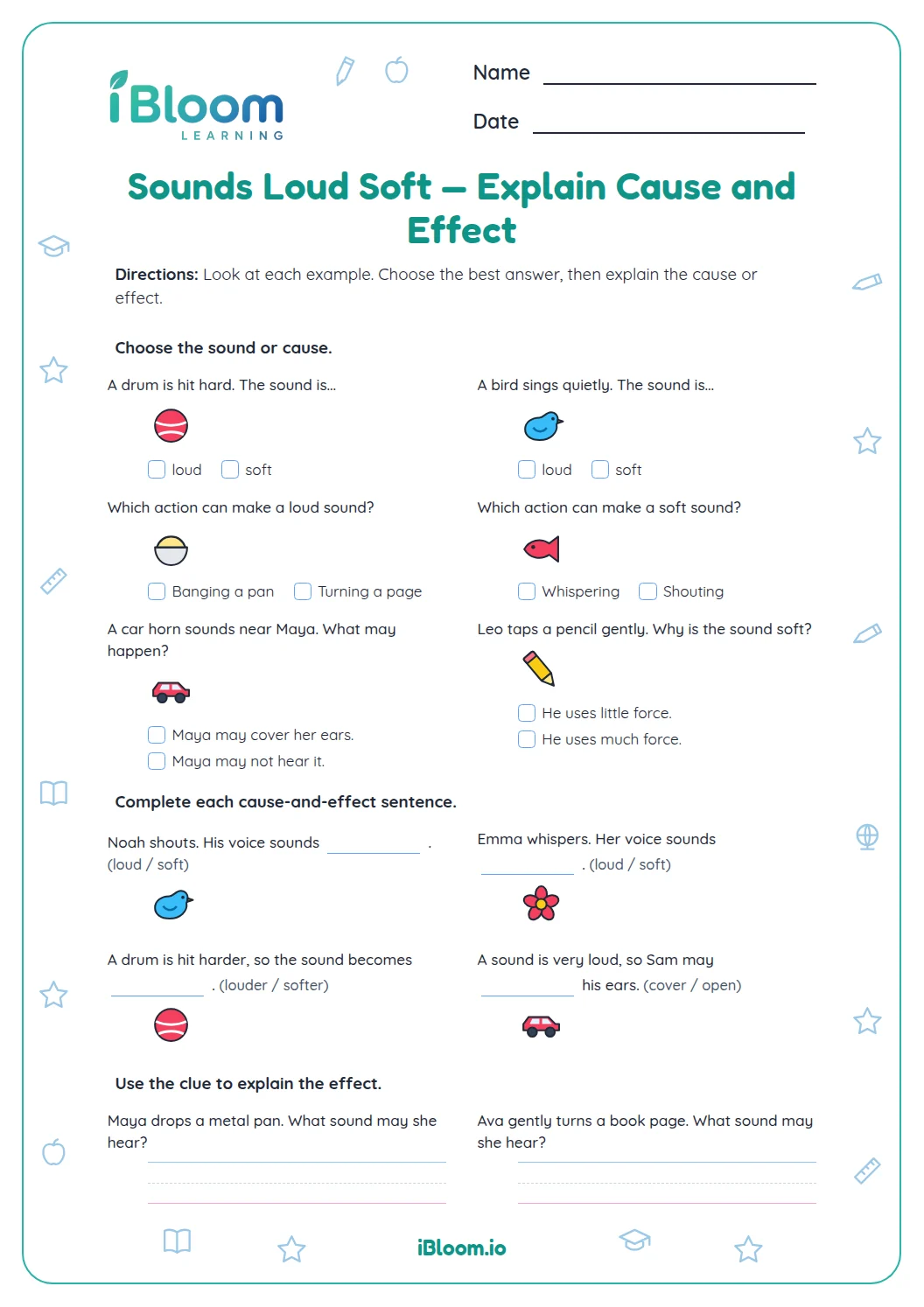
Yes. How an object is used can change its sound. A gentle drum tap may be soft, while a harder strike may be louder. Question 10 asks which action can make a drum sound louder, and question 9 connects a vibrating drum skin to sound.
What does it mean for something to vibrate?
To vibrate is to move back and forth quickly. A drum skin vibrates when struck, and that motion makes sound. Nearby objects can also move when sound reaches them, such as a loose strip of paper beside a speaker in question 13.
What should my child include in the drawing model?
There are 14 questions across two worksheet pages. Most are choices about sound level and vibration; one completes a simple source-vibration-sound model. The separate answer key also takes two pages and gives the expected response for every item. Children can use it after finishing the practice.
How many questions are on the worksheet?
There are 14 questions across two worksheet pages: choices about sound and vibration, including a model completion that links a source, vibration, and sound. The two-page answer key gives the expected choices so a learner can check each response.