



About this worksheet
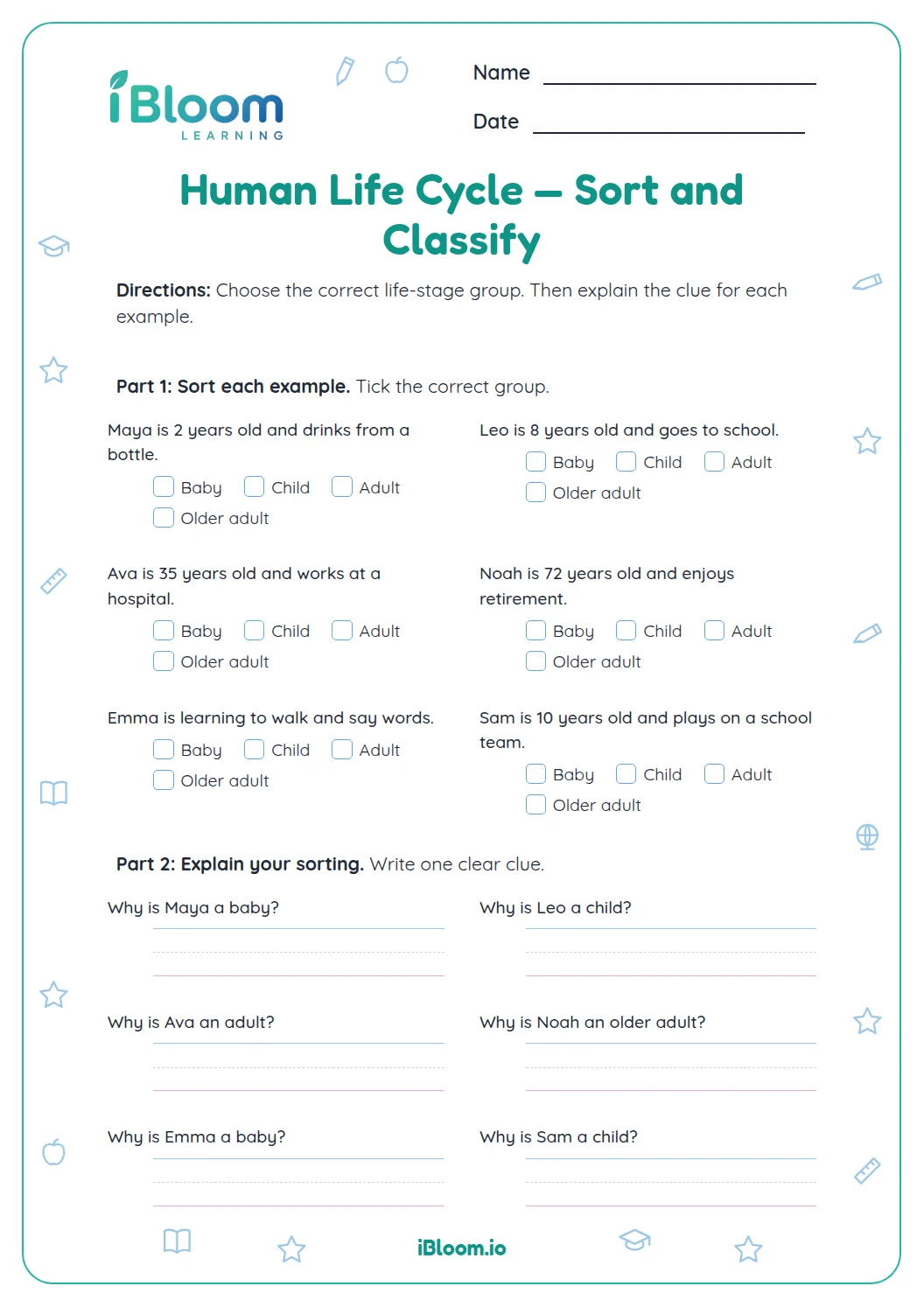
This Grade 2 science worksheet explores how people grow and change through life stages. Its 15 questions ask children to identify a typical stage order, compare babies and children, name basic needs, and reason about how people may differ. Eight multiple-choice items are followed by seven short written responses. The sheet is designed as a human-growth review, with a separate answer key for checking answers.
What are the human life stages?
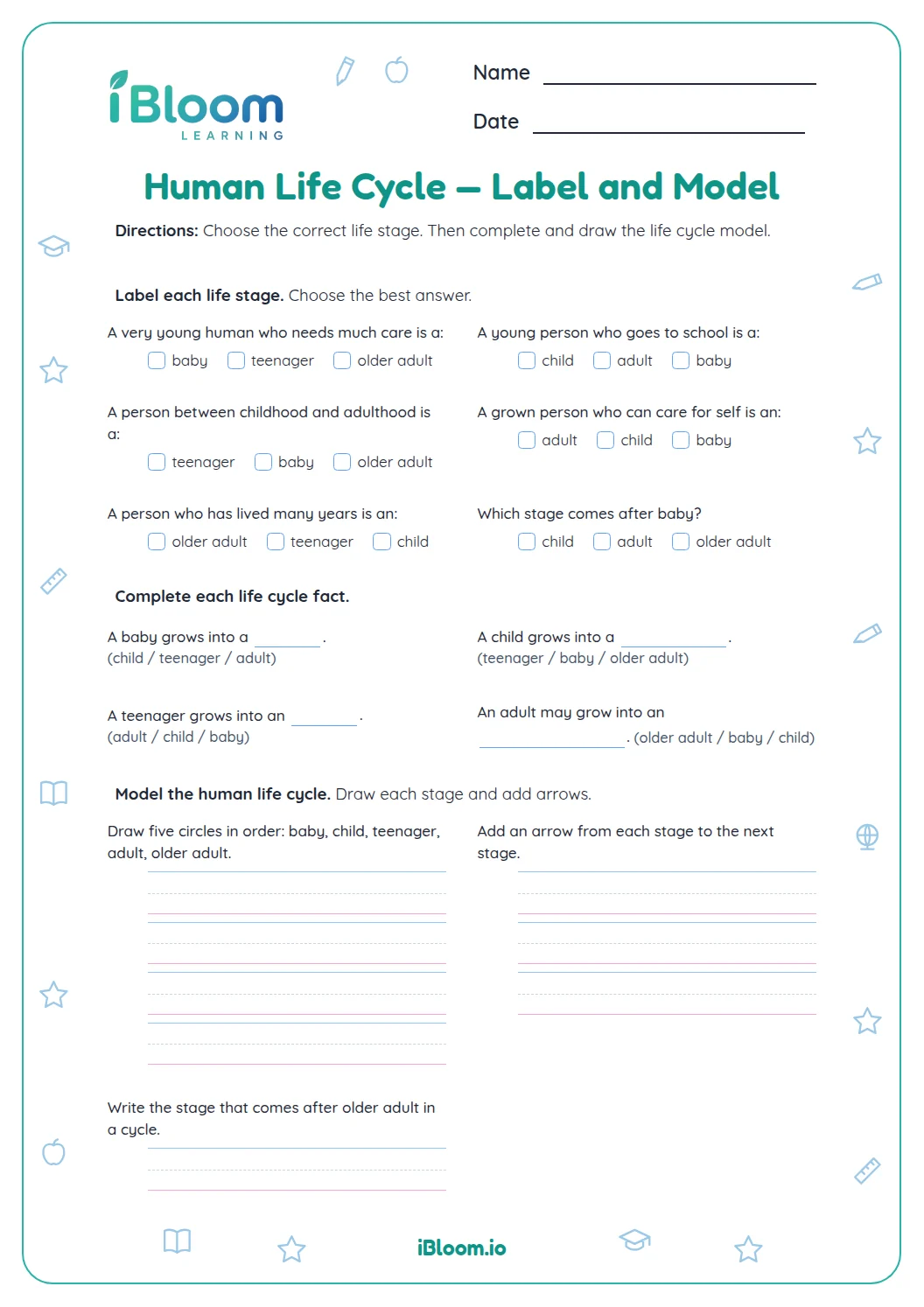
This sheet names babyhood, childhood, adulthood, and older adulthood. The questions focus on a typical order and examples of changes, while recognizing that people do not all grow at exactly the same rate.
What needs do people have as they grow?
People need food and water throughout life. Babies rely on adults for care, while older children can do more things for themselves. Answers should describe a reasonable need or age-related difference.
How can children explain a life-stage idea?
For example, a child can say that a baby usually cannot walk and talk as a child can. A written response should name a meaningful difference rather than claim that every person develops identically.
How to work through it
- 1Read each choice question and select the best answer.
- 2For the stage-order item, put baby before child and adult.
- 3Use a specific example for each written response.
- 4Remember that growth rates and abilities can differ.
- 5Check each response with the answer key.
Mistakes to watch for
The mistake
Assuming everyone reaches each change at the same time.
The fix
Describe a common pattern without saying every person grows at the same rate.
The mistake
Mixing up the order of childhood and adulthood.
The fix
Recall the broad sequence: baby, child, adult, older adult.
The mistake
Naming a want instead of a basic need.
The fix
Choose something people need to stay alive, such as food or water.
What to practice next
Make more practice
Questions parents and teachers ask
Which life stages are named on the worksheet?
The worksheet uses baby, child, adult, and older adult. Children identify typical order and connect stages with examples such as a child being able to walk or talk. Each written response can be compared with its matching entry in the separate key after the child finishes working independently.
How many questions does the science sheet include?
There are 15 questions across three worksheet pages: eight multiple-choice questions and seven written responses. A separate three-page answer key is included. Each written response can be compared with its matching entry in the separate key after the child finishes working independently.
Does the worksheet say everyone grows at the same rate?
No. One question asks whether all people grow at exactly the same rate, and the correct answer is no. The written items also invite children to recognize that people of the same age can differ. Each written response can be compared with its matching entry in the separate key after the child finishes working independently.
What basic needs do children name?
One item asks learners to identify needs people have at every life stage. Food and water are examples in the key; responses should name two basic needs. Each written response can be compared with its matching entry in the separate key after the child finishes working independently.
Why do babies need adult care?
Babies depend on adults because they cannot meet all their needs alone. The answer key gives this as a model response, and other clear explanations about care are also reasonable. Each written response can be compared with its matching entry in the separate key after the child finishes working independently.
Does the page include a model to draw?
No. The worksheet uses multiple-choice and written-response questions to review human growth and life stages. It does not ask children to build or draw a life-cycle model. Each written response can be compared with its matching entry in the separate key after the child finishes working independently.