Free printable practice
Animal Classification Practice Activities
Printable Grade 3 science activities help children classify animals by observable traits and explain how groups fit into ecosystems.
Free printable worksheet PDFs
Preview every available page, then download the free worksheet PDF for home, homeschool, tutoring, or classroom practice.
Preview the exact activity before downloading it.
 Animal Classification — Sort and ClassifyPrintable Grade 3 science activities help children classify animals by observable traits and explain how groups fit into ecosystems. This sort and classify worksheet provides a distinct, age-appropriate way to practise the same lesson.Grade 3Free PDF preview
 Animal Classification — Label and ModelPrintable Grade 3 science activities help children classify animals by observable traits and explain how groups fit into ecosystems. This label and model worksheet provides a distinct, age-appropriate way to practise the same lesson.Grade 3Free PDF preview
 Animal Classification — Explain Cause and EffectPrintable Grade 3 science activities help children classify animals by observable traits and explain how groups fit into ecosystems. This explain cause and effect worksheet provides a distinct, age-appropriate way to practise the same lesson.Grade 3Free PDF preview6 pages
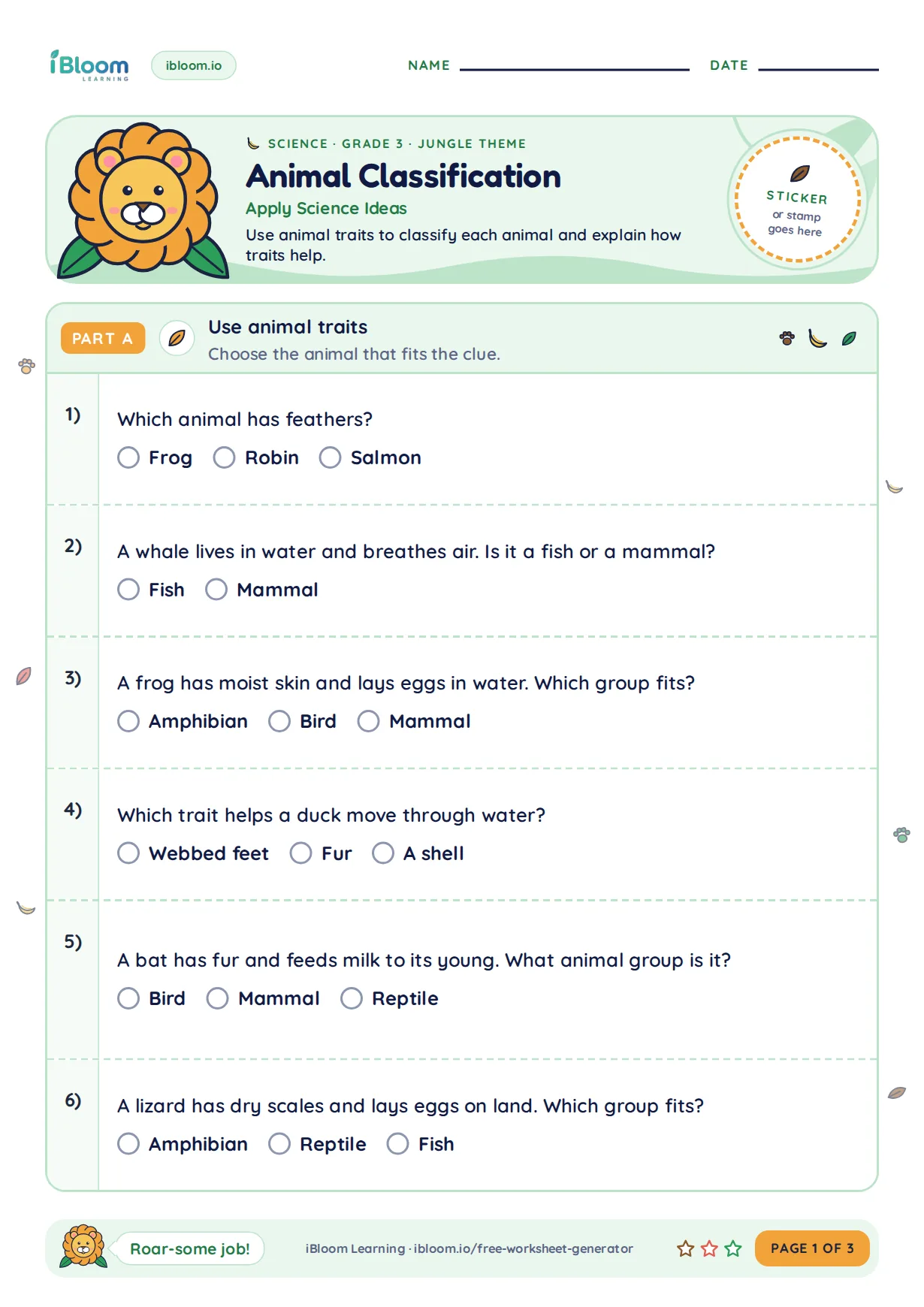 Animal Classification — Apply Science IdeasPrintable Grade 3 science activities help children classify animals by observable traits and explain how groups fit into ecosystems. This apply science ideas worksheet provides a distinct, age-appropriate way to practise the same lesson.Grade 3Free PDF preview
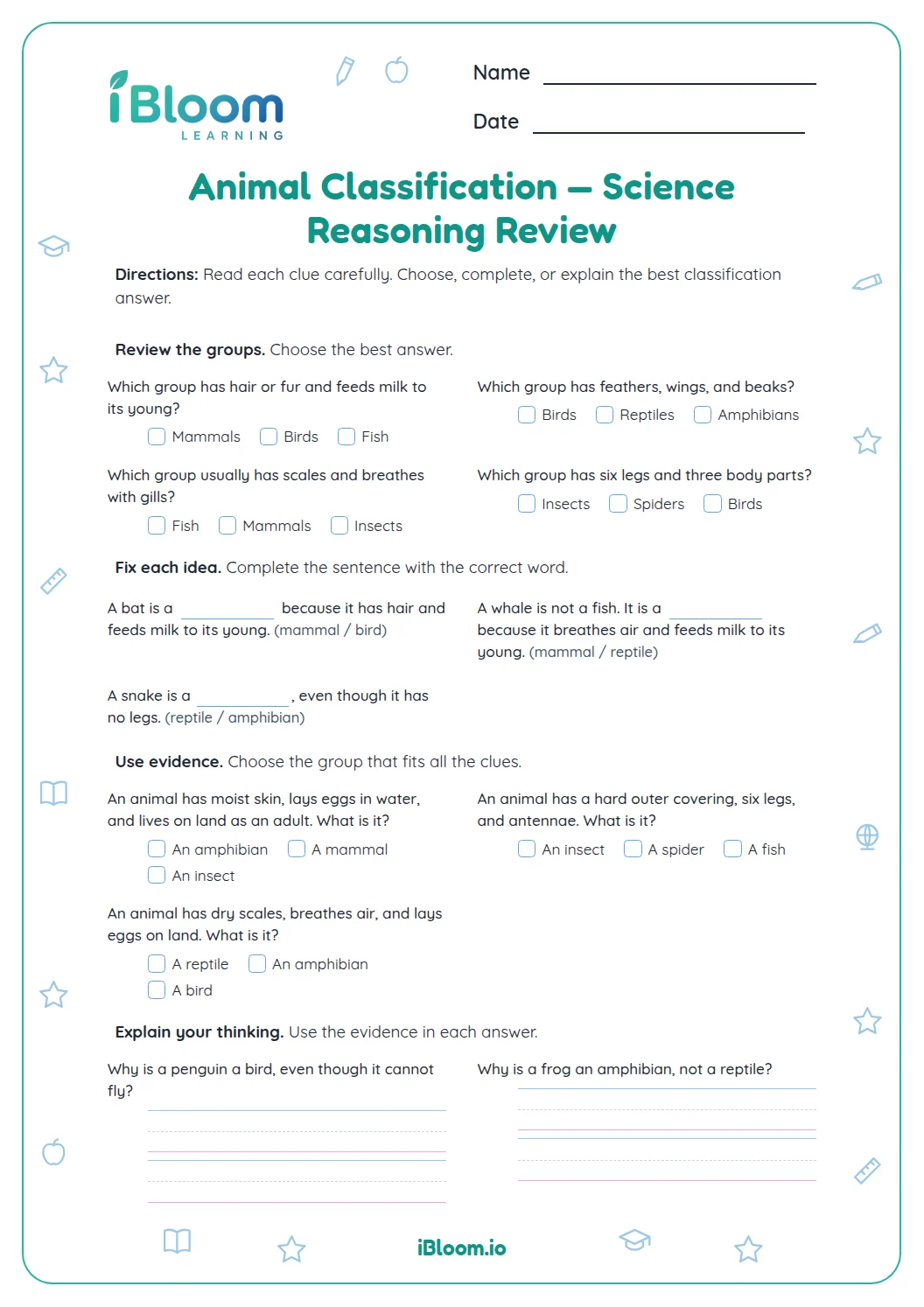 Animal Classification — Science Reasoning ReviewPrintable Grade 3 science activities help children classify animals by observable traits and explain how groups fit into ecosystems. This science reasoning review worksheet provides a distinct, age-appropriate way to practise the same lesson.Grade 3Free PDF preview
Practice that builds confidence
Building classification thinking
These Grade 3 science worksheets help children practise animal classification within the Ecosystems strand. Students look closely at body coverings, body parts, movement, breathing, and other observable traits to decide how animals can be grouped.
The printable activities include sorting tasks, classification charts, animal feature comparisons, short-response questions, and evidence-based matching. Children learn to use vocabulary such as mammal, bird, reptile, amphibian, fish, insect, vertebrate, invertebrate, habitat, and adaptation.
Animal classification is more than naming favorite animals. In Grade 3, children learn that scientists group living things by shared features. A robin is not a bird because it flies; it is a bird because it has feathers, a beak, wings, and lays eggs. A whale is a mammal even though it lives in water because it breathes air, has live young, and nurses them. The worksheets guide children from noticing one feature to comparing several features before choosing a group.

From traits to ecosystem understanding
Classification also helps children understand ecosystems. When students compare a frog, snake, fish, and rabbit, they begin to see how body structures support survival in different habitats. Activities may ask them to connect gills with water, feathers with birds, scales with reptiles or fish, or six legs with insects. The goal is not memorizing every animal, but using evidence to explain a decision.
A simple parent routine
At home, choose three animal pictures from a book, magazine, or online image search. Ask your child: “What do you notice?” Then sort the animals into two groups and ask, “What rule did you use?” Finally, have your child write one sentence using because: “A lizard is a reptile because it has dry scales.” This short routine builds observation, vocabulary, and scientific reasoning.

Classroom uses for teachers
Teachers can use these printables for science centers, small-group review, notebook evidence pages, or quick checks after an ecosystems lesson. They also work well as partner tasks: one student chooses a category while the other finds proof from the animal’s traits. For extension, students can create their own mystery animal card and list clues without naming the animal.

Common errors to watch for
Many children classify only by habitat, so they may call a whale a fish or a bat a bird. Others confuse insects with all small crawling animals; spiders, for example, do not have six legs. Some students rely on one clue, such as “lays eggs,” even though birds, reptiles, amphibians, fish, and many insects lay eggs. Encourage them to check more than one trait.
Free printable PDF download
Use this grade 3 animal classification worksheet page to preview the activity, print it, or download it as a PDF for quick practice. It works well for homework, homeschool lessons, tutoring, morning work, revision, and classroom centers.
Answers and answer key support
After the child completes the worksheet independently, parents and teachers can use the answer support or answer key information to check the work, review mistakes, and choose the next practice step.
Why iBloom worksheets help
These iBloom worksheets move from clear visual sorting to written explanations, so children practise both recognition and reasoning. A child-friendly strategy is: observe, sort, name the group, then prove it. When students can say, “I chose this group because…,” classification becomes a useful science tool rather than a guessing game.
Helpful answers
Frequently asked questions
What animal groups are covered in these Grade 3 worksheets?
The activities focus on common groups such as mammals, birds, reptiles, amphibians, fish, insects, vertebrates, and invertebrates, using traits children can observe and describe.
How do these worksheets connect animal classification to ecosystems?
Children classify animals by features and then relate those features to survival in habitats, such as gills for water, feathers for birds, or body coverings that help animals live in different environments.
Will students need to memorize many animal facts?
No. The emphasis is on using evidence from animal traits. Students practise looking for clues, comparing features, and explaining why an animal belongs in a particular group.
What common misconceptions can these worksheets help correct?
They help address mistakes such as calling whales fish because they live in water, calling bats birds because they fly, or grouping spiders with insects even though insects have six legs.
How can teachers use these animal classification printables in class?
Teachers can use them in science centers, small-group lessons, partner sorting tasks, ecosystem review, or as quick checks to see whether students can support a classification with evidence.
Is this grade 3 animal classification worksheet free?
Yes. You can preview it for free and use the printable worksheet for home or classroom practice.
Can I download this grade 3 animal classification worksheet as a PDF?
Yes. Use the worksheet download option to save a printable PDF, or print the worksheet directly from the page.
Does this grade 3 animal classification worksheet include answers or an answer key?
When the activity has fixed answers, iBloom includes answer support so parents and teachers can check the completed worksheet.