Free printable practice
Carnivore Herbivore Omnivore Practice Activities
Grade 3 ecosystem worksheets help children classify animals as carnivores, herbivores, or omnivores using food clues and animal evidence.
Free printable worksheet PDFs
Preview every available page, then download the free worksheet PDF for home, homeschool, tutoring, or classroom practice.
Preview the exact activity before downloading it.
 Carnivore Herbivore Omnivore — Sort and ClassifyGrade 3 ecosystem worksheets help children classify animals as carnivores, herbivores, or omnivores using food clues and animal evidence. This sort and classify worksheet provides a distinct, age-appropriate way to practise the same lesson.Grade 3Free PDF preview
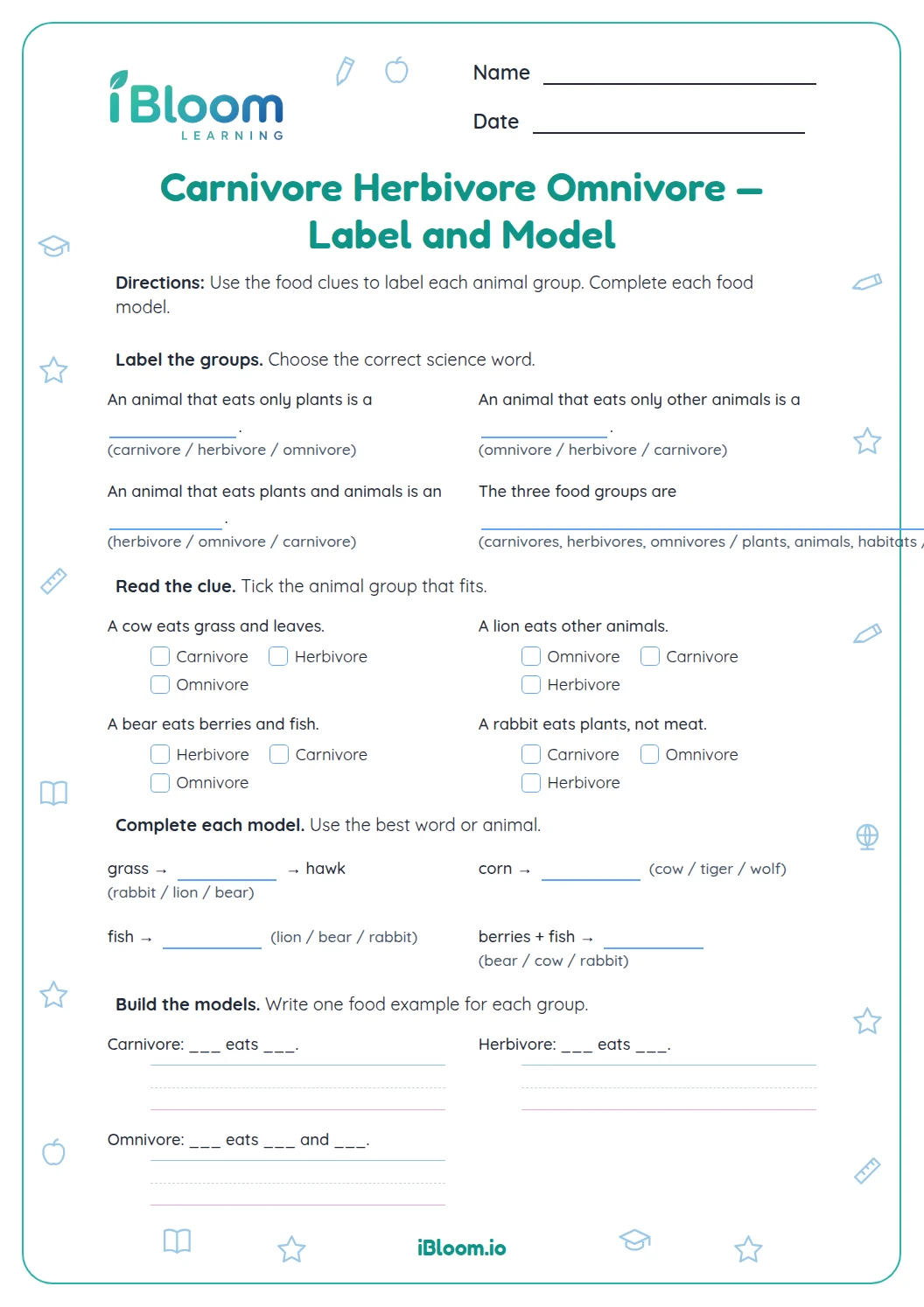 Carnivore Herbivore Omnivore — Label and ModelGrade 3 ecosystem worksheets help children classify animals as carnivores, herbivores, or omnivores using food clues and animal evidence. This label and model worksheet provides a distinct, age-appropriate way to practise the same lesson.Grade 3Free PDF preview
 Carnivore Herbivore Omnivore — Explain Cause and EffectGrade 3 ecosystem worksheets help children classify animals as carnivores, herbivores, or omnivores using food clues and animal evidence. This explain cause and effect worksheet provides a distinct, age-appropriate way to practise the same lesson.Grade 3Free PDF preview4 pages
 Carnivore Herbivore Omnivore — Apply Science IdeasGrade 3 ecosystem worksheets help children classify animals as carnivores, herbivores, or omnivores using food clues and animal evidence. This apply science ideas worksheet provides a distinct, age-appropriate way to practise the same lesson.Grade 3Free PDF preview
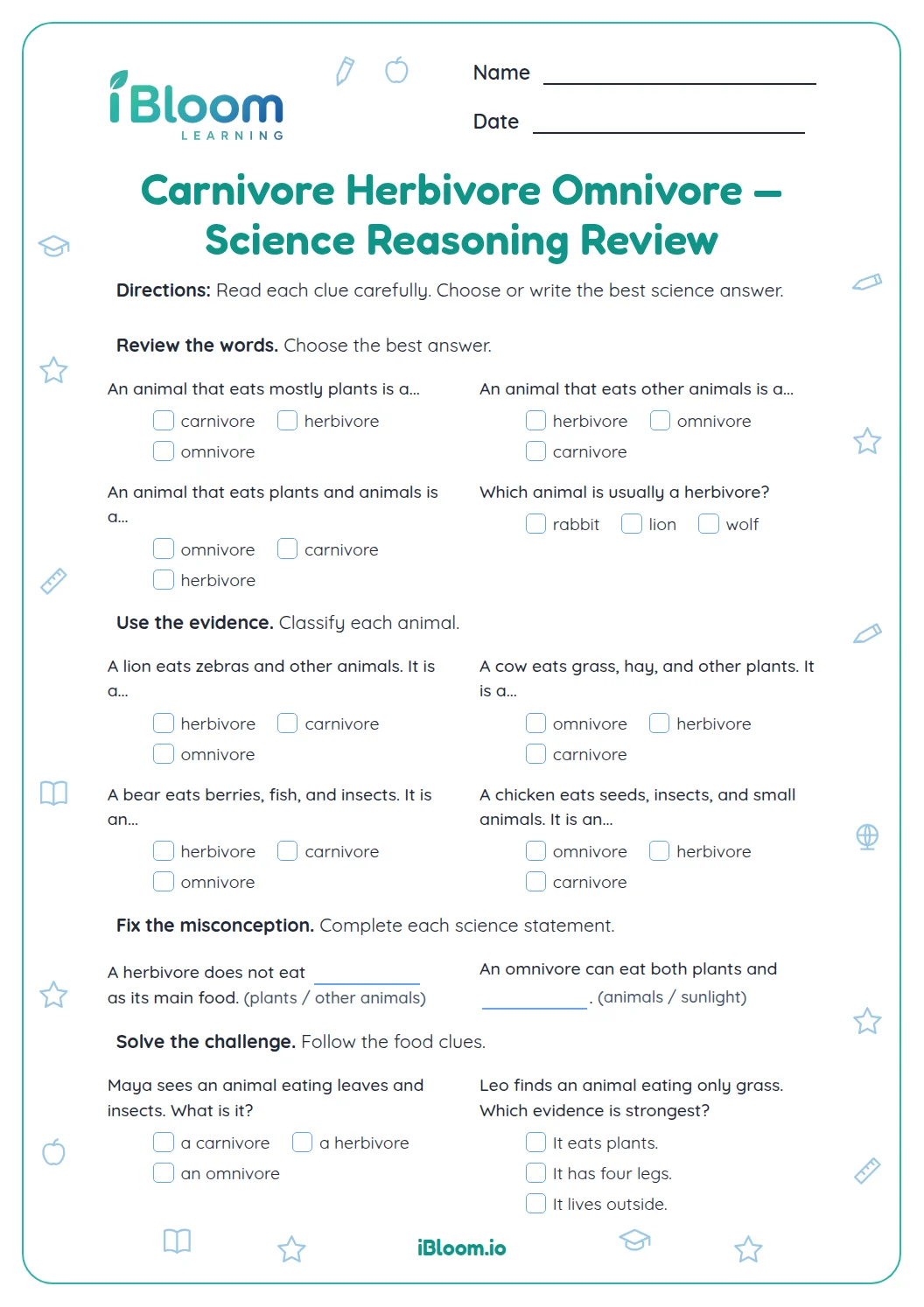 Carnivore Herbivore Omnivore — Science Reasoning ReviewGrade 3 ecosystem worksheets help children classify animals as carnivores, herbivores, or omnivores using food clues and animal evidence. This science reasoning review worksheet provides a distinct, age-appropriate way to practise the same lesson.Grade 3Free PDF preview
Practice that builds confidence
What the three feeding groups mean
In Grade 3 science, children learn that animals get energy by eating different kinds of food. These worksheets help students distinguish carnivores, herbivores, and omnivores within an ecosystem context.
Printable activities include sorting tasks, picture-based questions, food clue practice, animal examples, and short explanations that connect diet vocabulary to real animals and habitats.
Students practise the core vocabulary: carnivores eat other animals, herbivores eat plants, and omnivores eat both plants and animals. The focus is not memorizing a long animal list, but reading evidence such as teeth, food choices, and diet descriptions to decide which group fits best.

Build from clues to classification
The activities progress from simple picture sorting to short written clues. A child may see that a deer eats grass and leaves, then classify it as a herbivore. Another item might describe a bear eating berries and fish, leading to omnivore. This supports ecosystem thinking because feeding groups show how living things depend on other living things for energy.
Parent routine at home
Choose three animals your child knows, such as a rabbit, lion, and raccoon. Ask, What does it eat? Is that plant food, animal food, or both? Then have your child say the full sentence: A rabbit is a herbivore because it eats plants. Repeating the because sentence helps children connect the label to evidence instead of guessing from appearance.

Classroom uses for teachers
Teachers can use these printables during an ecosystems unit, in science centers, as review after a food chain lesson, or as a quick check for vocabulary understanding. Pair work works well: one student reads the food clue while the other chooses carnivore, herbivore, or omnivore and explains why.

Common errors to watch for
Some students think all large animals are carnivores or that all small animals are herbivores. Others classify an animal by where it lives instead of what it eats. Watch for confusion between omnivore and carnivore when an animal eats meat but also eats fruit, seeds, or other plant parts. A helpful child-friendly strategy is: Look at the food first, then name the group.
Free printable PDF download
Use this grade 3 carnivore herbivore omnivore worksheet page to preview the activity, print it, or download it as a PDF for quick practice. It works well for homework, homeschool lessons, tutoring, morning work, revision, and classroom centers.
Answers and answer key support
After the child completes the worksheet independently, parents and teachers can use the answer support or answer key information to check the work, review mistakes, and choose the next practice step.
Why iBloom worksheets help
The iBloom pages give repeated, varied practice with the same Grade 3 science idea. Children see labels, examples, and short reasoning prompts, so they move from matching words to explaining animal diets in their own words.
Helpful answers
Frequently asked questions
What will Grade 3 students practise on these worksheets?
They practise identifying whether animals are carnivores, herbivores, or omnivores by using food clues, pictures, and short diet descriptions.
How is an omnivore different from a carnivore?
A carnivore eats animals, while an omnivore eats both plant food and animal food. For example, an animal that eats berries and fish would be an omnivore.
Do children need to know many animal names first?
No. The worksheets emphasize evidence from what the animal eats, so students can classify animals even when the animal is less familiar.
How can I help if my child keeps guessing the category?
Ask your child to underline or say the food first, decide whether it is plant food, animal food, or both, and then choose the matching group.
Can these activities connect to food chains?
Yes. Understanding carnivores, herbivores, and omnivores helps students discuss how energy moves through ecosystems and how animals depend on plants and other animals.
Is this grade 3 carnivore herbivore omnivore worksheet free?
Yes. You can preview it for free and use the printable worksheet for home or classroom practice.
Can I download this grade 3 carnivore herbivore omnivore worksheet as a PDF?
Yes. Use the worksheet download option to save a printable PDF, or print the worksheet directly from the page.
Does this grade 3 carnivore herbivore omnivore worksheet include answers or an answer key?
When the activity has fixed answers, iBloom includes answer support so parents and teachers can check the completed worksheet.