Free printable practice
Food Chains Practice Activities
Grade 3 science worksheets that help students build, read, and explain food chains within ecosystems.
Free printable worksheet PDFs
Preview every available page, then download the free worksheet PDF for home, homeschool, tutoring, or classroom practice.
Preview the exact activity before downloading it.
 Food Chains — Sort and ClassifyGrade 3 science worksheets that help students build, read, and explain food chains within ecosystems. This sort and classify worksheet provides a distinct, age-appropriate way to practise the same lesson.Grade 3Free PDF preview8 pages
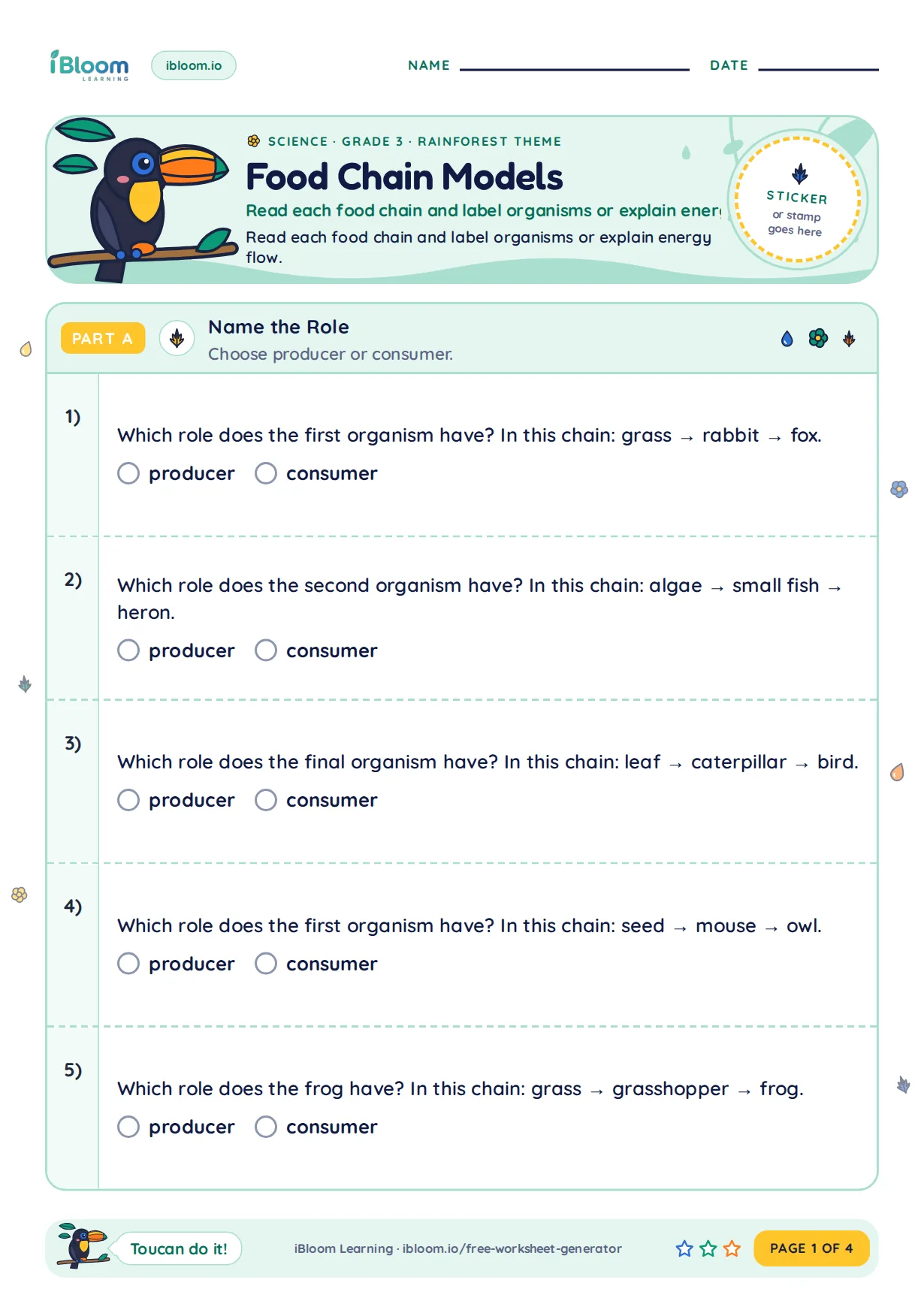 Food Chains — Label and ModelGrade 3 science worksheets that help students build, read, and explain food chains within ecosystems. This label and model worksheet provides a distinct, age-appropriate way to practise the same lesson.Grade 3Free PDF preview6 pages
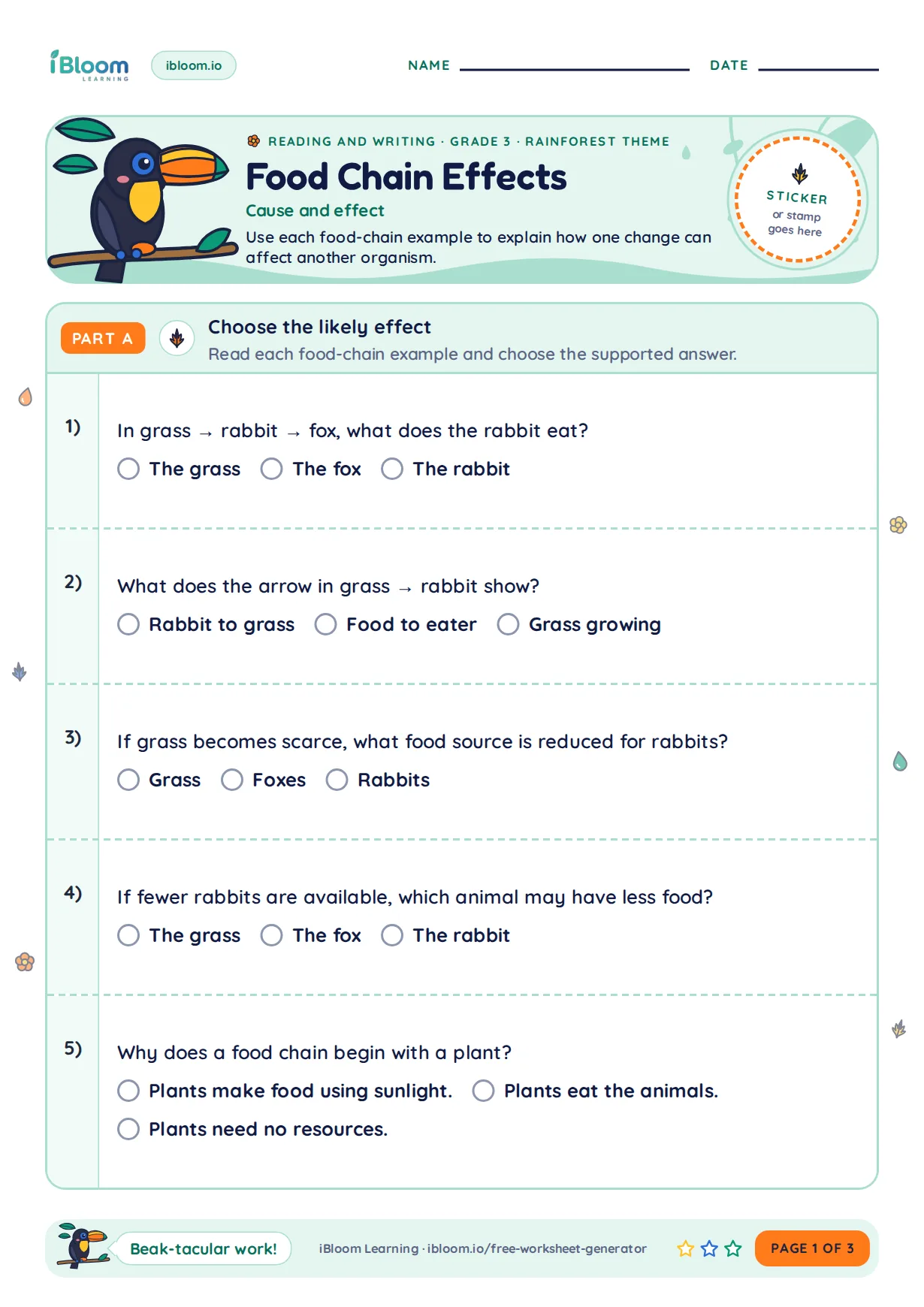 Food Chains — Explain Cause and EffectGrade 3 science worksheets that help students build, read, and explain food chains within ecosystems. This explain cause and effect worksheet provides a distinct, age-appropriate way to practise the same lesson.Grade 3Free PDF preview
 Food Chains — Apply Science IdeasGrade 3 science worksheets that help students build, read, and explain food chains within ecosystems. This apply science ideas worksheet provides a distinct, age-appropriate way to practise the same lesson.Grade 3Free PDF preview4 pages
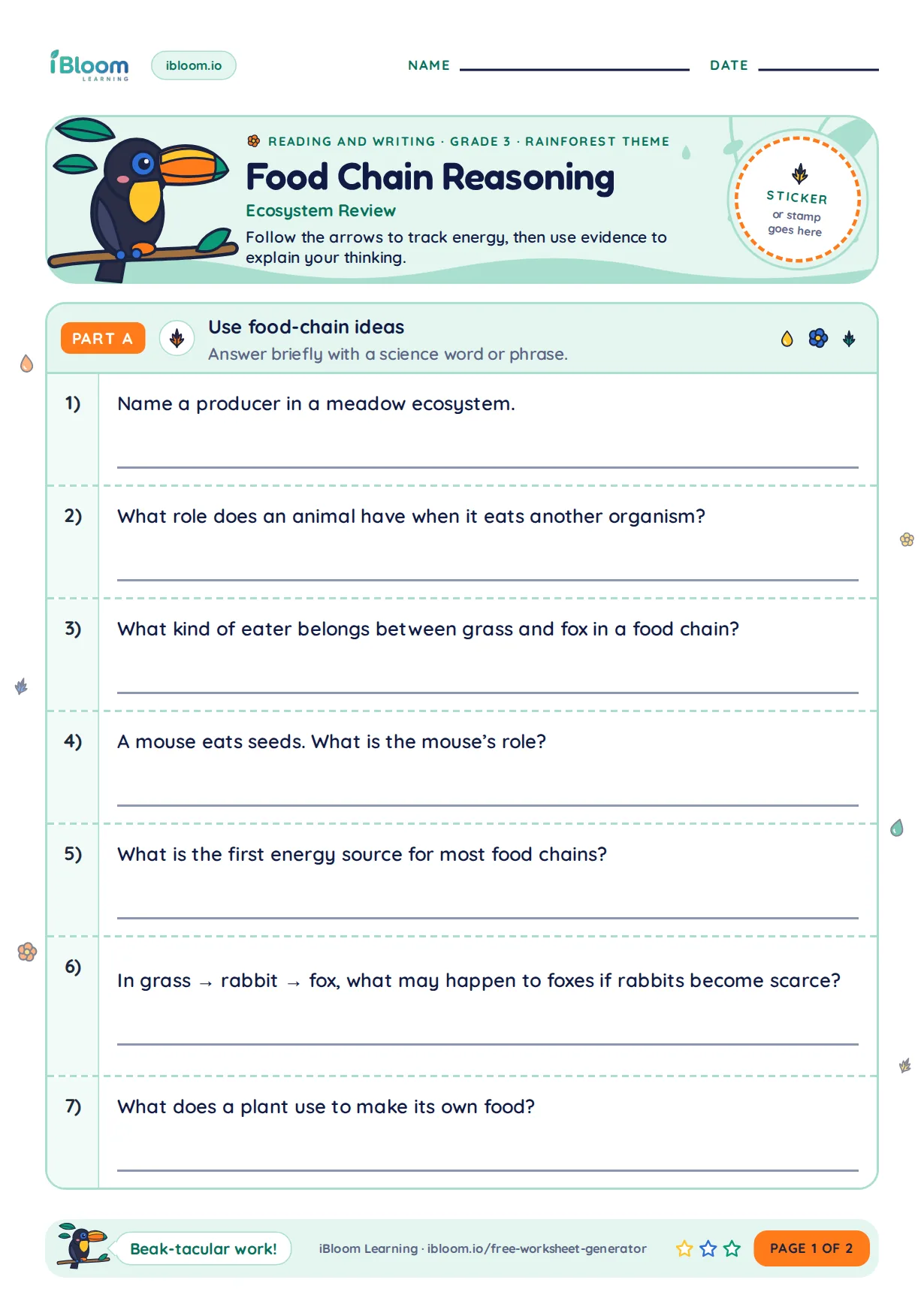 Food Chains — Science Reasoning ReviewGrade 3 science worksheets that help students build, read, and explain food chains within ecosystems. This science reasoning review worksheet provides a distinct, age-appropriate way to practise the same lesson.Grade 3Free PDF preview
Practice that builds confidence
Building a food chain step by step
These Grade 3 food chains worksheets help children see how living things depend on one another for energy. Students practise identifying producers, consumers, predators, prey, and the direction energy moves in an ecosystem.
The printable activities include simple food chain diagrams, matching tasks, sequencing practice, and short written explanations. Children work with familiar examples such as plants, insects, small animals, and larger predators while strengthening science vocabulary.
Food chains show one path of energy in an ecosystem. Grade 3 students first learn that most chains begin with a producer, such as a plant, because plants make their own food using sunlight. From there, energy passes to consumers. A grasshopper may eat grass, a frog may eat the grasshopper, and a snake may eat the frog. These worksheets guide children from recognizing the parts of a chain to arranging organisms in a logical order.

Reading arrows correctly
A key skill is understanding that arrows show the direction energy moves, not simply who is chasing whom. In a chain like grass → rabbit → fox, the arrow means energy from the grass moves to the rabbit, and energy from the rabbit moves to the fox. Activities ask students to trace arrows, complete missing organisms, and explain what each link depends on.
Parent routine for home practice
At home, choose one picture or outdoor observation, such as grass, a bird, or an insect. Ask: What does it eat? What might eat it? Then help your child draw a three-part chain with arrows. End with one sentence: The ___ gets energy from ___. Repeating this routine with different organisms builds confidence without memorizing long lists of animals.

Classroom uses for teachers
Teachers can use these printables during an ecosystems unit, small-group science centers, early finisher work, or review before a quiz. Students can sort organism cards into producers and consumers, compare two possible chains, or justify why an organism belongs in a certain place. The pages also support partner discussion because children must use precise words such as producer, consumer, herbivore, carnivore, predator, prey, and energy.

Common errors to watch for
Some children reverse the arrows, place a predator before its food source, or assume every animal eats only one thing. Others may call all plants consumers because animals consume plants. Encourage students to slow down and ask, Where does the energy start? What is being eaten? What receives the energy next?
Free printable PDF download
Use this grade 3 food chains worksheet page to preview the activity, print it, or download it as a PDF for quick practice. It works well for homework, homeschool lessons, tutoring, morning work, revision, and classroom centers.
Answers and answer key support
After the child completes the worksheet independently, parents and teachers can use the answer support or answer key information to check the work, review mistakes, and choose the next practice step.
Why iBloom worksheets help
The iBloom activities keep food chains clear and age-appropriate for Grade 3. They move from visual recognition to sequencing and explanation, so students do more than label a diagram. A child-friendly strategy is to say, Sun helps plant, plant feeds eater, eater feeds next eater, while pointing along the arrows. This simple chant helps students connect vocabulary with the flow of energy.
Helpful answers
Frequently asked questions
What do Grade 3 students learn in food chains?
They learn that energy moves from one living thing to another, usually beginning with a producer such as a plant and continuing through consumers such as insects, small animals, and predators.
Why do arrows matter in a food chain?
Arrows show the direction energy moves. For example, in grass → rabbit → fox, energy moves from the grass to the rabbit and then from the rabbit to the fox.
Are these worksheets only about labeling animals?
No. Students also sequence organisms, complete missing parts of a chain, interpret diagrams, and write short explanations using food chain vocabulary.
How can I help my child if they reverse the food chain arrows?
Ask them to say, What is being eaten, and who gets energy from it? Then have them point from the food source toward the organism receiving the energy.
Can these food chain worksheets be used in science centers?
Yes. They work well for centers, partner practice, ecosystem review, and quick checks because students can sort, sequence, draw, and explain food chains independently or in pairs.
Is this grade 3 food chains worksheet free?
Yes. You can preview it for free and use the printable worksheet for home or classroom practice.
Can I download this grade 3 food chains worksheet as a PDF?
Yes. Use the worksheet download option to save a printable PDF, or print the worksheet directly from the page.
Does this grade 3 food chains worksheet include answers or an answer key?
When the activity has fixed answers, iBloom includes answer support so parents and teachers can check the completed worksheet.