




About this worksheet
This Grade 3 science worksheet helps children label producers and consumers, model how energy moves through a food chain, and predict what may happen when a food source becomes scarce. It includes 16 questions across four worksheet pages and a separate four-page answer key. Food chains are shown with arrows from food to eater, and students use those models to reason about organisms’ needs.
How do I label a producer and a consumer?
A producer, such as grass, makes its own food. A consumer, such as a rabbit or fox, gets energy by eating plants or other animals.
Which way does energy move in a chain?
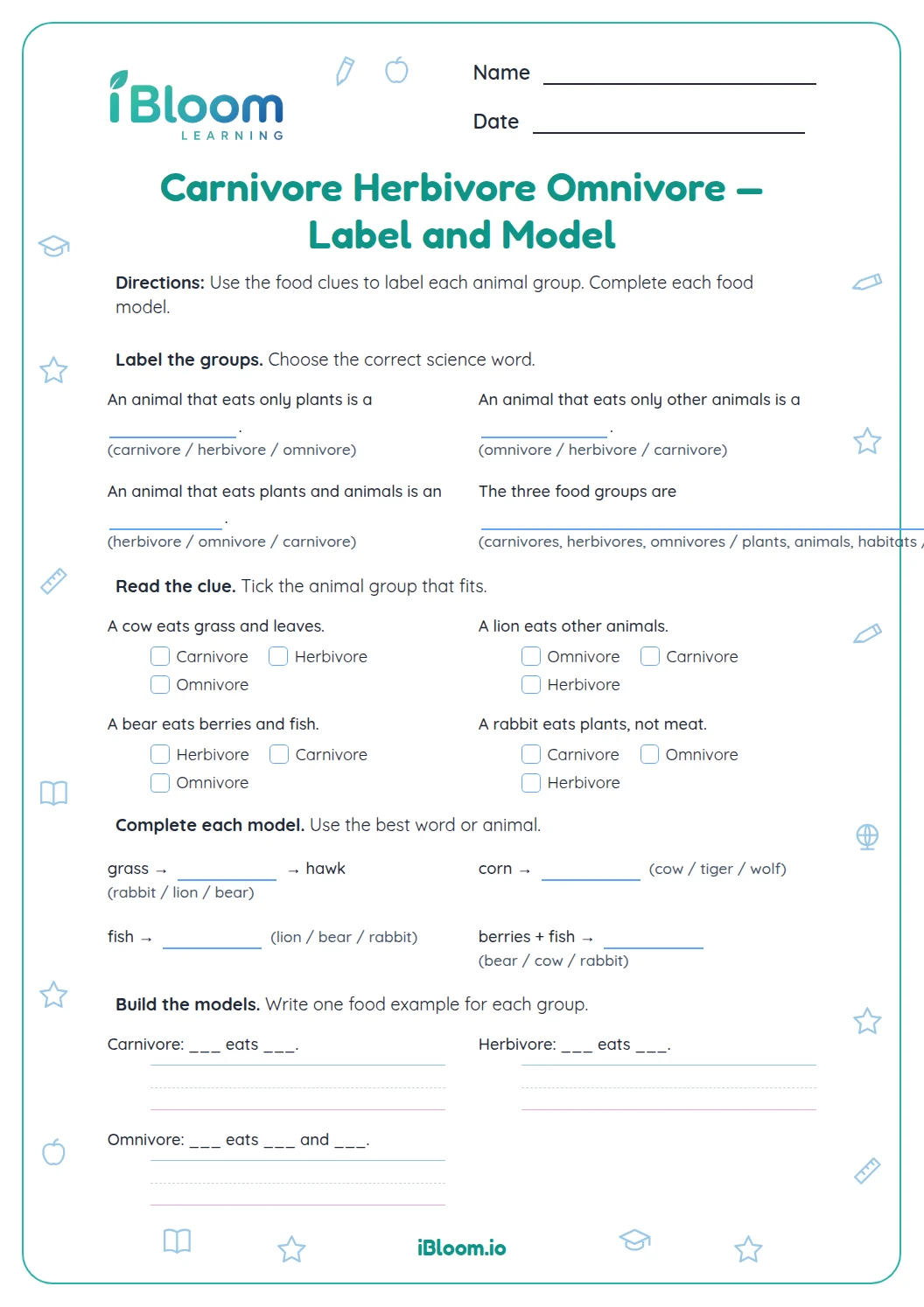
Read the arrow from the food to the eater: grass → rabbit → fox. The first arrow means the rabbit gets energy from the grass; the next means the fox gets energy from the rabbit.
What can happen when food becomes scarce?
If grass becomes scarce, rabbits may have less food. If mice become scarce, owls may have less food. The questions ask children to trace the relationship shown by each chain.
How to use this worksheet
- 1Read the organisms in the chain from left to right.
- 2Label plants and algae as producers when they make food.
- 3Label animals as consumers.
- 4Read each arrow from food toward the organism that eats it.
- 5Use the chain to predict how a reduced food source may affect a consumer.
Mistakes to watch for
The mistake
Reversing an energy arrow.
The fix
Point from the food organism to the eater.
The mistake
Calling an animal a producer.
The fix
A producer makes its own food; animals are consumers.
The mistake
Predicting an effect on the wrong organism.
The fix
Follow the arrows from the scarce food source to its consumer.
What to practice next
Make more practice
Questions parents and teachers ask
What is a producer in these food chains?
A producer is an organism such as a plant or algae that makes its own food using sunlight. The worksheet chains include grass, a pond plant, kelp, and a berry bush as producers; animals in the chains are consumers.
What do the arrows mean?
An arrow points from a food source toward the organism that eats it. In grass → rabbit → fox, grass feeds the rabbit, and the rabbit feeds the fox. Follow each arrow in that direction when reading a chain.
How many questions and pages are there?
The worksheet has 16 questions over four pages, followed by four pages of answers. Children label roles, interpret arrows, complete chains, and consider what may happen when food sources decrease. Some items ask for a short written explanation.
Why might a consumer have less food?
A consumer depends on an organism earlier in its chain. If grass becomes scarce, rabbits may have less to eat; if mice become scarce, owls may have less food. Trace the arrows to find the affected consumer in each example.
Does this page have a science standard listed?
A plant or algae can make its own food and is a producer. Animals such as rabbits, fish, and owls are consumers because they get energy by eating other organisms. The sheet practices these food-chain relationships with familiar examples.