


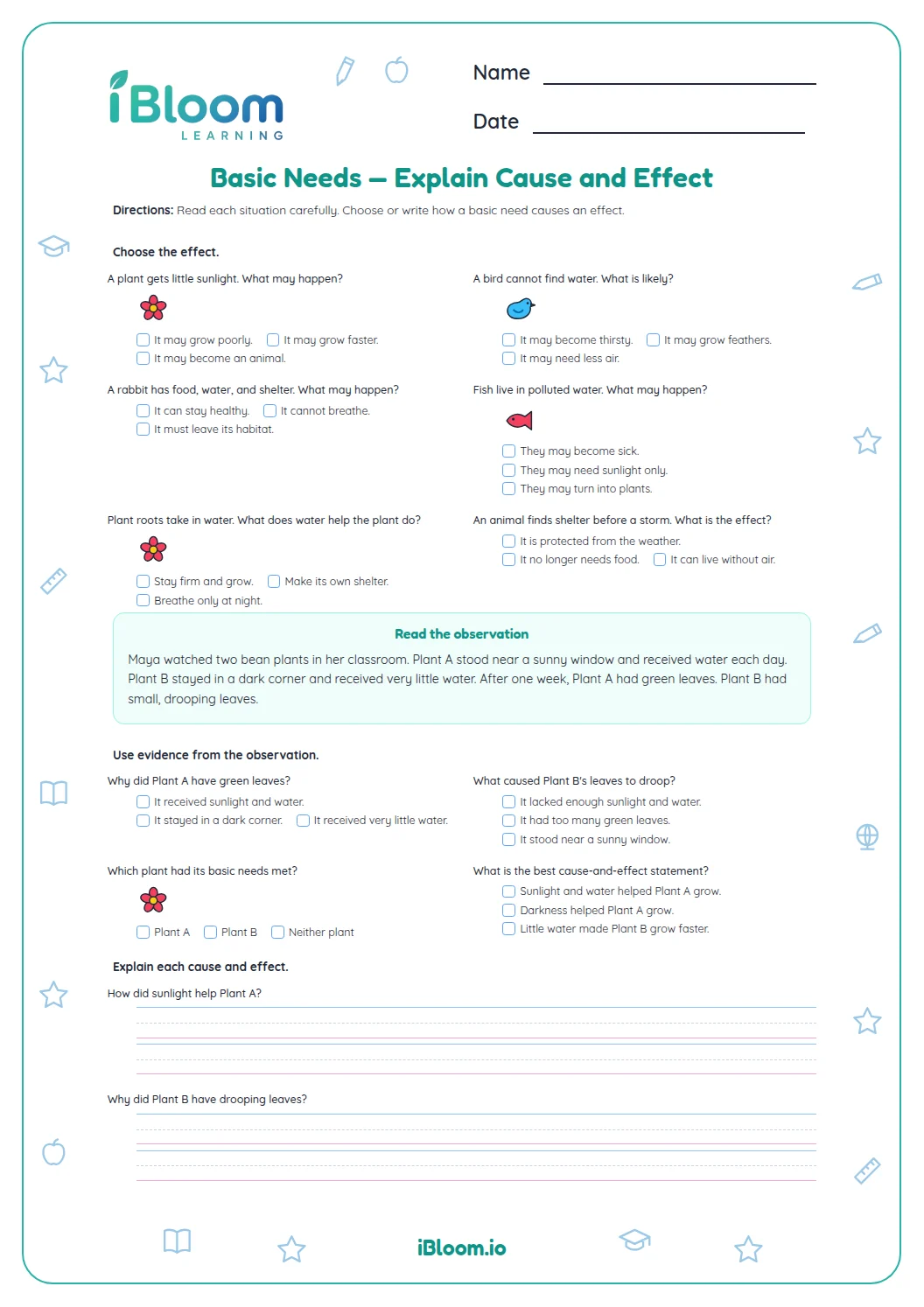
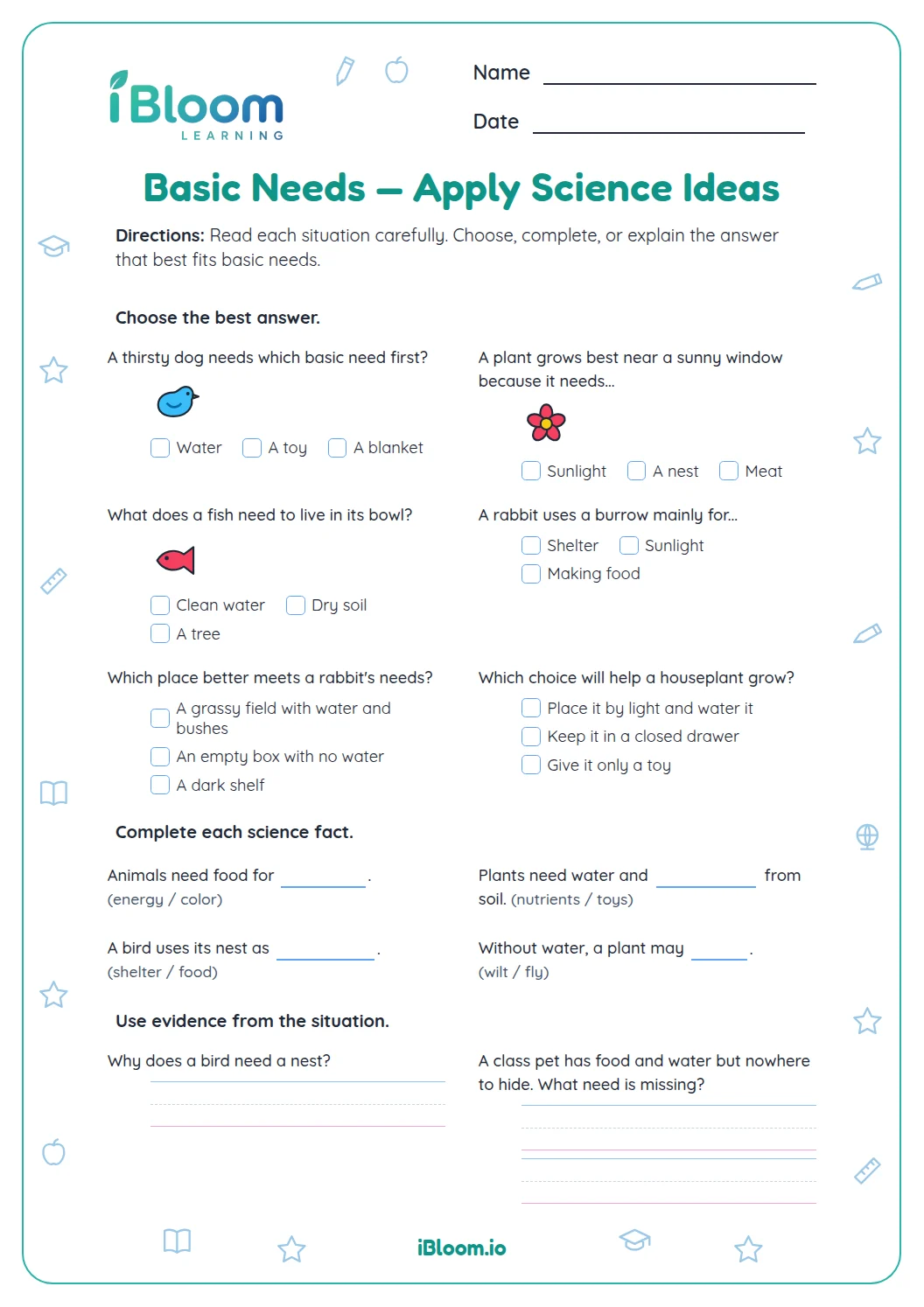
About this worksheet
This Grade 3 science worksheet asks students to trace cause-and-effect relationships in simple food chains. Students choose likely effects, complete cause-and-effect statements, and explain how changes in food sources may affect other organisms. Examples include grass, rabbits, foxes, and pond life. A separate answer key lists correct choices and sample written responses.
How does a food chain show who gets food?
A food chain names organisms in an order that shows how food energy moves. The arrow points from the food toward the organism that eats it.
- 1Grass → rabbit → fox
- 2The rabbit eats grass.
- 3The fox eats the rabbit.
- 4If grass becomes scarce, the rabbit may have less food.
How can one change affect the next organism?
Follow the chain one link at a time. If a food source becomes less common, the organism that eats it may have less food. Another animal that eats that organism may then be affected too.
What makes an explanation stronger?
Students move from choosing a likely effect to completing a cause-and-effect statement and explaining a link in a chain. Name the food source and the organism that depends on it; use may when the outcome is a prediction.
How to use this worksheet
- 1Read the whole chain from left to right.
- 2Use the arrow to identify the food and eater.
- 3Name the organism or resource that changes.
- 4Trace the next link to predict who may be affected.
- 5Support the response with a detail from the example.
Common mistakes and quick fixes
The mistake
Reading an arrow backward.
The fix
Start at the food and follow the arrow to the eater.
The mistake
Skipping a link.
The fix
Explain the first effect before predicting a later one.
The mistake
Claiming a certain outcome without evidence.
The fix
Name the food relationship that supports the prediction.
What to practice next
Make more practice
Questions parents and teachers ask
What does an arrow mean in a food chain?
The arrow points from a food source to the organism that gets energy by eating it. In grass → rabbit, the rabbit eats the grass. For example, grass is food for rabbits, so fewer grass plants can affect the rabbits first.
Can one organism be affected by a change it does not eat directly?
Yes. Follow the links step by step. If grass becomes scarce, rabbits may have less food, and foxes that eat rabbits may then have less prey. Then follow the chain to see which organism depends on that animal for food.
Why do answers say may happen?
A food-chain example supports a reasonable prediction, but it does not tell exactly what will happen in every habitat. “May” signals that the response is a prediction based on the evidence. A careful answer explains a possible effect and connects it to a stated food relationship.
What counts as evidence in these questions?
Evidence is a food relationship named in the chain, such as rabbits eating grass or foxes eating rabbits. Use that detail to explain a possible effect. On this worksheet, students also use the stated changes, such as grass becoming scarce or a population declining, to connect cause and effect.
Is an answer key included?
Yes. The separate key gives concise answers and sample explanations. Open responses may use different words as long as they connect a change in food to an organism that depends on it. The key models a short answer, while other evidence-based wording can also be correct.