





About this worksheet
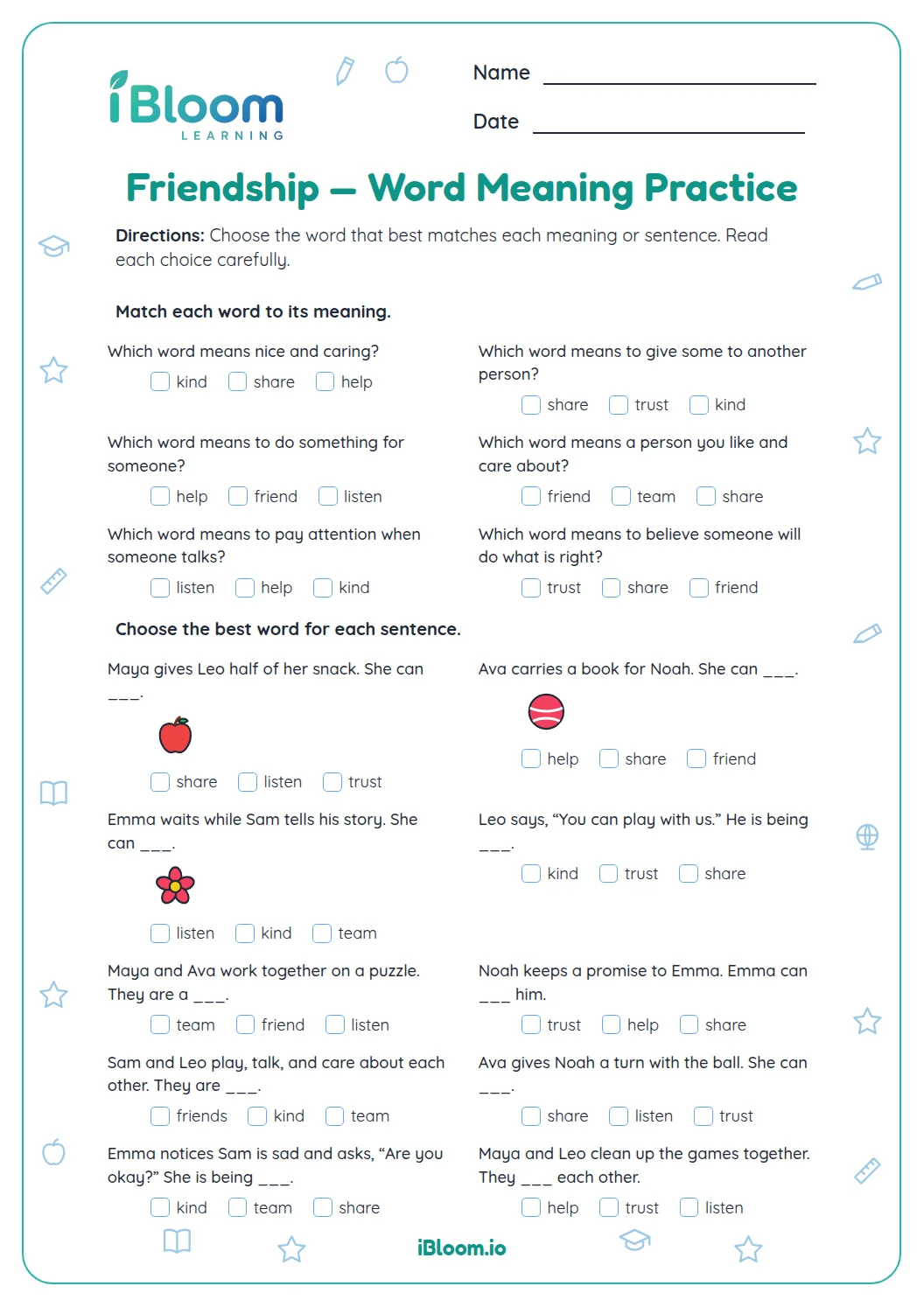
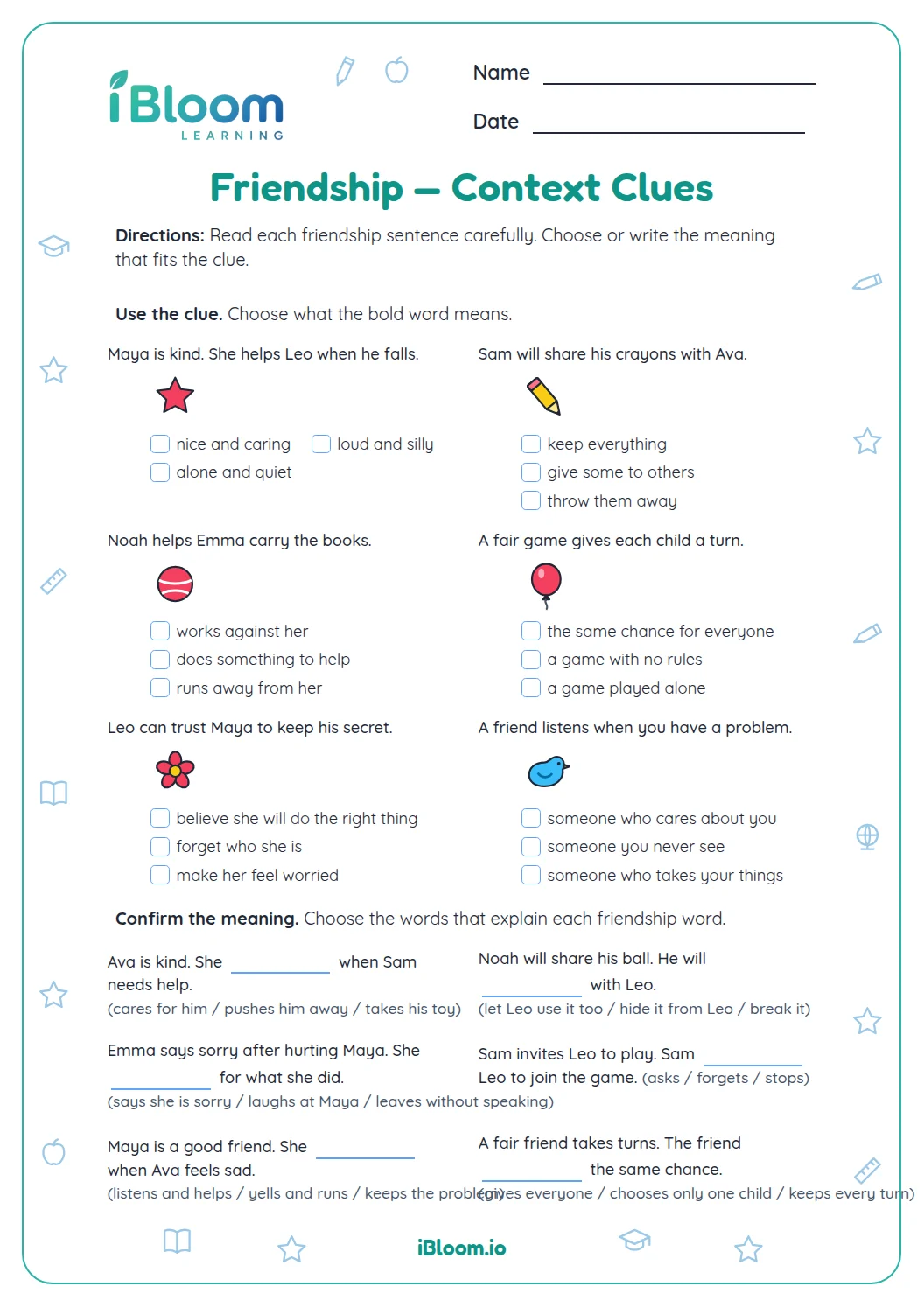
This free printable Grade 1 worksheet combines a friendship-themed word search with vocabulary reasoning. Children find eight words, choose words that fit short situations, complete context sentences, and write about helpful actions. It aligns with CCSS L.1.4a. The 14-question activity includes the letter grid, context questions, and an answer key.
Aligned to L.1.4a
How does the word search support vocabulary?
Searching the grid gives students a chance to notice and read each target word. The list includes friend, care, kind, play, share, help, team, and trust. Finding a word is the first step; using it in a sentence shows what it means.
How do children use context to choose a word?
Read the complete sentence and picture the action. If Mia gives Sam half her snack, share fits because the sentence describes giving part of something to another person. The surrounding words help narrow the choice.
- 1Mia gives Sam half of her snack.
- 2Clue: she gives part of it to Sam.
- 3The friendship word that fits is share.
What vocabulary practice follows the grid?
The page moves from recognizing words to applying them. Children choose a word for a short situation, supply a word in a sentence, then use their own words to describe a caring or helpful action.
- Eight words to find in the grid
- Ten context sentences to complete
- Three short responses about friendship actions
How to use this worksheet
- 1Read the word list before searching the grid.
- 2Circle each word when you find it and cross it off the list.
- 3Read each context sentence and fill in the friendship word that fits.
- 4Use the sentence clue or friendship situation to answer in a few words.
- 5Write a sentence that shows the meaning of the target word.
- 6Check the answers and talk about any word that was new.
Common mistakes and quick fixes
The mistake
Guessing from one word in a sentence.
The fix
Read the full sentence and use the action as a clue.
The mistake
Mixing up care and help.
The fix
Care means showing concern; help means doing something useful for someone.
The mistake
Finding a word in the grid but not reading it carefully.
The fix
Match each letter in order to the word list before circling it.
Common Core alignment
This worksheet gives children focused practice with the stated grade-level skill.
Use the other words in a sentence to work out a friendship word’s meaning.
On this sheet: Children use short context sentences to choose or supply friendship vocabulary.
Show the official wordingHide the official wording
Use sentence-level context as a clue to the meaning of a word or phrase.
What to practice next
Make more practice
Further reading
Questions parents and teachers ask
Which words are hidden in the grid?
The grid contains friend, care, kind, play, share, help, team, and trust. Children can check each word against the word list and circle its letters in the grid. The context items then show how those words describe actions between friends.
Do the words only go left to right?
The directions allow words across, down, or diagonally. Encourage the child to scan one letter at a time and check that the full word matches the list before circling it. This helps avoid circling a partial match. Check off each completed word on the list.
How does the worksheet practice meaning?
After the search, children use context sentences about sharing, caring, helping, playing, and trust. They choose or supply a word that matches the action described, then write their own examples. This moves practice from recognition to meaning in a sentence.
Can a parent read the questions aloud?
Yes. An adult can read a sentence aloud while the child listens for the action clue and chooses the word. The child can still search for and read the words in the grid at their own pace. An adult can repeat the direction if needed.
What is included in the answer key?
The key lists the word-search targets, the answers to the choices and sentence blanks, and sample responses for the open questions. Written answers may use different words while still showing the same friendship idea. Children may explain that idea in their own way.