





About this worksheet
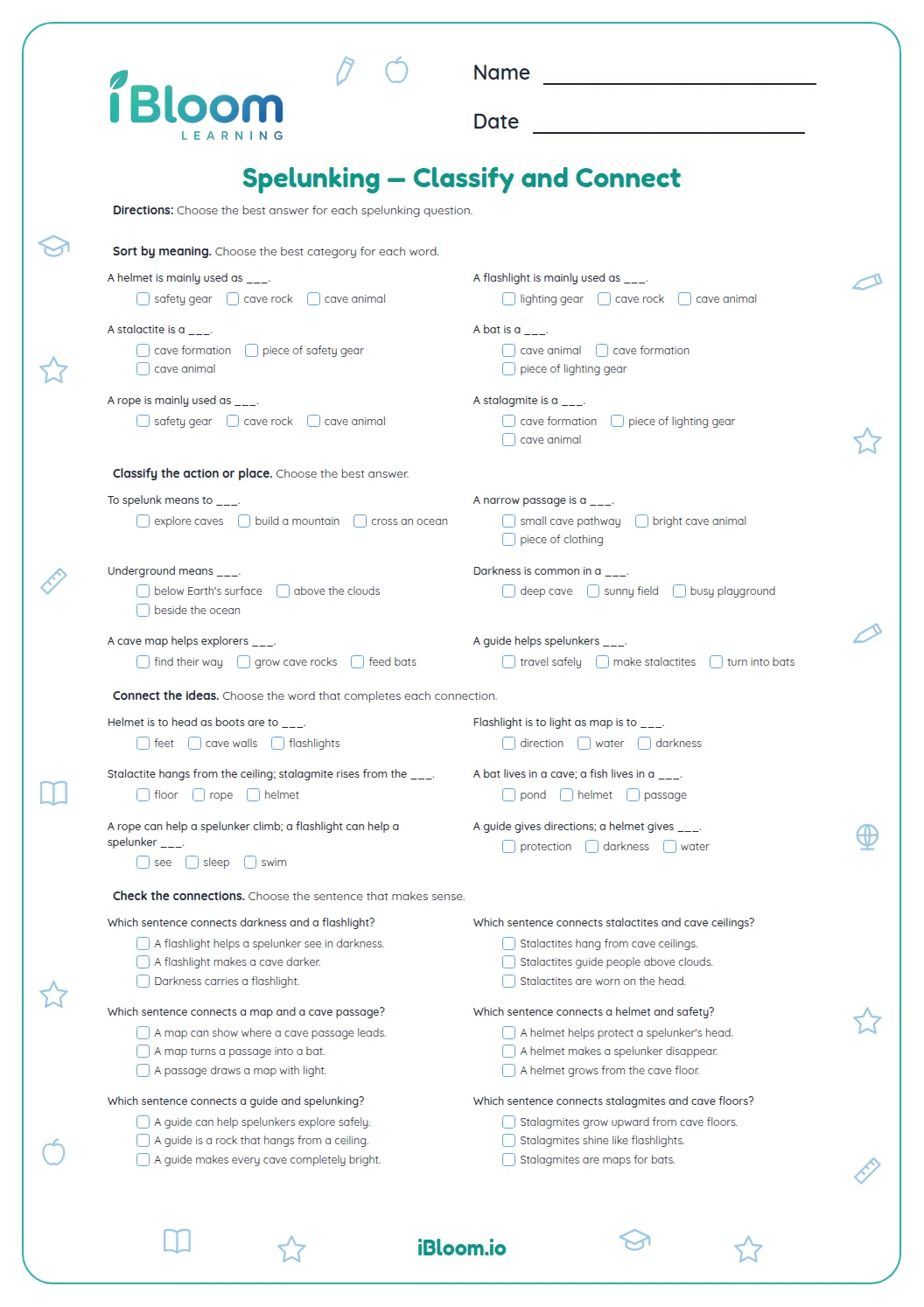
This Grade 3 printable pairs a cave-themed word search with word-meaning and context-clue practice. Children find six cave words, connect words to definitions, and use sentence clues to complete six sentences. The answer key supports quick checking as learners explain how they chose each word.
Aligned to L.3.4a
What cave words will children find?
The opening word search includes spelunking, cavern, stalactite, stalagmite, explorer, and underground. Children then select meanings for those words before using sentence clues to complete seven short contexts.
How can a child choose the right meaning?
Read the whole definition and compare it with each choice. For “What is a stalactite?”, the clue “hanging from a cave ceiling” identifies the rock formation.
- 1A stalactite hangs from a cave ceiling.
- 2A stalagmite rises from a cave floor.
- 3The word “hanging” points to stalactite.
How do sentence clues help?
Read the words before and after a blank. In “Ava heard an ___ of her voice bounce off the cave walls,” the bouncing sound points to “echo.”
How to use this worksheet
- 1Search each row and mark all six cave words.
- 2Read each meaning choice before selecting one.
- 3For a blank, reread the whole sentence and look for a clue.
- 4Check each answer with the key and explain the clue that helped.
Common vocabulary mix-ups
The mistake
Mixing up stalactite and stalagmite.
The fix
Remember: a stalactite hangs from the ceiling; a stalagmite rises from the floor.
The mistake
Choosing a word from the cave topic without checking its meaning.
The fix
Compare the definition with every answer choice.
The mistake
Filling a blank from the first few words alone.
The fix
Read to the end of the sentence for a clue such as “bounce off the walls.”
Common Core alignment
Use the sentence clues in the final section to identify cave words.
On this sheet: Use sentence-level context to select the cave word that completes each sentence.
Show the official wordingHide the official wording
Use sentence-level context as a clue to the meaning of a word or phrase.
What to practice next
Make more practice
Further reading
Questions parents and teachers ask
What does spelunking mean?
Spelunking means exploring caves. The first activity asks children to find the word in a grid, and the meaning choices help distinguish it from words such as cavern and explorer. The key gives the correct choices so a child can review both the word and its meaning.
How are stalactites and stalagmites different?
A stalactite hangs from a cave ceiling, while a stalagmite rises from the cave floor. Questions 4 and 5 use those direction clues directly. A child can say “ceiling” for stalactite and “floor” for stalagmite while checking the answer key.
What kinds of context clues are on the sheet?
The seven sentences include clues about a helmet protecting a head, a flashlight helping someone see, and an echo bouncing off cave walls. Children fill each blank with a vocabulary word that fits the whole sentence, then compare their answers with the key.
How many questions are included?
There are 14 numbered items: one word search, six multiple-choice meaning questions, and seven fill-in context sentences. The word search has six target words. The printable and its answer key are each designed for two pages, with space to work through both vocabulary tasks.
Can a child use the answer key while working?
Yes. A child can finish a section first, then use the key to check the word search and each response. If an answer is different, reread the definition or sentence and point to the clue that supports the key’s answer.