




About this worksheet
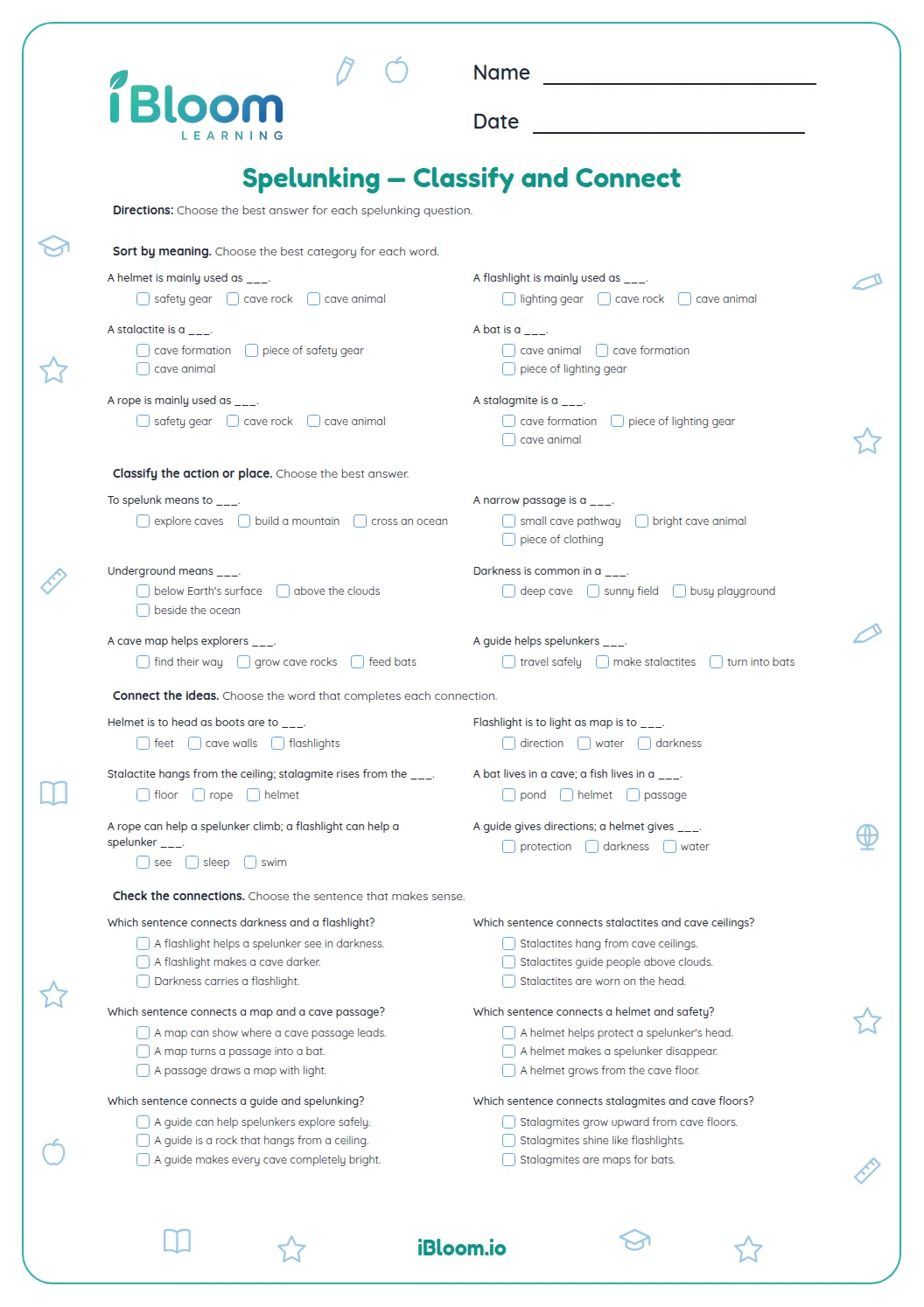
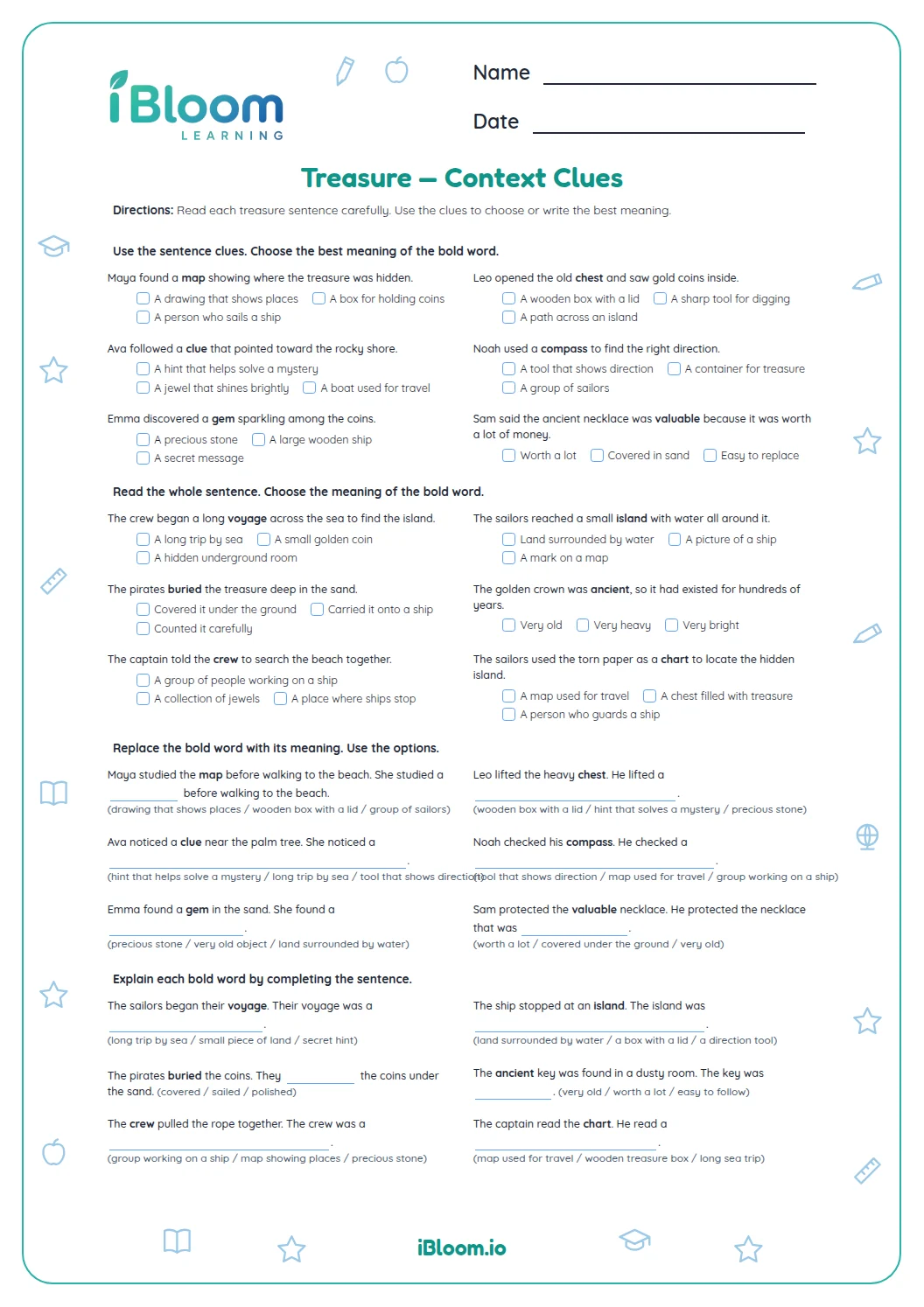
This Grade 3 vocabulary worksheet uses cave exploration words to practice precise meaning. Children identify cave features and tools, complete context sentences, and compare related words such as entrance and passage. The 14 questions apply CCSS L.3.4a by using sentence-level context to clarify word meaning. A separate answer key shows the correct choices.
Aligned to L.3.4a
How do cave words name different things?
The questions distinguish cave features, explorers, and equipment. A stalactite hangs from a ceiling; a stalagmite rises from the floor.
- 1Stalactite: hangs from the ceiling
- 2Stalagmite: rises from the floor
How do sentence clues narrow a choice?
In “Ava heard her voice return as an ___,” the returning voice points to echo. Use the whole sentence to choose a word that fits.
How can close meanings be compared?
An entrance is an opening, while a passage is a path through. Naming the feature each word describes helps keep related cave terms distinct.
How to use this worksheet
- 1Read the target cave word carefully.
- 2Use the definition choices to check its meaning.
- 3Read each full sentence before filling its blank.
- 4Compare the words in each pair and name the difference.
- 5Use a detail about the word in each written explanation.
- 6Check the key and revisit any answer that needs a clearer clue.
Common mistakes and quick fixes
The mistake
Mixing up stalactite and stalagmite.
The fix
Remember that a stalactite hangs down and a stalagmite grows up.
The mistake
Picking a context word before reading the whole sentence.
The fix
Use the action or detail around the blank as evidence.
The mistake
Defining entrance and passage as the same thing.
The fix
An entrance is an opening; a passage is a route through a space.
Common Core alignment
Use sentence clues to determine word meaning.
On this sheet: Sentence questions and written examples use nearby clues to establish precise meanings.
Show the official wordingHide the official wording
Use sentence-level context as a clue to the meaning of a word or phrase.
What to practice next
Make more practice
Further reading
Questions parents and teachers ask
What words does the worksheet use?
The practice uses spelunker, headlamp, harness, helmet, stalactite, stalagmite, ledge, passage, entrance, and echo. Learners meet these words in definitions, context sentences, and comparisons. The separate answer key lists the best choice for each item so an adult can review the meanings with the child.
How does the context practice work?
Four context sentences include a blank for a cave word. Learners read the full sentence and choose the word that makes sense, such as selecting echo after reading that a voice returned. The sentence detail helps narrow the meaning before the learner checks the answer key.
How are stalactites and stalagmites different?
A stalactite hangs from a cave ceiling, while a stalagmite grows upward from the cave floor. The worksheet asks learners to identify this distinction. Remembering “hangs” for stalactite and “rises” for stalagmite helps keep these similar terms apart.
Does the worksheet ask children to write?
The revised sheet uses multiple-choice practice throughout, so children can focus on identifying meanings and word relationships without extended writing. An adult can invite the learner to explain a choice orally, such as why an entrance is an opening and a passage is a path through.
How many questions and pages are included?
There are 14 questions across two worksheet pages, plus a two-page answer key. Items include cave-word meanings, sentence clues, and comparisons between related terms. The compact choice format leaves room to revisit unfamiliar vocabulary without long written responses.