
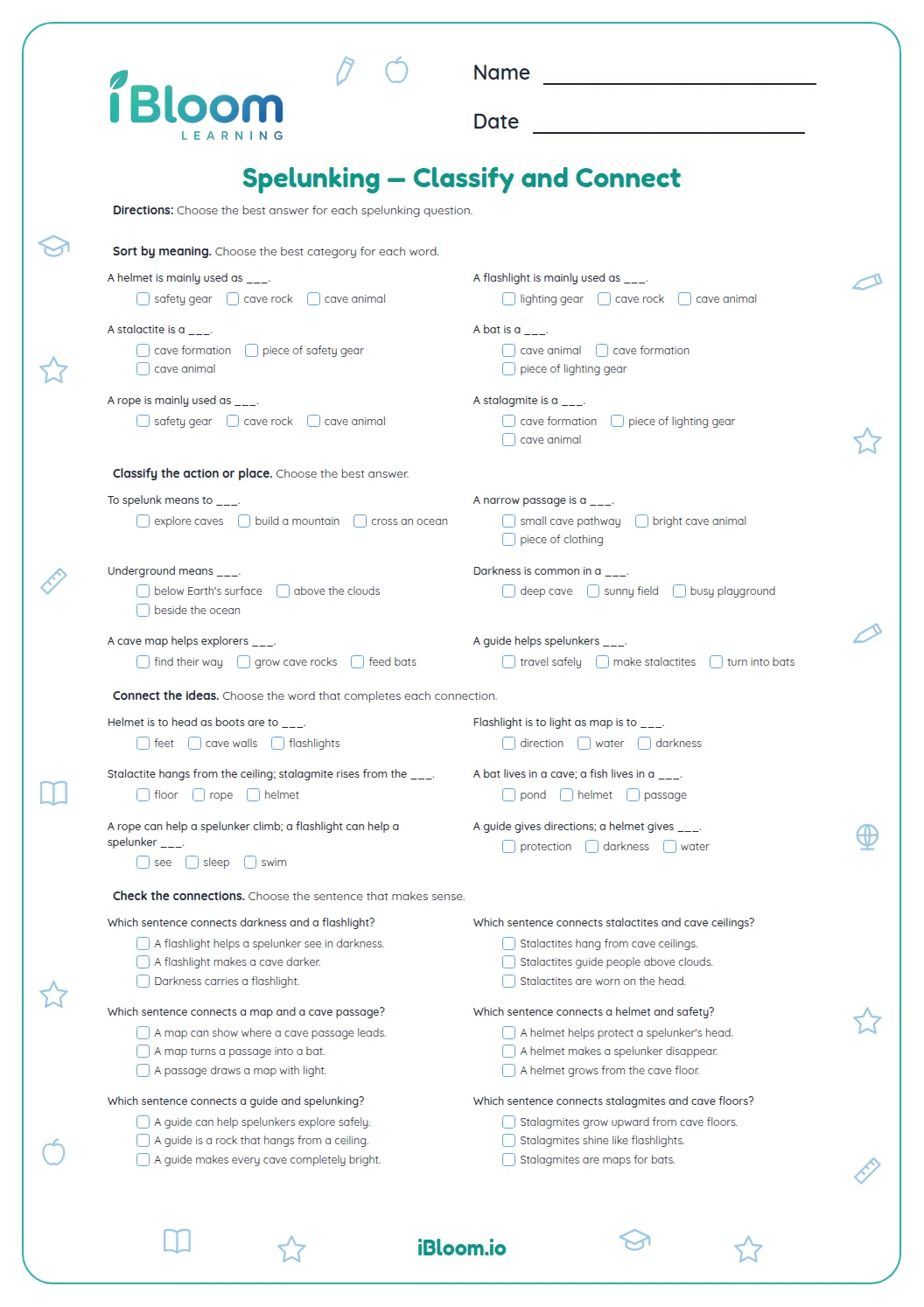


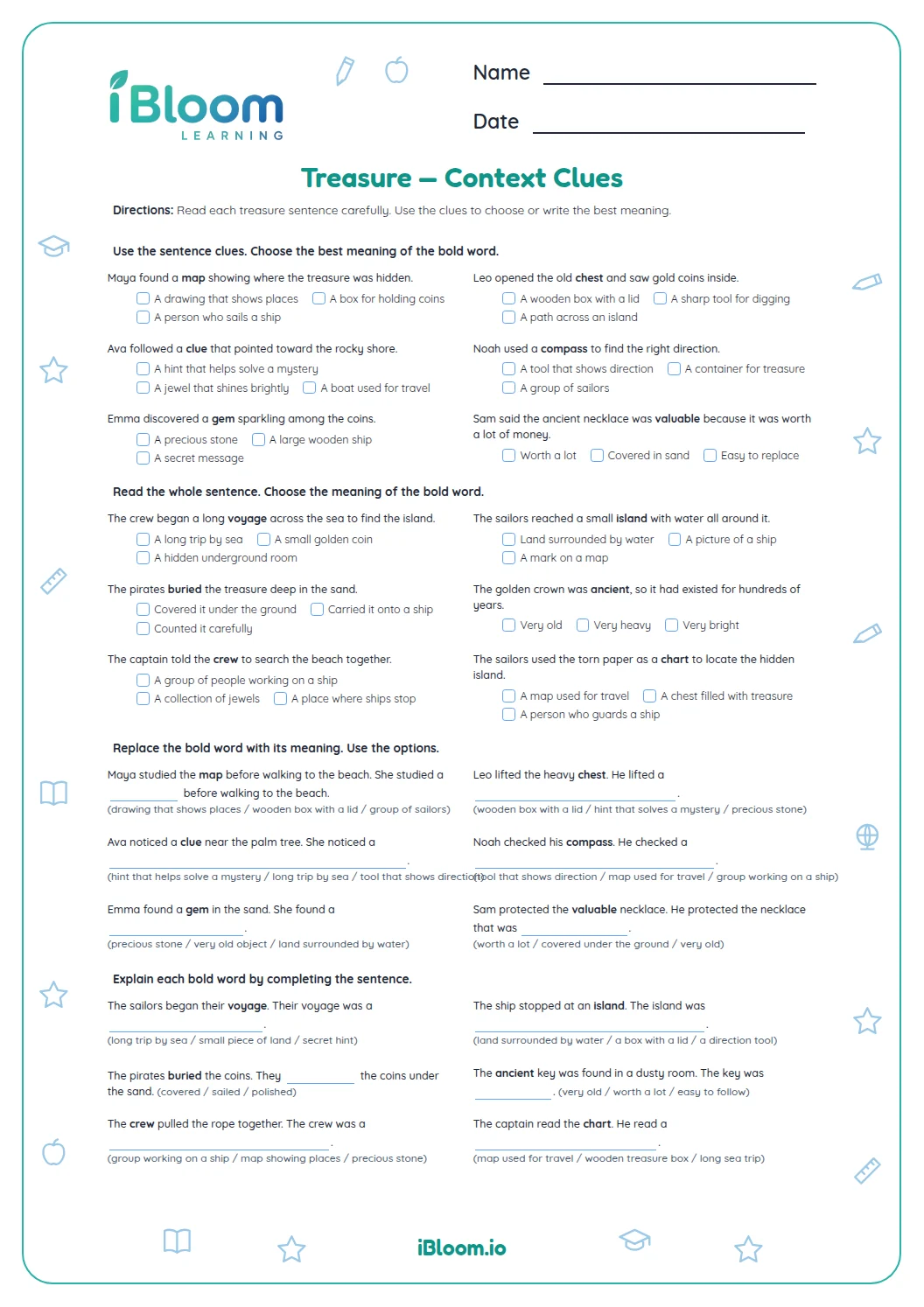


About this worksheet
This free printable Grade 3 vocabulary worksheet uses cave-themed sentences to help students work out unfamiliar word meanings. Fourteen questions move from choosing a word that fits a clue to explaining meanings in short answers. Students consider details such as water dripping from a cave ceiling or a passage that only one person can enter. The answer key lists correct choices and short responses. The page practices CCSS L.3.4.a: using sentence context to determine a word’s meaning.
Aligned to L.3.4.a
How can a sentence reveal a word’s meaning?
Look for a nearby action, description, or result that gives the word a clue. In “Water dripped from the ceiling, leaving the cave floor damp,” the dripping water tells what damp means.
- 1A passage is “narrow” when only one person can walk through.
- 2The clue that shoulders nearly touch the walls means narrow is close to “not wide.”
How can a reader check a word meaning?
Try the meaning in the sentence. If the sentence still makes sense, the surrounding details and the definition fit together. For example, a passage that lets one person through is narrow, or not wide.
How can I check a context-clue answer?
Substitute the chosen meaning into the sentence. If the sentence still makes sense, the clue and meaning fit together.
How to use this worksheet
- 1Read the full sentence before choosing a meaning.
- 2Notice nearby actions and descriptions that give clues.
- 3Choose a meaning that fits those details.
- 4Answer the short questions in your own words.
- 5Reread the sentence with your chosen meaning in place.
Common mistakes and quick fixes
The mistake
Choosing a meaning from memory without checking the sentence.
The fix
Reread the nearby details and see which meaning fits this sentence.
The mistake
Treating damp as completely underwater.
The fix
Use the clue about drips and a wet floor: damp means slightly wet.
The mistake
Searching for a word without checking its letters.
The fix
Match the word letter by letter, including its ending.
Common Core alignment
Sentence clues help readers determine unfamiliar word meanings.
Use sentence context as a clue to word meaning.
On this sheet: Students infer vocabulary meaning from surrounding sentence details.
Show the official wordingHide the official wording
Use sentence-level context as a clue to the meaning of a word or phrase.
What to practice next
Make more practice
Further reading
Questions parents and teachers ask
What does this worksheet practice?
The 14 items focus on words used in cave exploration, including narrow, damp, echo, lantern, cavern, and helmet. Students use a sentence detail to choose or state a meaning. The answer key includes the target meanings and short responses.
How can a student find a context clue?
Reread the whole sentence and look for an action, example, or restatement near the word. In the narrow-passage item, only one person can walk through and shoulders nearly touch the walls, so the clues point to a tight space rather than a wide one.
What kinds of questions are on the page?
Part A has six multiple-choice items. Part B asks two brief questions about cave words, and Part C has six short meaning or detail responses. The directions tell students whether to choose an option or write a short answer.
What does “spelunking” mean here?
Spelunking means exploring caves. The worksheet uses the word in a sentence about Maya enjoying cave exploration with her family, so that nearby phrase gives a clue. Students can explain the meaning in their own words before checking the key.
How should an adult check a written response?
Compare the response with the meaning in the key, while allowing clear wording with the same meaning. “A carried light” and “a light you carry” both explain lantern. For context-clue items, ask which nearby words helped the student decide.