




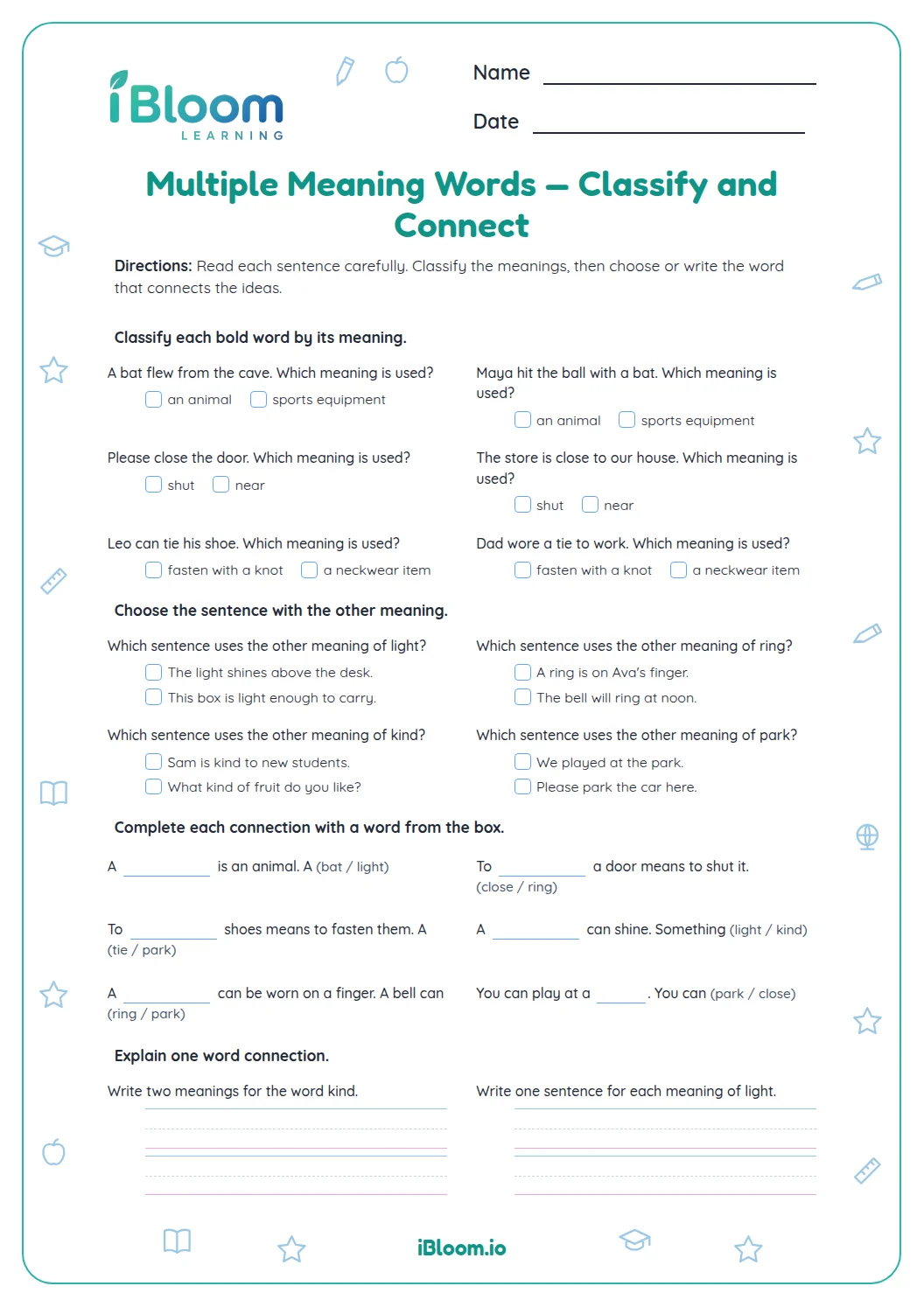

About this worksheet
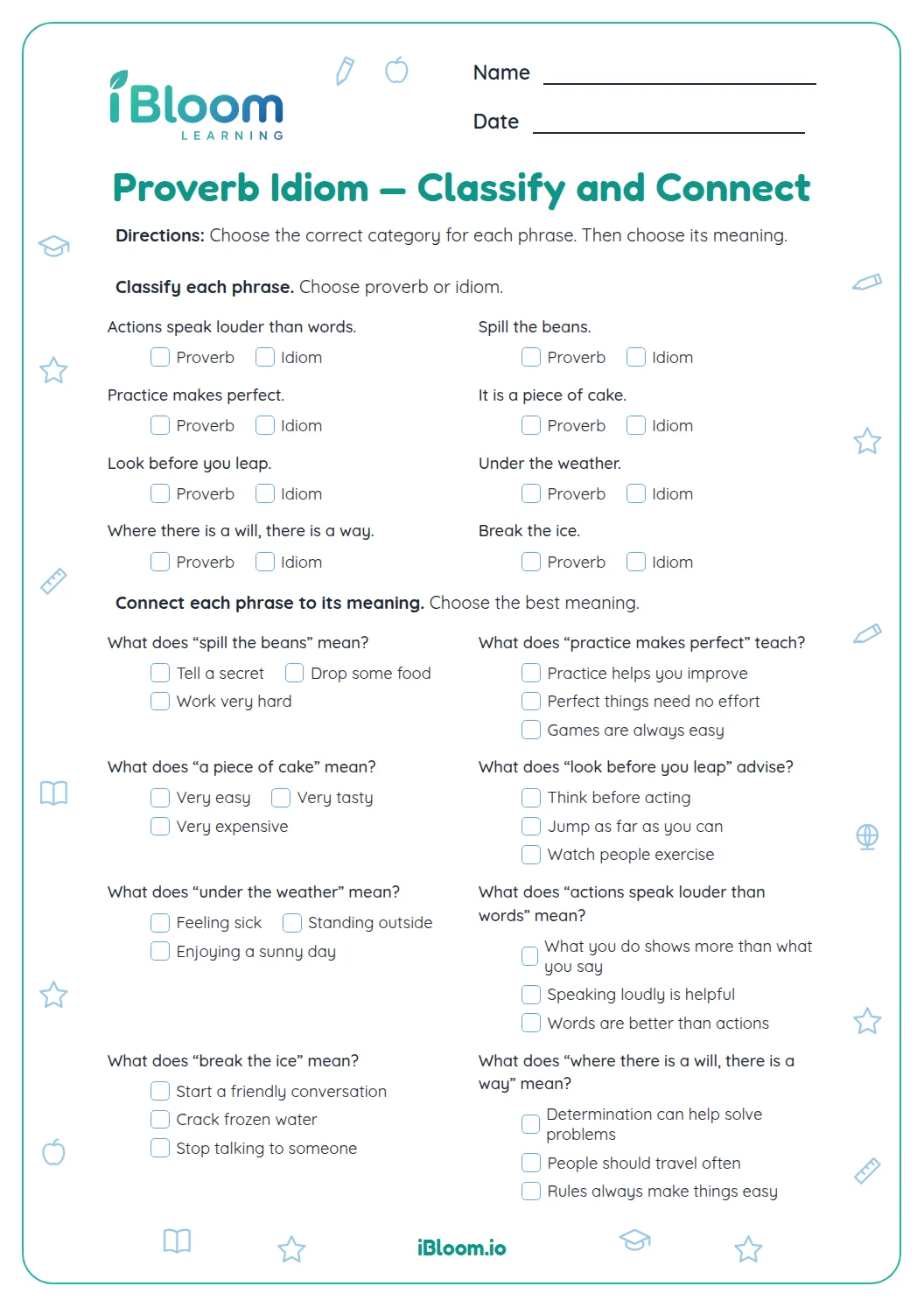
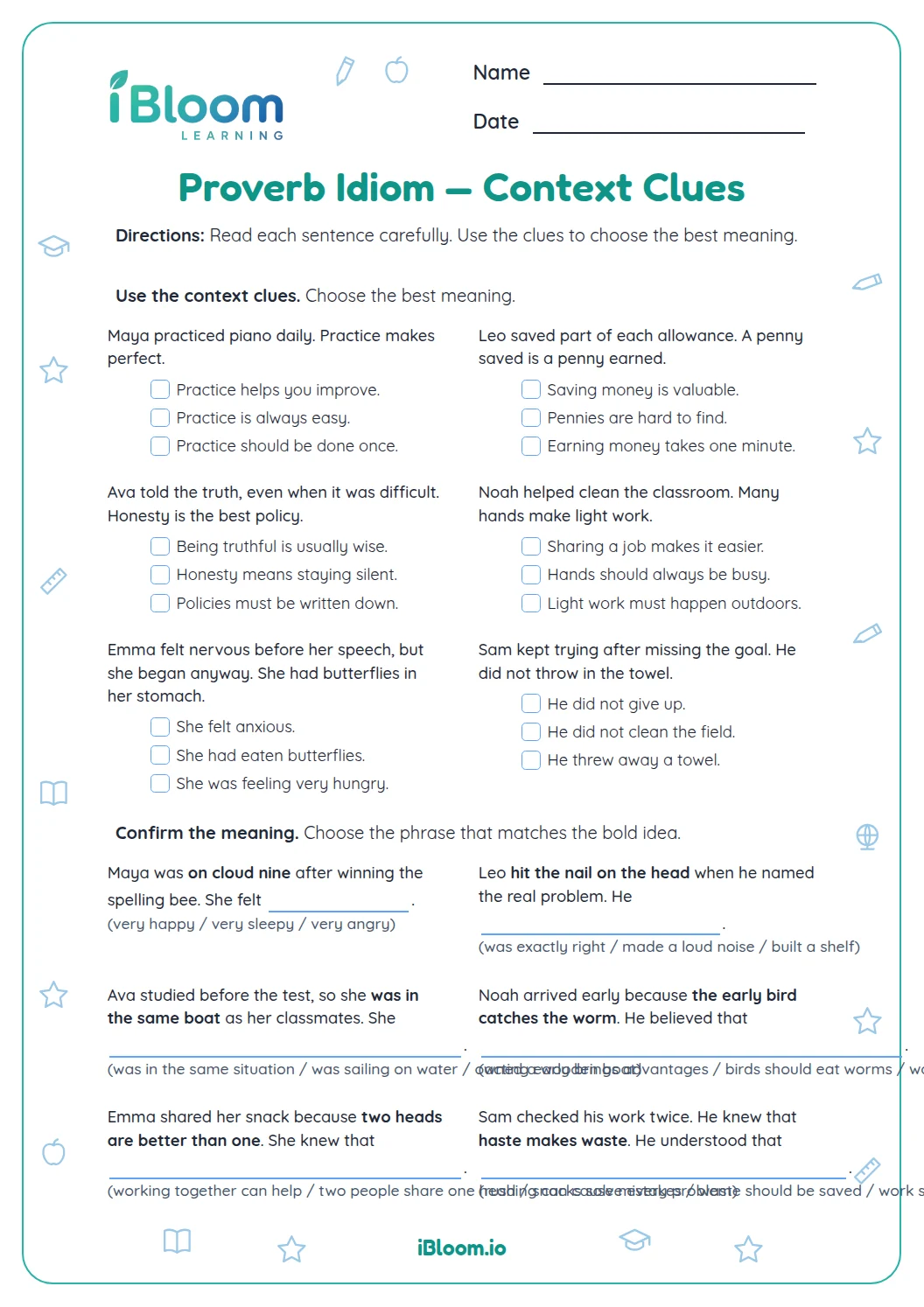
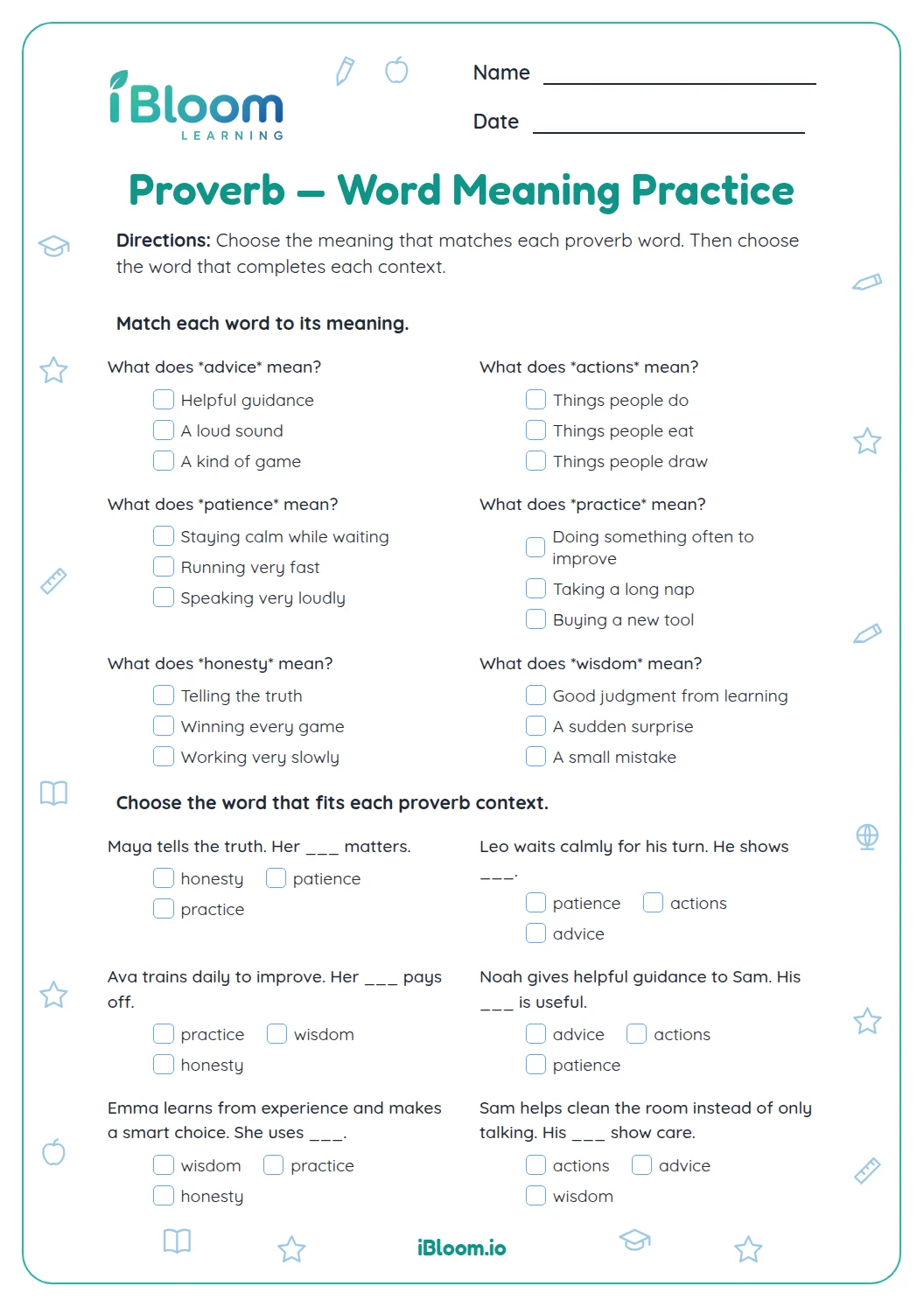
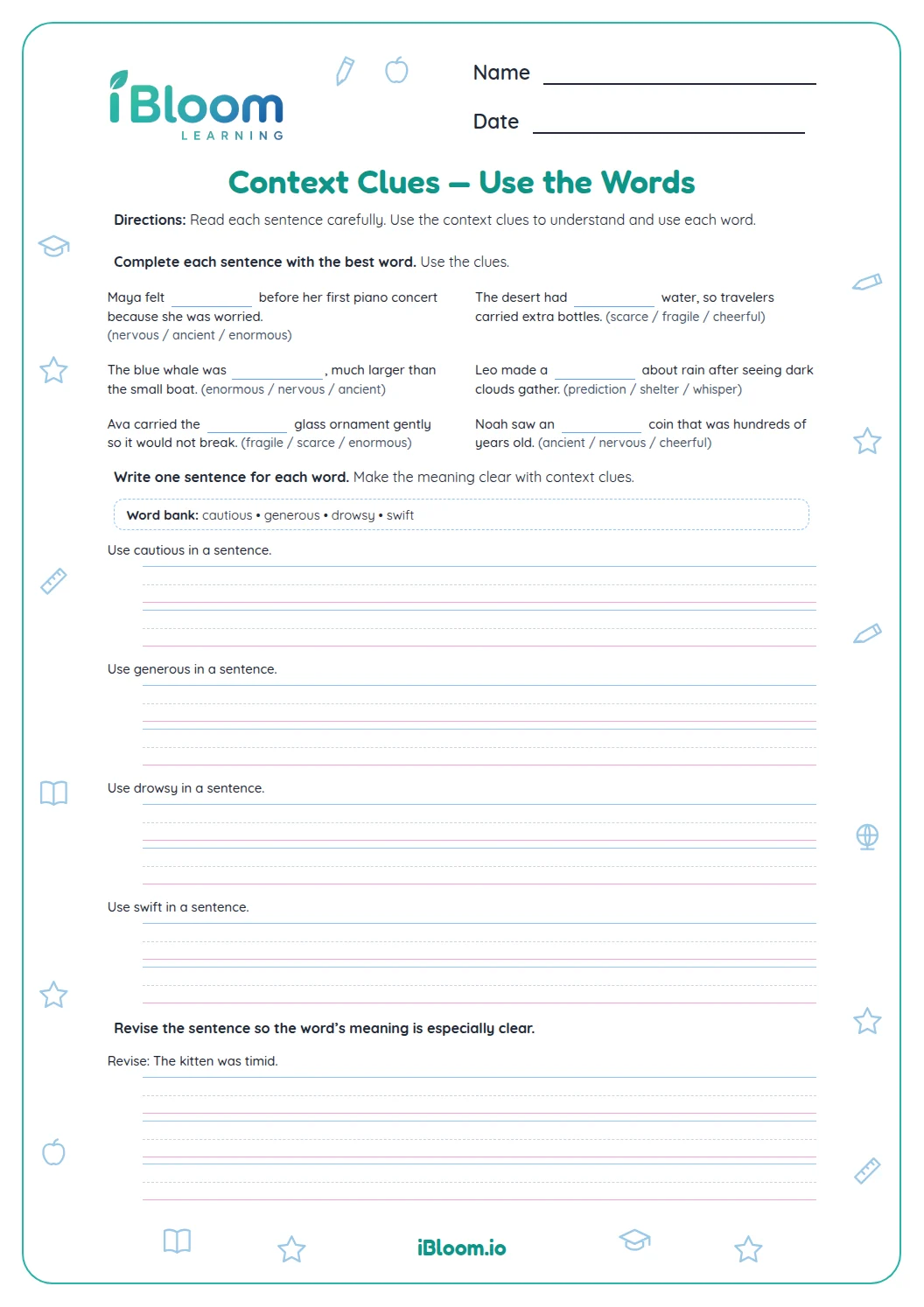
This Grade 4 vocabulary worksheet helps learners interpret common idioms and proverbs, then use each expression in context. Eight short prompts ask for meanings, followed by six sentence choices. The separate answer key gives concise responses. It practices Common Core L.4.5.b.
Aligned to L.4.5.b
How do you work out an idiom’s meaning?
An idiom’s intended meaning differs from the literal words. “Break the ice” usually means to make people feel comfortable at the start of a conversation. Look at the surrounding situation and ask which meaning makes sense.
- 1Phrase: “Break the ice”
- 2Situation: New students are quiet.
- 3A welcoming game can break the ice.
- 4Meaning: help people begin talking comfortably.
How is a proverb different from an idiom?
A proverb gives advice or a general lesson, such as “Better late than never.” An idiom is a phrase whose meaning is not simply the literal meaning of its words, such as “hold your horses.” Both become clearer in context.
What makes a sentence show the expression’s meaning?
In Part A, write a short meaning for each expression. In Part B, choose the sentence that uses it figuratively and fits the situation. A clear context helps distinguish an intended meaning from a literal one.
How to use this worksheet
- 1Read the whole expression before choosing.
- 2Picture a situation where someone might say it.
- 3Choose the meaning that fits that situation.
- 4For each context item, compare both sentences with the expression’s intended meaning.
- 5Check the meaning blanks and selected sentences with the key.
Common mistakes and quick fixes
The mistake
Taking every word literally.
The fix
Ask what the phrase means in the situation, not what each word names.
The mistake
Using an idiom in a sentence that only describes its literal meaning.
The fix
Add a situation that makes the figurative meaning clear.
The mistake
Writing a fragment instead of a complete sentence.
The fix
Include who or what the sentence is about and what happens.
Common Core alignment
This sheet practices interpreting idioms and proverbs in context.
Recognize and explain common idioms and proverbs.
On this sheet: Learners explain eight expressions and select six sentences that use them figuratively.
Show the official wordingHide the official wording
Recognize and explain the meaning of common idioms, adages, and proverbs.
What to practice next
Make more practice
Further reading
Questions parents and teachers ask
What is the difference between an idiom and a proverb?
An idiom is a phrase whose intended meaning is not simply literal, such as “hold your horses” for wait. A proverb expresses a general lesson or advice, such as “Better late than never.” This worksheet practices recognizing both forms. Part A asks for meanings, while Part B asks students to select a fitting use.
Do students need to use the exact answer key sentences?
No. The key gives a short meaning for each expression and identifies the strongest sentence choice. A student’s definition can use different words as long as it captures the expression’s intended idea. For the context items, the chosen sentence should show that meaning in a believable situation.
Why do some phrases sound strange if taken literally?
Idioms use a group of words to express an idea beyond the literal action. “Break the ice” is about easing a social moment, not breaking frozen water. The meaning blanks ask students to put that intended idea in their own words.
What should a strong sentence include?
Choose a sentence where the situation makes the expression’s intended meaning clear. “The quiz was a piece of cake” shows that it was easy; a sentence about eating dessert uses the words literally. The worksheet asks students to make this distinction for six expressions.
Is there an answer key?
Yes. The separate key lists a short meaning for each expression and marks the sentence that best demonstrates each phrase in context. Compare the student’s wording with the intended idea rather than requiring an exact definition. The key includes short meanings and the best matching sentence for each item.