




About this worksheet
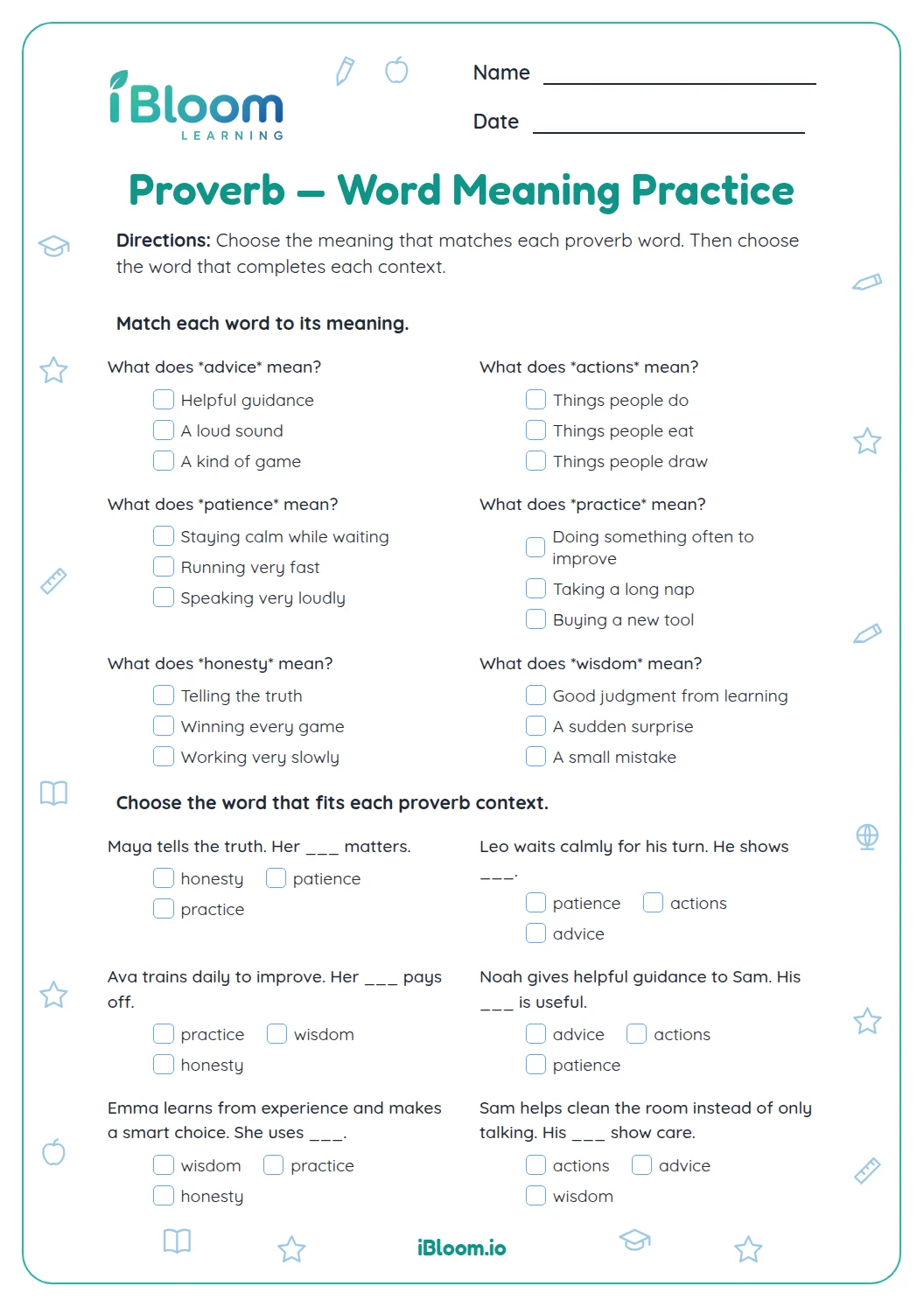
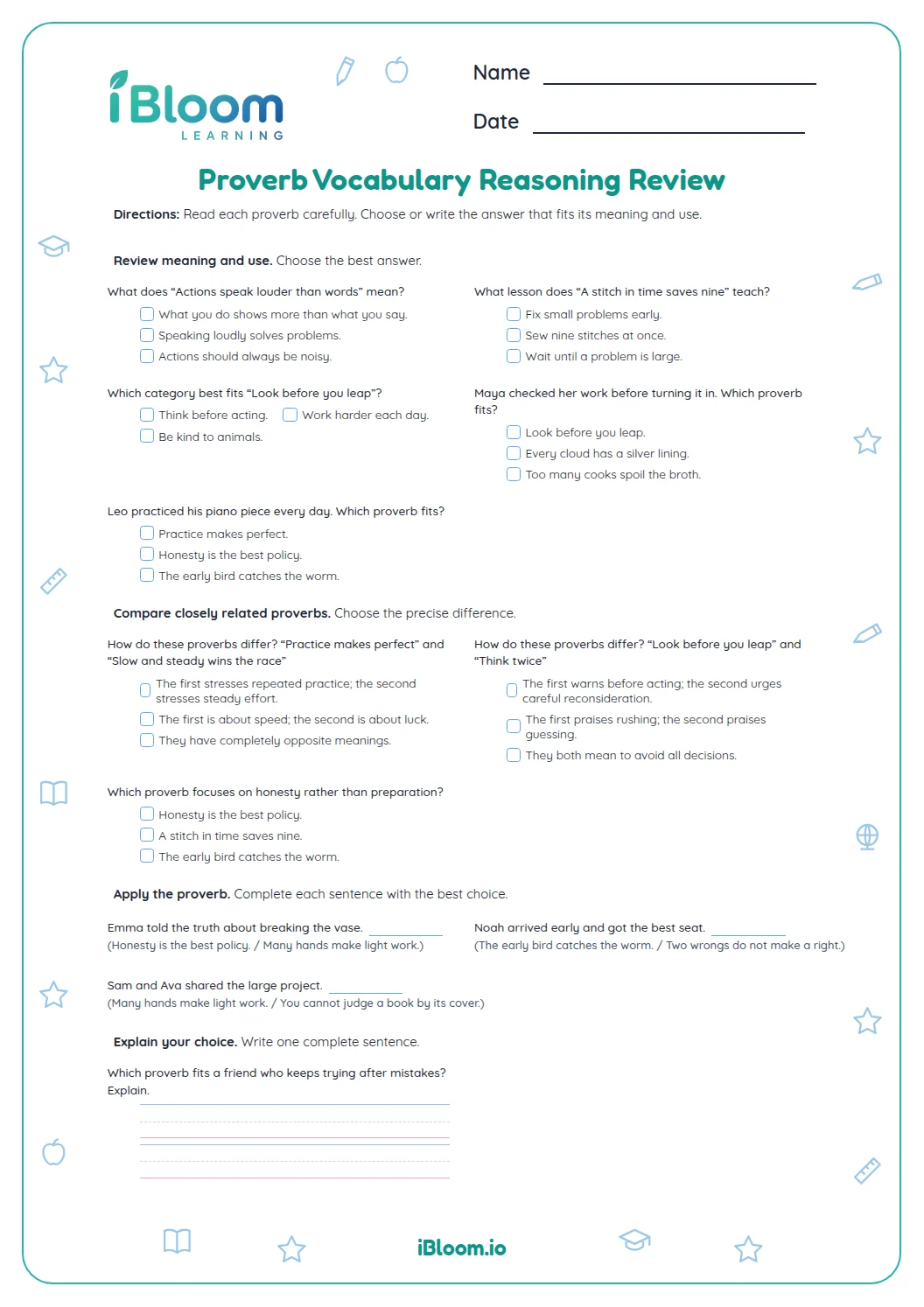
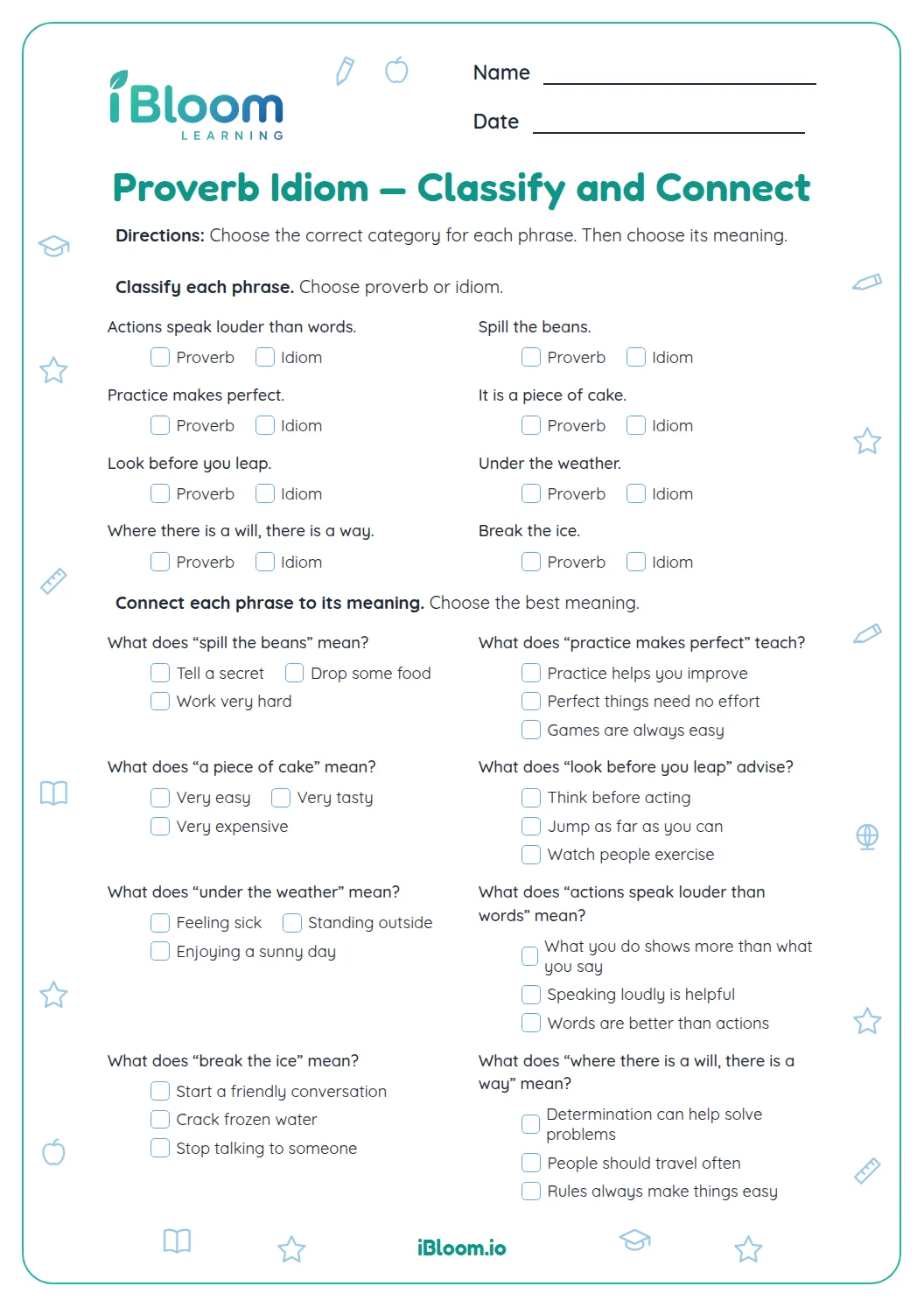
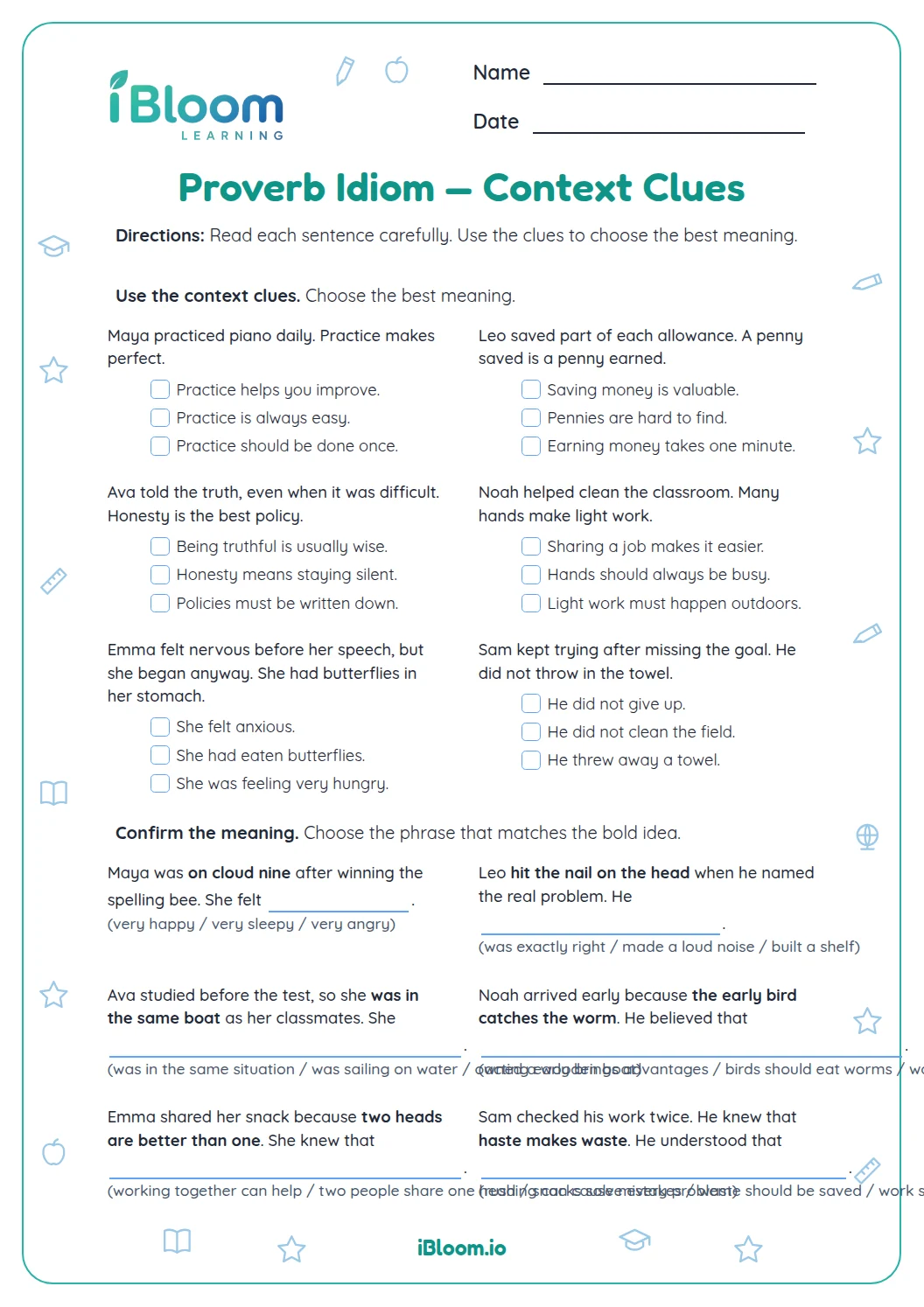
This free printable Grade 4 worksheet gives each of twelve familiar proverbs an everyday context. Students read about practicing, preparing, helping, saving and other experiences, then use those clues to work out each saying’s advice. Part A has four multiple-choice questions; Part B adds eight proverbs with a word to choose for each explanation. The work supports Common Core L.4.5b and L.4.4a through proverb meanings and context clues. A separate answer key supplies all twelve answers.
Aligned to L.4.5b and L.4.4a
What is a proverb?
A proverb is a familiar saying that offers advice or expresses a general lesson. Its words can describe one thing while its advice applies to many situations. “Don’t judge a book by its cover” can apply to a backpack, a person or another thing whose appearance gives an incomplete impression.
The worksheet presents the situation before the proverb so children have a concrete example to think about. They can ask what happened, what helped and what lesson the saying suggests.
How does a situation reveal a proverb’s meaning?
Look for the action and its result. In the piano example, Maya practices daily and eventually plays the song. Those details support improvement through practice. The proverb encourages repeated effort; the context does not promise that a musician will never make another mistake.
- 1Maya practiced piano daily and finally played her song.
- 2Proverb: Practice makes perfect.
- 3Clues: practiced piano daily; finally played her song
- 4Best meaning: Practice builds skill
How do the two parts use context clues?
Part A supplies four situations and asks children to choose the proverb’s advice. Part B adds eight sayings with a word missing from each explanation. The choices in parentheses help students put the advice into everyday language.
Ask children to point to the action that supports each meaning. Zoe arrives first and gets the last ticket; that outcome explains the advantage of starting early. Jay keeps trying until his kite flies, showing how persistence can help solve a problem.
How to use this worksheet
- 1Read each situation before reading the answer choices.
- 2Underline the action and result that give a clue to the advice.
- 3Restate the proverb in everyday words.
- 4Complete Part B by testing each word against the situation.
- 5After Part B, ask the student to point to the context clue behind each chosen word.
- 6Use the key to check meanings and discuss any literal interpretations.
Mistakes to notice and fix
The mistake
Thinking “Practice makes perfect” promises zero mistakes.
The fix
Use Maya’s progress as the clue: practice helps a skill improve.
The mistake
Assuming the book-cover proverb applies only to books.
The fix
Point out the contrast between Jo’s worn backpack and its useful pockets.
The mistake
Choosing a word from the proverb literally instead of thinking about its advice.
The fix
For the early-bird saying, focus on Zoe arriving first and getting a ticket. The lesson is about starting early.
Common Core alignment
Explain the everyday advice expressed by familiar proverbs.
On this sheet: Students choose and explain meanings of proverbs in short situations.
Show the official wordingHide the official wording
Recognize and explain the meaning of common idioms, adages, and proverbs.
Use the events in each situation as clues to a proverb’s meaning.
On this sheet: The situations provide examples that reveal what each saying means.
Show the official wordingHide the official wording
Use context (e.g., definitions, examples, or restatements in text) as a clue to the meaning of a word or phrase.
What to practice next
Make more practice
Further reading
Questions parents and teachers ask
Which proverbs appear on the worksheet?
Twelve proverbs cover practice, preparation, kindness, saving, careful decisions, appearances, actions, teamwork, starting early, honesty, persistence and friendship. Examples include “Practice makes perfect,” “Look before you leap” and “Where there’s a will, there’s a way.” Each saying has a short situation that helps students work out its advice.
Do students need to memorize these proverbs first?
No, the situations give clues that students can use even when a saying is unfamiliar. Read what happens first, then ask what lesson it suggests. For the savings example, one dollar each week eventually buys a kite, which helps explain why every little bit can contribute to a goal.
Why does the book-cover proverb describe a backpack?
The proverb’s advice can apply whenever appearance gives an incomplete impression. Jo’s backpack looks worn, but it still has strong pockets. That contrast is the clue. Children should explain that an old-looking object can still be useful, using the backpack details to support their answer.
How should I check the eight completion answers?
Check that each word fits both the proverb and its situation. Part B’s answers are think, mislead, do, together, early, truth, trying and help. Jay keeps working until his kite flies, so trying fits the advice about determination. Ask children to identify the clue for each choice.
How can we practice the same skill after finishing?
Choose one of the twelve sayings and invent another short situation that fits its advice. For example, two classmates sharing ideas might illustrate “Two heads are better than one.” Ask the child to identify the clue in the new situation and explain why the proverb fits that event.