


About this worksheet
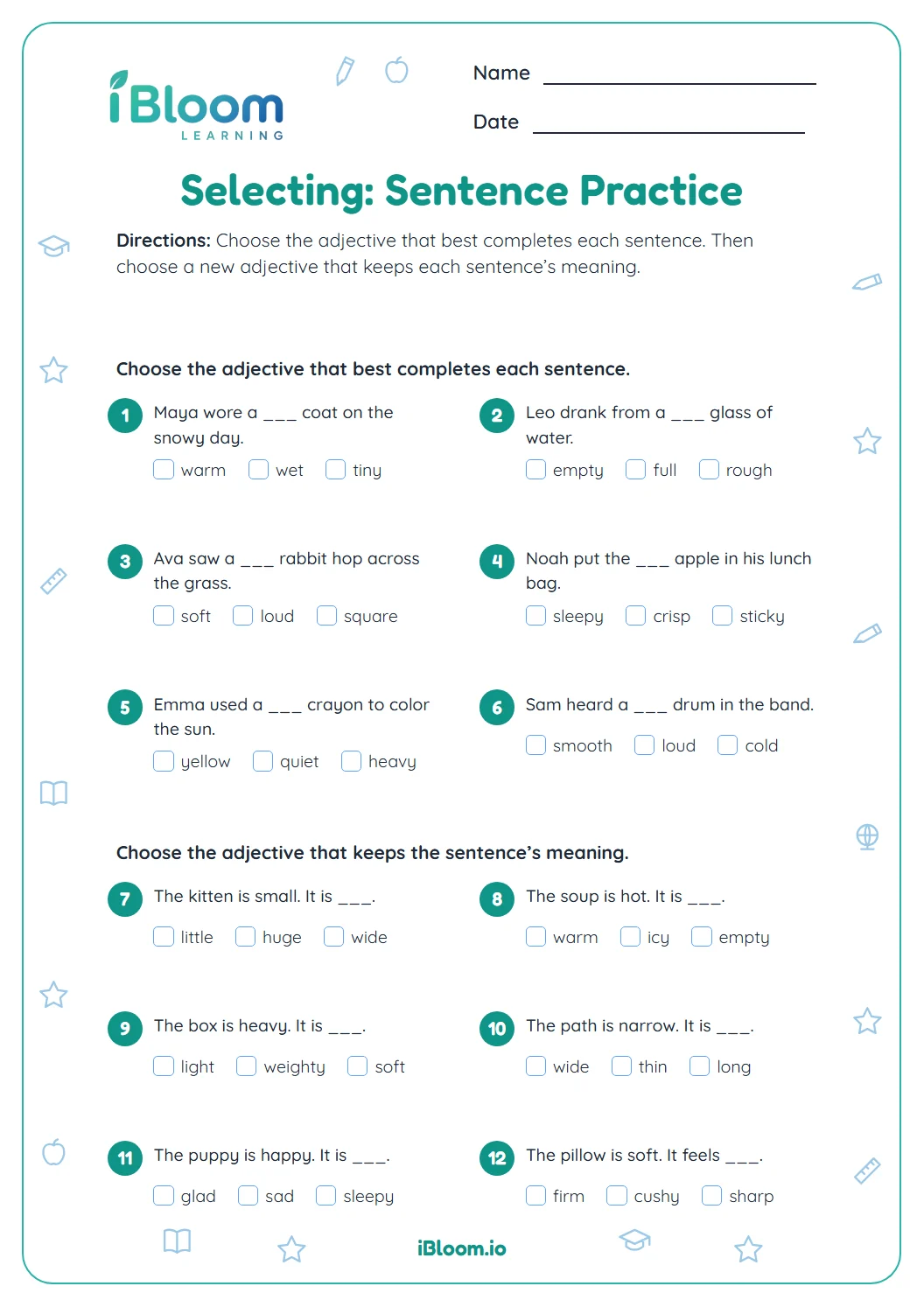
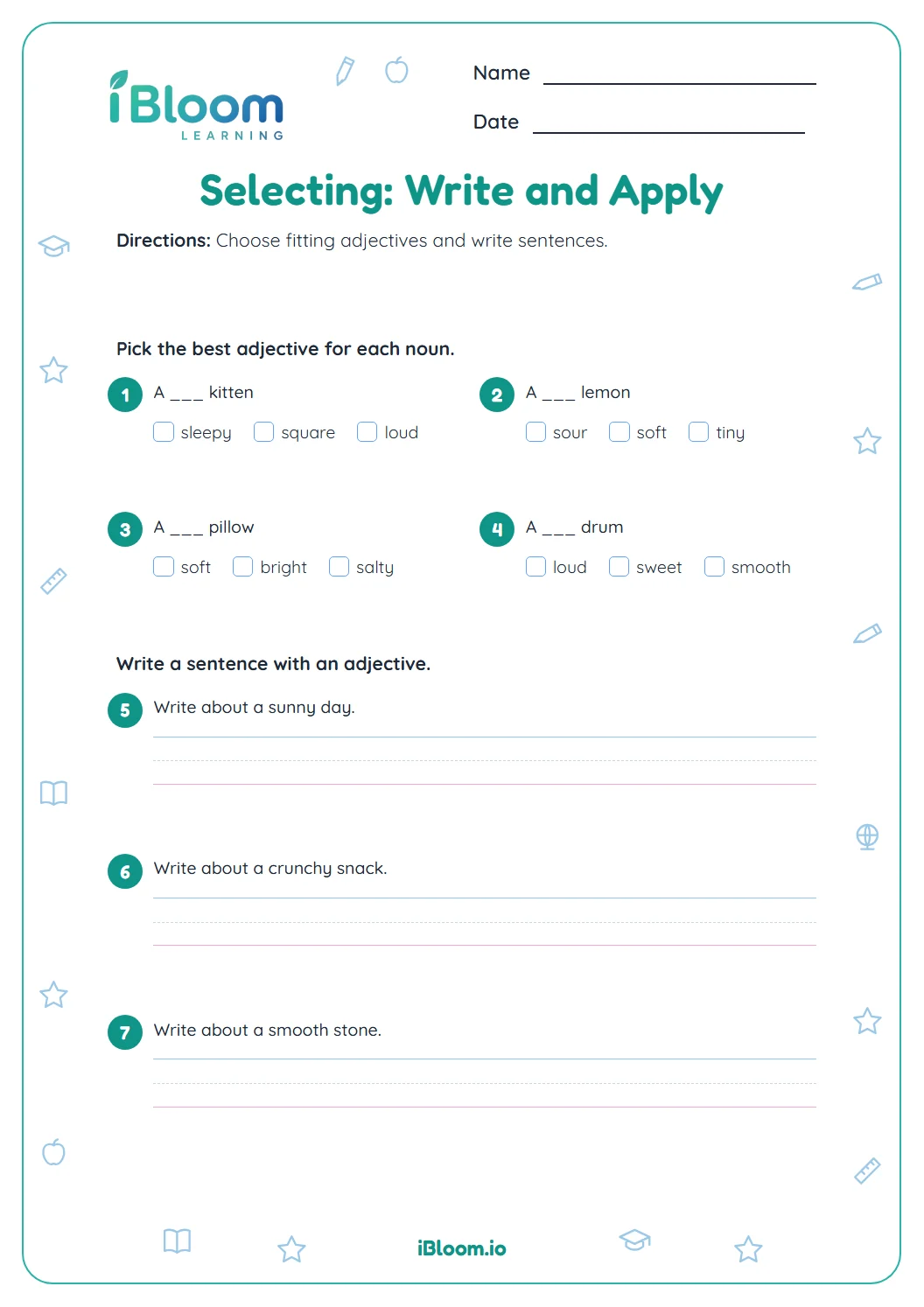
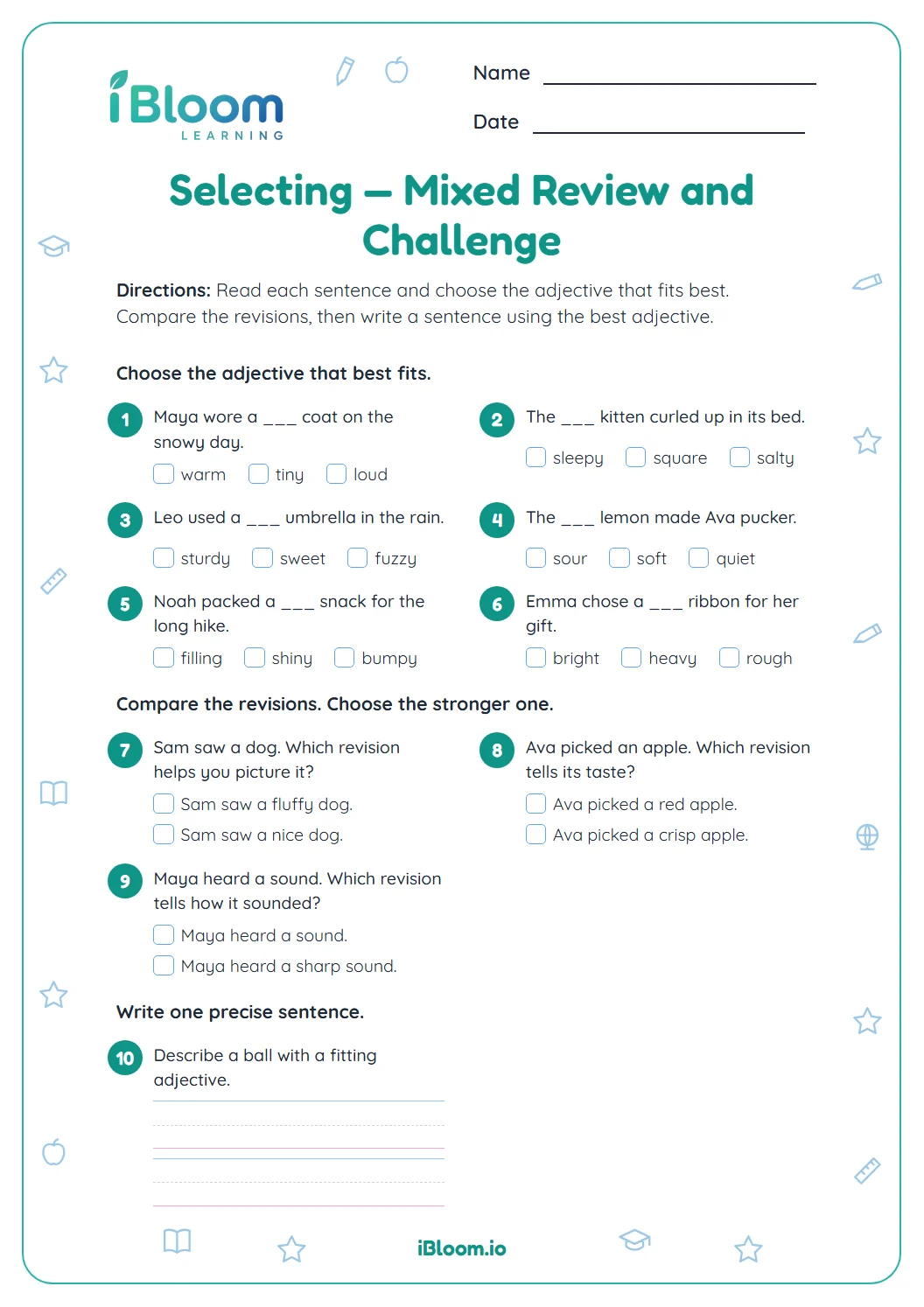
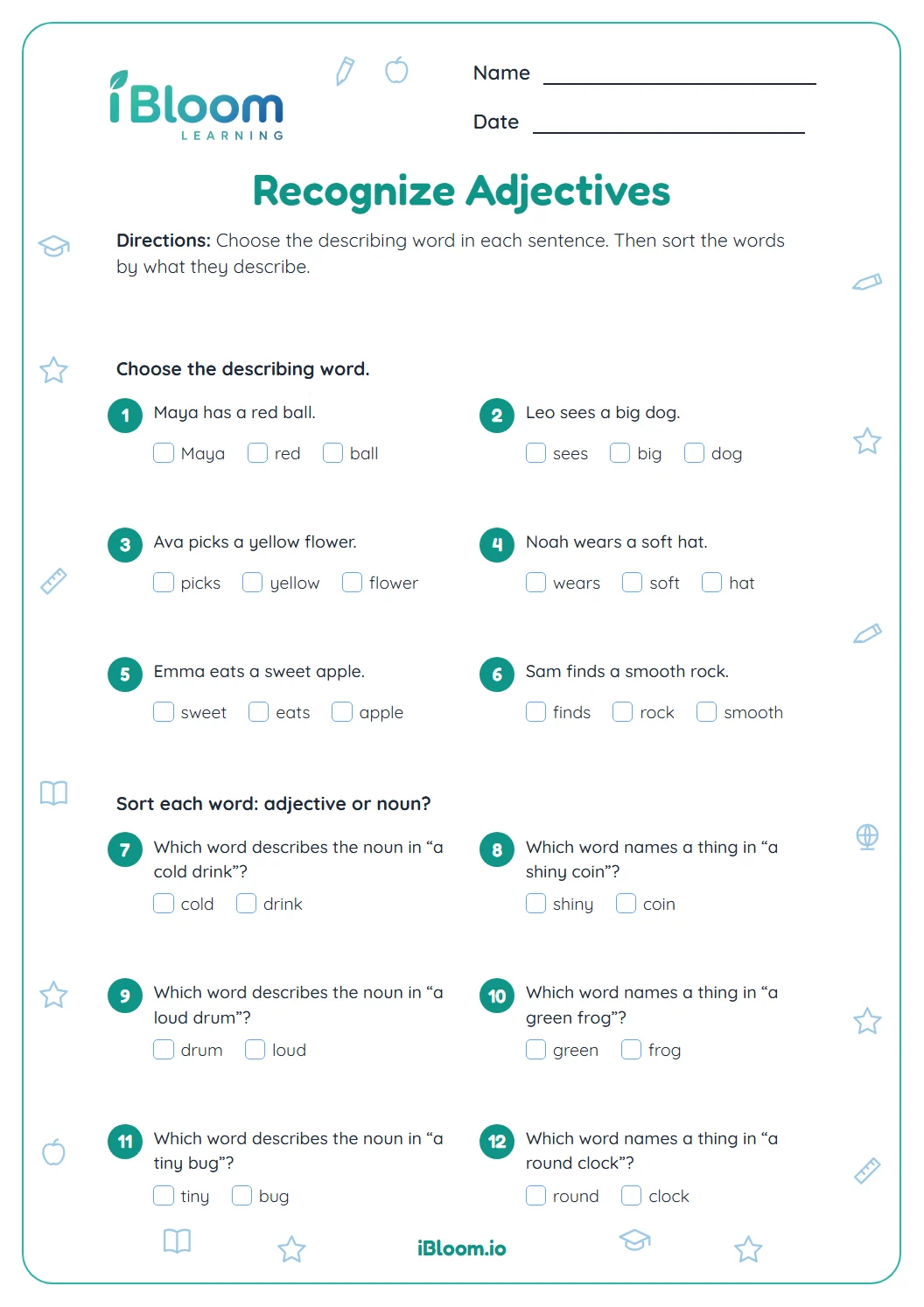
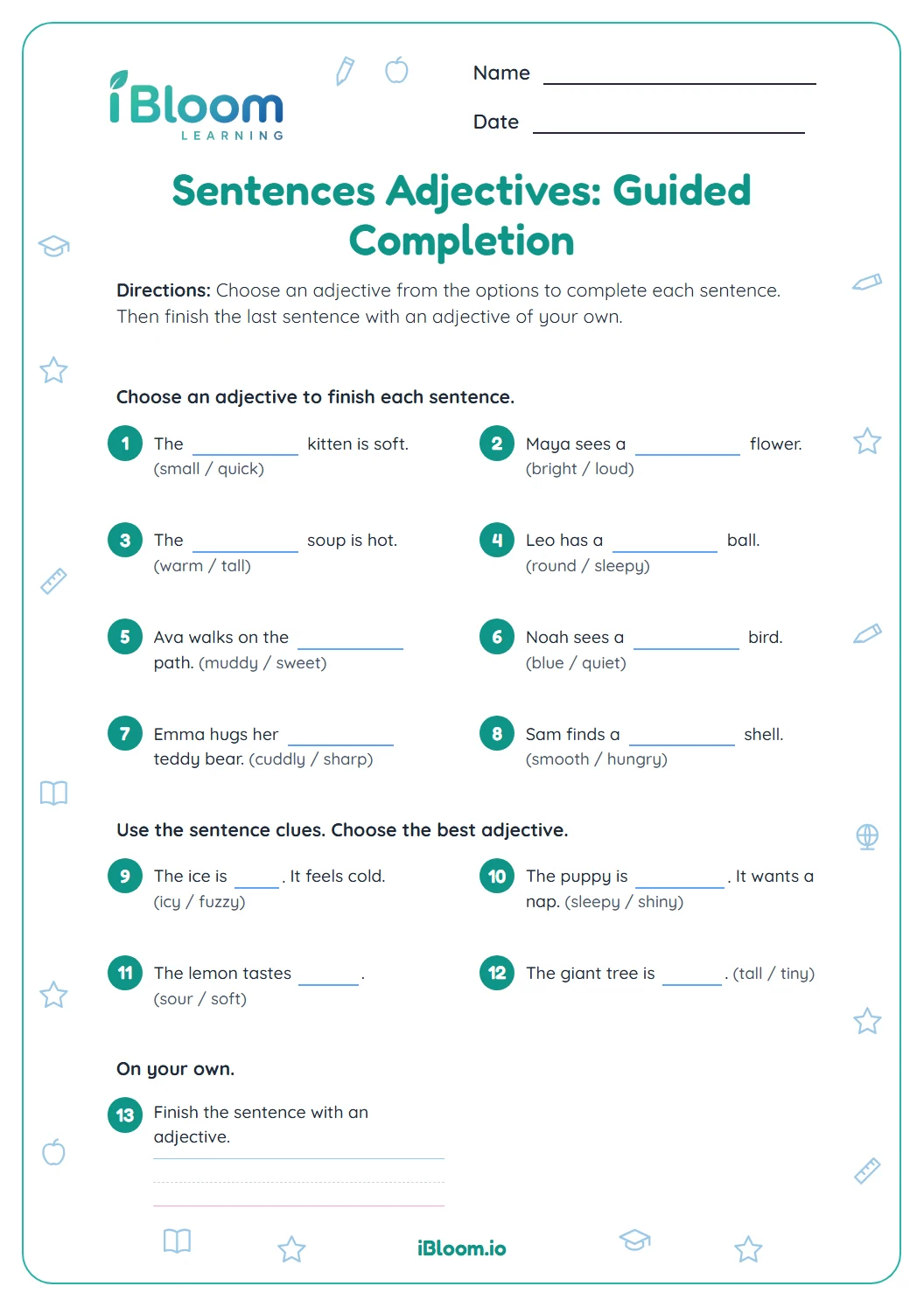
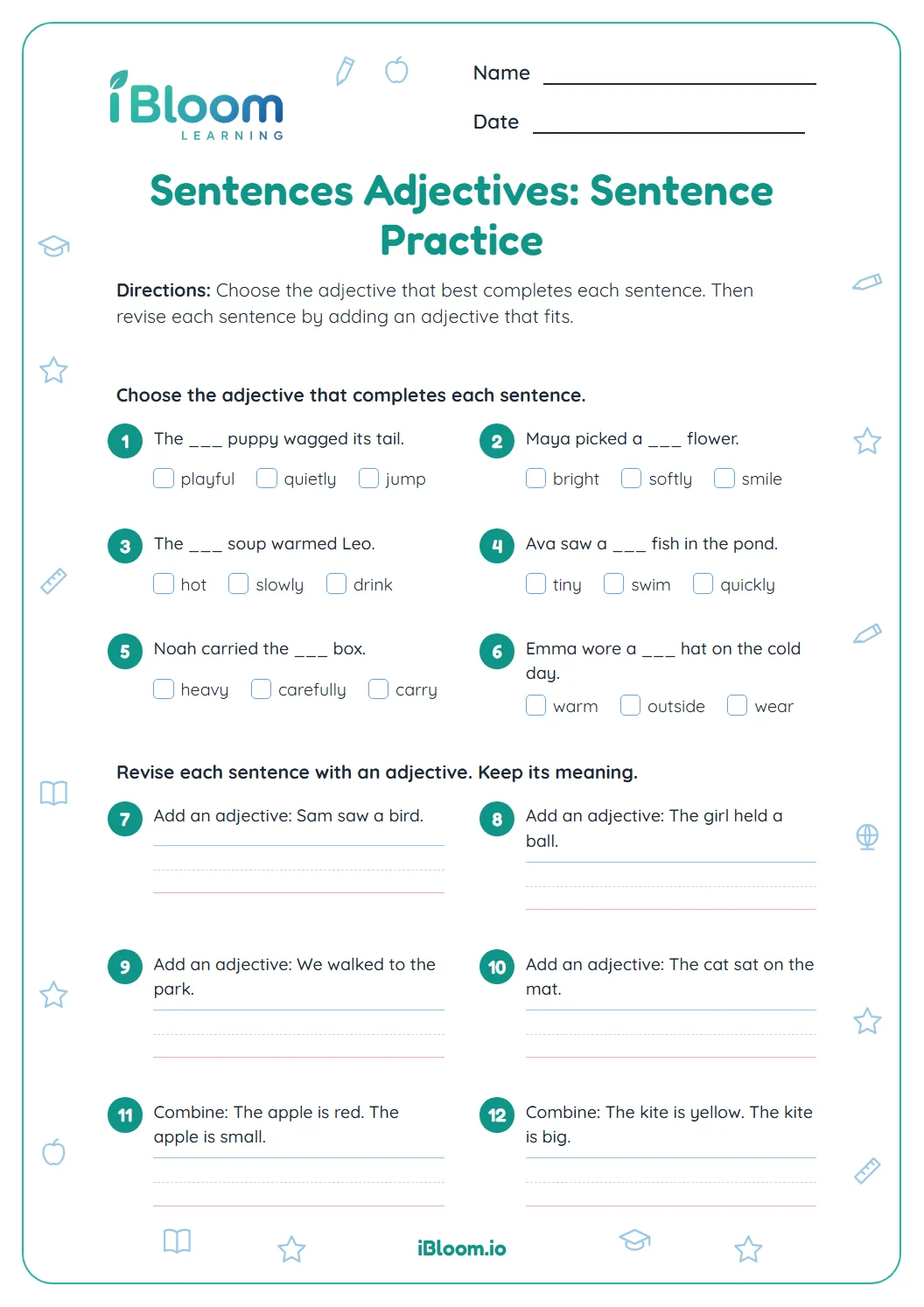
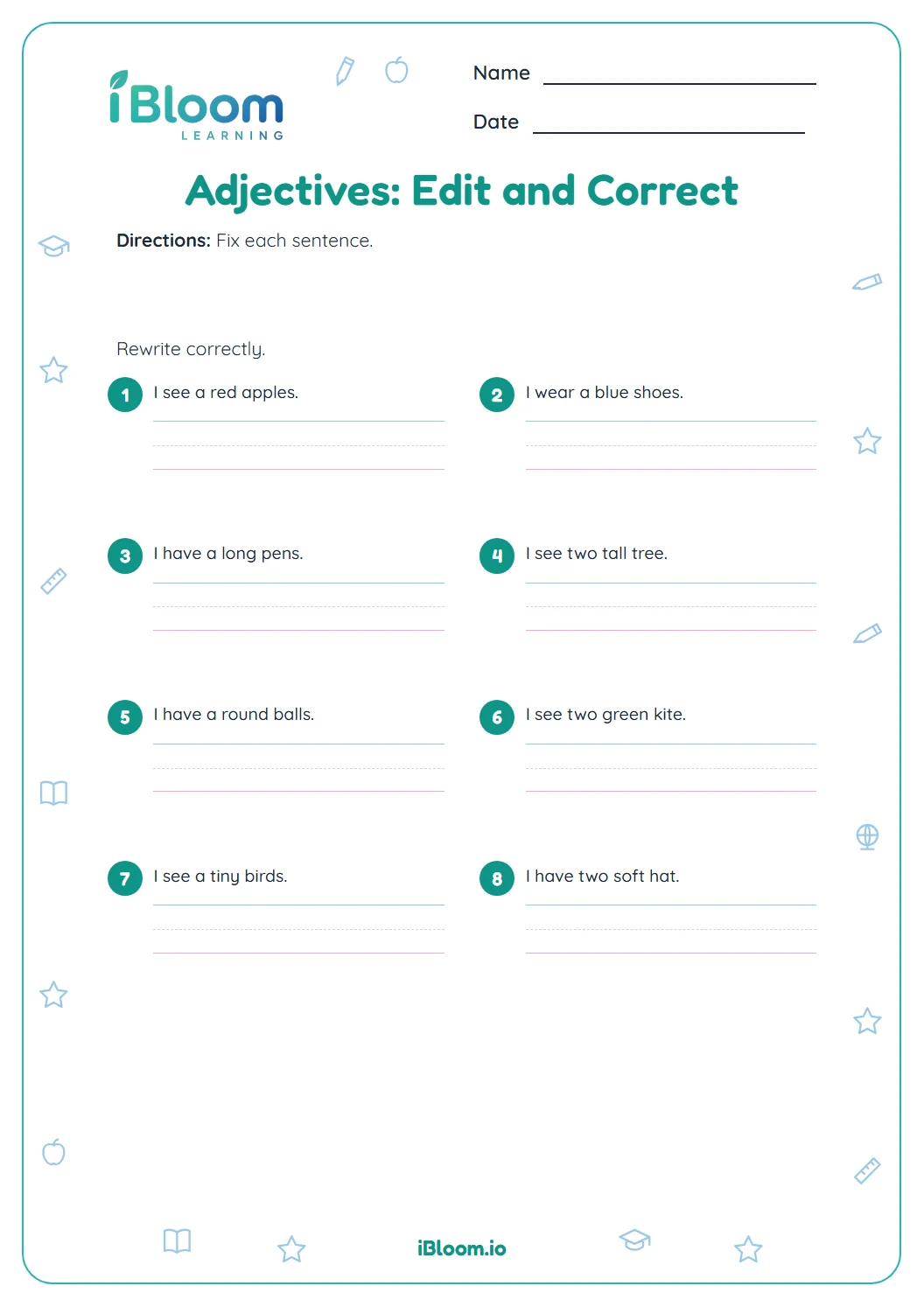
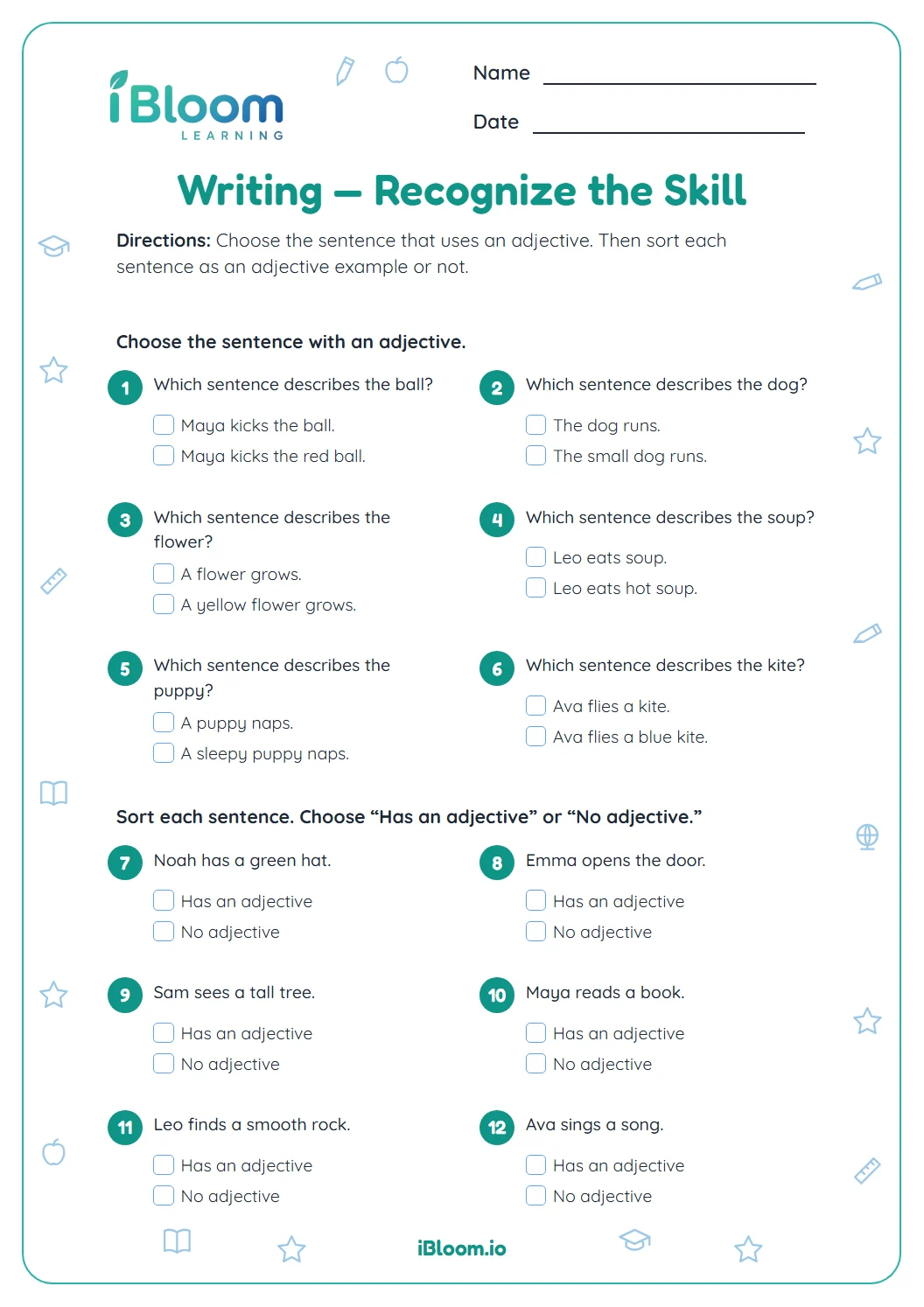
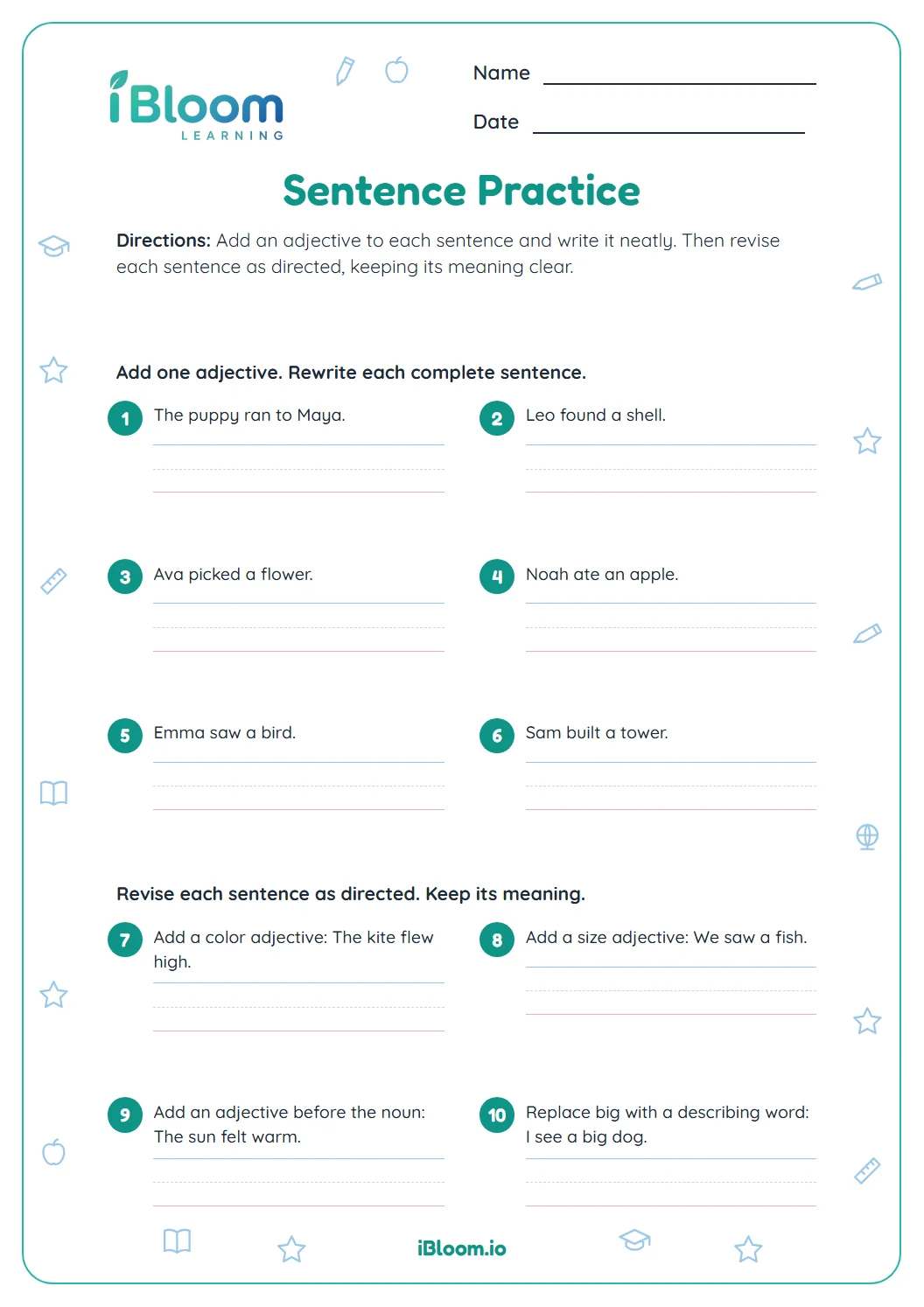
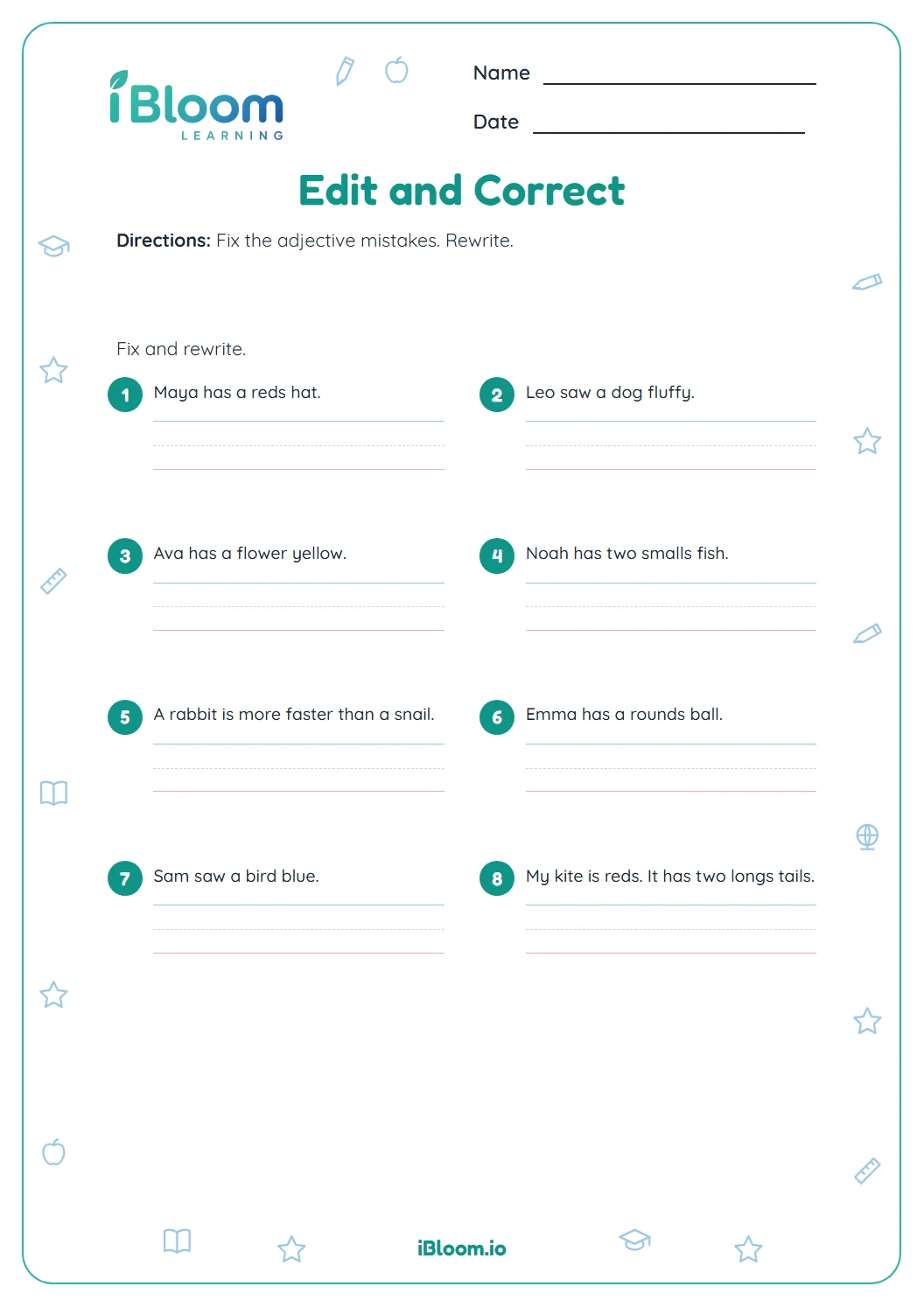
This free printable worksheet helps Grade 1 children choose the adjective that fits a sentence: ice is cold, a lemon is sour, a giraffe has a long neck. It is the guided version of the skill, so children always have words to pick from before they write any on their own. Part A has six multiple-choice sentences, Part B asks for four blanks filled from a word bank, and Part C asks children to circle the adjective in four short sentences. It practices Common Core L.1.1.f, using frequently occurring adjectives. A separate answer key is included.
Aligned to L.1.1.f
What does it mean to select an adjective?
An adjective is a describing word. It tells what a person, animal or thing is like: how it feels, tastes, sounds or looks. Grade 1 children meet the everyday ones first, such as big, soft, cold, loud and red.
Selecting means choosing the adjective that makes sense with the noun. A child asks, "Can ice be cold? Can ice be loud?" The meaning of the noun narrows the choices, which is why selecting comes before writing adjectives from scratch.
- 1The ice cube feels ___.
- 2Choices: warm, loud, cold
- 3Ask: what is ice like?
- 4Ice is not warm, and ice is not loud.
- 5Ice is cold.
- 6Answer: cold
How does guided completion help young writers?
Guidance here means the sheet narrows the job. In Part A, three words are offered and one fits. In Part B, a short word bank is printed above four sentences, and each word fits one sentence only. Children practice matching meaning without also having to spell a new word.
Crossing out a bank word once it is used is a good habit. It turns the last blank into a quick check: the one word left must fit.
What is on this worksheet?
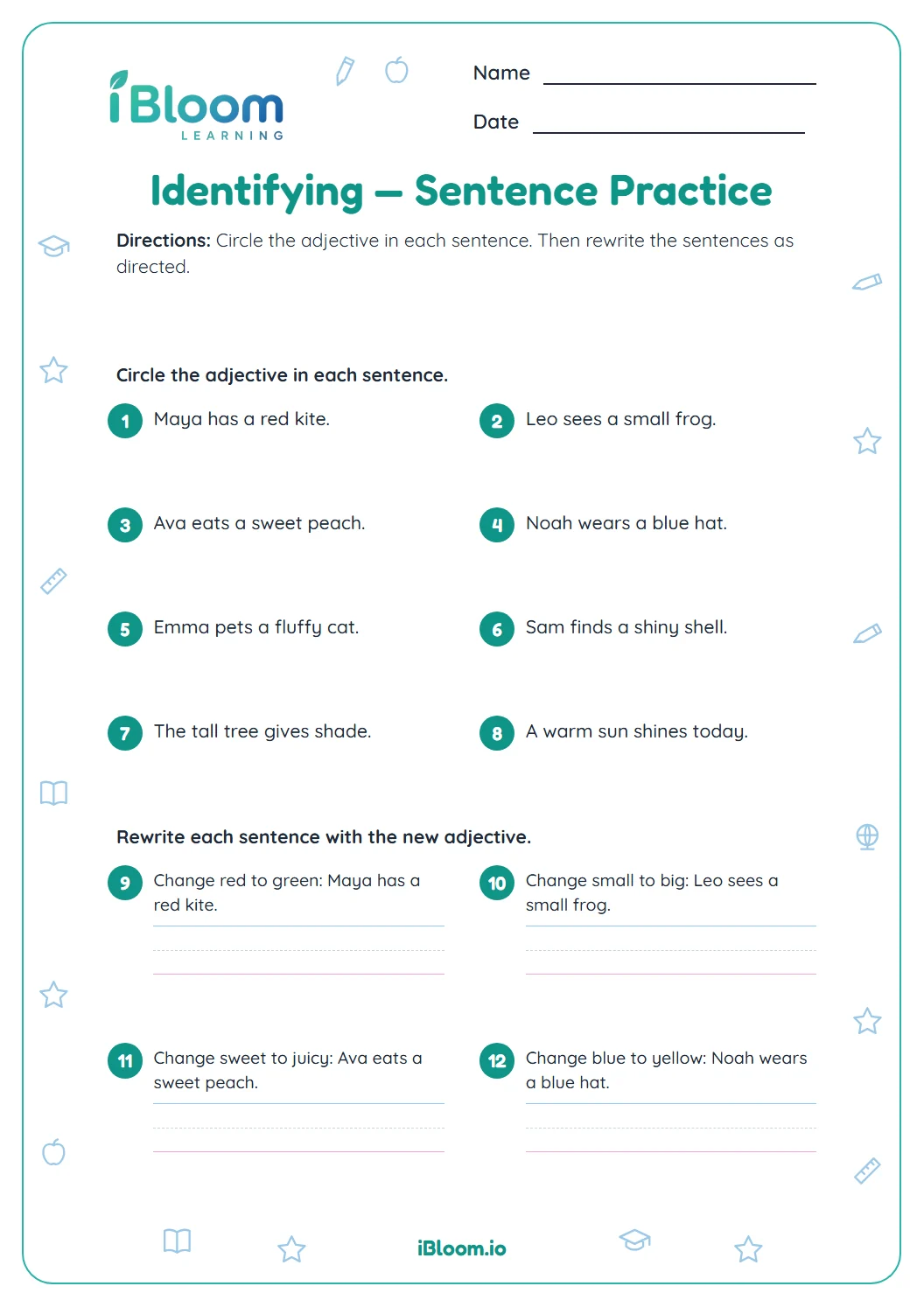
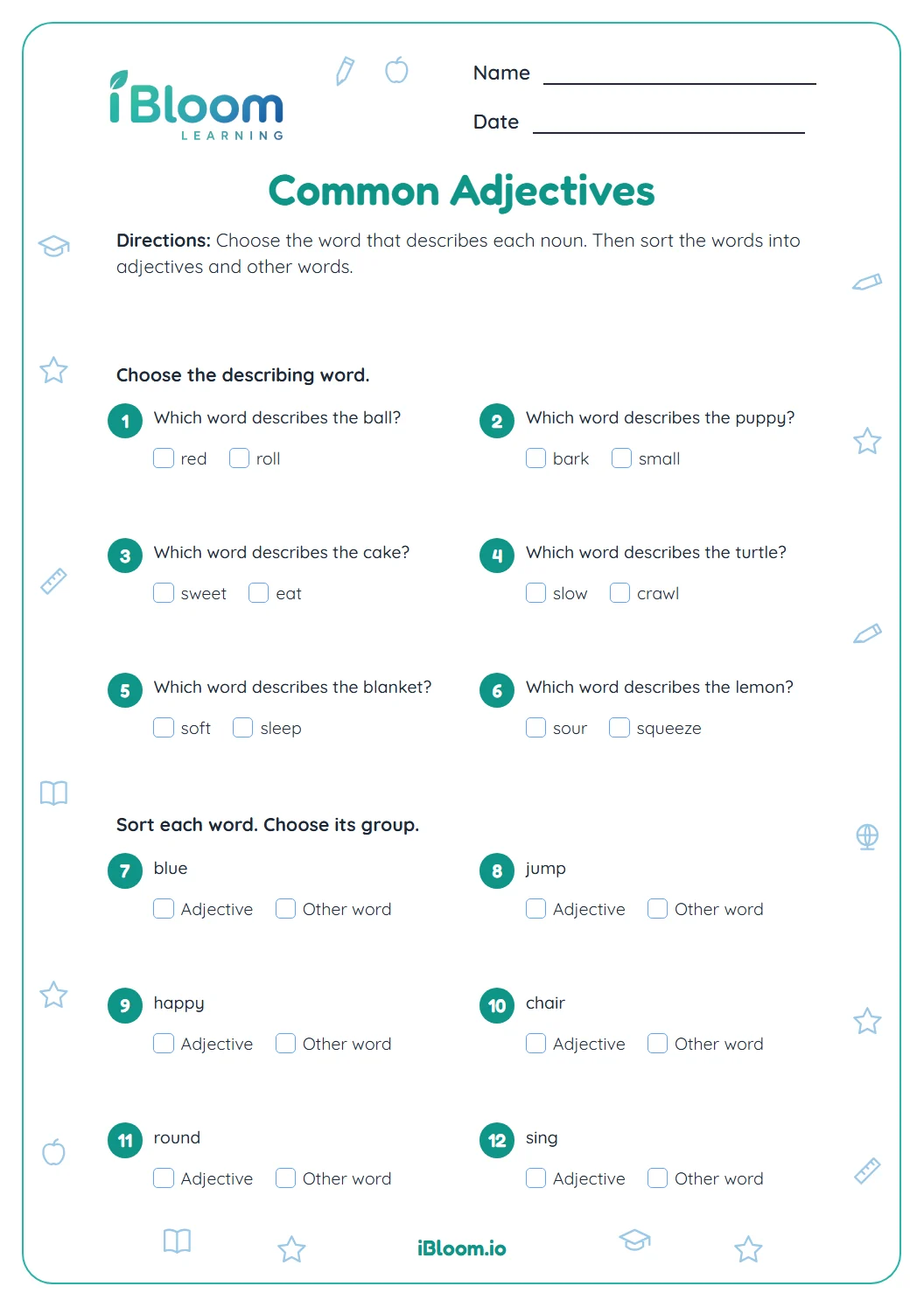
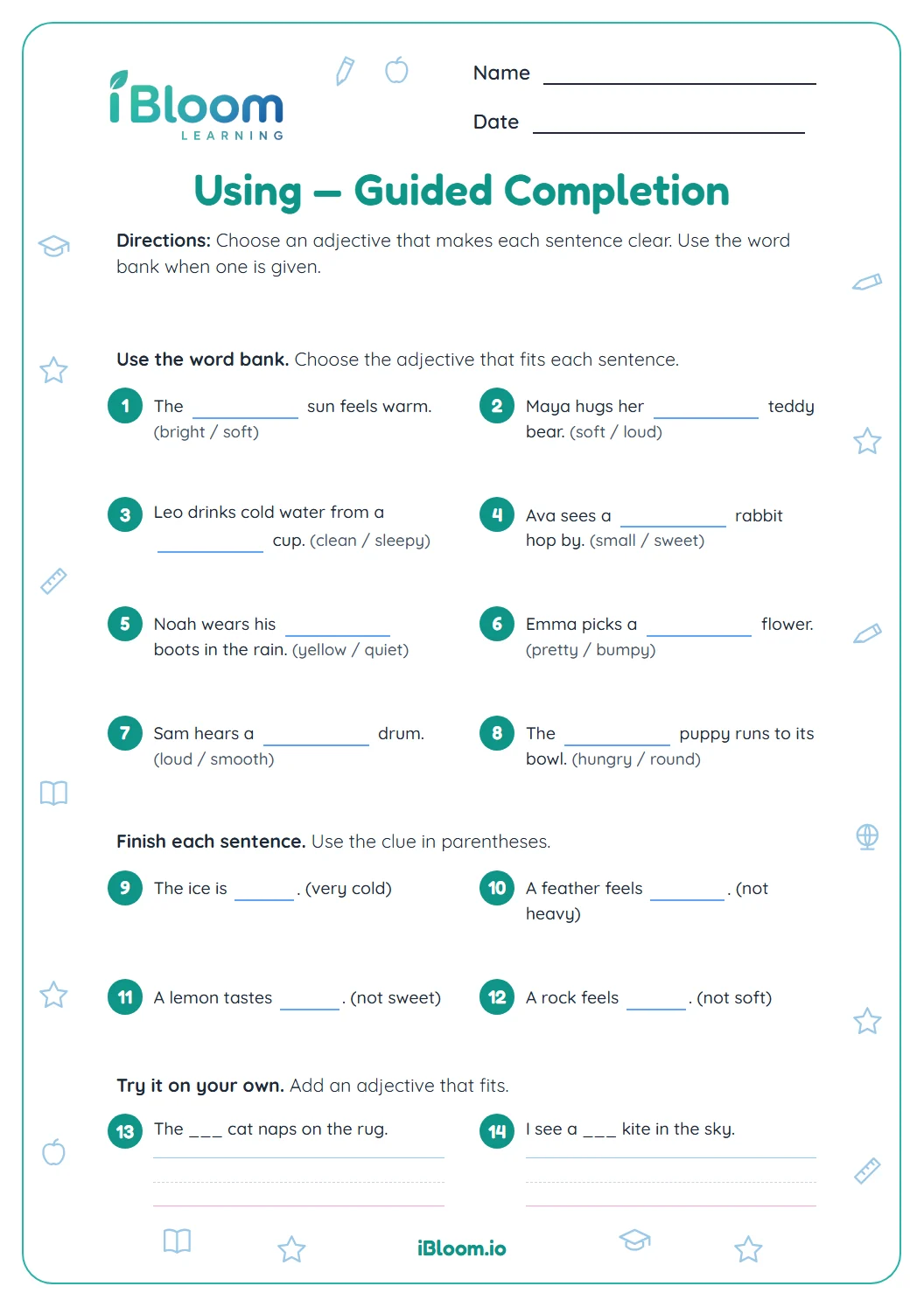
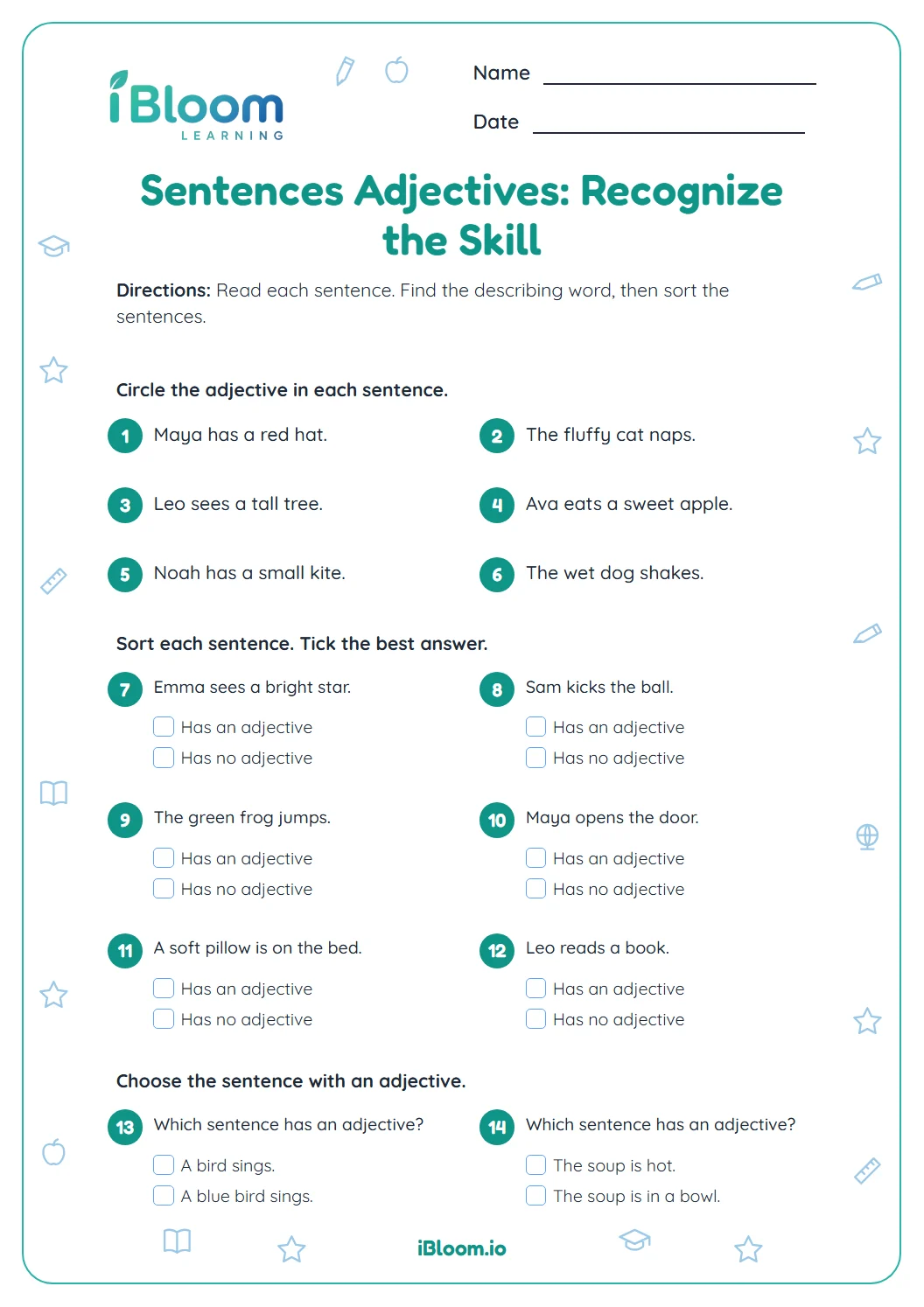
Fourteen questions on two pages, in three parts. The sentences are about things children know: an ice cube, a lemon, a blanket, a giraffe, a siren, a kitten, an ant and a stove.
- Part A, Pick the adjective: 6 sentences, color the one word that fits (cold, sour, soft, long, loud, furry)
- Part B, Finish with a word bank: 4 blanks using hot, tiny, round and sweet
- Part C, Circle the adjective: 4 short sentences, circle the word that describes the noun
- Answer key on separate pages
How can a child tell which word is the adjective?
Ask which word tells more about the noun. In "Ben has a red kite," the noun is kite and red tells what kind. Covering the word helps: "Ben has a kite" still makes sense, so the covered word was the extra describing word.
In Part C, the adjective always comes right before its noun (red kite, big dog, cold wind, juicy peach), so children can also look for the word that sits next to the thing it describes.
How to use this worksheet at home or in class
- 1Warm up out loud: ask your child to describe an ice cube, a lemon and a blanket in one word each. Tell them those are adjectives.
- 2Do question 1 together. Say each choice in the sentence and decide which one fits.
- 3Let your child finish Part A, reading each sentence aloud before coloring a circle.
- 4In Part B, read the four bank words first. Cross out each one after it is used.
- 5For Part C, ask, "Which word tells more about the noun?" before circling.
- 6Check with the answer key and talk through any miss by trying the chosen word in the sentence.
Common mistakes and quick fixes
The mistake
Choosing the opposite describing word, such as picking quiet for a siren because a siren is a sound.
The fix
Say both sentences out loud: "A siren is very loud" and "A siren is very quiet." Ask which one you would hear on a fire truck.
The mistake
Circling the noun instead of the adjective in Part C, such as circling kite in "Ben has a red kite."
The fix
Ask which word names the thing and which word tells about it. The naming word is the noun. The telling word is the adjective.
The mistake
Filling the bank words in order without reading, such as writing hot for the ant and tiny for the stove.
The fix
Read each full sentence before writing, and cross out each bank word after it is used. If a word sounds silly, try another.
Common Core alignment
Most US states use the Common Core Language standards or a close state version. This sheet practices the Grade 1 adjective standard below.
Use common adjectives like cold, sour, soft and big to describe things.
On this sheet: Children choose, supply and circle everyday adjectives in every part of the sheet.
Show the official wordingHide the official wording
Use frequently occurring adjectives.
What to practice next
Make more practice
Further reading
Questions parents and teachers ask
What is an adjective for first graders?
An adjective is a word that describes a person, animal, place or thing, like cold ice or a tall giraffe. On this sheet children choose, fill in and circle adjectives such as sour, soft, loud and furry. They can call them describing words until the term feels familiar.
Why does the sheet offer choices instead of blank lines?
Choices let children work on meaning before spelling. Part A offers three words per sentence and Part B gives a four-word bank, so the only job is matching a describing word to a noun. When your child picks adjectives easily, try the Using adjectives and Writing with adjectives skills linked on this page.
What are the answers to Part B?
The answers are tiny, hot, round and sweet, in that order. An ant is tiny, a stove is hot, a ball is round and ripe strawberries taste sweet. Each bank word fits one sentence only, so crossing words off as they are used helps children check their work.
My child circled the noun in Part C. What should I do?
Ask which word tells more about the noun. In "Ben has a red kite," kite is the noun and red describes it. Cover the word you think is the adjective: "Ben has a kite" still makes sense, so red was the extra describing word. Then try the next sentence together.
Can my child read the choices alone?
Most Grade 1 readers can try, since the words are short and common, such as cold, soft, loud and big. If reading slows your child down, read each sentence aloud and let them choose. The skill being practiced is matching a describing word to a noun, not decoding.
Is there an answer key, and how long does the sheet take?
Yes. The answer key is two separate pages that show all 14 answers in place on the sheet. Most children finish in about 10 to 15 minutes. Part C asks children to find the adjective on their own, so allow a few extra minutes there and talk through any word they circled by mistake.